
Every scraper developer shares a rite of passage: build something beautiful, watch it hum along on 10 test pages, and then—wall of CAPTCHAs. Pipeline dead.
I've lived this cycle more times than I care to admit, both from my years in automation at Automation Anywhere and now building Thunderbit. The thing is, CAPTCHAs in 2026 aren't the squiggly-text puzzles of 2010. Modern challenges like reCAPTCHA v3, Cloudflare Turnstile, and hCaptcha analyze your browser fingerprint, mouse behavior, TLS handshake, and session history before you even see a checkbox.
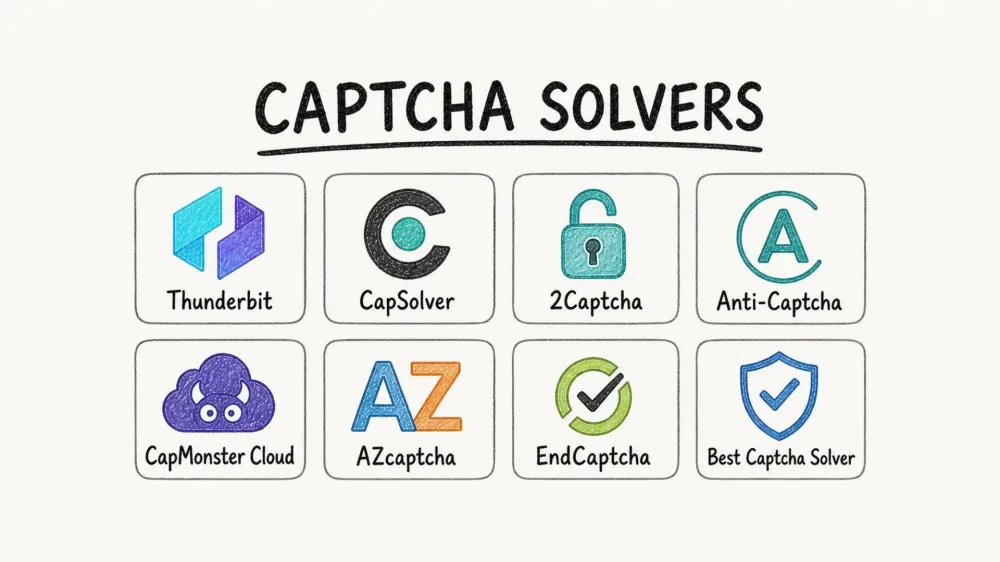
According to the HTTP Archive's 2025 Web Almanac, reCAPTCHA and Cloudflare Bot Management together protect about 30% of measured websites. And with bad bot traffic hitting 37% of all internet traffic in 2024 (up from 32% the year before), sites are only getting more aggressive. This guide covers 7 CAPTCHA solvers I've researched and tested at scale, plus one avoidance-based alternative—and it opens with a prevention-first framework that, for many use cases, eliminates the need for a solver entirely.
Before You Solve, Try Prevention: The CAPTCHA Avoidance-First Framework
After years in the scraping and automation world, one lesson keeps proving itself: the cheapest CAPTCHA to solve is the one you never trigger. Most CAPTCHA encounters during web scraping aren't inevitable—they're symptoms. The site's risk engine didn't like your IP, your request rate, your browser fingerprint, or your session history. Fix those, and the CAPTCHA often disappears.
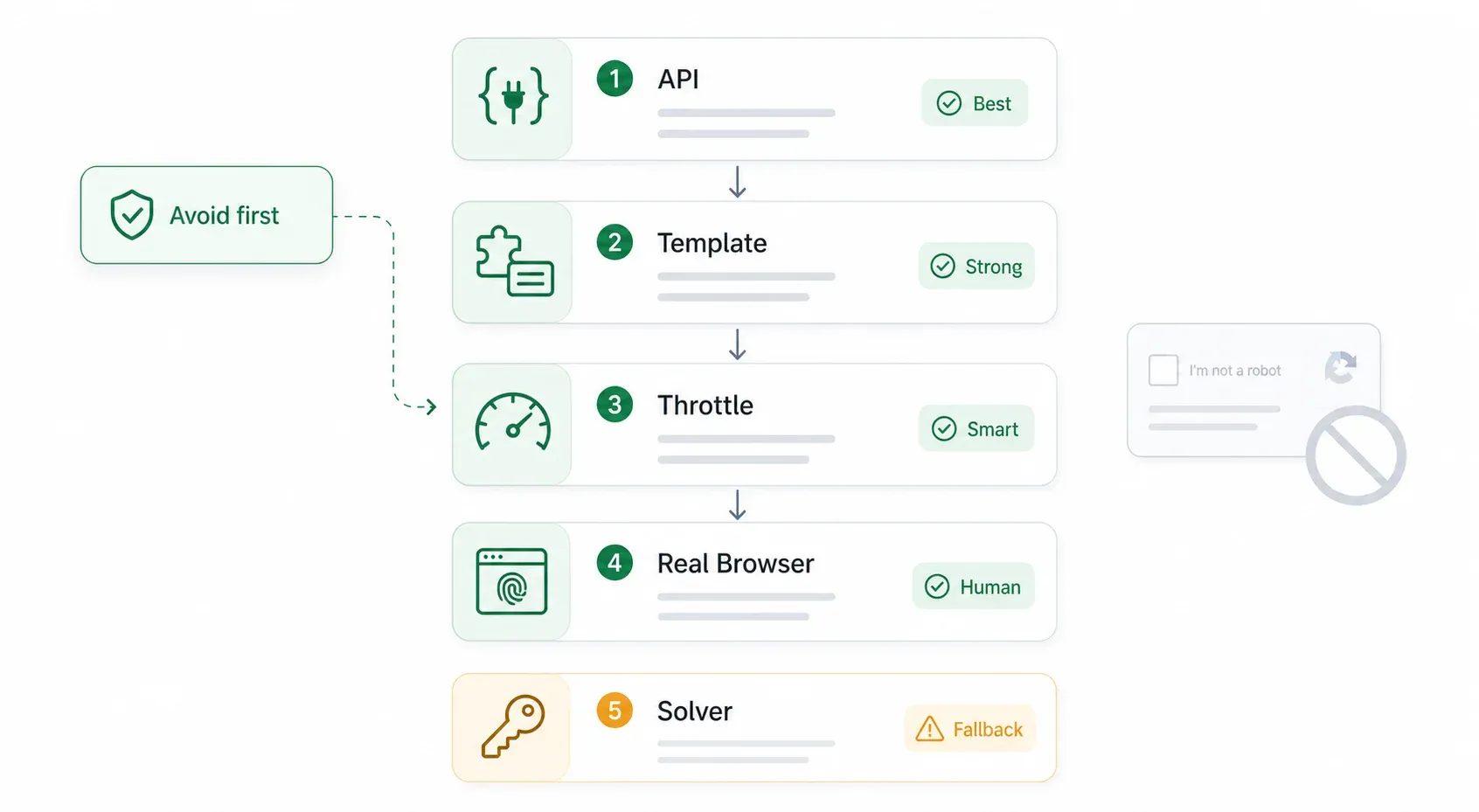
Before reaching for a CAPTCHA-solving API, walk through this decision tree. I think of it as Step Zero.
The CAPTCHA Prevention Decision Tree
- Does the site offer a public API, data feed, or export? → Use it. No CAPTCHA, no scraping complexity.
- Is the target a popular platform (Amazon, Zillow, LinkedIn, Shopify, Instagram)? → Try pre-built scraper templates first. Thunderbit, for example, offers instant templates for these sites that handle anti-bot measures in the cloud—no CAPTCHA interaction needed.
- Are CAPTCHAs only appearing when you scale up? → Fix your request hygiene: throttle requests, rotate residential proxies, persist sessions, align geo/timezone/language, and ensure your browser/TLS fingerprints look coherent.
- Are CAPTCHAs appearing immediately from a cloud or server runtime? → Compare against a real browser session. Datacenter IPs, containers, and default headless browsers are flagged more aggressively.
- Still hitting CAPTCHAs after all prevention steps? → Now choose a solver from the list below.
Common Avoidance Strategies That Actually Work
| Strategy | Why It Works | Practical Guidance |
|---|---|---|
| Request throttling & rate limiting | Fixed-interval fast requests scream "bot" | Randomize timing, model pages/minute, monitor 403/429/CAPTCHA rates |
| Residential/mobile/ISP proxies | Datacenter IPs have lower reputation on consumer sites | Use sticky sessions when tokens/cookies bind to IP |
| Browser fingerprint management | Sites compare user-agent, viewport, canvas, WebGL, fonts, timezone, language | Keep attributes consistent; align Accept-Language, timezone, and proxy country |
| TLS/HTTP/2 fingerprint consistency | Cloudflare uses JA3/JA4 to fingerprint TLS connections | Use real browsers or tools that mimic browser TLS behavior; raw Python requests often looks non-browser |
| Session persistence & cookies | Risk scores improve with coherent browsing history | Reuse cookies/localStorage for a session; rotate only when blocked |
| Headless stealth configuration | Default headless signals get flagged | Use Puppeteer/Playwright stealth plugins, but verify against real target behavior |
Fingerprint coherence matters more than most people think. What usually gets a session flagged is not request volume but a mismatch — a user agent that says one thing, a TLS handshake that says another, and JavaScript that reports a third.
Thunderbit's cloud scraping infrastructure handles all of this behind the scenes—rotating IPs, managing fingerprints, handling anti-bot measures—so business users in sales, ecommerce, and real estate rarely run into CAPTCHAs in the first place. My team built it specifically so you pay per output row, not per CAPTCHA challenge. More on that below.
Try Thunderbit's Managed Cloud Scraping
Understanding CAPTCHA Types: What Your Scraper Is Up Against
The CAPTCHA landscape in 2026 is a zoo, and not every solver handles every animal. Knowing what you're up against matters before you pick a tool.
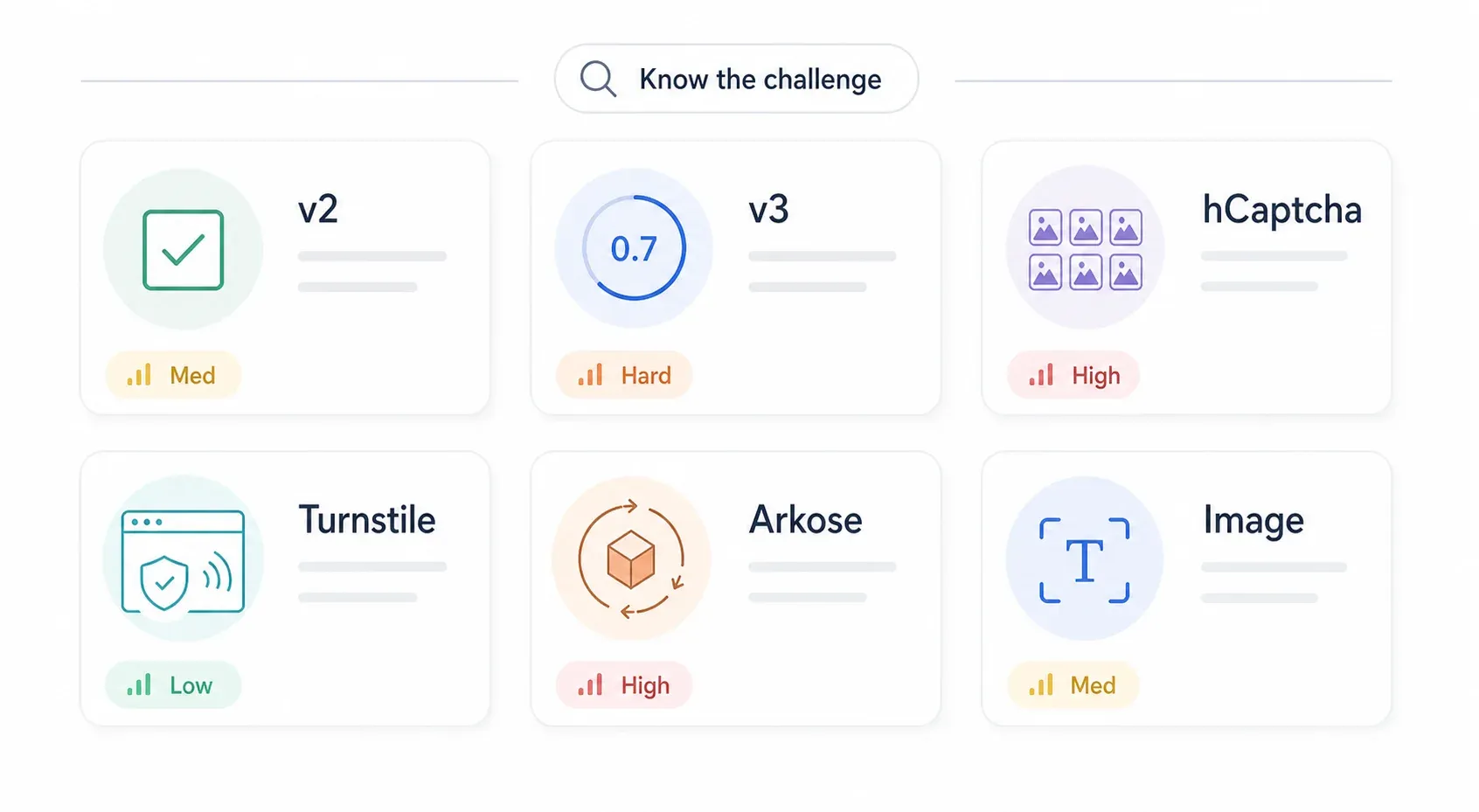
reCAPTCHA v2 (Checkbox and Image Challenges)
Google's familiar "I'm not a robot" checkbox. It analyzes browsing history, mouse movements, and browser behavior. Suspicious users get image selection challenges (traffic lights, crosswalks, fire hydrants—you know the drill). Google's reCAPTCHA v2 docs describe the widget rendering and customization options.
Difficulty: Medium. A USENIX Security 2025 benchmark found generalist visual solvers cracking reCAPTCHA v2 at 68-72%. Most commercial solvers handle it well.
reCAPTCHA v3 (Invisible Score-Based)
Runs invisibly in the background. Returns a score from 0.0 (likely bot) to 1.0 (likely human). The website decides the threshold—and that's the catch. Google's v3 docs recommend starting at a 0.5 threshold. Tokens expire after two minutes. Google has moved reCAPTCHA under Google Cloud Fraud Defense, adding enterprise risk reasons like AUTOMATION, UNEXPECTED_ENVIRONMENT, and TOO_MUCH_TRAFFIC.
Difficulty: Hard. A solver can return a v3 token, but whether it passes depends on the site's threshold, your browser state, IP reputation, and traffic pattern.
hCaptcha
A privacy-focused alternative to reCAPTCHA. Similar image-selection tasks, but Enterprise supports invisible and passive modes. hCaptcha's privacy policy says it collects mouse movements, scroll position, keypress events, and touch events.
Difficulty: Medium to High. The image tasks themselves aren't the hard part—USENIX 2025 put the best solver at 82% on hCaptcha's visual challenges. What pushes the difficulty up is Enterprise and passive mode, which score behavior instead of showing a puzzle.
Cloudflare Turnstile
Cloudflare calls Turnstile a "smart CAPTCHA alternative" that can work without showing visitors a visual challenge. It runs non-interactive JavaScript challenges gathering browser signals—proof-of-work, proof-of-space, web API probing, browser-quirk detection, and human-behavior signals. With pre-clearance, a Turnstile widget can issue a cf_clearance cookie to bypass later WAF challenges on the same zone.
Difficulty: Hard to Very Hard. The challenge isn't an image puzzle—it's maintaining coherent TLS/browser/IP/session context.
FunCaptcha (Arkose Labs), GeeTest, and Others
Arkose Labs uses interactive game-like puzzles: rotate objects, match dice, drag shapes. Third-party comparisons claim 1,250+ puzzle variations. USENIX 2025 found wide variation in AI success rates: 20% on the 3D rollball puzzle, 71% on dice match.
GeeTest v4 includes Slide Puzzle, Icon Selection, Match-Three, Gobang, and invisible probe modes. AWS WAF has its own CAPTCHA and Challenge actions. Friendly Captcha uses proof-of-work instead of visual puzzles.
Difficulty: Hard for Arkose, Medium to High for GeeTest. Both keep shipping new puzzle variants, which is what breaks solvers trained on last quarter's set. Plain image and text CAPTCHAs sit at the other end of the range — Low, and every commodity solver handles them.
How We Evaluated the Best CAPTCHA Solvers for Web Scraping
I evaluated every tool against a standardized framework to keep this comparison apples-to-apples:
- Supported CAPTCHA types — breadth of coverage
- Solving method — AI, human workers, hybrid, or avoidance-based
- Average solve speed under real-world conditions
- Pricing per 1,000 solves and cost at scale
- API and language support — Python, JS, PHP, Go, etc.
- Proxy integration and compatibility
- Free tier or trial availability
- Concurrency handling and rate limits
- Best-fit use case — who should actually use this tool
I cross-referenced official documentation, current pricing pages, community feedback on Reddit and Stack Overflow, and independent benchmarks like the USENIX Security 2025 CAPTCHA study. Where pricing is dynamic, I used the rates posted at the time of research.
Best CAPTCHA Solvers for Web Scraping at a Glance
The master comparison table is below. Scan it first, then dig into the individual reviews.
| Tool | Solving Method | reCAPTCHA v2/v3 | hCaptcha | Cloudflare Turnstile | FunCaptcha | Price per 1K Solves | Avg Speed | Free Tier | Best For |
|---|---|---|---|---|---|---|---|---|---|
| Thunderbit | AI avoidance / managed scraping | n/a | n/a | n/a | n/a | No per-solve rate; $38/mo Pro buys 3,000 credits | n/a — no solve step | 6 pages/mo, recurring | Non-devs who want data, not solver plumbing |
| CapSolver | AI-first | ✅ / ✅ | Not in pricing | ✅ | Not in pricing | v2 $0.80, v3 $1.00, Turnstile $1.20 | Often 1-10s | Free trial, amount not published | Fast Cloudflare/JS-heavy scraping |
| 2Captcha | Human + automation | ✅ / ✅ | ✅ $2.99 | ✅ | ✅ | v2 from $1.00, Turnstile $1.45 | ~13s reCAPTCHA | None published | Broadest CAPTCHA type coverage |
| Anti-Captcha | Human-worker network | ✅ / ✅ | Not in pricing | ✅ | ✅ | v2 $0.95-2, Turnstile $2.00 | ~5-10s | None published | Accuracy and queue transparency |
| CapMonster Cloud | AI-first | ✅ / ✅ | Not in pricing | ✅ | ✅ | v2 $0.60, Turnstile $1.30 | 1-5s common | $0.10 test balance, one-time, on request | Drop-in 2Captcha/Anti-Captcha replacement |
| AZcaptcha | AI/OCR | ✅ / ✅ | Not in pricing | ✅ | Not in pricing | v2 $1.00, Turnstile $1.20 | v2 8-15s, Turnstile 5-10s | $0.10 one-time, after email verification | High-volume reCAPTCHA and Turnstile |
| EndCaptcha | Human with SLA | ✅ / ✅ | Not in pricing | Not in pricing | Not in pricing | $4.00-$4.79 per 1K credits, no per-type rate | ~7-8s (70%), ≤11s | 1,000 credits, one-time | SLA-backed image/text workflows |
| Best Captcha Solver | 100% human | ✅ / ✅ | Not in pricing | ✅ | ✅ | reCAPTCHA $2/1K, Turnstile $1.80/1K | ~14s regular, ~46s reCAPTCHA | None published | Human accuracy for complex formats |
A note on Thunderbit: Unlike the other seven tools, Thunderbit doesn't sell CAPTCHA tokens, so most of the columns above don't apply to it. It's in the table because avoidance is a real alternative to buying solves, not because it competes on price per solve. If what you need is a token to inject into your own scraper, one of the other seven is your answer.
1. Thunderbit — Avoid Most CAPTCHAs Instead of Paying to Solve Them
Thunderbit takes a fundamentally different approach from every other tool on this list. Instead of solving CAPTCHAs after they appear, Thunderbit's cloud scraping infrastructure avoids triggering them in the first place—handling JavaScript rendering, anti-bot protection, IP rotation, browser fingerprinting, and geo-routing behind the scenes. As someone who co-founded the company, I'm obviously biased, but the logic holds: if your scraper never encounters a CAPTCHA, you never need to pay to solve one.
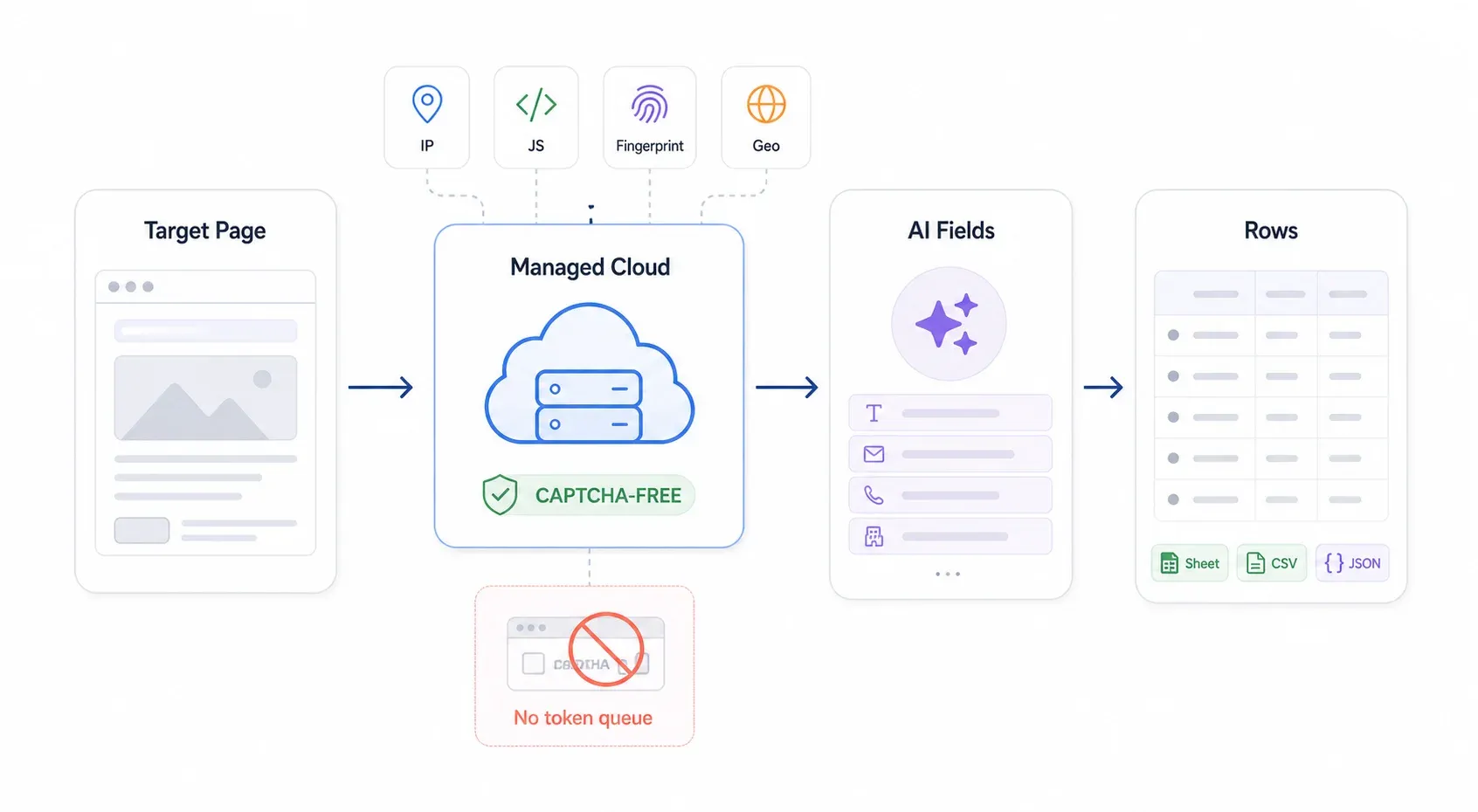
The workflow is dead simple. Install the Thunderbit Chrome extension, navigate to any page, and click once. Thunderbit's AI then builds the column set itself and runs the extraction end to end. If you already know exactly what you need, say so and it scrapes to your spec. The data lands in a structured table you can export to Excel, Google Sheets, Airtable, Notion, CSV, or JSON. No proxies to configure, no CAPTCHA tokens to inject, no queue logic to manage.
Key features:
- Cloud scraping processes up to 50 pages simultaneously, handling anti-bot measures in the cloud
- Hands-off field setup puts the AI in charge of the columns on any page—no manual CSS selector work
- Subpage scraping follows links to detail pages and enriches your dataset automatically
- Instant scraper templates for popular sites (Amazon, Zillow, Instagram, Shopify, and more)
- Free data export to Excel, Google Sheets, Airtable, Notion—no paywall on exports
- Credit-based pricing: 1 credit = 1 output row, or 2 if subpage scraping is on. Month to month, Starter is $15 for 500 credits and Pro is $38 for 3,000. The annual plans hand you a year of credits up front instead: Starter $108 for 5,000, Pro $288 for 30,000 — so annual Pro lands near $0.01 a row against $0.013 monthly, while annual Starter gives you 5,000 credits where twelve monthly payments would give 6,000. Past 3,000 credits a month there is no published tier, only a Business quote
Limitations: Thunderbit doesn't hand back a CAPTCHA token, so it can't slot into a solver pipeline you have already built — it replaces that pipeline or it doesn't fit. Avoidance isn't universal either: when a site does throw a challenge, you switch that run to browser mode and use your own logged-in session. And the published plan limits cap a single bulk run at 2,000 URLs and pagination at 200 pages, so a very large job has to be split across runs.
Best for: Non-technical business users—sales, ecommerce, real estate, ops—who want structured data without managing CAPTCHA-solving pipelines, proxies, or browser stealth configurations.
2. CapSolver — Best AI-Powered CAPTCHA Solver for Speed and Cloudflare
CapSolver is an AI-first CAPTCHA solving service built for speed. It uses machine learning models instead of human workers, which means faster solve times and no dependence on worker availability. Their official docs list support for reCAPTCHA v2/v3, reCAPTCHA Enterprise, Cloudflare Turnstile, Cloudflare Challenge, GeeTest, AWS WAF, DataDome, MTCaptcha, and ImageToText.
Key features:
- AI-driven solving with typical response times of 1-10 seconds for common types
- Strong Cloudflare Turnstile and Challenge support at $1.20/1K solves
- JSON REST API with community libraries for Python, Node.js, TypeScript, C#, PHP, and a Puppeteer plugin
- Proxy support including SOCKS4, SOCKS5, HTTP, HTTPS
- Chrome browser extension for non-developers
Pricing: reCAPTCHA v2 $0.80/1K, v3 $1.00/1K, v3 Enterprise $3.00/1K, Turnstile $1.20/1K, GeeTest $1.20/1K, AWS WAF $2.00/1K, ImageToText $0.40/1K — all from their pricing page.
Limitations: AI accuracy can temporarily drop when CAPTCHA providers update their detection logic. And if hCaptcha or Arkose are your main targets, ask them first—neither one shows up on their public pricing page.
Best for: Developers and technical teams scraping JavaScript-heavy or Cloudflare-protected sites at scale who prioritize speed and automation.
3. 2Captcha — Most Reliable Human-Powered CAPTCHA Solver
2Captcha is one of the oldest CAPTCHA-solving marketplaces, operating since 2007. It uses a global network of human workers, giving it the widest CAPTCHA type coverage I've found—their API docs list over 30 types, including reCAPTCHA v2/v3/Enterprise, Arkose/FunCaptcha, GeeTest v4, Turnstile, Capy, KeyCAPTCHA, Amazon, DataDome, Friendly Captcha, Tencent, and many more.
Key features:
- Broadest published CAPTCHA type support in the industry
- Dynamic pricing: reCAPTCHA v2 from $1.00/1K, reCAPTCHA v3 from $1.45/1K, hCaptcha $2.99/1K, Turnstile $1.45/1K, Amazon WAF $1.45/1K, GeeTest $2.99/1K, image CAPTCHAs from $0.50/1K, and Arkose from $1.45 to $50 per 1K — a 34x band that 2Captcha doesn't break down any further, so get a quote for your specific target before you budget it
- Live capacity numbers on their pricing page: when I checked, free capacity was 11,273/min for reCAPTCHA v2 and 12,000/min for image CAPTCHA
- Only charges for successful solves
- Official SDKs for Python, JavaScript/Node.js, Go, Ruby, C++, PHP, Java, and C#
Speed and proxies: Average speed is ~13 seconds for reCAPTCHA, 5-15 seconds for simpler types, up to 30 seconds during peak hours. Their proxy docs note that proxies are not supported for reCAPTCHA v3/Enterprise v3 because they reduce success rate.
Limitations: Slower than AI-based solvers. Speed varies with worker availability. Costs add up at very high volumes.
Best for: Teams that need the broadest CAPTCHA type coverage and can tolerate slightly slower solve times—especially projects encountering unusual or custom CAPTCHA formats where AI models haven't been trained.
4. Anti-Captcha — Trusted Human Solver with Consistent Accuracy
Anti-Captcha is another long-running human-worker service (also since 2007). Its homepage claims 5-second solving speed, 99.99% uptime, and "unlimited parallel processing threads."
Key features:
- Supported types include reCAPTCHA v2/v3/Enterprise, FunCaptcha/Arkose, GeeTest, Turnstile, Amazon WAF, Friendly Captcha, Altcha, Prosopo, and custom AntiGate tasks
- Pricing: image CAPTCHAs $0.50-0.70/1K, reCAPTCHA v2 $0.95-2/1K, reCAPTCHA v3 $1-2/1K, Turnstile $2/1K, GeeTest $1.80/1K, Amazon WAF $2/1K, Arkose $3/1K
- Queue transparency via getQueueStats API—you can check waiting workers, load percentage, speed, and total workers before sending tasks
- Proxy-based solving for IP-bound tokens
- SDKs for Python, JavaScript, PHP, C#, Go; browser extensions for Chrome, Firefox, Safari
Limitations: Speed varies with worker load. Complex CAPTCHAs can take 30-50 seconds. Slightly less breadth than 2Captcha's type list.
Best for: Users who value accuracy and queue transparency, and projects where CAPTCHA tokens must originate from a specific IP.
5. CapMonster Cloud — Lowest reCAPTCHA v2 Rate, Drop-In API Compatibility
CapMonster Cloud is an AI-first solver from the CapMonster ecosystem. What makes it interesting for existing scraping setups: it's API-compatible with 2Captcha and Anti-Captcha, meaning you can often swap it in without changing your integration code.
Key features:
- Supported types: reCAPTCHA v2/v3/Enterprise, GeeTest v3/v4, Cloudflare Turnstile/Challenge, DataDome, Amazon WAF, FunCaptcha, Friendly Captcha, Tencent, Altcha, and more
- Pricing: reCAPTCHA v2 $0.60/1K (claimed 99% success), v3 $0.90/1K, Turnstile $1.30/1K, GeeTest $1.20/1K, Amazon WAF $1.40/1K, FunCaptcha $1.10/1K, text CAPTCHAs $0.30/1K—and proxies are included in those rates
- Fast AI-based solving, typically 1-5 seconds for common types; FAQ says 1-30s depending on type
- SDKs for C#, Python, JS, Go, PHP
Limitations: Like other AI solvers, it can struggle with novel or rapidly changing challenge variants.
Best for: Teams already integrated with 2Captcha or Anti-Captcha who want faster speeds and lower per-solve costs without rewriting their code.
6. AZcaptcha — Ties for the Cheapest Turnstile Rate, Mid-Pack on reCAPTCHA
AZcaptcha is a no-frills service aimed at the challenges most scrapers actually hit: reCAPTCHA and Cloudflare Turnstile. Its pricing page says billing is pay-as-you-go with no daily cap, and that failed attempts are not charged.
Key features:
- Supported types: reCAPTCHA v2, v2 Grid, v3, and v2 Enterprise; Cloudflare Turnstile and Challenge; Amazon WAF; Friendly Captcha; image CAPTCHAs
- Pricing: reCAPTCHA v2 $1.00/1K, v3 $1.00/1K, v2 Enterprise $1.50/1K, Turnstile $1.20/1K, Amazon WAF $1.12/1K, image CAPTCHAs $0.40/1K. Bulk rates are half price, but only above 10M solves/month
- Published speed and success rates: reCAPTCHA v2 8-15s at 98%, v3 10-20s at 95%, Turnstile 5-10s at 97%
- New accounts get $0.10 free credit after email verification; minimum top-up is $5
Limitations: Narrower type support than premium services. Less polished documentation. Accuracy claims may not hold at peak load.
Best for: High-volume reCAPTCHA and Turnstile work; if you also need hCaptcha, Arkose, or GeeTest, check with them first—none of those appear in their public pricing.
7. EndCaptcha — SLA-Backed Reliability for Mission-Critical Scraping
EndCaptcha differentiates with something rare in this space: a public Service Level Agreement. Their homepage advertises Slowness Insurance (approximately 70% of images decoded within 7-8 seconds, remainder guaranteed within 11 seconds) and Outage Insurance (credit compensation during qualifying outages, claims within 72 hours).
Key features:
- 1,000 free CAPTCHA credits to start
- Sold as prepaid credit packages, and the public site posts the pack prices: $11.99 for 3,000 credits, $43.99 for 10,000, $149.99 for 35,000, $479.01 for 100,000 — $4.00 to $4.79 per 1,000 credits. What it doesn't say is how many credits a reCAPTCHA costs versus a plain image, so you can't line those packs up against a per-type rate
- SLA with uptime and speed guarantees—compensation if service expectations aren't met
- Primarily covers reCAPTCHA and image/text CAPTCHAs
Limitations: Current public pages are strongest for image/text and reCAPTCHA. I couldn't find clear support for hCaptcha, Turnstile, Arkose, GeeTest, or AWS WAF. The SLA excludes unsupported image types and maintenance windows.
Best for: Users whose scraping pipelines cannot tolerate downtime or slow solving—especially mission-critical ecommerce monitoring or time-sensitive data collection.
8. Best Captcha Solver — Human-Powered Accuracy for Complex Challenges
Best Captcha Solver (BCS) uses 100% human workers with its own typing team. It's been operating for 7+ years and supports migration from 2Captcha, DeathByCaptcha, and Anti-Captcha API formats.
Key features:
- Supported types: reCAPTCHA v2/v3, reCAPTCHA Enterprise, GeeTest v4, FunCaptcha/Arkose, Turnstile, image CAPTCHAs, Captcha Task
- Pricing: reCAPTCHA $2/1K (one rate covers v2, invisible, and v3), Enterprise $3/1K, Turnstile $1.80/1K, FunCaptcha $2.50/1K, GeeTest v4 $1/1K and regular GeeTest $1.50/1K, image CAPTCHAs $0.60/1K
- API libraries for multiple languages; no client-side browser required
- 24/7 human support and solving
Limitations: Slowest average speed on this list (~14 seconds for regular CAPTCHAs, ~46 seconds for reCAPTCHA). Not ideal for high-volume time-sensitive scraping.
Best for: Smaller-scale projects or those encountering unusual CAPTCHA formats where accuracy matters more than speed.
CAPTCHA Type × Solver Cross-Reference: Which Tool Handles What
Here is the full cross-reference: every reviewed tool mapped against every major CAPTCHA type, with difficulty ratings and indicative pricing.
| CAPTCHA Type | Difficulty | Thunderbit | CapSolver | 2Captcha | Anti-Captcha | CapMonster | AZcaptcha | EndCaptcha | BCS |
|---|---|---|---|---|---|---|---|---|---|
| reCAPTCHA v2 | ⚠️ Medium | Not sold per solve | ✅ $0.80 | ✅ from $1.00 | ✅ $0.95-2 | ✅ $0.60 | ✅ $1.00 | ✅ Credit packs, no per-type rate | ✅ $2.00 |
| reCAPTCHA v3 | 🔴 Hard | Not sold per solve | ✅ $1.00 | ✅ from $1.45 | ✅ $1-2 | ✅ $0.90 | ✅ $1.00 | ✅ Credit packs, no per-type rate | ✅ $2.00 |
| hCaptcha | ⚠️ Medium to High | Not sold per solve | ⚠️ Not in pricing | ✅ $2.99 | ⚠️ Not in pricing | ⚠️ Not in pricing | ⚠️ Not in pricing | ⚠️ Not in pricing | ⚠️ Not in pricing |
| Cloudflare Turnstile | 🔴 Hard to Very Hard | Not sold per solve | ✅ $1.20 | ✅ $1.45 | ✅ $2.00 | ✅ $1.30 | ✅ $1.20 | ⚠️ Not in pricing | ✅ $1.80 |
| FunCaptcha/Arkose | 🔴 Hard | Not sold per solve | ⚠️ Not in pricing | ✅ $1.45 to $50 | ✅ $3.00 | ✅ $1.10 | ⚠️ Not in pricing | ⚠️ Not in pricing | ✅ $2.50 |
| GeeTest | ⚠️ Medium to High | Not sold per solve | ✅ $1.20 | ✅ $2.99 | ✅ $1.80 | ✅ $1.20 | ⚠️ Not in pricing | ⚠️ Not in pricing | ✅ $1-1.50 |
| AWS WAF | 🔴 Hard | Not sold per solve | ✅ $2.00 | ✅ $1.45 | ✅ $2.00 | ✅ $1.40 | ✅ $1.12 | ⚠️ Not in pricing | ⚠️ Not in pricing |
| Image/Text CAPTCHA | 🟢 Low | Not sold per solve | ✅ $0.40 | ✅ from $0.50 | ✅ $0.50-0.70 | ✅ $0.30 | ✅ $0.40 | ✅ Credit packs, no per-type rate | ✅ $0.60 |
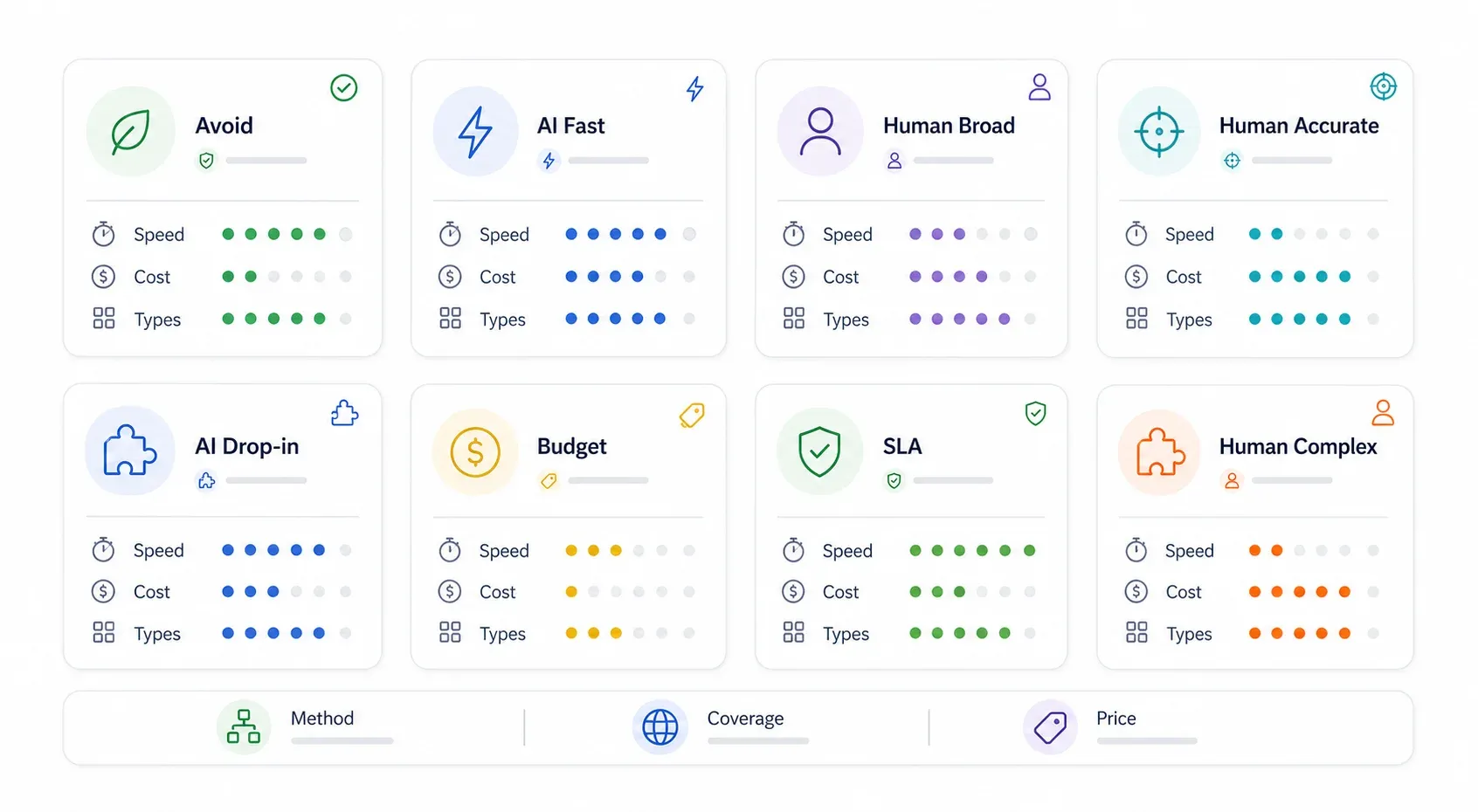
Key takeaways: No single service is cheapest across the board, so pick by the challenge you actually hit. CapMonster Cloud has the lowest reCAPTCHA v2 rate at $0.60/1K; CapSolver and AZcaptcha tie for the lowest Turnstile rate at $1.20/1K, where Anti-Captcha charges $2.00. 2Captcha still has the broadest type coverage, and it's the only service here that publishes an hCaptcha rate. EndCaptcha publishes no per-solve rates at all, so its case rests on the SLA. And Thunderbit eliminates the entire question for users who need extracted data rather than a raw CAPTCHA token.
What CAPTCHA Solving Actually Costs at 10K, 100K, and 1M Solves a Month
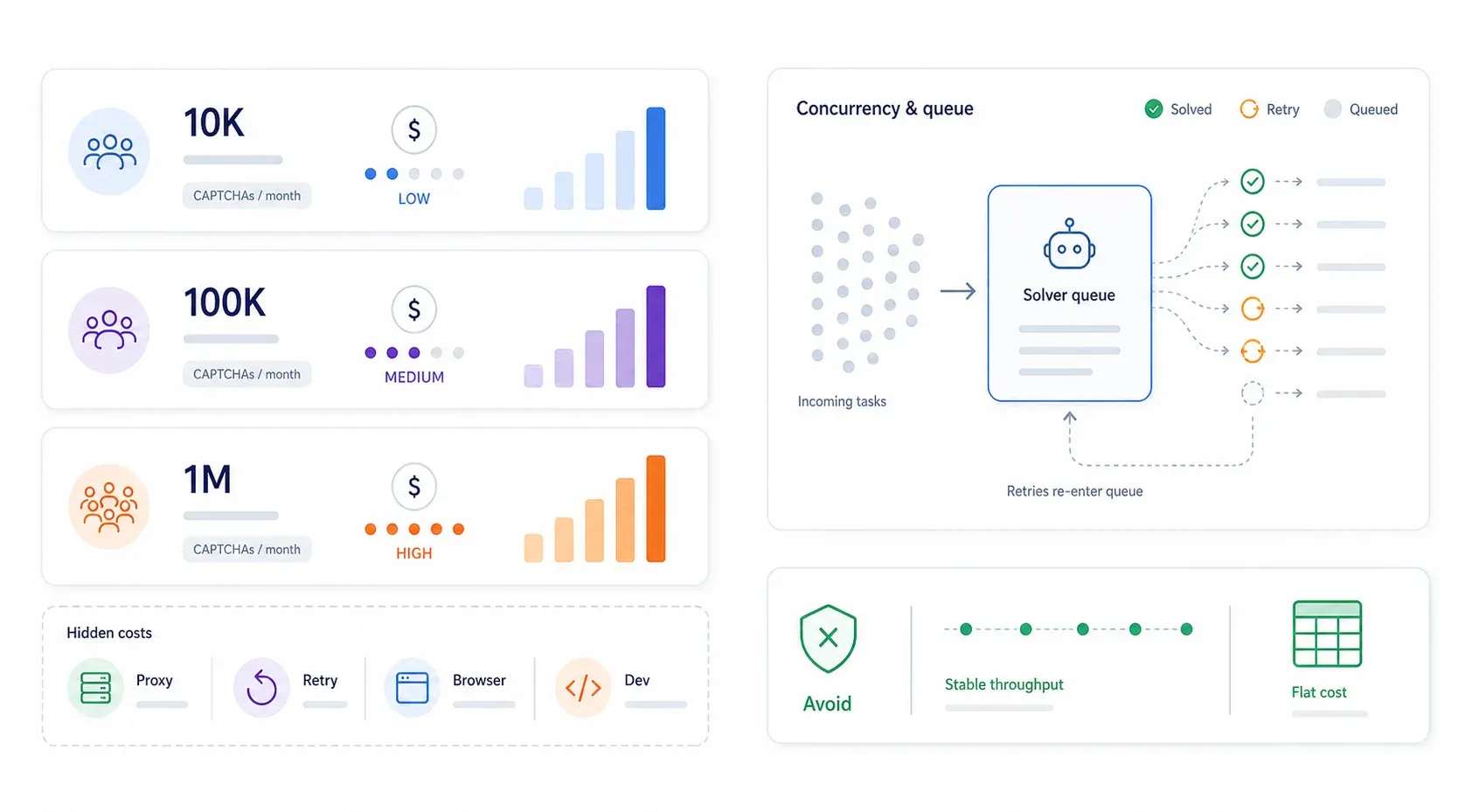
Per-solve pricing is one thing. What actually hits your budget at scale is a different conversation entirely. Every dollar figure below is what that month actually costs at pay-as-you-go rates if every solve is a Cloudflare Turnstile: I multiplied the volume by each vendor's published per-1,000 rate, the same rates listed in the reviews above. Two rows can't be worked out that way — Thunderbit isn't billed per solve, and EndCaptcha publishes no Turnstile rate — so those cells say as much instead of guessing. Nothing is deducted anywhere either, because none of these plans carries a free allowance that resets each month: AZcaptcha's and CapMonster's $0.10 and EndCaptcha's 1,000 credits are one-time signup credits, and Thunderbit's free 6 pages a month is its own plan rather than a discount on a paid one. Proxies, browser runtime and engineering time sit outside these numbers unless the vendor bundles them — CapMonster's rate card includes proxies, and Thunderbit's credit price covers proxy and browser runtime.
| Service | Monthly bill at 10K solves | Monthly bill at 100K solves | Monthly bill at 1M solves |
|---|---|---|---|
| Thunderbit | Not billed per solve — you pay per output row, and the top published tier is Pro at 3,000 rows a month | Custom quote above that | Custom quote |
| CapSolver | $12 | $120 | $1,200 |
| 2Captcha | $14.50 | $145 | $1,450 |
| Anti-Captcha | $20 | $200 | $2,000 |
| CapMonster Cloud | $13 | $130 | $1,300 |
| AZcaptcha | $12 | $120 | $1,200 |
| EndCaptcha | Custom quote — no published Turnstile rate | Custom quote | Custom quote |
| Best Captcha Solver | $18 | $180 | $1,800 |
For reCAPTCHA v2 at 1M solves/month, the spread runs from about $600 (CapMonster at $0.60/1K) to $2,000 (Best Captcha Solver at $2.00/1K). That's more than 3x, just from picking a different provider.
Hidden Costs to Watch
The per-solve price is never the full picture:
- Proxy costs can dwarf solver costs. Oxylabs residential pricing ranges from $6/GB to $2.50/GB depending on volume. Decodo charges $8.50/GB pay-as-you-go.
- Failed solves that get refunded still burn proxy bandwidth, browser time, and session reputation.
- Retry logic and queue management require developer time to build and maintain.
- Browser runtime costs CPU/RAM, especially at scale.
- CAPTCHA provider updates can break AI solvers overnight.
Thunderbit rolls the proxy, browser runtime and retry logic into the credit price, so none of them arrive as separate line items — though whether that comes out cheaper depends on how many rows you need, not how many challenges you hit. If you want a plain-English refresher on what a CAPTCHA is actually testing for, Techquickie's seven-minute explainer below is worth the time; it's from 2017, so it covers the puzzle era rather than the score-based challenges above.
Which CAPTCHA Solvers Handle High-Volume Parallel Scraping
Concurrency is the pain point I see most often in scraping forums. A pipeline that runs clean on one worker starts hitting Cloudflare challenges as soon as you parallelize it, and rate limiting becomes constant once you're running a fleet of nodes.
So which solvers actually handle concurrency?
| Service | Concurrency Signals | Practical Note |
|---|---|---|
| Thunderbit | Cloud scraping: up to 50 pages in parallel | Sidesteps token queueing entirely |
| CapSolver | Rate-limit errors documented; 120s task timeout | AI-first; use backoff on rate limits |
| 2Captcha | Published capacity: 11,273/min for reCAPTCHA v2, 2,883/min for Turnstile | High capacity, but poll every 5s after 10-20s wait |
| Anti-Captcha | "Unlimited parallel processing threads"; queue stats API | Query queue load before bursts |
| CapMonster Cloud | Poll every 2-5s; max 120 getTaskResult requests per task | Fast AI-first; sane polling required |
| AZcaptcha | No published concurrency limit | Test burst behavior on your target |
| EndCaptcha | Claims "tens of millions of submissions per day" | SLA strongest for covered image types |
| Best Captcha Solver | No published concurrency limit | Human-worker service; test before 500-task bursts |
What happens when you send 500 requests at once? AI-based services (CapSolver, CapMonster, AZcaptcha) generally accept and return faster for supported types, but fail quickly on unsupported variants. Human-worker services (2Captcha, Anti-Captcha, BCS) may queue, return no-slot errors, or show rising latency as worker availability becomes the bottleneck.
The production answer is a rate-limited job queue with callbacks, per-provider circuit breakers, budget caps, and fallback routing. Or, if you just need the data: use an avoidance-based tool like Thunderbit and skip the queue entirely.
Self-Hosted and Open-Source CAPTCHA Solvers: An Honest Look
"Can I solve CAPTCHAs locally without paying a service?" The question comes up in forums constantly. The honest answer: it depends on the CAPTCHA type.
Where Self-Hosted Works
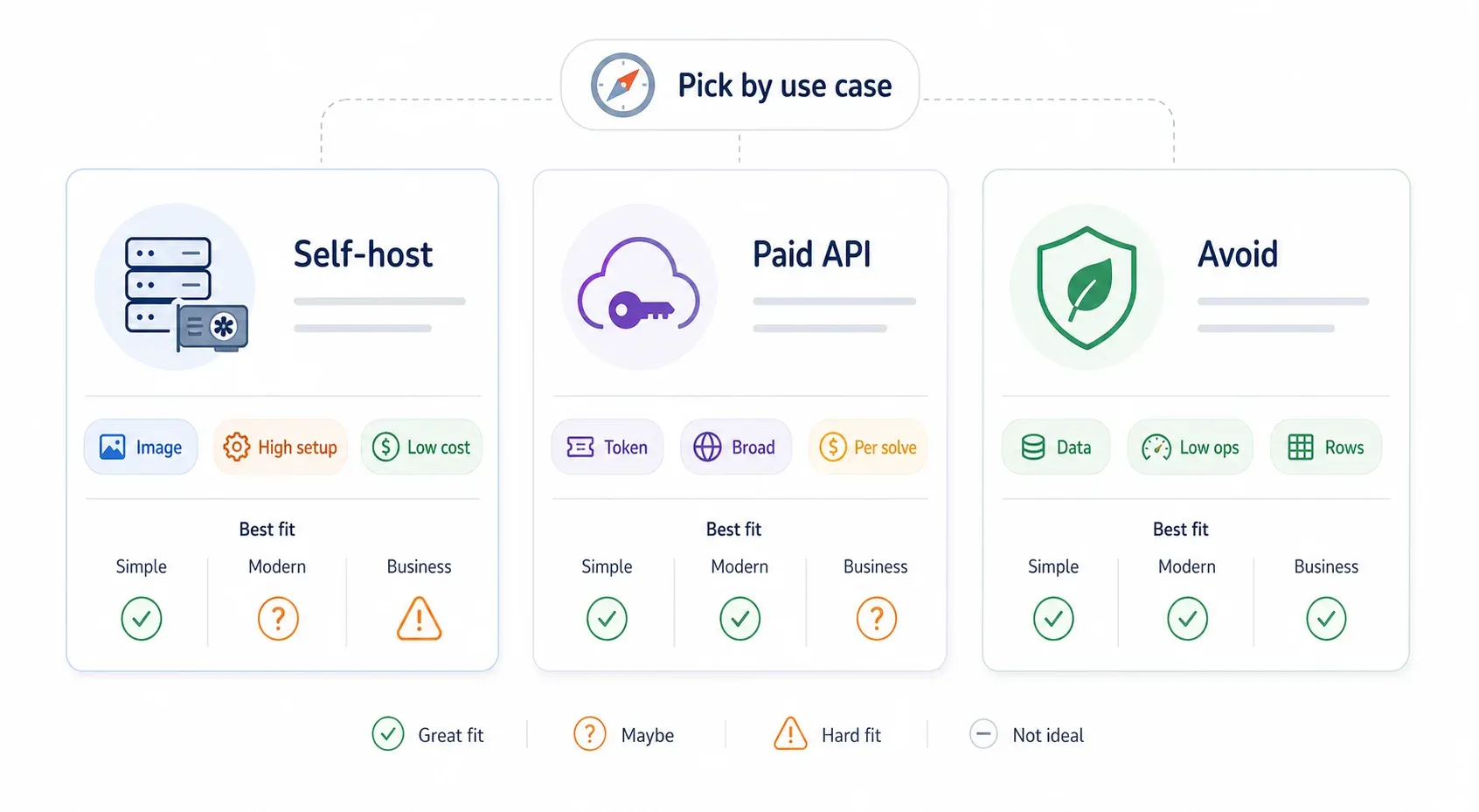
- Simple image and text CAPTCHAs: Viable with open-source OCR models. ddddocr (14K+ GitHub stars) is a solid offline OCR SDK, and there are CAPTCHA OCR models on Hugging Face you can fine-tune on your own samples.
- Some Cloudflare challenge flows: FlareSolverr (v3.5.0, released May 2026) runs a real browser until Cloudflare's challenge clears, then hands back the
cf_clearancecookie so your own HTTP client can reuse it. It's fragile and target-dependent. Since v3.5.0 it can also return a Turnstile token, but you have to tell it how many times to press Tab to reach the widget, so it breaks as soon as the page changes. - Best for: Very high-volume simple CAPTCHA solving where you have GPU resources and technical skill.
Where Self-Hosted Falls Short
- reCAPTCHA v3 is essentially unsolvable locally. It scores behavior, session history, and browser environment—there's nothing to recognize. Cloudflare Turnstile works the same way, and the only local route to it is the FlareSolverr workaround above, which is too brittle to build a pipeline on. That's what FlareSolverr's ⚠️ Partial in the table below means—a narrow workaround, not a practical option.
- hCaptcha Enterprise and FunCaptcha adapt dynamically, making self-hosted models a constant maintenance burden.
- A 2025 benchmark (Open CaptchaWorld) found the best multimodal AI agents topped out at 40% across a mix of CAPTCHA types, against 93.3% for humans—still far below production reliability.
| Approach | Simple Image CAPTCHA | reCAPTCHA v2 | reCAPTCHA v3 | Cloudflare Turnstile | Cost basis | Setup Effort |
|---|---|---|---|---|---|---|
| Self-hosted ML model | ✅ Viable | ⚠️ Partial | ❌ Not viable | ❌ Not viable | Free software, plus GPU time | High |
| FlareSolverr | ❌ | ❌ | ❌ | ⚠️ Partial | Free software, plus your own runtime | Medium |
| Paid API (2Captcha etc.) | ✅ | ✅ | ✅ | ✅ | Per solve — $0.30–$2.00/1K depending on the type | Low |
| AI scraper (Thunderbit) | Usually avoided, not solved | Usually avoided, not solved | Usually avoided, not solved | Usually avoided, not solved | Per output row — $15–$38/mo | Very low |
Bottom line: Self-hosted is niche-viable for simple, stable CAPTCHAs at high volume. For modern JS-based challenges, paid APIs or avoidance tools remain the practical choice.
How to Pick the Right CAPTCHA Solver for Your Use Case
Rather than a generic "it depends," I put together a scenario-based guide:
| Your Situation | Recommendation | Why |
|---|---|---|
| Non-technical user who just wants the data | Thunderbit | No proxies, no API, no solver queue—$15/mo or $38/mo, billed per output row |
| Scraping Cloudflare-heavy sites at scale | CapSolver or CapMonster Cloud | AI-first Turnstile support, fast, $1.20–$1.30 per 1K |
| Encountering unusual or custom CAPTCHAs | 2Captcha | Broadest type coverage, human adaptability |
| Accuracy and queue transparency matter most | Anti-Captcha | Human network plus real-time queue stats API |
| Cheapest path for high-volume reCAPTCHA v2 or Turnstile | CapMonster Cloud for reCAPTCHA v2, CapSolver or AZcaptcha for Turnstile | $0.60/1K on reCAPTCHA v2; $1.20/1K on Turnstile—no single vendor is cheapest at both |
| Need SLA guarantees for mission-critical pipelines | EndCaptcha | Slowness and outage insurance are the differentiator |
| Drop-in replacement for existing 2Captcha integration | CapMonster Cloud | API compatibility, common SDKs |
| Complex visual CAPTCHAs where speed is less critical | Best Captcha Solver | Human-powered, supports Turnstile/FunCaptcha/GeeTest |
The avoidance-first principle still holds: prevent CAPTCHAs through proper request hygiene, proxy rotation, and fingerprint management, and you save money, time, and operational complexity. A solver should be the fallback, not the first move.
If you want to go deeper, the Thunderbit blog has guides on web scraping without coding and what web scraping actually is. And if you want to see the avoidance-first approach in action, give the Thunderbit free tier a try—you might find you never need a CAPTCHA solver at all.
Happy scraping—and may your pipelines stay challenge-free.
Try Thunderbit's Managed Cloud Scraping Get Started Free
FAQs
1. What is a CAPTCHA solver and how does it work?
A CAPTCHA solver is a service or tool that resolves CAPTCHA challenges so an automated script can keep running. Some use AI to recognize images and generate tokens. Others employ human workers. And avoidance-based tools like Thunderbit prevent the challenge from appearing in the first place through managed infrastructure, fingerprint management, and proxy rotation.
2. Are CAPTCHA solvers legal to use?
CAPTCHA-solving tools are not inherently illegal, but legality depends on context. Users must comply with each website's Terms of Service, applicable laws (like the CFAA in the US), and privacy regulations (like GDPR in the EU). The hiQ v. LinkedIn case narrowed some CFAA theories for public data, but it didn't give blanket permission for all scraping. Always check robots.txt (RFC 9309) and use data responsibly.
3. What is the fastest CAPTCHA solver in 2026?
Among common CAPTCHA types, AI-first services like CapSolver and CapMonster Cloud publish the fastest claims—often 1-10 seconds depending on the challenge. AZcaptcha, by comparison, lists 5-10 seconds for Turnstile and 8-15 seconds for reCAPTCHA v2. But the fastest approach overall is CAPTCHA avoidance: when a tool like Thunderbit doesn't trigger a challenge, there's no solve step to wait on at all.
4. Can I solve CAPTCHAs for free?
A few services offer free tiers or trial credits. EndCaptcha provides 1,000 free credits, AZcaptcha offers $0.10 free credit after email verification, and CapMonster Cloud has a $0.10 test balance available on request. Self-hosted open-source models (like ddddocr) are free in software cost but require GPU resources and technical setup. Thunderbit offers a free tier of 6 pages/month, and on most sites those runs don't hit a CAPTCHA at all.
5. What is the difference between CAPTCHA solving and CAPTCHA avoidance?
Solving is reactive: the scraper hits a challenge, sends it to a service, receives an answer or token, and injects it back into the session. Avoidance is proactive: the scraper uses proper request patterns, session persistence, proxy rotation, and browser fingerprint consistency so the site's risk engine never triggers a challenge in the first place. Avoidance is faster and less fragile—nothing sits in a solver queue, and a CAPTCHA vendor shipping a new challenge variant doesn't break your pipeline. Whether it's cheaper depends on how much data you need, not how many challenges you hit. It's not possible on every target site, but it's still the first thing to try.
Learn More




