

Etsy's marketplace in 2026 is massive — 5.6 million active sellers, 86.5 million active buyers, and over 100 million items listed. With $10.46 billion in Etsy marketplace GMS last year alone, demand isn't the problem. Figuring out which niches are actually converting? That's the hard part.
I've spent a lot of time digging into this exact problem — testing tools, reading seller forums, scraping search results, and comparing what works. Whether you're launching your first Etsy shop or expanding an existing one, finding Etsy best sellers is the foundation of smart product research. But most guides just hand you a static list of top shops and call it a day.
This article is different. I'm covering 10 tools (from AI-powered scrapers to free URL hacks), plus actionable frameworks for seasonal planning, niche saturation checks, and pattern analysis that I haven't seen anywhere else. If you want to go from "what should I sell?" to "here's the data proving this niche works," keep reading.
Why Finding Etsy Best Sellers Is the First Step to a Profitable Shop
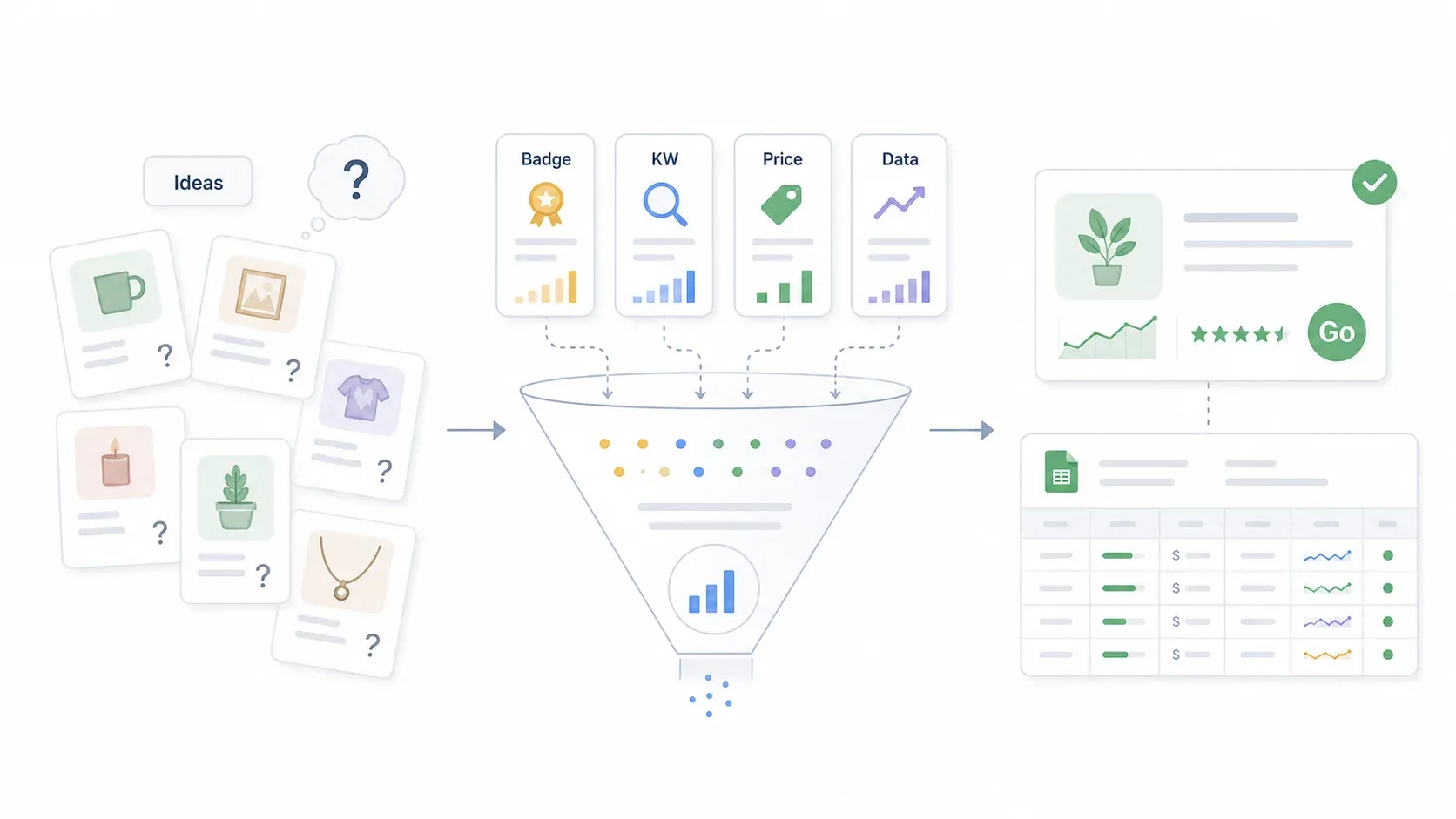
Researching Etsy best sellers before you create a single listing is the closest thing to a cheat code in e-commerce. It reduces guesswork, validates demand, and reveals pricing benchmarks — all before you invest time or money.
Here's how sellers actually use best seller data:
- Product ideation: Instead of guessing what buyers want, you see what they're already purchasing. The Bestseller badge is a live demand signal, not a popularity contest.
- Competitive pricing: Analyze price clusters among top-performing listings. Position your product in the sweet spot — not so cheap you're in a race to the bottom, not so expensive you kill conversion.
- Niche validation: A keyword with 50,000 listings sounds promising until you realize only 10 carry the Bestseller badge. That's low buyer intent, or a market locked by incumbents.
- Sourcing inspiration: Top sellers reveal packaging strategies, personalization options, shipping promises, and description tactics you can borrow and adapt.
This isn't just for newcomers. Etsy itself is shifting its search systems toward more personalized, relevance-driven ML models — early tests are driving increases in add-to-cart and conversion rates, according to Etsy's Q1 2026 shareholder letter. Established sellers use best seller research to spot trends, adjust inventory, and avoid markets that are about to get crowded.
You can't do this kind of research by manually browsing Etsy for an afternoon. You need the right tools — and ideally, a combination of them.
What the Etsy Bestseller Badge Actually Means (And Why It Matters for Research)
Before we get into the tools, we need to clear up one of the biggest points of confusion I see on Etsy forums: the Bestseller badge.
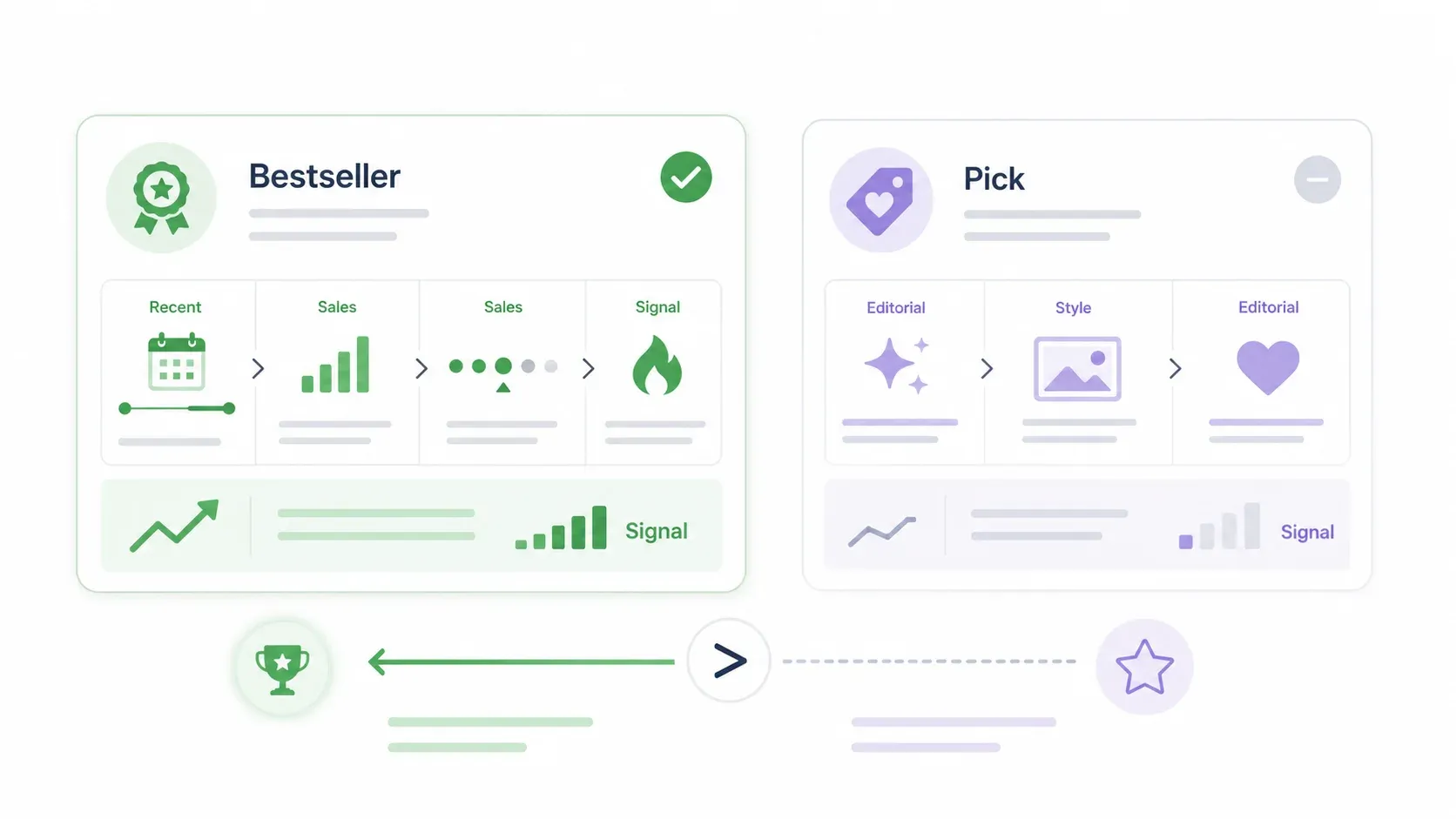
The Etsy Bestseller badge is a relative, recent-performance signal — it means a listing is selling strongly compared to similar listings in its category within a recent time window. Not a global "top 100 across all of Etsy" label. Not a lifetime achievement award. Etsy does not publish the exact formula — no fixed number of sales or precise time window — but seller communities and third-party tools generally describe it as category-relative and velocity-based.
One Reddit seller asked why a brand-new shop could earn the Bestseller badge quickly while established shops lost visibility. The answer: the badge reflects current momentum in a specific competitive context, not cumulative trust.
Bestseller Badge vs. Etsy's Pick Badge
This is where a lot of sellers trip up. Here's the difference:
| Bestseller Badge | Etsy's Pick Badge |
|---|---|
| Basis | Recent sales performance relative to category peers |
| How to earn it | Drive enough recent sales/conversion in your listing's competitive context |
| Reliability as research signal | HIGH — reflects actual buying activity |
| Research value | Best for validating that a product type converts now |
| Bestseller Badge | Etsy's Pick Badge |
|---|---|
| Basis | Recent sales performance relative to category peers |
| How to earn it | Drive enough recent sales/conversion in your listing's competitive context |
| Reliability as research signal | HIGH — reflects actual buying activity |
| Research value | Best for validating that a product type converts now |
When using any of the 10 tools in this article, filter for the Bestseller badge, not Etsy's Pick. That's your reliable demand signal. Tools like Thunderbit can capture badge text as a data field when scraping Etsy search results, letting you build a dataset of only validated top-performing products.
What We Looked For: How We Evaluated These Etsy Best Sellers Tools
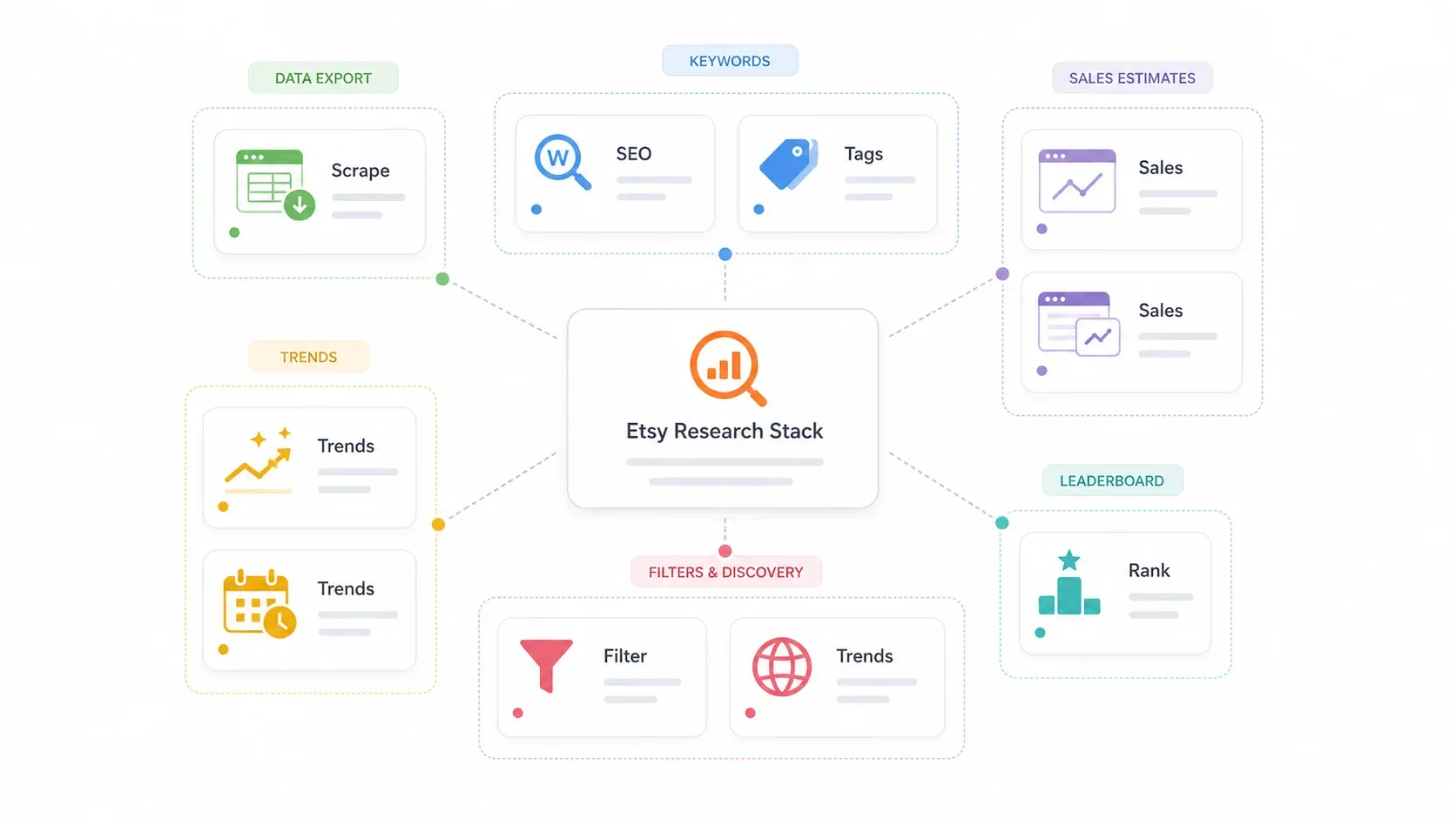
I evaluated each tool across eight criteria. Spoiler: no single tool covers every use case. The smartest approach is combining 2–3 for a complete research workflow.
| Criteria | Why It Matters |
|---|---|
| Etsy-Specific Data | Does it provide Etsy sales estimates, listing analytics, or shop rankings? |
| Keyword & Niche Research | Can it surface search volume, competition, and trending keywords on Etsy? |
| Sales/Revenue Estimates | Does it offer estimated monthly sales or revenue per listing/shop? |
| Ease of Use | Setup time and learning curve — critical for non-technical sellers |
| Free Tier / Pricing | Availability and generosity of a free plan; cost of paid tiers |
| Data Export Options | Can you export to Excel, CSV, Google Sheets, or other tools? |
| Bulk/Scale Research | Can you analyze many listings or shops at once? |
| Unique Differentiator | Any standout feature not found in other tools? |
If you can't export data to a spreadsheet, you'll spend hours on manual note-taking. If the tool doesn't offer bulk research, you'll be stuck clicking through listings one by one. Keep these trade-offs in mind as we go through the list.
1. Thunderbit: Scrape Any Etsy Page into a Spreadsheet with AI
Thunderbit is an AI web data agent that can extract structured data from any Etsy page — search results, category pages, individual shop listings, or product detail pages. It's not an Etsy-only analytics product; it works on any website. But that flexibility is exactly what makes it powerful for Etsy research at scale.
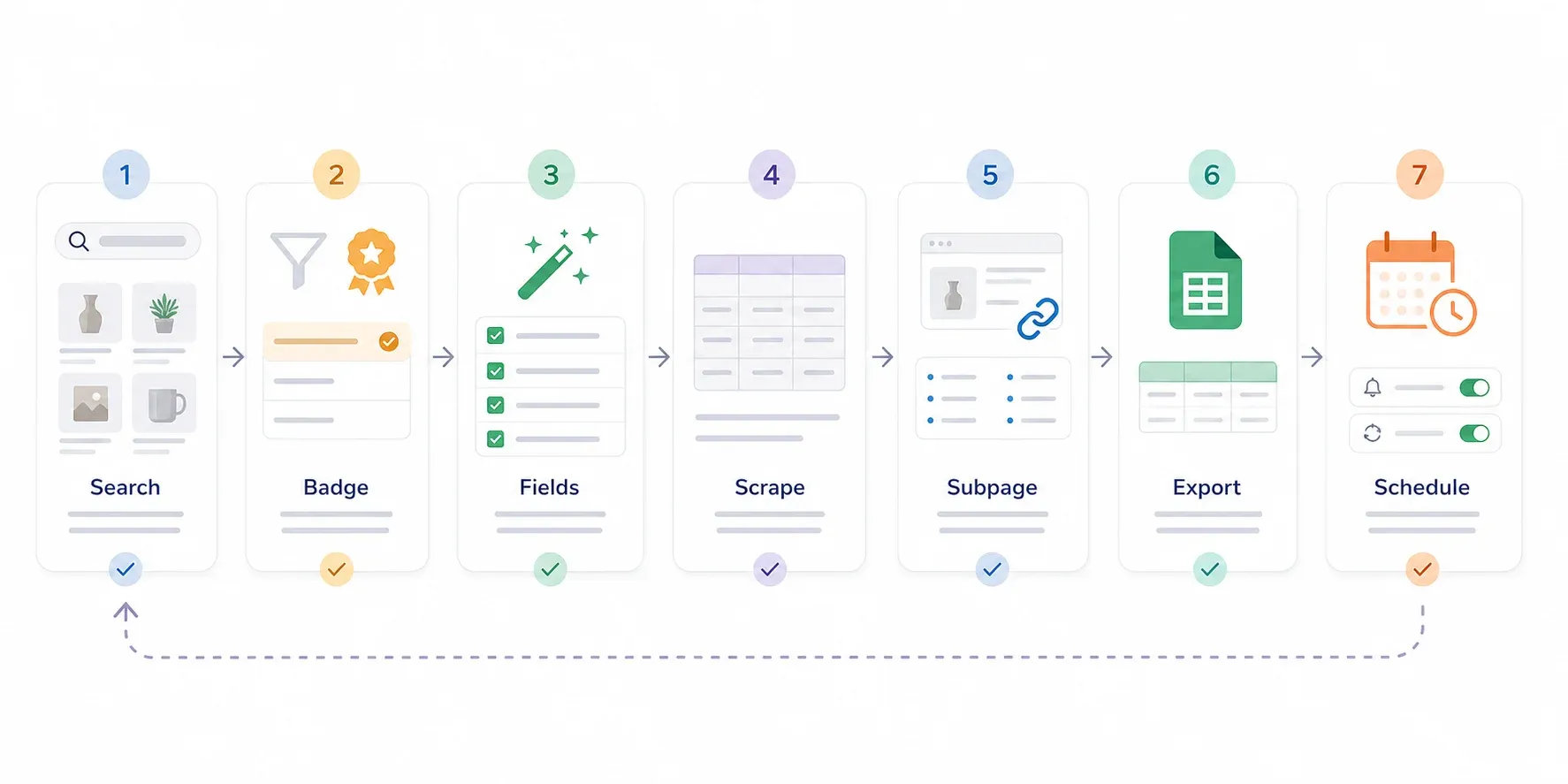
Here's the workflow I use: open an Etsy search results page (say, "custom pet portrait"), click AI Suggest Fields, and Thunderbit reads the page and recommends columns — title, price, shop name, review count, rating, badge text, listing URL, and more. Click Scrape, and the data lands in a table you can export to Excel, Google Sheets, Airtable, or Notion. The whole thing takes about two clicks and a few seconds per page.
The real advantage is cloud scraping: Thunderbit can process up to 50 pages at once, so scraping the first 5 pages of an Etsy search takes seconds rather than an afternoon of clicking.
Subpage scraping takes it further. After scraping search results, Thunderbit visits each product page and enriches your table with descriptions, materials, personalization options, shipping info, and more.
For ongoing monitoring, Thunderbit's scheduled scraper lets you set up a weekly or monthly scrape — for example, tracking "personalized gifts" bestseller-filtered results over time to see which products gain or lose the badge as seasons shift.
One honest limitation: Thunderbit scrapes what's visible on the page. It won't give you proprietary Etsy sales estimates or keyword search volume. For that, pair it with eRank or EverBee.
- Key features: AI field suggestions, bulk cloud scraping (50+ pages), subpage enrichment, scheduled scraping, free export to Sheets/Excel/Airtable/Notion, no coding required
- Pricing: Free tier (6 pages, or 10 with trial boost); paid plans from ~$9/month billed annually (500 credits/month, 1 credit = 1 output row)
- Best for: Sellers who want to pull large Etsy datasets into spreadsheets for custom analysis, price monitoring, or competitive intelligence at scale
Scrape Etsy pages into a spreadsheet with AI
2. eRank: All-Around Etsy SEO and Market Research
eRank is one of the most established Etsy-specific analytics platforms, and for good reason. It covers keyword research, trend tracking, shop analytics, listing audits, and a top sellers leaderboard — all tuned for the Etsy ecosystem.
The Keyword Tool shows search volume, competition, click rate, and trend data across Etsy and other marketplaces. Compare Keywords lets you put several terms side by side. Competitor Tracking estimates daily sales for shops you're watching, and Top Sellers Insights ranks Etsy shops by sales volume.
The free plan is generous for beginners: 5 keyword lookups/day, 1 shop with 50 listings, 5 listing audits/day, and 1 AI Listing Helper use/day. Paid plans run from $5.99/month (Basic) to $29.99/month (Expert), with annual discounts.
eRank is more keyword-oriented than revenue-oriented. A Reddit seller made a fair point: no tool can perfectly estimate Etsy revenue because Etsy doesn't share that data with third-party apps. Use eRank for directional insights, not exact figures.
- Key features: Keyword explorer with search volume and competition, top sellers leaderboard, trending searches, listing audit, tag analysis, browser extension
- Pricing: Free tier (limited); Basic $5.99/mo, Pro $9.99/mo, Expert $29.99/mo
- Best for: Etsy sellers who want an all-in-one SEO and market research dashboard
3. Marmalead: Etsy Keyword Research and Listing Optimization
Marmalead is laser-focused on Etsy keyword research and listing optimization. Its standout feature is the keyword grading system — "MarmaMeters" — that scores keywords on search volume, engagement, and competition in a simple visual format.
Beyond keyword scoring, Marmalead offers seasonality data (over a year of history), 3-month keyword forecasting, side-by-side keyword comparisons, and price-range charts showing bargain, mid-range, and premium tiers. The listing optimization feature analyzes your existing listings and suggests improvements to titles, tags, and descriptions.
Marmalead's strength is clarity. It tells you which keywords to use and why — invaluable if you're not an SEO expert. For broad market research or shop-level revenue analysis, though, you'll need to pair it with a scraping or analytics tool.
- Key features: Keyword grading (MarmaMeters), seasonality and forecasting, listing optimization, price-range charts, side-by-side keyword comparisons
- Pricing: $19/month monthly, $18/month quarterly, $16/month annually, $300 lifetime
- Best for: Etsy SEO beginners who want clear, actionable keyword and tag recommendations
4. Alura: Shop-Level Analytics and Top-Seller Directory
Alura is built for competitive intelligence on Etsy. Its shop analyzer lets you view any shop's estimated sales, revenue, listing count, and categories. The product research tool and keyword research are solid, but the real draw is the top-seller directory — a browsable leaderboard filterable by category (Jewelry, Craft Supplies, Home & Living, and more) with estimated monthly sales and lifetime revenue.
The Chrome extension overlays analytics directly on Etsy pages — research while you browse, no tab-switching required. On higher tiers, Alura supports CSV data export, which matters if you want to do your own spreadsheet analysis.
The free plan includes up to 5 daily searches per tool, 10 listing optimizations, and access to the Chrome extension. Paid plans start at $7.99/month (Basic), with Growth at $24.99/month and Professional at $49.99/month.
- Key features: Shop analyzer, top-seller directory by category, Chrome extension overlay, keyword research, sales/revenue estimates, CSV export (Professional)
- Pricing: Free (limited); Basic $7.99/mo, Growth $24.99/mo, Professional $49.99/mo
- Best for: Sellers who want to analyze specific competitors or browse top Etsy best sellers by category
5. EverBee: In-Browser Product Analytics While Browsing Etsy
EverBee is a Chrome extension that overlays sales estimates, revenue data, and analytics directly on Etsy search results and listing pages as you browse. You don't leave Etsy — EverBee shows estimated monthly sales, revenue, listing age, and tags for each product right in the search results.
The free Hobby plan includes product analytics (views, reviews, favorites) and limited keyword research (10 keywords). The Growth plan ($29.99/month monthly, $19.99/month annually) unlocks sales, revenue, conversion rate, unlimited keywords, keyword score, tag analyzer, and shop insights. The Business plan ($99/month monthly, $69/month annually) adds deeper trend tables, unlimited custom filters, and priority support. Source: EverBee Pricing.
EverBee is great for quick, in-context product validation. The trade-off: it's focused on individual product analysis. If you need bulk data extraction or spreadsheet exports, supplement with Thunderbit or another scraping tool.
- Key features: In-browser overlay on Etsy, product-level sales/revenue estimates (paid), keyword research, tag analyzer, saved product collections
- Pricing: Free Hobby plan; Growth $19.99–$29.99/mo; Business $69–$99/mo
- Best for: Sellers who want quick product-level analytics without leaving Etsy
6. Sale Samurai: Deep Keyword and Tag Analysis for Etsy
Sale Samurai specializes in keyword and tag analysis for Etsy. It surfaces long-tail keywords, real Etsy search volume, tag suggestions, competition grades, and price spreads. The Chrome extension analyzes listings directly on Etsy, and you can download Etsy search results for offline analysis.
There's no forever-free plan — pricing is $9.99/month or $99.99/year, both with a 3-day free trial. For sellers who want granular tag intelligence without a big monthly spend, it's one of the more affordable dedicated options.
The interface feels less polished than Alura or EverBee, and bulk research is moderate rather than industrial-scale. For the price, though, the keyword and tag depth is hard to beat.
- Key features: Long-tail keyword search, real Etsy search volume, tag suggestions, competition grade, Chrome extension, downloadable search results
- Pricing: $9.99/mo or $99.99/yr (3-day free trial, no free tier)
- Best for: Sellers who want granular keyword and tag intelligence at an affordable price
7. Etsy Hunt: Trending Product Discovery and Niche Exploration
Etsy Hunt (also branded as EHunt) is focused on discovering trending products, top shops, and rising niches. Its trending product lists and category browsing make it easy to spot what's gaining momentum right now, rather than just what's been popular all-time.
The free plan includes 10 product searches/day, 10 shop searches/day, and 10 keyword searches/day. Paid plans start at $3.99/month (Basic) and go up to $59.99/month (Team), with annual discounts.
EtsyHunt's top-shop page is a useful real-data resource. As of May 2026, top rows include SeedCult (Home & Living, 39.03K monthly sales, 77,599 reviews), WarungBeads (Craft Supplies & Tools, 34.67K monthly sales, 124,756 reviews), SeedGeeks (31.64K monthly sales, 140,964 reviews), and CaitlynMinimalist (Jewelry, 23.13K monthly sales, 738,576 reviews).
- Key features: Trending product lists, top-shop rankings, keyword research, sales/revenue estimates, category browsing
- Pricing: Free (limited daily searches); Basic $3.99/mo, Pro $19.99/mo, Team $59.99/mo
- Best for: Sellers scouting for rising trends and emerging niches on Etsy
8. Google Trends: Spot Seasonal Demand and Macro Trends for Free
Google Trends is not Etsy-specific, but it's one of the most underrated tools for Etsy sellers. It reveals search interest over time for any term, lets you compare up to 5 keywords side by side, and filters by geography, time range, and category.
For Etsy research, try comparing terms like "personalized necklace," "custom stickers," "wedding welcome sign," and "printable planner" over the past five years. You'll see clear seasonal spikes — Q4 for gifts and ornaments, Q2 for weddings, Q1 for planners — that directly inform when to launch new listings.
The catch: Google Trends shows general web search interest, not Etsy-specific search volume. Pair it with eRank, Marmalead, or EverBee for Etsy-native data.
- Key features: Interest-over-time graphs, keyword comparison (up to 5), geographic filtering, related queries, fully free
- Pricing: Completely free, no sign-up required
- Best for: Validating seasonal timing and macro demand patterns before committing to a niche
9. Etsy's Built-in Search and Bestseller Filter: The Free URL Hack
This is the simplest, zero-cost way to find Etsy best sellers — and it's a technique I see discussed on Reddit and seller forums but rarely documented in guides.
Here's how it works:
- Search any keyword on Etsy (e.g., "custom pet portrait").
- After the page loads, click into the URL bar.
- Append
&is_best_seller=trueto the end of the URL. - Press Enter.
The results should now filter or bias toward listings with the Bestseller badge. You can also combine this with category navigation for more targeted scouting.
Example URL: https://www.etsy.com/search?q=custom%20pet%20portrait&is_best_seller=true
Multiple seller communities and a Chrome extension document this parameter. One seller on Reddit noted that if only a handful of results carry the badge in a large niche, it may signal weak buyer demand or a very high bar for conversion.
The downside: this is manual, one-search-at-a-time research. You can see the listings, but exporting or analyzing at scale requires a tool like Thunderbit.
- Key features: Free, no tools needed, shows real Etsy Bestseller badge holders, works for any keyword or category
- Pricing: Completely free
- Best for: Quick bestseller scouting and validation before investing in paid tools
10. Marketplace Pulse: High-Level Top-Seller Leaderboard and Industry Overview
Marketplace Pulse is a marketplace intelligence platform that tracks top sellers across Etsy, Amazon, eBay, and others. Its Top Etsy Sellers page ranks sellers by lifetime sales and is updated regularly.
The current leaderboard shows CaitlynMinimalist (Jewelry, 3,763,891 lifetime sales), Beadboat1 (Craft Supplies & Tools, 2,280,891), SilverRainSilver (Jewelry, 2,097,919), PlannerKate1 (Paper & Party Supplies, 2,075,700), and SeedGeeks (Home & Living, 1,539,585). Of the top 100 Etsy sellers worldwide, 71 are in the United States, followed by the UK and China with 6 each.
Marketplace Pulse gives you the 30,000-foot view — who dominates, which categories lead, where sellers are located. It's not designed for keyword research or day-to-day product scouting.
- Key features: Top 100 Etsy sellers by lifetime sales, category and geographic breakdowns, macro industry overview
- Pricing: Top 100 list is free; advanced data may require subscription
- Best for: High-level competitive intelligence and understanding who the biggest Etsy best sellers are
Etsy Best Sellers Tools at a Glance: Comparison Table
| Tool | Etsy-Specific | Keyword Research | Sales Estimates | Free Tier | Bulk/Scale | Best For |
|---|---|---|---|---|---|---|
| Thunderbit | ✅ (scrapes any Etsy page) | ⚠️ (via extracted data) | ⚠️ (scrape visible data) | ✅ | ✅ (cloud, 50+ pages) | Scraping full Etsy listings/shops into spreadsheets at scale |
| eRank | ✅ | ✅ | ✅ | ✅ (limited) | ⚠️ | All-around Etsy SEO & market research |
| Marmalead | ✅ | ✅ | ⚠️ | ⚠️ (free tools) | ⚠️ | Etsy keyword research & listing optimization |
| Alura | ✅ | ✅ | ✅ | ✅ (limited) | ✅ (paid) | Shop-level analytics & top-seller directory |
| EverBee | ✅ | ✅ | ✅ (paid) | ✅ (limited) | ⚠️ | In-browser product analytics while browsing Etsy |
| Sale Samurai | ✅ | ✅ | ✅ | ❌ (trial only) | ⚠️ | Deep keyword + tag analysis |
| Etsy Hunt | ✅ | ✅ | ✅ | ✅ (limited) | ⚠️ | Trending product discovery |
| Google Trends | ❌ (general) | ✅ (general) | ❌ | ✅ (fully free) | ✅ | Seasonal demand patterns & macro trends |
| Etsy Search + Filter | ✅ | ⚠️ | ❌ | ✅ (fully free) | ❌ | Quick bestseller scouting with URL hack |
| Marketplace Pulse | ✅ | ❌ | ✅ (lifetime) | ✅ (top 100) | ⚠️ | High-level top-seller leaderboard & industry overview |
Recommended tool combinations:
- Free starter stack: Etsy URL hack + Google Trends + eRank free + Thunderbit free tier
- SEO-focused stack: eRank or Marmalead + Sale Samurai for tags + Google Trends for seasonality
- Competitive intelligence stack: Alura or EverBee + Thunderbit export + Marketplace Pulse leaderboard
- Trend scouting stack: Etsy Hunt + Etsy URL hack + scheduled Thunderbit monitoring
What Top Etsy Best Sellers Actually Have in Common: A Pattern Analysis
Every guide lists top shops — CaitlynMinimalist, PlannerKate1, Beadboat1. Almost none analyze what patterns these shops share. I pulled data from Marketplace Pulse and EtsyHunt, and here's what actually stands out:
| Trait | Observed Pattern Among Top Shops |
|---|---|
| Category focus | Top shops dominate one repeatable category, not scatter across random products |
| Large review base | 50,000+ reviews common among top 10; CaitlynMinimalist has 738,576 reviews |
| High catalog/variation depth | Winners create repeatable SKUs, variations, bundles, and seasonal spins |
| Price accessibility | Many top categories include low-to-mid priced, repeatable or giftable purchases |
| Longevity | Most top lifetime shops date back to the 2010s |
| Demand engine | Top sellers often serve recurring occasions (weddings, holidays, gardening, crafting) |
A less obvious insight: many top Etsy sellers actually sell to other sellers. Craft supplies, beads, fabrics, seeds, SVGs, and templates let Etsy sellers monetize Etsy's own creator ecosystem. Beadboat1 and WarungBeads are supply shops, not end-consumer brands.
Another distinction worth making: lifetime sales and current momentum are different. Marketplace Pulse ranks by lifetime totals, while EtsyHunt shows monthly sales. A shop can be a lifetime giant but not the fastest grower this month.
How to Run Your Own Best Seller Pattern Analysis
You don't have to take my word for it. Here's how to do this yourself:
- Go to EtsyHunt's top shops page or Marketplace Pulse's leaderboard.
- Use Thunderbit to scrape the table — shop name, category, country, monthly sales, reviews, favorites.
- Export to Google Sheets.
- Group by category and country. Calculate median reviews, median monthly sales, and category concentration.
- Pull sample listings from 10 shops in your target category and analyze price bands, photo style, personalization options, and review recency.
For a seller researching "custom pet portrait," the global top-shop numbers are less useful than running this same analysis on pet portrait listings specifically — looking for lower-review shops still earning the Bestseller badge, which signals current demand not fully locked by incumbents.
Seasonal Etsy Best Sellers: What Sells in Q1, Q2, Q3, and Q4
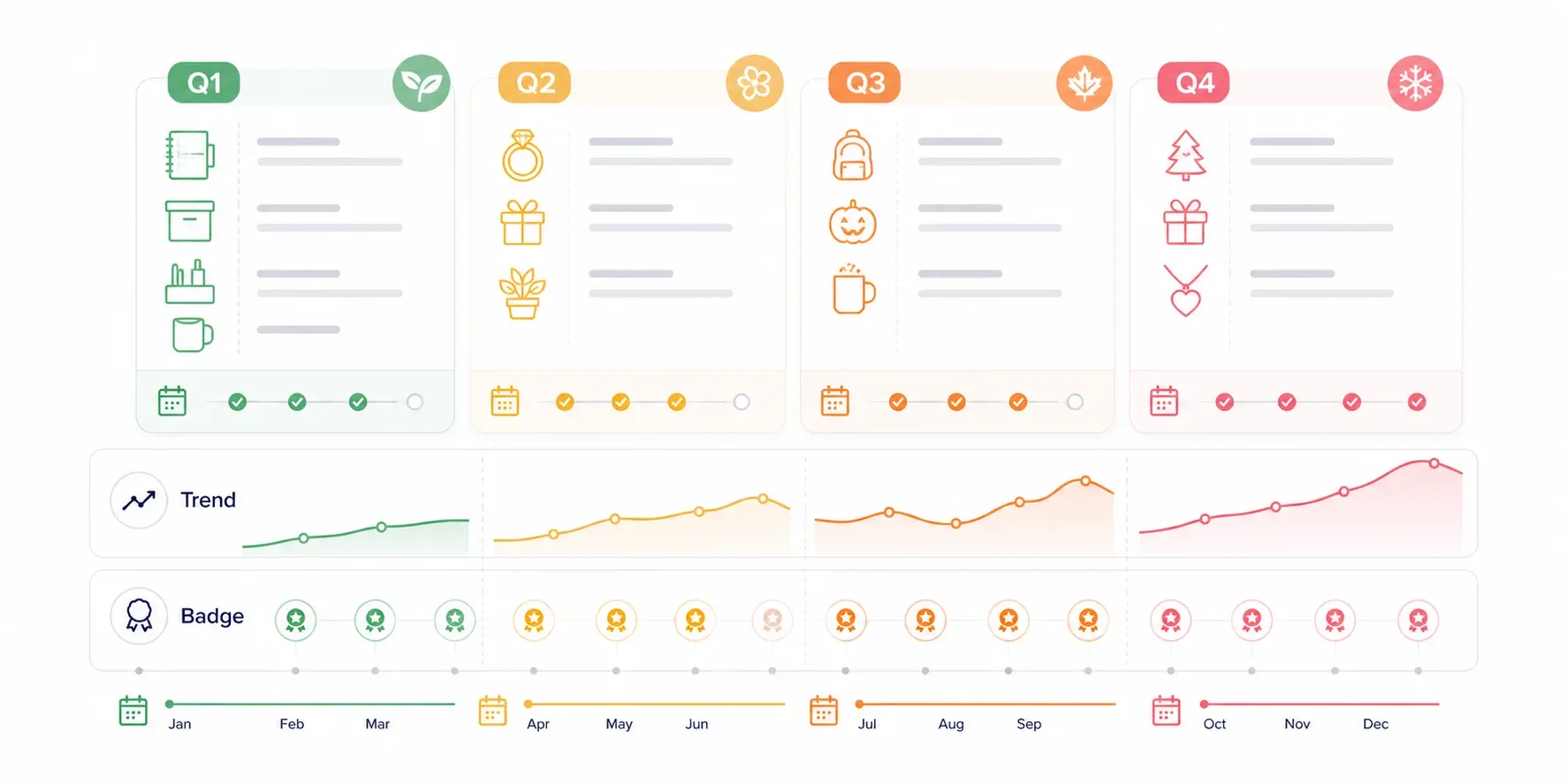
Most Etsy best seller guides treat the marketplace like it's frozen in time — "here are the top sellers, period." But Etsy is deeply seasonal. Timing your listings to match demand peaks can make or break a launch.
Here's a quarterly calendar based on Google Trends data, Etsy's own trend reports, and seller community patterns:
| Quarter | Categories Likely to Peak | Validation Method |
|---|---|---|
| Q1 | Planners, goal trackers, budget templates, Valentine gifts, organization products, early wedding planning | Google Trends for "printable planner," "budget planner"; eRank/Marmalead keyword seasonality |
| Q2 | Mother's Day gifts, Father's Day gifts, graduation gifts, bridal showers, wedding signs, garden/outdoor decor | Etsy Spring/Summer 2026 trend report: bridesmaid baskets +4,200%, wedding statement rings +200% |
| Q3 | Back-to-school, dorm decor, fall decor pre-launches, Halloween prep, teacher gifts, hobby kits | Google Trends "back to school," "Halloween decor," "teacher gift" |
| Q4 | Personalized gifts, ornaments, holiday decor, cards, calendars, stocking stuffers, party supplies | Google Trends Q4 spikes; Etsy holiday merchandising guidance |
Etsy's Spring/Summer 2026 trend report is packed with specific rising searches: embroidered straw bags up 20,000%, wall art decor up 110%, polka dot phone cases up 835%, traveler journal searches doubled, and journal charms up 395%.
How to Monitor Seasonal Trends with Thunderbit's Scheduled Scraper
Here's a practical workflow I recommend:
- Set up a Thunderbit scheduled scrape for a target keyword — say,
personalized gifts&is_best_seller=trueon Etsy. - Run it monthly. Capture title, shop, price, review count, badge text, discount, and URL.
- Append results to a Google Sheet each month.
- Over several months, track which products first appear in September/October, gain badge visibility in November, and discount heavily in December.
A sticker seller or digital download creator could use this data to plan Q4 releases 6–8 weeks before peak search interest, rather than scrambling after buyers have already purchased. Timing new listings to coincide with seasonal demand — and whatever "new listing boost" Etsy may provide — gives your products the best shot at gaining early traction.
The DIY Research Playbook: How to Find Etsy Best Sellers Step by Step
This is the section I wish existed when I started researching Etsy niches. Most articles hand you a list of tools and leave you to figure out the rest. Here's the step-by-step process I actually use, with "custom pet portrait" as the running example.
Step 1: Start with Keyword Research (eRank or Marmalead)
Open eRank or Marmalead and compare related terms: "custom pet portrait," "watercolor pet portrait," "dog memorial portrait," "cat portrait custom," and "pet portrait digital." Look for meaningful search volume, manageable competition, and long-tail phrases tied to clear buyer intent. Note which terms have high engagement and which are oversaturated.
Step 2: Filter for Etsy Best Sellers (URL Hack)
Take your strongest keyword to Etsy search and append &is_best_seller=true to the URL. Manually scan what remains: are the best sellers physical prints, digital files, watercolor styles, memorial gifts, minimalist line art, or humorous portraits? This gives you a fast read on what buyers are actually purchasing in that niche.
Step 3: Scrape the Results at Scale (Thunderbit)
Use Thunderbit to scrape the filtered search result pages. Suggested columns: title, price, sale_price, shop_name, review_count, rating, badge_text, personalization, ad_status, listing_url. Then use subpage scraping to enrich each row with description summary, delivery format, turnaround time, materials, photo requirements, shipping info, and refund policy from the individual listing pages.
Step 4: Analyze and Compare in Your Spreadsheet
Sort by review count ascending while keeping Bestseller badge = true. The opportunity signal: a lower-review or newer shop still earning the badge, because it suggests current demand is not fully locked by incumbents.
Group prices into tiers: under $10 (digital-only), $10–$30 (printable or digital+print), $30+ (premium framed or hand-painted). Look for underserved combinations — memorial-focused cat portraits, multiple-pet portraits, fast digital delivery, or premium physical options.
Specific insights you might discover:
- A high percentage of best sellers are digital-only, creating a premium opportunity for physical framed delivery.
- Bestseller listings with fewer reviews may share one angle (e.g., "memorial gift" or "watercolor from photo"), showing a demand pocket.
- Sellers promising 24–48 hour previews can win against slower custom shops — turnaround time is a real differentiator.
Niche Saturation Check: How to Use Data to Avoid Crowded Etsy Markets
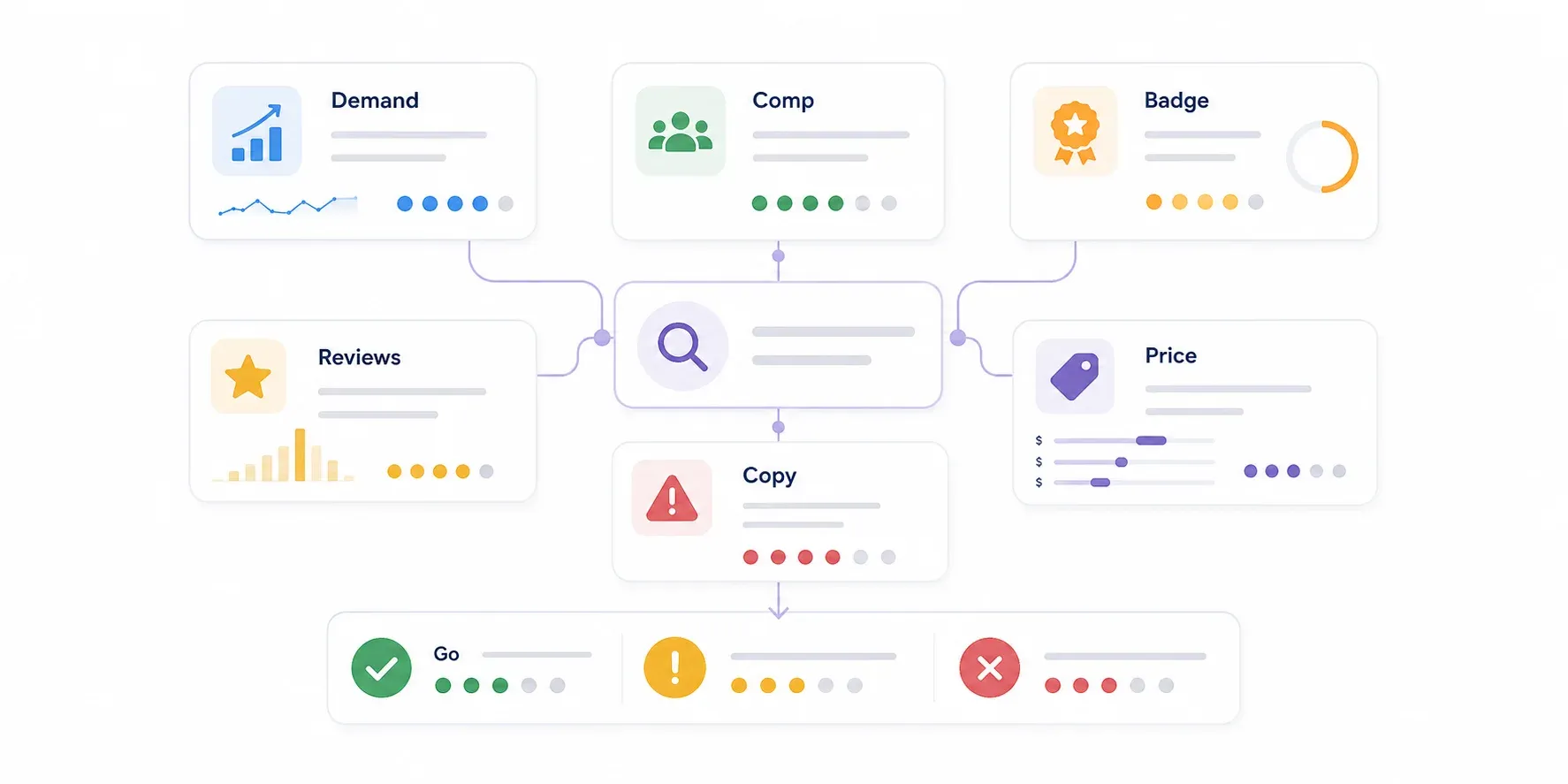
Two fears dominate Etsy seller forums: saturation and copycats.
One Reddit seller put it bluntly: "They've killed my store stealing my bestsellers." Another warned about AI-generated digital products: "if the pattern is created using AI, you will be blasted in all the communities." Pricing pressure is real too — sellers complain about competitors who "vastly underprice their handmade items."
The answer isn't to avoid research. It's to use data to validate a niche before you invest.
Step 1: Confirm Keyword Demand Exists
Use eRank or Marmalead to check that the niche keyword has at least 1,000+ monthly searches (or a cluster of long-tail terms with buyer intent).
Step 2: Assess Competition Density
Use Thunderbit to scrape the first 3–5 pages of Etsy search results for that keyword. Export listing count, price, review count, and shop age. If the top results are all 5-star shops with 10,000+ reviews and sub-$5 pricing, the niche may be too saturated for a newcomer.
Step 3: Check Bestseller Badge Density
Use the &is_best_seller=true URL hack. A high ratio of badge holders to total listings signals a healthy, converting niche. A low ratio — very few badges despite thousands of listings — signals low demand or a very high bar.
Step 4: Analyze Price Tiers
From the scraped data, group listings by price range ($0–$10, $10–$30, $30+). Look for underserved price tiers where you could position a product with better value or differentiation.
Healthy Niche vs. Saturated Niche: Decision Framework
| Signal | Healthy Niche ✅ | Saturated Niche ⚠️ |
|---|---|---|
| Search volume | 1,000+ monthly | 1,000+ but dominated by 3–5 mega-sellers |
| Review distribution | Mix of new and established shops earning badges | All top results have 10K+ reviews |
| Price range | Multiple price tiers represented | Race-to-the-bottom pricing below $5 |
| Bestseller badge ratio | 10–30% of results carry the badge | <5% of results carry the badge |
| Copycat risk | Unique materials/style hard to replicate | Generic digital templates easily cloned |
This framework won't make the decision for you. But it turns "I feel like this niche is crowded" into "here's the data — go or no-go."
How to Choose the Right Etsy Best Sellers Tool
Ten tools is a lot. Here's my quick cheat sheet:
- Just starting out, no budget? Etsy URL hack + Google Trends + eRank free + Thunderbit free tier. You'll get demand signals, seasonal context, keyword data, and exportable listings for zero dollars.
- Want Etsy-specific keyword and SEO help? eRank or Marmalead + Sale Samurai for tag depth.
- Need competitive intelligence on specific shops? Alura or EverBee for shop-level analytics + Thunderbit for bulk export.
- Scouting trends and emerging niches? Etsy Hunt + Etsy URL hack + scheduled Thunderbit monitoring.
- Macro industry context? Marketplace Pulse for the top-seller leaderboard and geographic breakdowns.
No single tool does everything. The sellers making the smartest decisions combine a keyword tool, a demand-validation method, and a data export workflow.
Wrapping Up: Pick the Right Tools and Start Finding Etsy Best Sellers Today
Finding Etsy best sellers is not about copying what's popular. It's about understanding demand, pricing, positioning, and gaps — then building a product strategy backed by real data, not gut feelings.
Start with the free stack: Etsy's URL hack for badge scouting, Google Trends for seasonal timing, eRank's free plan for keyword research, and Thunderbit's free tier for exporting Etsy search data into a spreadsheet. Layer in paid tools as your research needs grow.
The sellers who succeed on Etsy in 2026 aren't guessing. They're researching. With the right combination of tools, that research takes minutes — not days.
If you want to see what AI-powered Etsy data extraction looks like, give the Thunderbit Chrome Extension a spin on your next Etsy search. You might be surprised how fast you go from "what should I sell?" to "here's my niche, validated."
For more on scraping and data extraction workflows, check out the Thunderbit YouTube Channel and guides like how to scrape into Google Sheets, best Etsy scrapers, and product research step by step.
Try Thunderbit for Etsy Market Research Get Started Free
FAQs
1. How do I find what's selling best on Etsy right now?
Use the Etsy Bestseller badge as a current-demand signal. Search a keyword on Etsy, append &is_best_seller=true to the URL, and review the filtered results. For broader scouting, browse EtsyHunt's trending page or Marketplace Pulse's top-seller leaderboard. To export and analyze results at scale, use Thunderbit to scrape the search page into a spreadsheet.
2. Is there a free way to research Etsy best sellers?
Yes. Etsy's built-in search with the bestseller URL hack, Google Trends, and the free tiers of eRank, Alura, EverBee, Etsy Hunt, and Thunderbit all offer no-cost starting points. You can build a solid research workflow without spending a dollar.
3. What is the Etsy Bestseller badge and how do you get it?
The Bestseller badge is a relative, recent-performance signal indicating a listing is selling strongly within its specific category. Etsy does not publish the exact formula, but it is driven by recent sales velocity relative to similar listings. You earn it through strong keywords, competitive pricing, quality photos, fast fulfillment, and products that match buyer intent. It is not the same as the Etsy's Pick badge, which is an editorial selection.
4. How can I tell if an Etsy niche is too saturated?
Scrape the first 3–5 pages of Etsy search results for your keyword and analyze review counts, price ranges, and Bestseller badge density. If the top results are all dominated by shops with 10,000+ reviews, pricing is racing to the bottom, and very few listings carry the Bestseller badge, the niche is likely saturated. Look for niches where newer shops still earn the badge and multiple price tiers are represented.
5. How often should I research Etsy best sellers?
Monthly checks are enough for evergreen categories. During seasonal ramps — weddings in spring, back-to-school in late summer, holidays in Q4 — weekly checks help you catch rising trends early. A deeper quarterly refresh of keywords, pricing, and competitor benchmarks keeps your strategy current. Thunderbit's scheduled scraper can automate recurring checks so you don't have to remember.




