
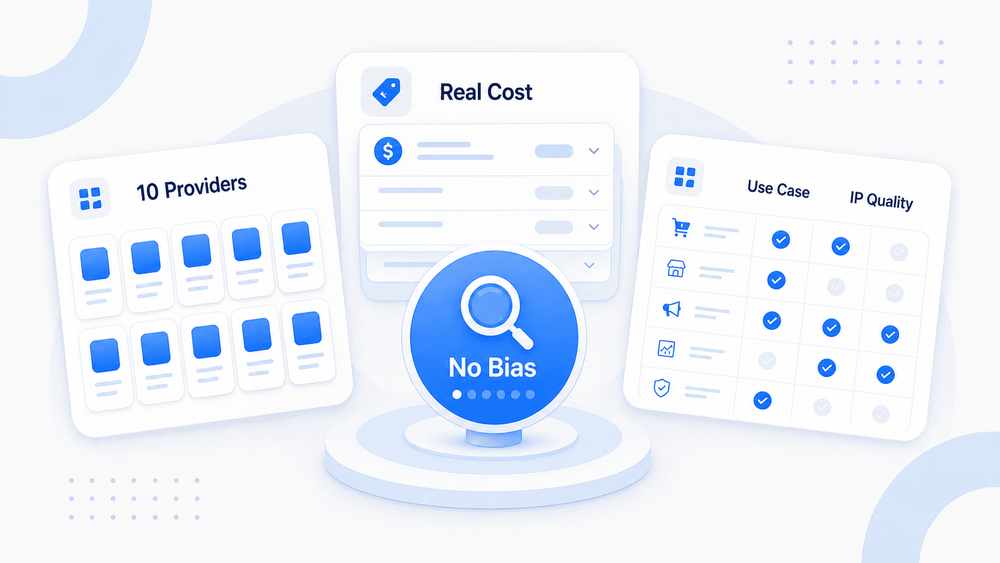
Most proxy roundups you've read this year probably made money from the providers they ranked first. That's the uncomfortable truth about "Top 10 Proxy" lists in 2026, and it's the reason forum threads are full of people asking, "Can anyone recommend a provider who wasn't just the highest affiliate bidder?"
I've spent a lot of time in proxy-adjacent territory — building and documenting Thunderbit's scraping API, reading through Reddit threads where users compare residential proxy ban rates, and watching small operators get burned by $500 minimums they didn't see coming. This article is my attempt to do what most proxy listicles don't: disclose how we evaluated, show real pricing at volumes people actually buy, map providers to specific use cases instead of generic pros/cons, and — this is the part no competitor covers — ask whether you need a proxy provider at all if your goal is web scraping. Thunderbit is on this list, but not as a proxy provider. We're transparent about that. More on why below.
Why Most "Top 10 Proxy Provider" Lists Miss the Mark
The proxy review ecosystem has a structural conflict. Bright Data publishes a "best proxy providers" article where Bright Data ranks first. Oxylabs publishes its own "best datacenter proxy" list and — surprise — Oxylabs is best overall. Anti-detect browser vendors publish partner-style "top 10" lists for multi-accounting. And independent-looking review sites often earn affiliate commissions from the same providers they rank.
None of this makes the information useless. But it means you should watch for red flags:
- The publisher's own product is ranked #1 with no disclosed conflict.
- Only a single $/GB number is quoted — no minimum spend, no volume tiers, no traffic expiry.
- No test methodology: no target sites, no request volume, no dates.
- Zero mention of ethical IP sourcing or compliance.
- "Best for everything" wording instead of use-case segmentation.
This article is different in a few specific ways. I disclose evaluation criteria up front. I show estimated costs at 1 GB, 10 GB, and 100 GB — not just the marketing-page rate. I include a use-case decision matrix so you can find the provider that fits your workflow, not a generic ranking. And I include Thunderbit not as a proxy but as an alternative approach for the most common proxy use case (web scraping), because for structured data extraction, you may not need a proxy provider at all.
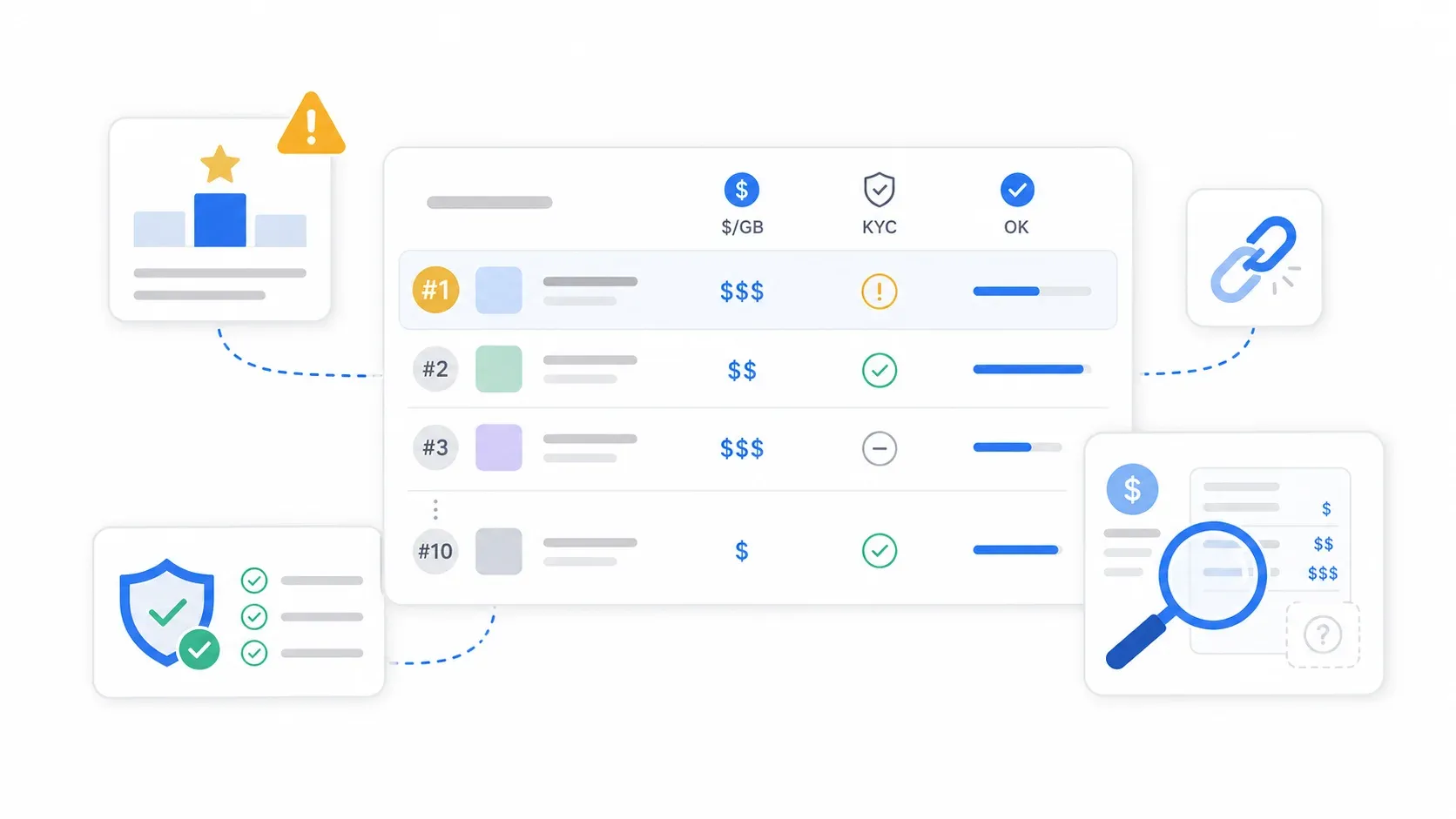
What We Looked For in These 9 Proxy Providers
These eight criteria come from actual user pain points — forum complaints, Reddit threads, and support conversations — not marketing copy.
| Criteria | Why It Matters |
|---|---|
| IP quality / ban rate | The #1 user complaint. A cheap GB is expensive if target sites already flag the IP range. |
| Real $/GB at realistic volumes | Listed rates mislead. Effective cost depends on 1 GB / 10 GB / 100 GB tiers, minimums, and traffic expiry. |
| Sticky session reliability | Sessions dropping mid-action is a frequent, high-severity issue for multi-account and checkout workflows. |
| Ethical IP sourcing transparency | After the 911 S5 botnet takedown, users want proof IPs aren't from compromised devices. |
| Protocol support (HTTP/S, SOCKS5) | Determines compatibility with scraping frameworks, anti-detect browsers, and custom tooling. |
| Minimum spend / KYC barrier | Freelancers and small operators get blocked by $500+ minimums and mandatory sales calls. |
| Use-case fit | Generic rankings don't map to specific workflows — scraping, multi-account, ad ops each need different things. |
| Free trial honesty | Multiple forum reports of quality degrading after trial conversion. A trial is useful only if it reflects paid-pool quality. |
IP Quality and Ban Rate
This is the single biggest variable across providers. "IP quality" in practice means: what percentage of a provider's IPs are already flagged by anti-bot systems? How diverse are the subnets? How fresh is the pool rotation? Two providers can both claim "millions of residential IPs" and deliver wildly different detection rates on the same target site. Forum users report this constantly — one provider works great on Amazon but fails on Instagram, and vice versa.
Real Pricing at Real Volumes
Most listicles quote a single $/GB number pulled from the provider's marketing page. That number is almost always the lowest possible rate at the highest possible commitment. What you actually pay at 1 GB or 10 GB can be 2–4x higher. Minimum spend requirements, traffic expiry, and mandatory sales calls add hidden friction that the headline number doesn't capture.
Sticky Sessions, Protocols, and Access Barriers
Sticky sessions let you maintain the same IP across multiple requests — critical for login flows, checkout sequences, and social media account management. When a sticky session drops mid-action, the workflow fails. Protocol support matters too: SOCKS5 is required by many anti-detect browsers and custom scraping setups, while HTTP(S) is the baseline. And minimum spend / KYC requirements can be a dealbreaker for freelancers who just want to test 1 GB without a sales call.
Before You Buy: Do You Actually Need a Proxy Provider?
This is the question no competing proxy listicle asks. If your primary use case is web scraping — extracting product data, SERP results, lead information, or content from websites — a standalone proxy may be unnecessary overhead.
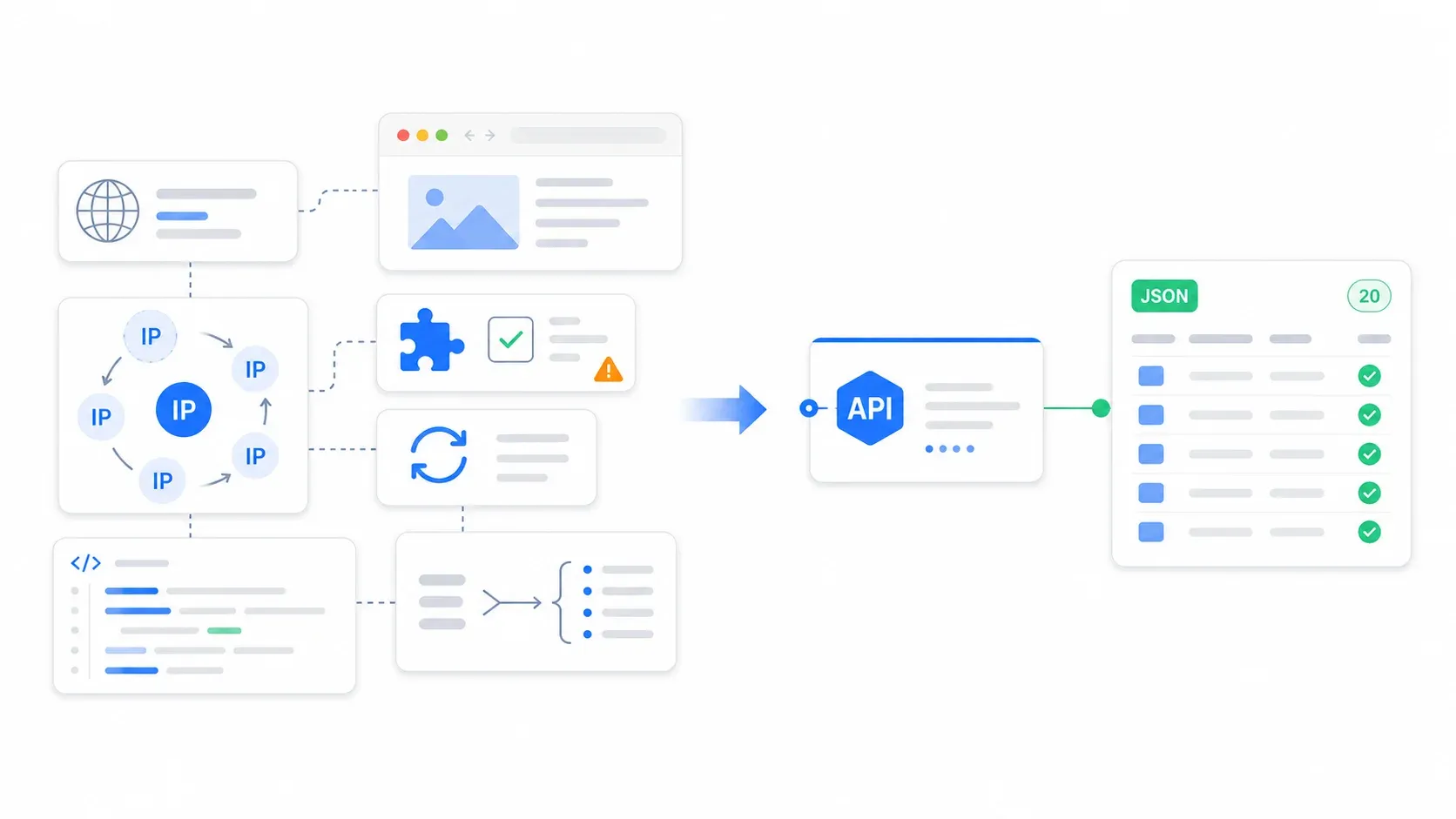
The traditional scraping stack looks like this: choose a proxy provider, configure rotation logic, set up Playwright or Selenium, handle browser/TLS fingerprinting, manage retries, solve CAPTCHAs, parse HTML into structured data, and monitor for breakage. That's a lot of moving parts, and most of the complexity exists just to get past anti-bot systems.
AI-powered scraping APIs take a different approach. They handle JS rendering, anti-bot, CAPTCHAs, and IP rotation through built-in cloud infrastructure. You send one API call and get structured data back.
| Dimension | Raw Proxy + DIY Scraping | Thunderbit API (POST /extract) | Thunderbit MCP Server |
|---|---|---|---|
| Setup complexity | Provider selection, proxy config, browser setup, parser, validation | API key + JSON Schema + one endpoint call | API key + MCP config; agent calls tools mid-task |
| Anti-bot handling | You manage everything | Built-in (JS, CAPTCHA, anti-bot) | Built-in |
| Structured output | You parse HTML yourself | Schema-matched JSON | Schema-matched JSON returned to AI workflow |
| Cost model | Proxy $/GB + infra + retries | 20 credits per extract request | Same credits through MCP calls |
| Best for | Non-scraping proxy needs, exact exit IP control | Structured data extraction, pipelines, RAG | Research agents and coding assistants |
If you need proxies for social media multi-accounting, ad account warmup, sneaker bots, or exact exit IP control, a proxy provider is still the right tool. But if your goal is "get structured data from websites," read the Thunderbit section below before spending money on proxy bandwidth.
1. Thunderbit: AI Scraping API That Replaces Proxy Setup
Thunderbit is not a proxy provider. It's an AI web scraper with a developer stack — Open API, MCP server, and CLI — that handles the entire extraction pipeline internally. No proxy config, no rotation logic, no HTML parsing. One API call, structured data out.
I work on the Thunderbit team, so I'm biased — but I'm also the person who knows exactly where the product is strong and where it's not the right fit. For web scraping at scale, Thunderbit replaces the proxy + browser + parser stack. For multi-account management or ad warmup, it doesn't. That's an honest assessment.
Try Thunderbit for AI Web Scraping
Key Features for Developers
- Open API:
POST /openapi/v1/extractreturns schema-matched structured JSON.POST /openapi/v1/distillconverts pages to clean Markdown.POST /openapi/v1/suggest_fieldsdiscovers extractable fields (and it's free). - MCP server: Tools like
thunderbit_suggest_fields,thunderbit_distill, andthunderbit_extractlet AI agents (Claude, Cursor) decide when and how to scrape mid-task. No human in the loop required. - CLI:
npx @thunderbit/thunderbit-cli extract <url> --schema schema.json -f jsonworks in terminal, CI, and cron. Batch operations support up to 100 URLs per job. - Built-in anti-bot: JS rendering, CAPTCHA handling, and rotation are handled internally. You don't configure any of it.
- Rate limits: Free tier gets 10 requests/min and 2 concurrent; Pro gets 100 req/min and 10 concurrent; Enterprise gets 1,000 req/min and 50 concurrent.
Pricing
Credit-based. Extract costs 20 credits per request, Distill costs 1 credit. Free tier available — no KYC, no minimum spend, no sales call. The Chrome extension is a secondary no-code option for non-technical users who just want to point, click, and export to Google Sheets or Notion.
Best For
Web scraping at scale (e-commerce, SERP, lead generation). Developers building data pipelines, RAG ingestion, or research agents. Teams that want structured data without managing proxy infrastructure. If you're spending more time debugging proxy rotation than analyzing data, this is the category shift worth considering.
2. Bright Data: The Enterprise Proxy Powerhouse
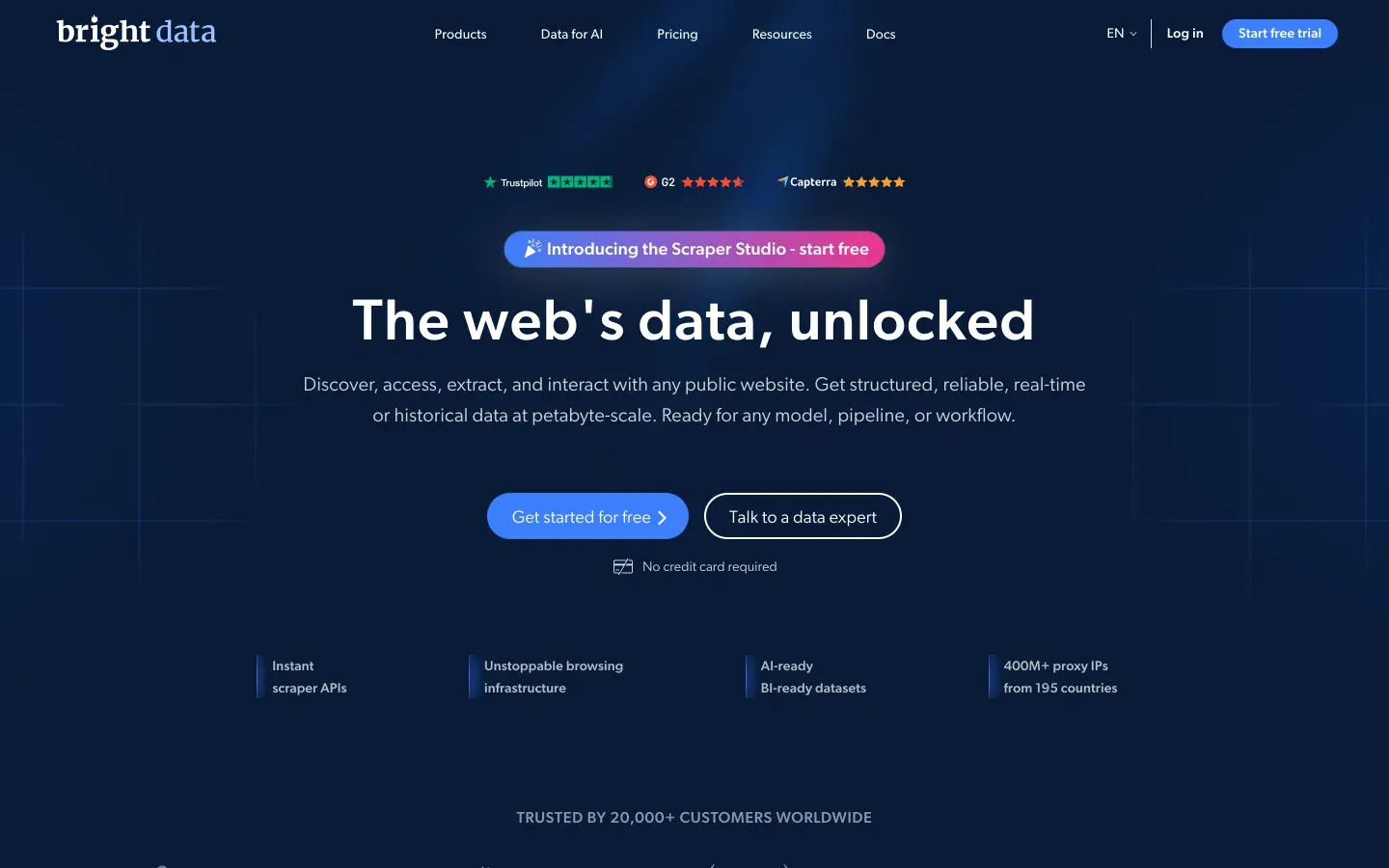
Bright Data is the largest (or among the largest) proxy networks in the market, claiming 400M+ residential IPs across 195 countries. It's been around long enough to build serious infrastructure and serious complexity.
Proxy types: residential, datacenter, ISP, mobile. Protocols: HTTP, HTTPS, SOCKS5. Beyond raw proxies, Bright Data offers Web Unlocker, Scraping Browser, SERP API, Web Scraper IDE, and ready-made datasets. It's less "proxy provider" and more "web data platform."
Strengths
- Deepest geo-targeting available: city, ZIP, carrier, ASN-level selection.
- Strong compliance and sourcing documentation — their Trust Center describes explicit opt-in via consent screen for residential/mobile IPs.
- 24/7 support and 99.95% claimed success rate for residential proxies.
- Full data platform beyond raw proxies: Web Unlocker, Scraping Browser, SERP API, datasets.
Drawbacks
- Expensive and complex for small teams. TechRadar notes entry-level plans around $499/month for some product lines.
- Mandatory KYC still gates raw proxy purchases — a new free tier (5,000 credits/month, no card required) covers the Unlocker, SERP, and Scraper APIs separately.
- Dashboard and pricing structure have a steep learning curve.
- Residential PAYG starts around $5.88/GB on the pricing page, though promotional rates can be lower.
Best for: Enterprise teams, compliance-conscious organizations, heavily protected targets, deep geo-targeting needs.
3. Oxylabs: Premium Proxies for Large-Scale Operations
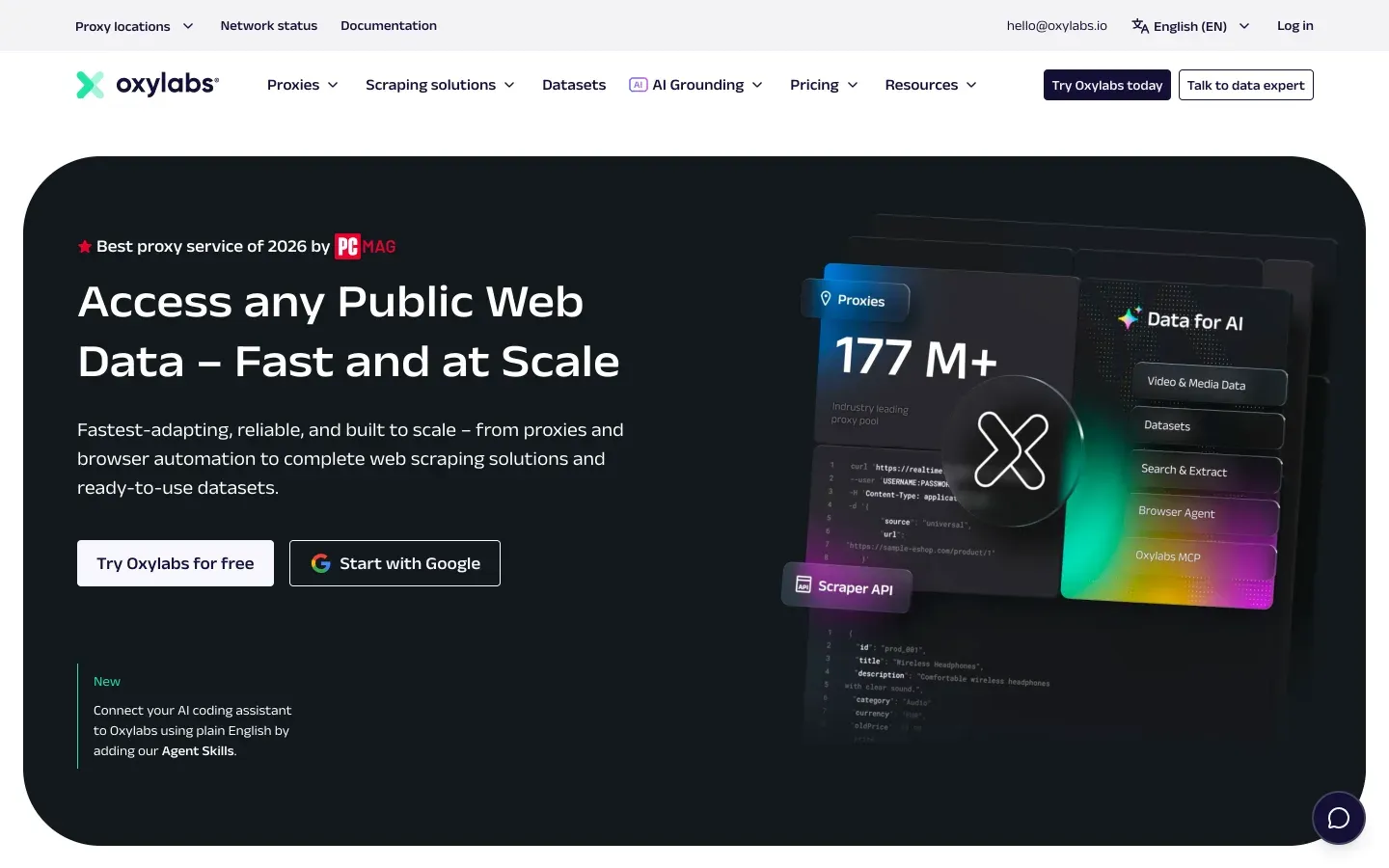
Oxylabs is Bright Data's closest enterprise competitor, with 175M+ residential IPs reported across 195 countries. The product line includes residential, datacenter, ISP, and mobile proxies, plus Web Unblocker and scraping APIs.
Strengths
- Large residential pool with generally high IP quality (low fraud scores per third-party testing).
- Granular geo-targeting down to ASN and ZIP code level.
- Strong developer tooling, SDKs, and API documentation.
- 7-day free trial for verified companies; 3-day trial for individual clients.
- HTTP(S) and SOCKS5 support.
Drawbacks
- Trial requires contact/verification — not instant self-service.
- Entry pricing around $5–6/GB for residential, which adds up fast at scale.
- Reddit users have reported ISP proxies being detected as datacenter/VPN by some checkers — anecdotal, but worth noting.
- Setup can be daunting for non-technical users.
Best for: Large-scale scraping operations, enterprise data extraction, teams that need dedicated account support.
4. Decodo (formerly Smartproxy): The Budget All-Rounder
Decodo rebranded from Smartproxy and positions itself as the affordable-yet-capable option. With 115M+ IPs across 195 locations, it covers residential, datacenter, ISP, and mobile proxy types.
Strengths
- True PAYG at $2/GB for residential (from $2.25/GB for mobile) with no subscription required.
- Decodo's free Web Scraping API plan gives new users 2,000 standard-proxy requests/month, recurring — low friction to start.
- Vendor-reported G2 rating of 4.6/5 and Trustpilot 4.2/5.
- Useful browser extension and no-code scraper tool included.
- HTTP(S) and SOCKS5 support.
Drawbacks
- The free plan's 2,000 requests/month drops to as low as 667 for premium+JS targets — check which request type you'll actually be testing.
- Enterprise residential rates can reach as low as $2.00/GB at large commitments (Decodo), but most users won't hit those volumes.
- KYC may be required for restricted-use targets.
Best for: Small/mid-sized scraping operations, teams that want a usable dashboard without enterprise complexity, mixed proxy needs on a budget.
5. SOAX: Granular Geo-Targeting with Protocol Breadth
SOAX claims 155M+ IPs across 195+ countries and differentiates on geo-targeting precision and protocol support. It's one of the few providers offering HTTP(S), SOCKS5, UDP, and QUIC — useful for specialized tooling.
Strengths
- Granular geo-targeting: country, region, city, ISP, carrier.
- Protocol breadth (UDP/QUIC) is rare among competitors.
- Proprietary infrastructure (not a reseller) — better session quality and sourcing transparency.
- Ethical sourcing claims with transparent opt-in for residential IPs.
- 99.9% network uptime claimed.
Drawbacks
- The free Sandbox plan is pay-per-GB only, at the steepest per-GB rate tier ($5.00 down to $2.00/GB by volume) — cheaper rates require a paid plan.
- Plan-based pricing above Sandbox; the cheapest paid tier (Builder) is $200/month + VAT.
- Budget teams can test for free on Sandbox, but scaling up means a straight jump to $200/month — no mid-tier PAYG option in between.
Best for: Geo-sensitive scraping, ad verification, localized market research, use cases requiring UDP/QUIC or precise location targeting.
6. IPRoyal: Pay-As-You-Go with Non-Expiring Traffic
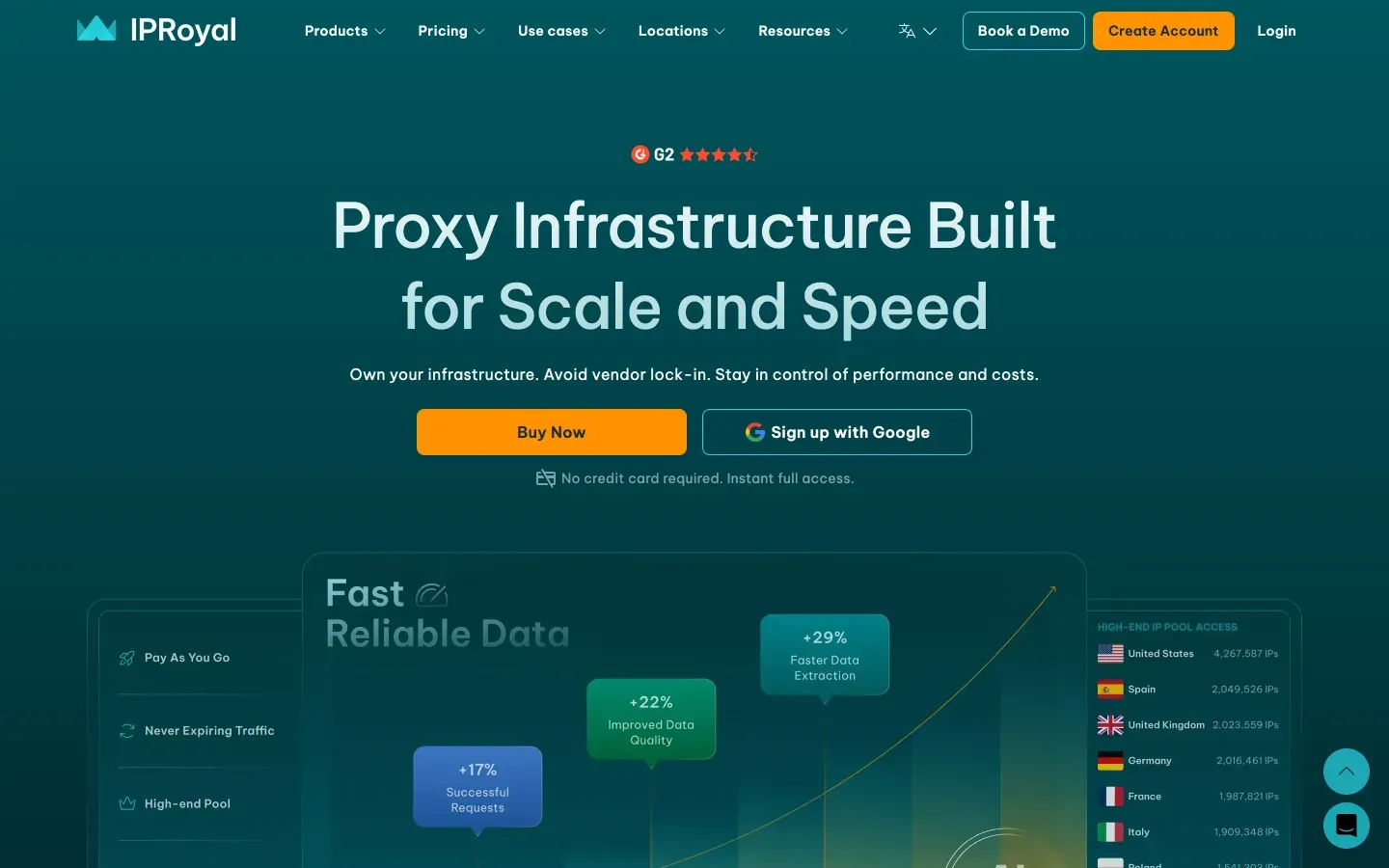
IPRoyal is the PAYG-friendly option with a unique selling point: purchased traffic never expires. If you buy 10 GB today and use 2 GB this month, the remaining 8 GB sits in your account until you need it. No monthly bandwidth burn.
Proxy types: residential, datacenter, ISP, mobile across 195+ countries. Protocols: HTTP(S), SOCKS5. Pool size: 64M+ residential IPs per current official claims.
Strengths
- True PAYG with no minimum spend and no KYC — ideal for freelancers and small operators.
- Non-expiring traffic is genuinely unique and suits project-based or occasional use.
- Discord community for peer support.
- Bulk pricing drops to $1.75/GB at high volumes.
Drawbacks
- No free trial at all.
- PAYG price is $7/GB — expensive compared to volume plans elsewhere.
- Forum reports suggest lower IG/FB login success rates (~45%) — not ideal for social media multi-accounting.
- Smaller IP pool than top-tier competitors limits rotation diversity.
Best for: Budget or occasional use, one-off projects, users who hate traffic expiry, sneaker bots and disposable workflows where IP burn rate is acceptable.
7. Webshare: The Budget Option with a Free Tier
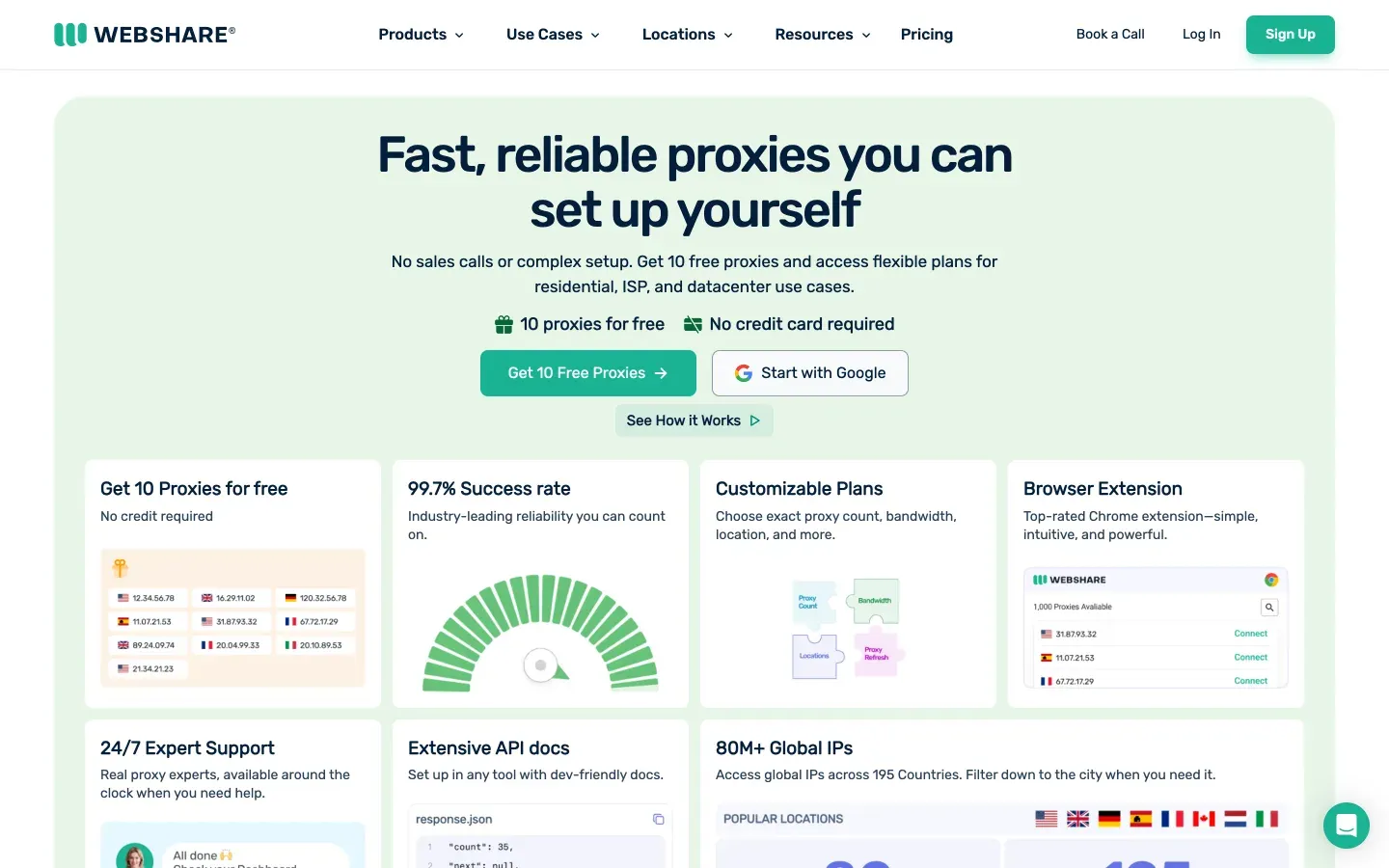
Webshare is the cheapest proxy provider on this list and one of the few offering a genuinely free plan. Rotating residential proxies range from $3.50/GB at the 1 GB tier down to $1.40/GB at the 3,000 GB tier, and the free plan includes 10 proxies for basic testing. TechRadar reports 80M+ static/rotating residential proxies across 195 countries, and notes that Webshare was acquired by Oxylabs in September 2022.
Proxy types: residential, datacenter (no mobile proxies). Protocols: HTTP, SOCKS5.
Strengths
- Cheapest option at virtually every tier.
- Free plan lets you test before committing any money — rare in this market.
- No KYC and no sales call required for standard plans.
- 30% discount for annual payments.
Drawbacks
- No mobile proxies.
- IPs are more likely to be flagged by aggressive anti-bot systems — lower quality than premium providers.
- Slow response times on popular/protected targets.
- City-level targeting is now available for rotating residential proxies.
- Email-only support.
- KYC may be required for certain restricted sites.
Best for: Budget testing, datacenter/static needs, hobby projects, low-protection sites, anyone who wants to try proxies before spending real money.
8. NodeMaven: Clean IPs for Multi-Account Management
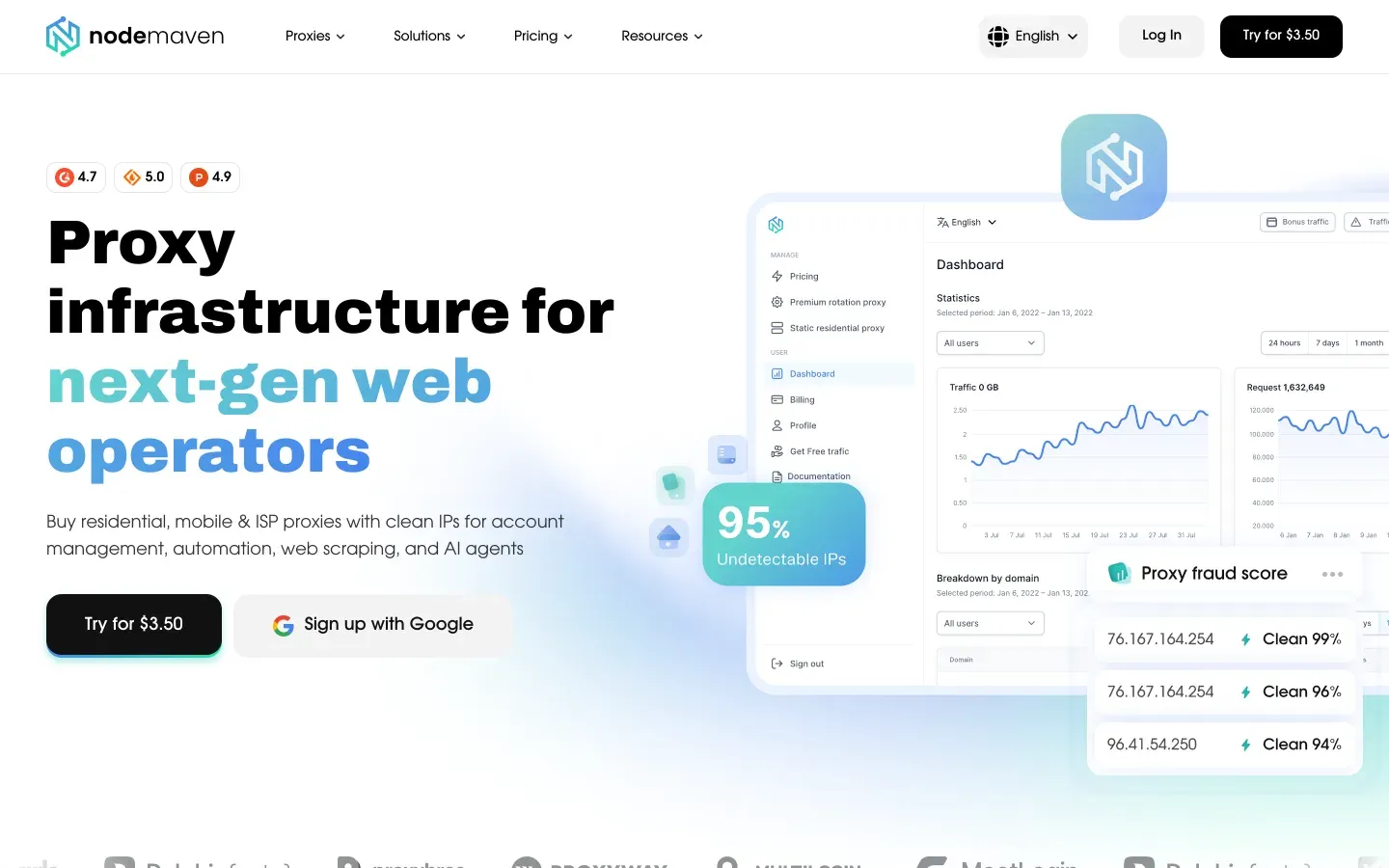
NodeMaven focuses on IP quality over pool size. With 30M+ residential IPs across 190+ countries, it's smaller than the enterprise players — but its proprietary IP Quality Filter claims 95% of addresses are clean (vendor-reported, validated via PixelScan-style detection tools).
Proxy types: residential and ISP (mobile IPs included in the unified pool). Protocols: HTTP(S), SOCKS5. Pricing: residential from $2.20/GB on monthly plans, PAYG available, and a $3.50 / 750 MB paid trial.
Strengths
- Forum users specifically praise NodeMaven for IG/TikTok/FB account survival rates — this is its niche.
- Sticky sessions up to 24 hours, useful for social media and ad account workflows.
- ZIP-level geo-targeting.
- Financial compensation guarantee for proxy failures.
- Traffic rollover and cashback systems.
- PAYG with no KYC.
Drawbacks
- Smaller IP pool than enterprise providers — limits rotation diversity for high-volume scraping.
- Paid trial only (no free option).
- Fewer scraping-specific tools compared to Bright Data or Oxylabs.
- The 95% clean IP claim and 99.54% success rate are vendor-reported — treat accordingly.
Best for: Multi-account management (social media, ad accounts), anti-detect browser setups, any workflow where IP cleanliness matters more than pool size.
9. Rayobyte: Ethical Sourcing with a Compliance Focus
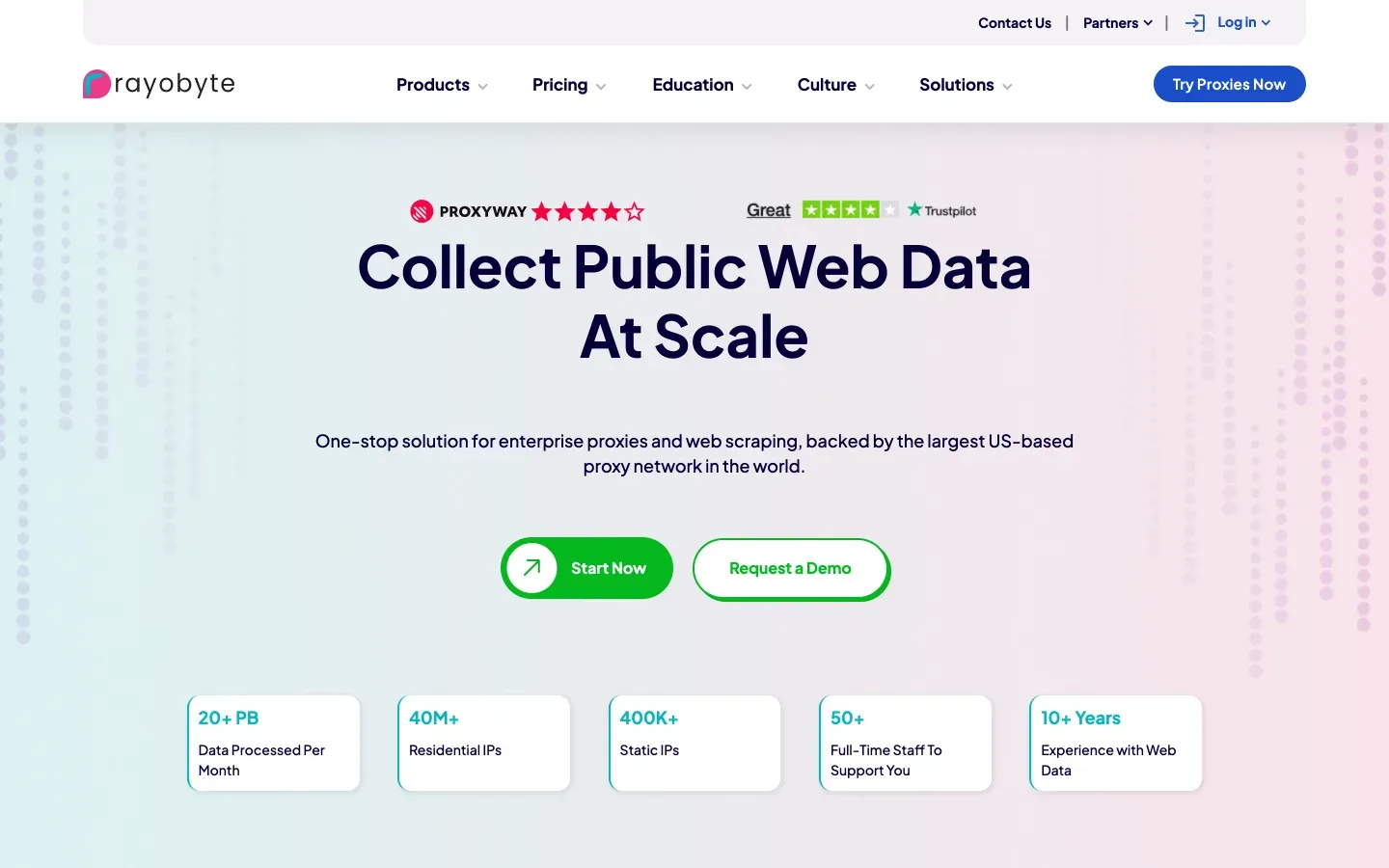
Rayobyte is the provider you pick when your compliance team asks "where do these IPs come from?" It claims 40M+ ethically sourced residential IPs with full end-user consent, and it's one of the few providers that publicly documents its sourcing process.
Proxy types: residential, datacenter, ISP. Protocols: HTTP(S), SOCKS5. Pricing: residential PAYG from $3.50/GB at the 1-49GB tier, scaling down to $0.50/GB at 5TB+, with unused bandwidth that never expires.
Strengths
- Strongest ethical sourcing narrative on this list — publicly documents how IPs are obtained and emphasizes end-user consent.
- Good option for compliance-conscious agencies and teams.
- Competitive PAYG pricing.
- Non-expiring bandwidth (similar to IPRoyal).
Drawbacks
- Smaller IP pool limits geo-coverage and rotation diversity.
- No mobile proxies highlighted in current product pages.
- Fewer advanced tools and integrations than Bright Data or Oxylabs.
- Less well-known — limited G2 reviews and public benchmarks.
- Pricing is tiered by volume — $3.50/GB at the 1-49GB entry tier down to $0.50/GB at 5TB+ — not a single flat rate, so confirm which tier applies before committing.
Best for: Compliance-conscious teams, agencies that need to audit their proxy supply chain, ethically sourced residential proxy needs.
All 9 Proxy Providers at a Glance
| Provider | Proxy Types | Starting $/GB (Resi) | Min. Spend | Sticky Sessions | SOCKS5 | Free Trial | KYC Required | IP Pool Size | Best For |
|---|---|---|---|---|---|---|---|---|---|
| Thunderbit | N/A (built-in cloud infra) | Credit-based (20 credits/extract) | Free tier available | N/A | N/A | ✅ | No | N/A | Structured web extraction |
| Bright Data | Resi, DC, ISP, Mobile | ~$5.88/GB | $500+ (some plans) | ✅ | ✅ | ✅ (API products only) | Yes | 400M+ claimed | Enterprise, hard targets |
| Oxylabs | Resi, DC, ISP, Mobile | ~$5–6/GB | $49+ | ✅ | ✅ | ✅ 7-day | Yes | 175M+ reported | Large-scale scraping |
| Decodo | Resi, DC, ISP, Mobile | ~$4/GB PAYG | PAYG option | ✅ | ✅ | ✅ (2K req/mo free) | Light | 125M+ reported | Budget all-rounder |
| SOAX | Resi, DC, ISP, Mobile | $2.00–$5.00/GB (free Sandbox tier) | $200+/mo (cheapest paid plan) | ✅ | ✅ | ✅ Sandbox (free) | Light | 155M+ claimed | Geo-targeting |
| IPRoyal | Resi, DC, ISP, Mobile | ~$7/GB PAYG | PAYG (no min) | ✅ | ✅ | ❌ | No | 32M+ reported | Occasional/PAYG |
| Webshare | Resi, DC | ~$1.40/GB | Free tier | ✅ | ✅ | ✅ (10 free proxies) | No | 80M+ reported | Budget/free testing |
| NodeMaven | Resi, ISP | ~$2.20/GB | PAYG | ✅ | ✅ | $3.50 trial | No | 30M+ claimed | Multi-accounting |
| Rayobyte | Resi, DC, ISP | ~$3.50/GB PAYG | $50+ (est.) | ✅ | ✅ | ✅ | Light | 40M+ claimed | Ethical sourcing |
NetNut was previously included here. Its domains were seized by the FBI in July 2026 and the service is no longer available.
Note: Thunderbit's row says "N/A" for proxy-specific features because it's not a proxy provider — it's an AI scraping API that handles IP rotation, anti-bot, and rendering internally. IP pool sizes and pricing signals are from official pages and third-party reviews; verify current rates before purchasing.
Which Proxy Provider Fits Your Use Case?
Most proxy listicles stop at generic rankings. Below is a decision matrix mapped to actual workflows.
| Your Primary Use Case | Best Approach | Top Pick(s) | Why |
|---|---|---|---|
| Web scraping at scale (e-commerce, SERP, leads) | API abstraction first; raw proxies only if you need exit IP control | Thunderbit, Bright Data, Oxylabs | Thunderbit's POST /extract handles JS/anti-bot/rotation internally — no proxy config. For raw proxy needs: Bright Data and Oxylabs have the largest pools. |
| Multi-account management (IG, TikTok, FB) | Static ISP or sticky residential | NodeMaven, Oxylabs | Forum users praise NodeMaven for social account survival rates; sticky sessions up to 24 hours are useful here. |
| Ad account warmup | Static ISP | NodeMaven, Decodo | Long-lived, clean IPs needed — ISP proxies from these providers rated positively in discussions. |
| Price monitoring / dropshipping | Scheduled scraping API or affordable residential | Thunderbit, Decodo, SOAX | Thunderbit's API + scheduling eliminates proxy setup for monitoring workflows. |
| Budget or one-time use | PAYG / free tier | IPRoyal, Webshare | Non-expiring traffic (IPRoyal) or free proxies (Webshare) suit disposable use where IP burn rate is acceptable. |
| Compliance-conscious proxy buying | Transparent sourcing | Bright Data, Rayobyte, Oxylabs, SOAX | Public sourcing/compliance materials available for audit. |
Web Scraping at Scale
If your goal is structured data — product prices, SERP results, lead contact info — start with Thunderbit's API. One POST /extract call with a JSON Schema returns structured data without touching proxy config, rotation logic, or HTML parsing. For teams that need raw proxy bandwidth (custom browser automation, exact exit IP control), Bright Data and Oxylabs have the deepest pools and most mature infrastructure.
Multi-Account Management
This is where proxy quality matters most. NodeMaven's clean-IP filter and 7-day sticky sessions are specifically built for social media account survival. Oxylabs' ISP proxies are another strong option. IPRoyal's forum-reported ~45% IG/FB login success rate makes it a weaker choice here.
Price Monitoring and Dropshipping
If you're monitoring prices on e-commerce sites, you need structured data on a schedule — not raw proxy bandwidth. Thunderbit's API handles the extraction and anti-bot layers. For teams that prefer traditional proxies, Decodo and SOAX offer good cost-to-quality ratios at moderate volumes.
Real-World Pricing: What You Actually Pay at 1 GB, 10 GB, and 100 GB
Most listicles quote a single $/GB number. Residential proxy costs at three realistic volume tiers, based on current public pricing signals:
| Provider | ~1 GB Cost | ~10 GB Cost | ~100 GB Cost | Notes |
|---|---|---|---|---|
| Bright Data | ~$5.88 | ~$58.80 (or plan-based) | Negotiated / enterprise tier | $500+ minimum on some plans; KYC required for proxies (a free tier now covers the API products separately) |
| Oxylabs | ~$5–6 | ~$50–60 (plan tier) | Lower at volume; contact sales | 7-day trial for companies; 3-day for individuals |
| Decodo | ~$4 (PAYG) | ~$40 (PAYG) or lower on plan | Enterprise rates as low as $1.50/GB | Free plan: 2,000 requests/month (recurring, not proxy bandwidth) |
| SOAX | ~$5.00 (Sandbox Tier1, PAYG) | Tier-based, breakpoints not published | Volume discounts down to $0.35/GB (Enterprise) | Free Sandbox plan (pay-per-GB); paid plans from $200/mo |
| IPRoyal | ~$7 (PAYG) | ~$70 (PAYG) or lower bulk | Down to $1.75/GB at high volume | Traffic never expires; no free trial |
| Webshare | ~$1.40 | ~$14 | Lower at scale | 10 free proxies; cheapest option |
| NodeMaven | ~$2.20 (monthly) | ~$22 (monthly) | Lower at volume | $3.50 / 750 MB paid trial |
| Rayobyte | ~$3.50 (PAYG, 1-49GB tier) | ~$35.00 (PAYG, still in 1-49GB tier) | Tier above 49GB not published — drops to $0.50/GB at 5TB+ | Unused bandwidth never expires |
Hidden Costs and Gotchas to Watch For
- Mandatory sales calls / KYC as a time cost. Bright Data and Oxylabs require verification before you can test. If you're a freelancer who wants to try 1 GB this afternoon, that's a blocker.
- Bandwidth minimums that force over-buying. A $500 minimum at $5/GB means you're committing to 100 GB whether you need it or not.
- Traffic expiry. Some providers expire unused bandwidth at the end of the billing cycle. IPRoyal and Rayobyte are notable exceptions with non-expiring traffic.
- Trial-to-paid quality drop. Forum users report a pattern where trial pools are higher quality than paid pools. I didn't find provider-specific proof, but it's a recurring theme in Reddit discussions. Advice: run a small paid test on your actual target sites before committing to an annual plan.
Ethical IP Sourcing: How Transparent Is Your Proxy Provider?
After the 911 S5 botnet takedown — which the FBI described as one of the largest residential proxy botnets, involving over 19 million compromised IP addresses in 190+ countries — ethical sourcing isn't a nice-to-have. It's a business risk.
If your proxy traffic routes through compromised devices, you're potentially complicit in a supply chain that harms real people. One forum user put it well: "I'd rather pay a bit more than route client work through someone else's compromised router."
Transparency checklist, applied to each provider:
| Provider | Public Sourcing Disclosure | Opt-In Consent Mechanism | Known Compliance Incidents | Enterprise Compliance Docs |
|---|---|---|---|---|
| Thunderbit | N/A — uses own cloud infra, not residential IPs | N/A | None | N/A |
| Bright Data | ✅ Strong — Trust Center with detailed sourcing docs | ✅ Explicit opt-in via consent screen | None public | ✅ |
| Oxylabs | ✅ Publishes acquisition best-practice materials | ✅ Advocates transparent acquisition | None public | ✅ |
| Decodo | Partial — claims ethical sourcing; details less prominent | Needs verification | None public | Partial |
| SOAX | ✅ Claims ethically sourced with opt-in | ✅ Per official pages | None public | Partial |
| IPRoyal | Partial — says IPs from real ISPs | Needs detailed confirmation | None public | Limited |
| Webshare | Partial — reported as consenting users; source no longer available | Needs verification | None public | Limited |
| NodeMaven | Clean-IP filter focus, not sourcing-first | Needs sourcing detail check | None public | Limited |
| Rayobyte | ✅ Strong — publicly documents sourcing, full end-user consent | ✅ Explicit | None public | ✅ |
Bright Data, Rayobyte, and Oxylabs provide the most public documentation on IP sourcing. SOAX makes clear claims. The rest require more digging. And Thunderbit sidesteps the issue entirely — its cloud infrastructure uses its own servers, not residential IPs from third-party devices.
Picking the Right Proxy Provider (or Skipping One Entirely)
There is no universal "best proxy provider." The right choice depends on your use case, volume, budget, and compliance requirements. Quick summary:
- Need structured web data? Try Thunderbit's free tier before buying proxy bandwidth. One API call may replace your entire proxy + scraper stack.
- Enterprise scraping with exact IP control? Bright Data or Oxylabs.
- Budget all-rounder? Decodo.
- Social media multi-accounting? NodeMaven.
- Occasional or one-time use? IPRoyal (non-expiring traffic) or Webshare (free tier).
- Compliance-first? Bright Data or Rayobyte.
- Geo-targeting precision? SOAX.
If you want to see what scraping without proxies looks like, give Thunderbit a spin — the free tier doesn't require a credit card or a sales call. And if you do need a proxy provider, use the decision matrix and pricing tables above to find the one that matches your actual workflow, not the one that paid the most for its ranking.
We've written deeper guides on web scraping without coding, AI web scraping, and the best AI web scrapers on the Thunderbit blog. Our YouTube channel has walkthrough videos if you'd rather watch than read.
Learn AI web scraping with Thunderbit Get Started Free
Try Thunderbit AI Web Scraper for Free Get Started Free
FAQs
1. Why are most "Top 10 Proxy Provider" lists unreliable?
Many proxy roundups are written by proxy vendors ranking themselves first, or by affiliate publishers earning commissions from the providers they recommend. The structural conflict means rankings often reflect business relationships rather than genuine testing. Watch for red flags: undisclosed methodology, single $/GB numbers without volume context, and no mention of ethical sourcing or trial quality.
2. Can I scrape websites without buying a proxy provider?
Yes. AI scraping APIs like Thunderbit handle IP rotation, anti-bot systems, JS rendering, and CAPTCHAs internally. You send one API call with a JSON Schema and get structured data back — no proxy config, no rotation logic, no HTML parsing. This approach works well for e-commerce data, SERP results, and lead generation. You still need standalone proxies for non-scraping use cases like social media multi-accounting or ad account warmup.
3. How much do proxy providers actually cost at realistic volumes?
Residential proxy prices range from about $1.40/GB (Webshare) to $7/GB (IPRoyal PAYG), with volume discounts dropping enterprise rates below $1/GB. But the headline $/GB number is misleading — factor in minimum spend requirements ($500+ for Bright Data), traffic expiry policies, KYC delays, and whether the trial pool matches paid-pool quality. Always calculate your cost at the volume you'll actually use.
4. What is the difference between residential, datacenter, and ISP proxies?
Residential proxies route traffic through real consumer IP addresses and are hardest for anti-bot systems to detect. Datacenter proxies use IPs from cloud/server providers — faster and cheaper, but easier to flag. ISP proxies combine the best of both: they're hosted in data centers but registered with ISPs, offering speed and stability with lower detection rates. Choose based on your target's anti-bot aggressiveness and your session requirements.
5. How do I know if a proxy provider sources IPs ethically?
Check whether the provider publicly discloses how residential IPs are obtained, whether there's an explicit opt-in consent mechanism for IP donors, and whether the provider has faced any legal or compliance incidents. Bright Data, Rayobyte, and Oxylabs provide the most transparent documentation. After the 911 S5 botnet takedown — which involved 19 million compromised IPs — ethical sourcing is a genuine business risk, not just a marketing checkbox.
Learn More




