Last reviewed and updated in August 2026.
8 Free-Start AI Web Scraping Tools for Current Workflows
“Free AI web scraper” can mean three different things: a product with a free starter plan, a limited trial, or open-source software that is free to use but still needs engineering time and infrastructure. Those are useful entry points, but they are not interchangeable.
This guide compares eight current options by workflow. It avoids fixed credit allowances, prices, ratings, and performance claims because those change often. Confirm current plan limits, permitted use, and export or API availability on each official product page before committing a workflow.
Pick the Right Free-Start Path
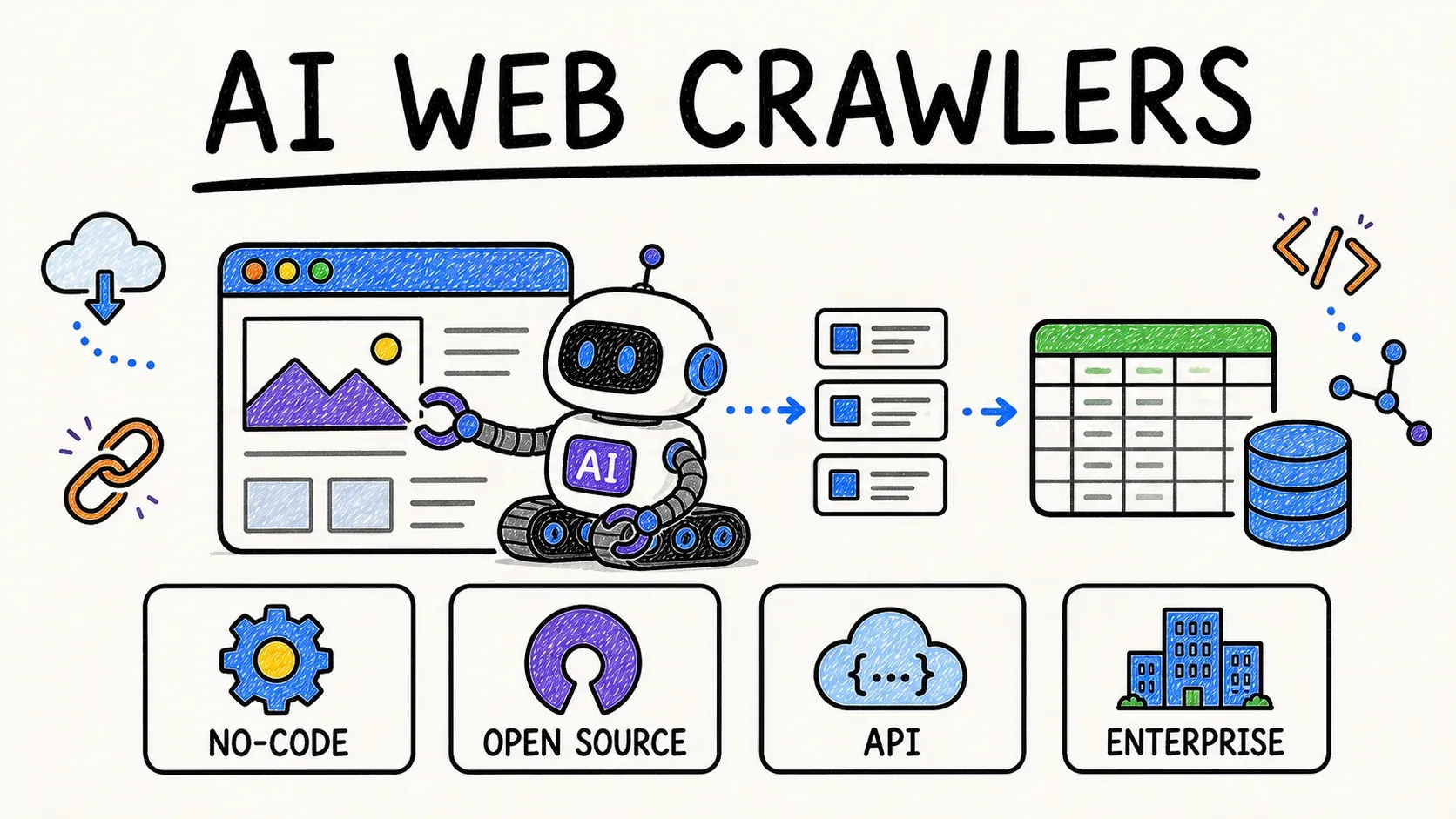
- Fast browser-to-table work: Start with a no-code AI or browser tool when a business user needs to turn approved visible page content into rows.
- Visual extraction projects: Choose a visual builder when somebody will configure, test, and maintain page interactions, pagination, and detail pages.
- Reusable browser rules: Use a recipe-oriented extension for common tables and repeatable page patterns.
- Code or cloud automation: Use an open-source framework or cloud platform when engineers need custom logic, scheduling, APIs, or stored datasets.
- Content for an application or agent: Use an API-first product when the output needs to enter a codebase, knowledge workflow, or AI system.
1. Thunderbit: Agentic Browser-First Extraction
Thunderbit is an agentic web scraper—an AI agent for web scraping—for turning authorized browser-visible content into structured rows. It suits sales, operations, ecommerce, research, and real-estate workflows where a usable table is the practical outcome.
The browser workflow is direct: AI Suggest Fields proposes columns, you review or adjust them, then one click on Scrape starts extraction. Results can be exported to Excel, Google Sheets, Airtable, and Notion.
For technical workflows, Thunderbit also supports a Web Scraper API, MCP, and CLI.
Free-start fit: Business users who want to test AI-assisted extraction in a browser before designing a larger process.
Try Thunderbit for AI Web Scraping
2. Browse AI: No-Code Robots and Monitoring
Browse AI lets users train no-code robots to extract structured data, run workflows, and monitor website changes. Its current product materials describe a free plan, page-to-table extraction, scheduling, and integrations including API, webhooks, and common business tools.
Free-start fit: Teams that want to test a no-code robot and then keep a small set of pages or workflows monitored.
3. ParseHub: Desktop Visual Extraction
ParseHub is a desktop-oriented visual scraper. Its product page describes point-and-click selection, interaction with dynamic page elements, cloud collection, scheduled runs, API access, and JSON or Excel output.
Free-start fit: Users who prefer a visual project for multi-page or interactive sites and are comfortable defining the extraction themselves.
4. Octoparse: Visual Tasks and Cloud Runs
Octoparse supports no-code scraping tasks that can be configured, tested, and run in the cloud. Its current documentation also includes an MCP server for compatible AI clients, with template search, cloud-task control, and data export.
Free-start fit: A team that wants to try visual task design and later connect recurring extraction tasks to a technical or agent workflow.
5. Data Miner: Browser Recipes and Custom Rules
Data Miner is a Chrome and Edge extension for extracting page data into CSV or Excel. The current product page describes a large library of reusable extraction rules, user-created custom rules, and both single-page and multi-page collection.
Free-start fit: Browser-based table, list, or contact-data work where an existing recipe or a custom rule is more suitable than an AI-generated schema.
6. Scrapy: Open-Source, Code-First Crawling
Scrapy is an open-source Python framework for crawling websites and extracting structured data. Its documentation covers spiders, CSS and XPath selectors, requests and responses, throttling, pipelines, and exports.
Free-start fit: Developers who need to own crawler logic and are prepared to maintain code, infrastructure, target-specific behavior, and compliance controls.
7. Apify: Cloud Actors and Datasets
Apify is a cloud platform built around Actors—programs with defined inputs, outputs, and storage. Its datasets support results from scraping, crawling, and data-processing jobs, with exports in several formats and API access.
Free-start fit: Technical teams that want to try an existing cloud component or develop a reusable program with stored results and scheduling.
8. Firecrawl: Content and Structured-Extraction API
Firecrawl is an API-first web-data product for content and structured extraction. Its scrape workflow supports web content outputs and schema- or prompt-guided structured results, making it useful inside an application or an agent-oriented pipeline.
Free-start fit: Developers validating an API path for clean web content, structured records, or knowledge-workflow inputs.
Quick Comparison
| Tool | Operating model | Free-start path | Strongest fit |
|---|---|---|---|
| Thunderbit | Browser-first AI extraction; API, MCP, CLI | Product starter access | Turn visible page data into structured tables |
| Browse AI | No-code robots and monitoring | Free plan | Train a robot and monitor recurring web data |
| ParseHub | Desktop visual projects | Free plan | Configure visual multi-page extraction projects |
| Octoparse | Visual tasks and cloud execution | Product starter access | Build and run recurring no-code tasks |
| Data Miner | Browser recipes and custom rules | Extension starter access | Extract common tables with reusable rules |
| Scrapy | Open-source Python framework | Open source | Own a code-first crawling and extraction stack |
| Apify | Cloud Actors and datasets | Platform starter access | Run reusable cloud programs and store results |
| Firecrawl | Content and extraction API | API starter access | Feed web content or structured data into software |
What “Free” Should—and Should Not—Decide
Use free access to verify the workflow, not to infer a long-term cost or capability guarantee. Check whether the plan covers the type of page, the expected run frequency, exports, API access, subpages, scheduling, and collaboration needs. For open-source tools, factor in engineering time, hosting, monitoring, and maintenance.
For business users, start with a browser-first or visual workflow. For developers, decide whether control belongs in a maintained framework, a cloud program, or an API. In every case, review results before using them downstream and collect only data you are authorized to access.
FAQs
Are free AI web scraping tools really free?
Some have a continuing free plan; some offer trials or starter access; open-source frameworks do not charge a license fee but still require engineering and infrastructure. Plan limits change, so validate them from the current official source before relying on them.
Which free-start tool is best for nontechnical users?
Thunderbit, Browse AI, ParseHub, Octoparse, and Data Miner all provide a no-code or visual path. Choose based on whether you want AI field suggestions, a trainable robot, a desktop project, a cloud task, or a browser recipe.
When should I use Scrapy, Apify, or Firecrawl instead?
Use Scrapy for code-level ownership of crawling logic; Apify for reusable cloud programs and stored datasets; and Firecrawl when an application or agent needs API-delivered content or structured output. These options usually require more technical design than a browser-first tool.
Start with Thunderbit AI Web Scraping Get Started Free