
I've been in enough eng-team Slack threads to know how this question usually starts: someone drops a link to a "best web scraper" listicle, and three engineers immediately reply "none of these mention Colly." That's not an accident. I looked at the four articles currently ranking for "Thunderbit vs Colly" and every single one compares Thunderbit against other no-code tools — Crawl4AI, Browse AI, rtrvr.ai, Chat4Data. Colly doesn't show up once.
Which is a little wild, because Colly has a real, loyal following on r/golang and in Go shops that need fast, code-owned crawlers. So this is the article that actually answers the question — not a rebadged "AI tools comparison" with Colly's name pasted on top.
Quick Answer
Here's the short version if you're skimming between meetings: Thunderbit is a managed, agentic web scraper you click and go — no selectors, no code, browser or cloud execution, plus a Web App, Open API, MCP Server, and CLI for when developers want programmatic access. Colly is an open-source Go framework — you write the crawler, you own the logic, you tune the concurrency.
These aren't really competitors in the classic sense. One is a product. One is a library. Comparing them head-to-head only makes sense if you're standing at a fork in the road wondering which path fits your actual situation — and that's exactly what I want to help you figure out.
At a Glance
| Dimension | Thunderbit | Colly |
|---|---|---|
| Main user | Business users, ops teams, developers wanting speed | Go developers |
| Setup | Click One Click Extract on a page | go get github.com/gocolly/colly + write Go code |
| Time to first result | Seconds to minutes, agent auto-runs | Depends on how fast you write callbacks |
| Language | None required for browser use | Go |
| Crawling model | Agentic page analysis, compatible pagination/subpages | Manual Collector + OnHTML/OnResponse callbacks |
| Rendering | Managed browser/cloud execution paths | Primarily HTTP/HTML; JS-heavy sites need extra tooling |
| Extraction rules | Agent proposes fields, user can refine | Developer writes CSS selectors by hand |
| Concurrency | Managed by the platform | Full manual control via goroutines |
| Storage/exports | Exports to spreadsheets, sheets, and other supported destinations | Developer-built (files, databases, Redis, etc.) |
| Deployment | Browser extension, Web App, API, MCP, CLI | Self-hosted Go binary/script |
| Maintenance | Managed extraction logic; still depends on site compatibility | Developer patches selectors when sites change |
| License/cost | Credit-based plans (verify current tiers on pricing) | Apache-2.0, free — but infra/dev time isn't |
What Is Thunderbit?
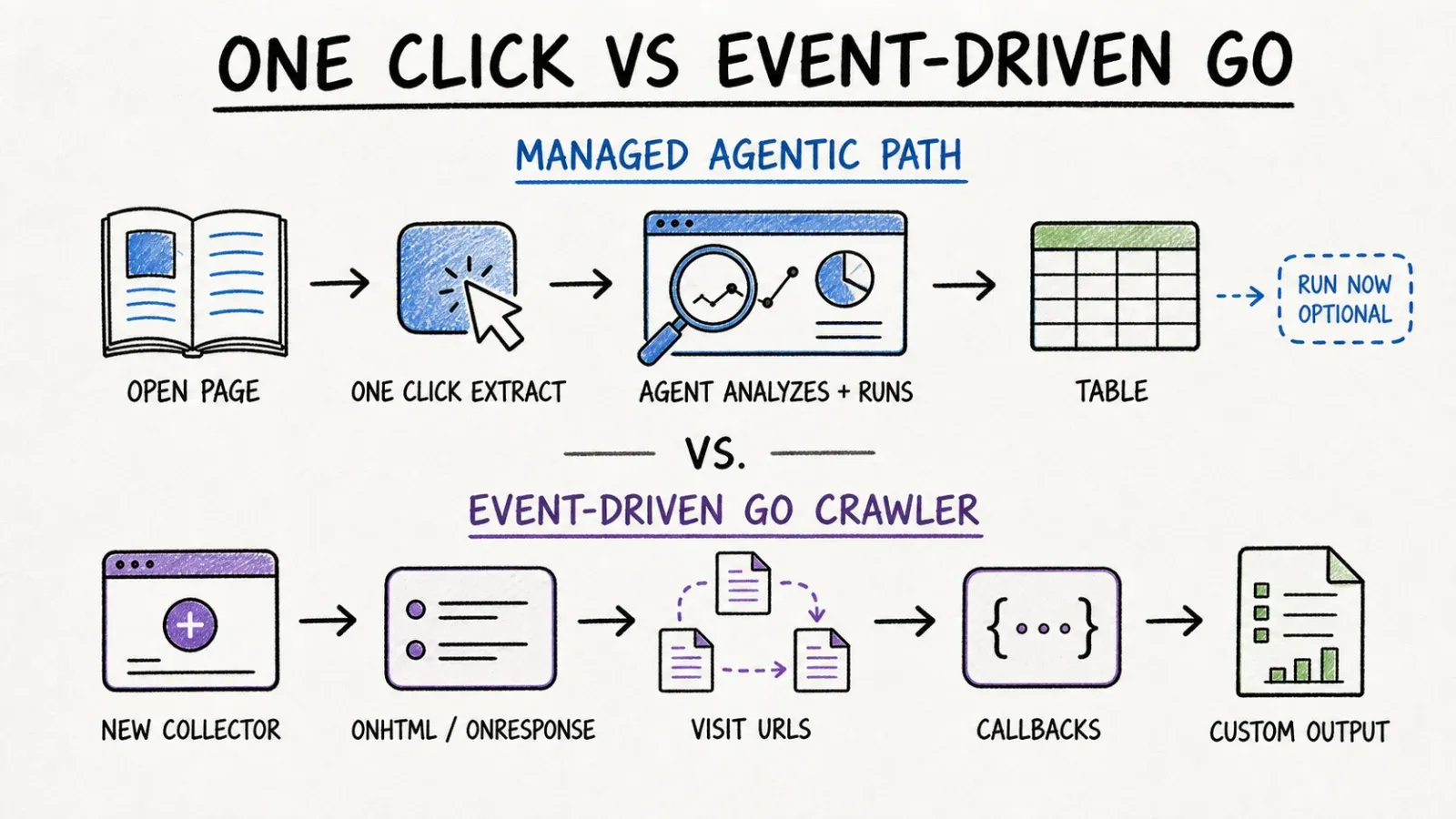
Thunderbit's default workflow is genuinely one click. You open a page you're authorized to access, hit One Click Extract, and the agent reads the page, figures out what's worth pulling, and proposes the fields. There's a Run Now button, but honestly it's mostly there for peace of mind — if you don't touch anything, extraction starts on its own. No selector-writing, no schema setup, on pages the agent supports.
From there you can refine fields if the agent didn't nail it, and on compatible sites it'll walk through pagination or dig into subpages for enrichment — think grabbing extra detail from each product page in a list. Once you've got your data, it exports to the usual suspects: Excel, Google Sheets, and a few other supported destinations.

But the browser extension is just the front door. If you're a developer, there's the Open API for triggering extraction from your own code, the MCP Server for plugging extraction into Claude, Cursor, or Windsurf as a callable tool, and the CLI for terminal and coding-agent workflows. I mention this because a lot of "no-code vs code" framing treats Thunderbit as strictly a business-user toy, and that's just not accurate anymore.
What Is Colly?
Colly is a Go library — full stop. There's no dashboard, no hosted service, no AI layer deciding what to scrape. You write Go, you get a Collector, and you attach callbacks like OnHTML and OnResponse to tell it exactly what to do when it hits a page.
Here's roughly what that looks like:
c := colly.NewCollector()

c.OnHTML("a[href]", func(e *colly.HTMLElement) {
    link := e.Attr("href")
    c.Visit(e.Request.AbsoluteURL(link))
})

c.OnResponse(func(r *colly.Response) {
    fmt.Println("Visited", r.Request.URL)
})

c.Visit("https://example.com")
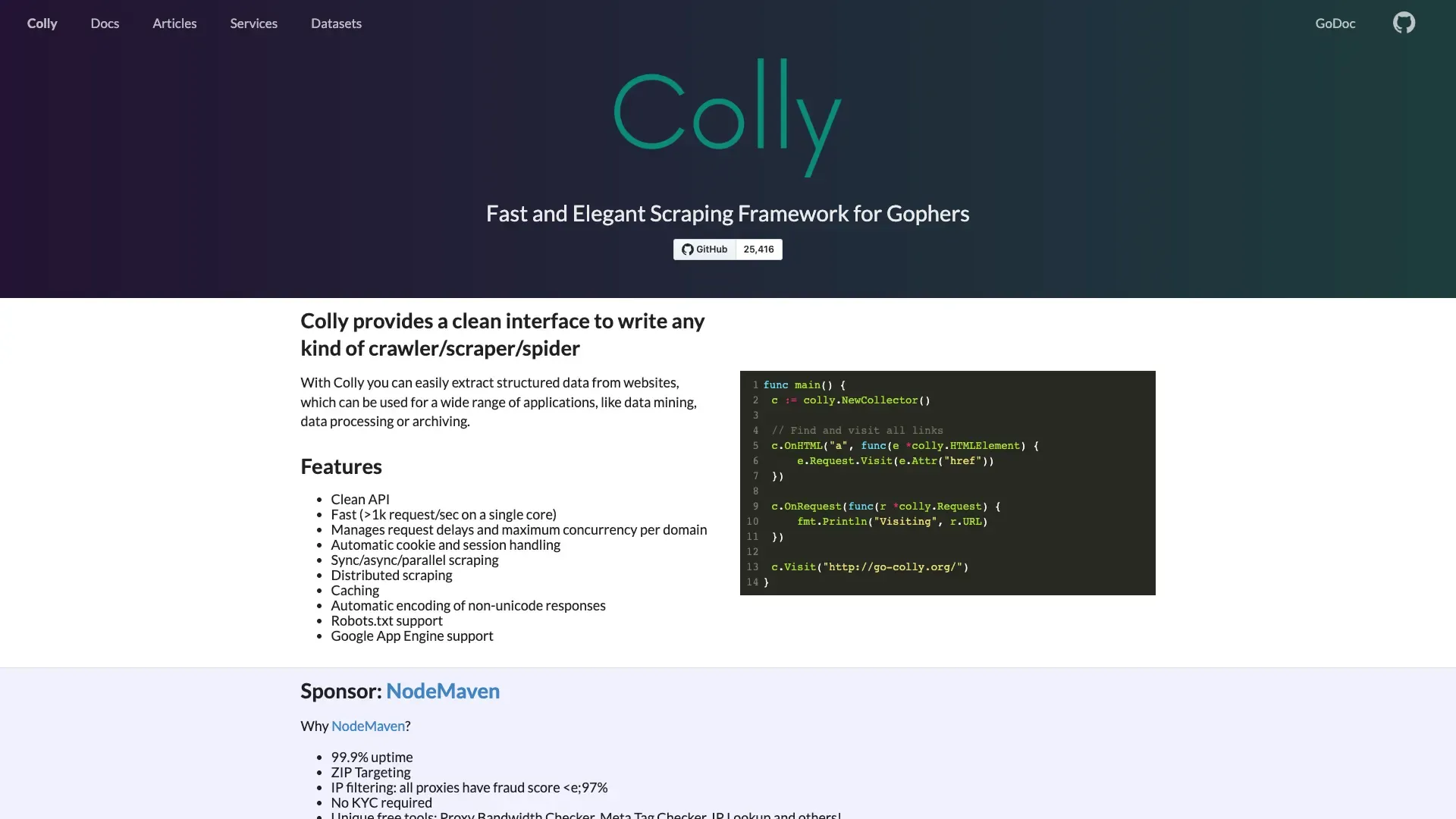
That's the whole mental model: define what to look for, define what to do when you find it, let the collector crawl. Under the hood you get synchronous, asynchronous, and parallel crawling, per-domain rate limiting, automatic cookie/session handling, request caching, robots.txt respect, proxy rotation, and pluggable storage backends including Redis for distributed setups.
One thing worth being upfront about: Colly is primarily an HTTP/HTML framework. It doesn't run a full browser like Playwright would. If your target site leans heavily on JavaScript rendering, you're either hunting for the underlying JSON API it calls, or pairing Colly with a separate browser automation tool. That's not a knock on Colly — it's just a different design philosophy than a fully agentic, browser-aware product.
Core Difference: Managed Agentic Extraction vs Go Code Framework
Time to first table
This is where the gap is starkest. With Thunderbit, "time to first result" is measured in the time it takes to click a button and wait for the agent to finish reading the page — seconds to a couple of minutes depending on page complexity. With Colly, "time to first result" includes writing the collector, figuring out the right selectors (which usually means some trial and error in dev tools), handling pagination logic yourself, and running the thing. For a one-off task, that's a real time cost even for a competent Go developer.
Performance and control
Colly wins on raw control, no argument. Because you're writing the logic, you decide exactly how many goroutines run concurrently, how aggressive your rate limiting is, what gets cached, and how errors get retried. The project's own docs cite over 1,000 requests per second on a single core for suitable static targets — that's a Colly benchmark claim, not a controlled comparison against Thunderbit, and I'm not going to pretend otherwise. But it does tell you something real: for HTTP-friendly targets, hand-tuned Go concurrency is going to be hard to beat.
Thunderbit trades that granular control for managed execution. You're not tuning goroutine pools — you're relying on the platform's browser and cloud execution paths, plus scheduled extraction where your plan supports it. That's the right tradeoff if you don't want to own infrastructure decisions, and the wrong one if your job literally is to squeeze maximum throughput out of a crawler.
Deployment and maintenance ownership
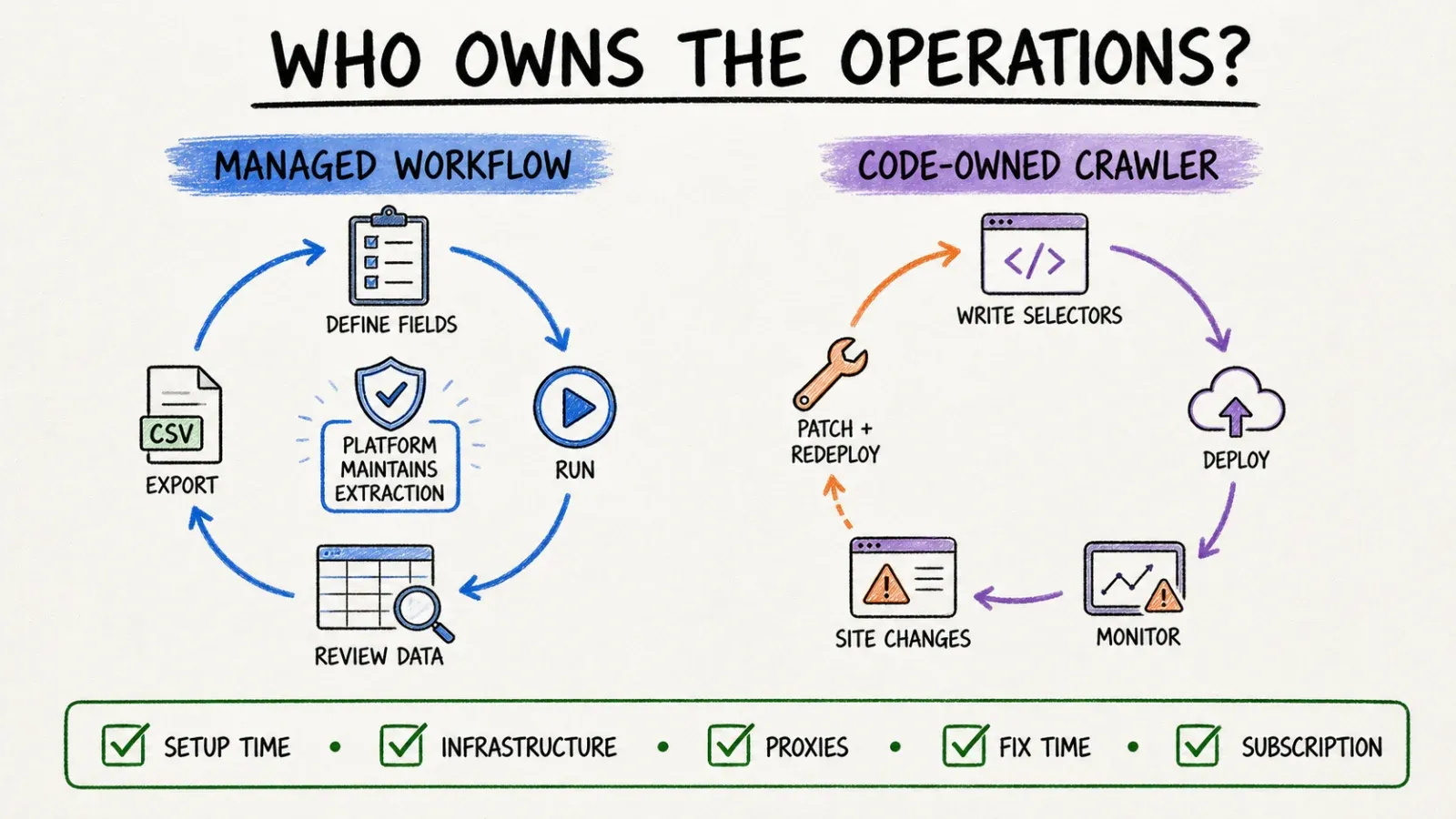
Here's the part that doesn't get talked about enough. Colly is "free" in the sense that the Apache-2.0 license costs nothing. But someone still has to write it, host it, monitor it, and — this is the big one — fix it when the target site changes its HTML. Selectors break silently. Nobody gets an alert saying "hey, this site redesigned their product page." A developer has to notice the pipeline went quiet or started returning garbage, then go patch it.
With Thunderbit, the extraction logic is managed by the platform, and its agentic page analysis is designed to adapt to layout variation on supported, authorized pages. I want to be careful here though — that's not a blanket guarantee. Heavily anti-bot-protected pages, login-gated content outside what's authorized, or sites the agent simply doesn't handle well are real limitations. The honest framing is: with Colly, the fix is always on you. With Thunderbit, the burden is lower, but "lower" isn't "zero" — success still depends on whether the target page is one Thunderbit supports well.
Hands-On Scenarios
One-off directory/product extraction
Say you need a table of 200 products from a competitor's catalog page by end of day, and you're not a developer (or you are, but you have better things to do). This is Thunderbit's home turf — click, let the agent propose fields, refine if needed, export to Sheets. Writing a Colly script for a single-use extraction is technically possible but feels like using a chainsaw to trim a bonsai tree.
High-throughput custom Go crawler
Now flip it: you're building a monitoring pipeline that hits thousands of URLs a day, you already have a Go stack, and you need exact control over retry logic, distributed storage via Redis, and per-domain rate limits tuned to avoid getting blocked. This is squarely Colly territory. You're not paying a subscription, you own every line of logic, and you can optimize for your specific traffic patterns in ways a managed product isn't built to expose.
JavaScript-heavy target
If your target renders everything client-side with heavy JS, Colly alone probably isn't your answer — you'd be reaching for its JSON-API-hunting tricks or bolting on a browser automation layer. Thunderbit's managed browser/cloud execution paths are built with this kind of page in mind, though again — test compatibility on your specific target before assuming it'll just work.
API or AI-agent integration
Building an internal tool where an AI agent (say, something running in Claude or Cursor) needs to pull structured data as part of a larger workflow? This is where Thunderbit's MCP Server becomes genuinely useful — it exposes extraction as a callable tool inside agent workflows, which is a use case Colly simply doesn't serve natively since it's a standalone library, not something an AI agent can just invoke as a tool out of the box.
Reliability, Scale, and Maintenance
I want to separate two things that get conflated a lot: raw throughput and total success rate on real websites. Colly can move fast on static, HTTP-friendly pages — that's its whole design. But "fast" doesn't automatically mean "still working in three months" when the target site ships a redesign. Every selector you wrote is now potentially stale, and nobody tells you until your data pipeline quietly starts returning nulls.
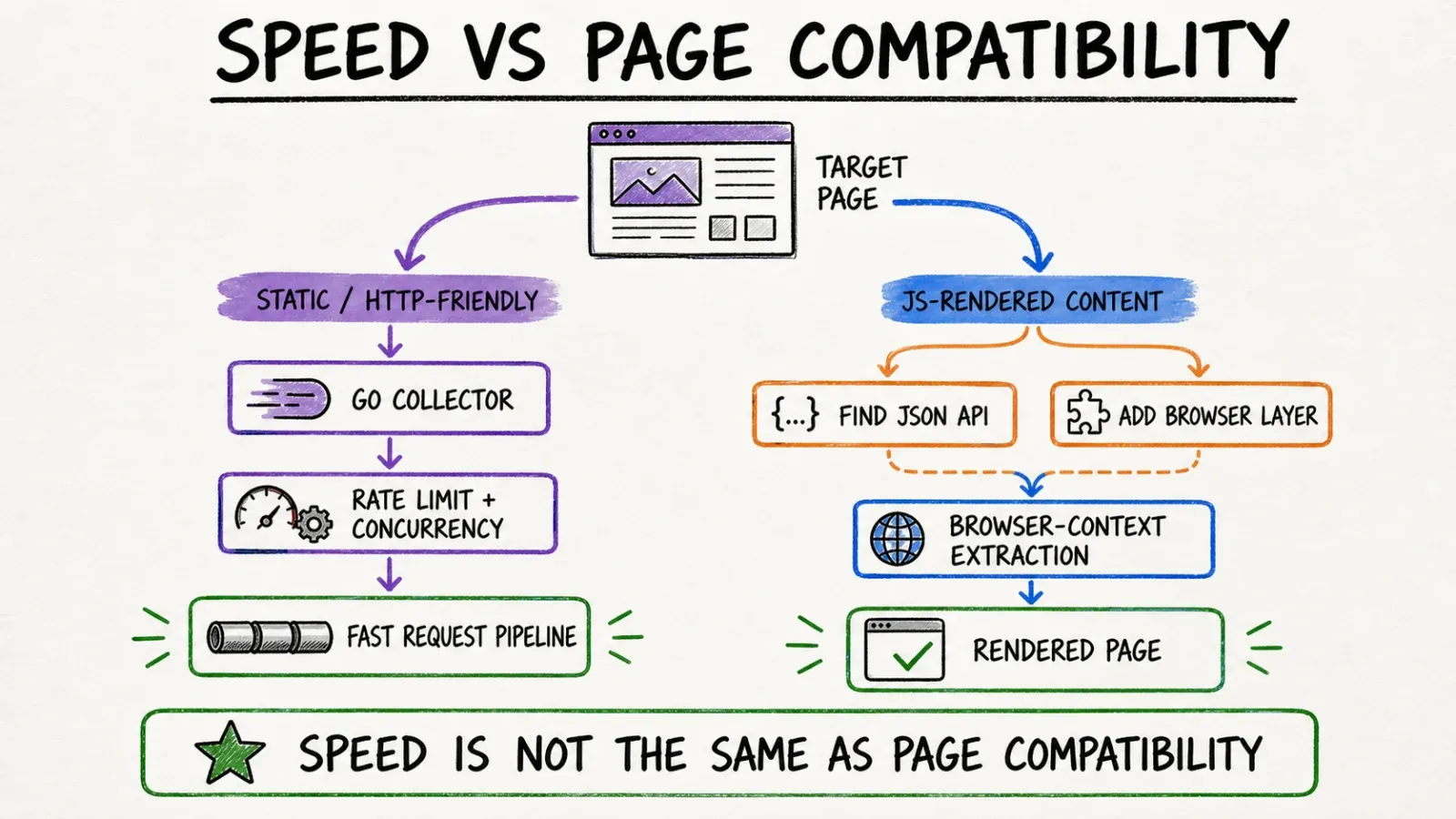
Thunderbit's agentic approach means you're not maintaining selectors yourself — but I'd push back on any framing (including from Thunderbit's own marketing, frankly) that implies universal reliability across every site, especially ones with aggressive anti-bot measures or content behind authentication you're not authorized to access. If you're evaluating either tool, the real question to ask is "who fixes it when it breaks, and how long does that take" — not just "how fast does it run on day one."
Pricing, License, and Total Cost
Colly is open-source under Apache 2.0 — the library itself is free. But total cost of ownership includes developer hours to write and debug the crawler, compute for running it, proxy costs if you need IP rotation, and ongoing time whenever a target site changes and breaks your selectors. For a team already fluent in Go, this can be genuinely cheap at scale. For a team without that skill on staff, "free" quickly turns into "expensive in hidden ways."
Thunderbit runs on credit-based plans — check the current pricing page since tiers and credit allowances are the kind of thing that changes and I'd rather send you to the source than quote a number that's stale by the time you read this. The tradeoff is you're paying for less hands-on upkeep on supported pages, not zero upkeep everywhere.
If you want an honest mental framework, build a rough table for your own situation: setup time, infra/proxy cost, ongoing fix time, and subscription cost. Whichever side wins on that table for your team's actual skills and workload — that's your answer, not a generic "open source is cheaper" take.
Who Should Choose Thunderbit?
If you're a business user, ops person, or growth team member who needs structured data now and doesn't want to touch code, Thunderbit's browser extension is the obvious pick. If you're a developer who wants extraction as a building block — via API, CLI, or inside an AI agent workflow via MCP — Thunderbit also fits, just through a different door than the point-and-click one.
Who Should Choose Colly?
If you're a Go developer (or your team is Go-first) and you need a custom, high-throughput crawler where you control every request, every retry, every proxy rotation — Colly is built exactly for that job. It's also the right call if you specifically want to own the code with no subscription dependency, and you have the engineering bandwidth to maintain it.
Can Teams Use Both?
Honestly, yes, and I don't think that's a cop-out answer. It's pretty common for an engineering team to run a durable, high-scale Colly crawler for a core data pipeline, while other teams — sales, ops, marketing — use Thunderbit for ad hoc extraction that doesn't warrant writing and maintaining a script. I'm not going to invent some fake "official integration" between the two here — there isn't one that I'm aware of — but architecturally, nothing stops both tools living in the same organization solving different problems.
Verdict
Pick based on who's doing the work and what they're optimizing for. If you've got Go skills, custom logic requirements, and you want to own the maintenance in exchange for full control and zero subscription cost, Colly is the right tool. If you want data fast, don't want to write or maintain code, and you're fine trading some low-level control for a managed experience — including the option to plug extraction into an API or an AI agent — Thunderbit is the better fit. Neither one is "better" in the abstract; they're built for different people solving different problems.
FAQ
Is Colly free? Yes — Colly is open-source under the Apache 2.0 license, so the library itself costs nothing. Your actual costs come from developer time, hosting, proxies if needed, and ongoing maintenance when target sites change.
Does Colly render JavaScript? Not natively. Colly is primarily an HTTP/HTML framework, so JavaScript-heavy sites typically require finding the underlying JSON API the page calls, or pairing Colly with a separate browser automation tool.
Does Thunderbit support API and MCP access for developers? Yes. Thunderbit offers an Open API for programmatic extraction and an MCP Server that exposes extraction as a callable tool inside compatible AI agent workflows like Claude, Cursor, or Windsurf.
Which is faster to get started with? Thunderbit, by design — the browser extension's One Click Extract flow gets you a result in seconds to minutes with no code. Colly requires writing and testing Go code before you see your first result.
Which gives more low-level control over the crawl itself? Colly, hands down. You control concurrency via goroutines, request rate limiting, caching, proxy rotation, and storage backends directly in code — a level of tuning that a managed product like Thunderbit doesn't expose by design.




