
Here’s a stat that would have sounded wild just a few years ago: by 2026, 75% of all new business apps will be built with no-code or low-code tools. That’s not just a tech trend—it’s a full-blown business revolution. As someone who’s spent years in SaaS and automation (and, let’s be honest, has broken more than a few “no-code” prototypes along the way), I’ve watched no-code workflow adoption go from a fringe experiment to the backbone of digital transformation for companies of every size.
In 2026, business leaders aren’t just asking, “Should we automate?” They’re asking, “How fast can we roll out no-code workflows to every team?” The numbers back it up: the global market for no-code and low-code platforms is on track to hit $44.5 billion by 2026, and the impact on business efficiency is nothing short of staggering. Let’s dig into the latest adoption rates, efficiency stats, and why this year is the tipping point for no-code automation in business.
Top No-Code Automation Statistics for Business in 2026
Let’s kick things off with the headline numbers every business leader should know. These stats capture the scale, adoption, and ROI of no-code automation as we head into 2026:

- $44.5 billion: The global low-code/no-code development technologies market is forecast to reach $44.5 billion by 2026 (Gartner).
- 75% of new apps: By 2026, 75% of new application development will use low-code/no-code tools, up from 40% in 2021 (Gartner).
- 80% of users outside IT: 80% of low-code/no-code users will be outside formal IT departments by 2026 (Gartner).
- 81% see strategic value: 81% of business decision-makers say low-code/no-code is strategically important for their organization (KPMG).
- 31% have made no-code central: 31% of companies report no-code/low-code is already a central part of their software strategy (KPMG).
- 53% cite process efficiency: 53% of companies cite process efficiency as the top benefit of no-code adoption, with 51% highlighting employee productivity.
- 224% ROI: Organizations using Microsoft Power Platform (a leading no-code suite) report a 224% ROI and payback in under 6 months (Forrester TEI).
- Nearly 60% of US firms automated last year: Nearly 60% of US companies (and 84% of large firms) implemented automation technology in the past year (Duke University Fuqua School of Business).
- Process automation is the #1 use case: 48% of companies use no-code/low-code for business process and workflow automation.
- Unified platforms are surging: Enterprise interest in unified automation platforms (combining no-code, RPA, and AI) jumped 120% from 2023 to 2024 (Everest Group).
If you’re not already seeing these trends in your own business, trust me—they’re coming soon.
No-Code Workflow Adoption Rates: 2026 Growth Trends
The growth curve for no-code adoption over the past five years has been nothing short of exponential. Let’s break it down:
The Global Surge
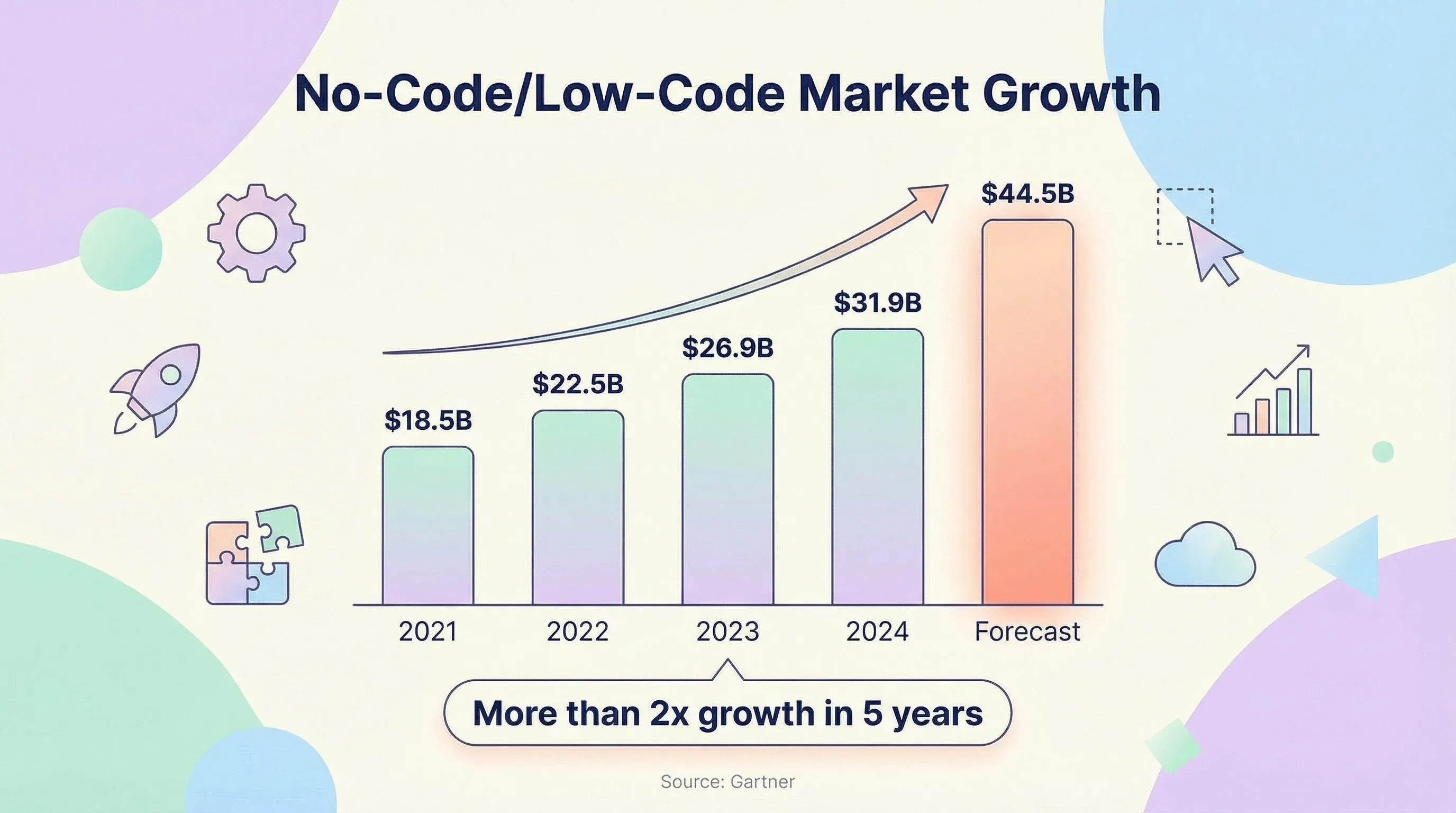
- In 2021, the market for low-code development technologies was valued at $18.5 billion.
- By 2024, it had climbed to $31.9 billion.
- The 2026 forecast? $44.5 billion.
That’s more than doubling in just five years. And it’s not just about spending—the way businesses are using these tools is changing, too.
From Pilot Projects to Core Strategy
According to KPMG’s global survey of 2,000 decision-makers:
- 31% say no-code/low-code is now a central component of their software development strategy.
- 25% have completed their first no-code projects.
- 19% are planning to implement within the next 12 months.
- Only 1% say no-code isn’t on their radar at all.
This isn’t just a tech department thing, either. By 2026, 80% of no-code users will be outside IT—think sales, marketing, operations, and even HR teams building their own workflows.
Visualizing the Growth
Here’s a quick look at the market growth (in billions USD):
| Year | Market Size (USD, billions) |
|---|---|
| 2021 | 18.5 |
| 2022 | 22.5 |
| 2023 | 26.9 |
| 2024 | 31.9 |
| 2026 | 44.5 (forecast) |
Regional and Industry Breakdown
No-code adoption isn’t happening at the same pace everywhere. Here’s where the action is hottest:
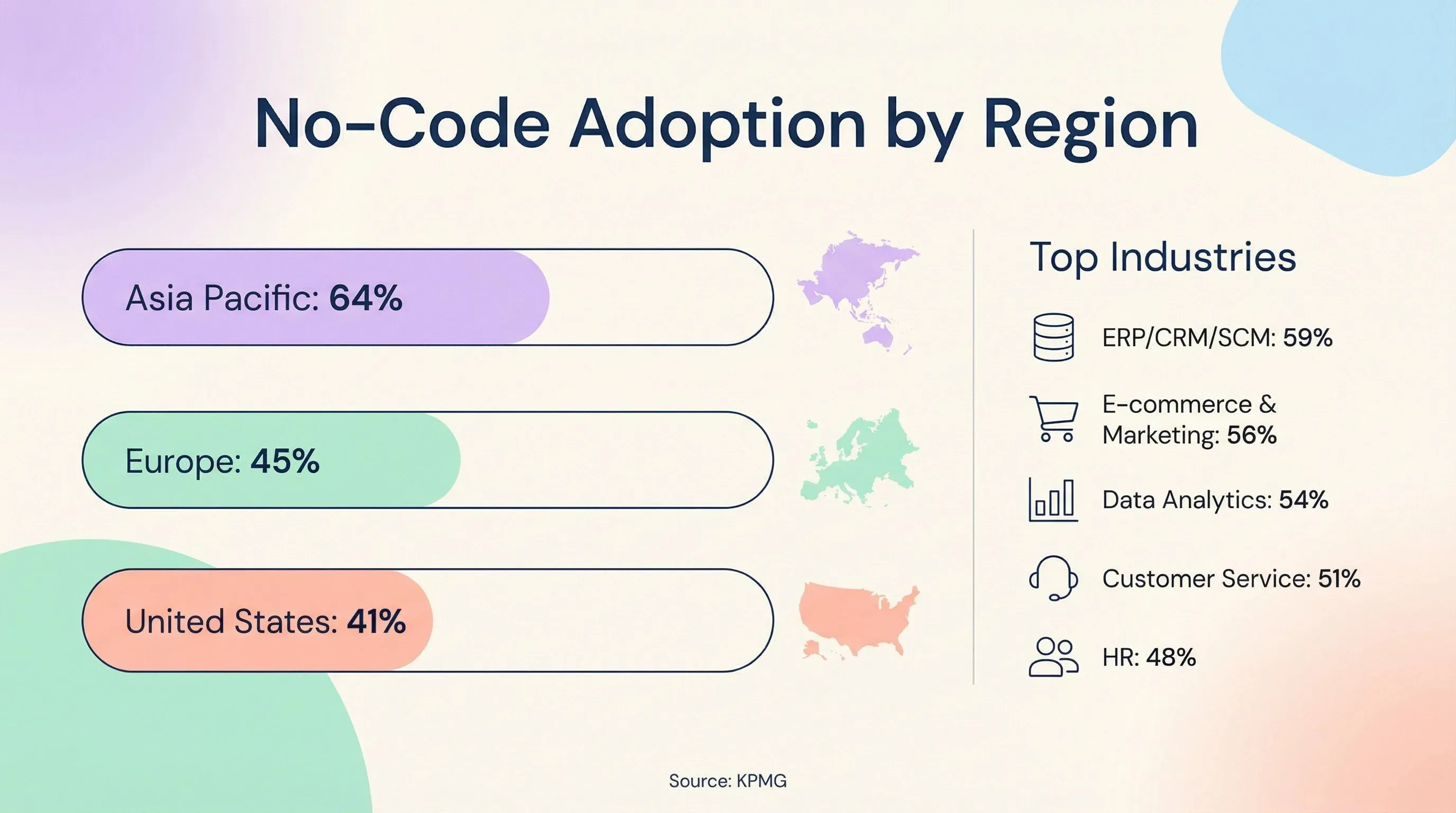
- Asia Pacific: Leads the pack, with 64% of companies using no-code for business process automation.
- Europe: 45% adoption rate for process automation.
- United States: 41% adoption for process/workflow automation.
By industry, the leaders are:
- ERP/CRM/SCM: 59% of companies use no-code here.
- E-commerce, sales & marketing: 56%.
- Data analytics: 54%.
- Customer service: 51%.
- HR: 48%.
In short: if you’re in sales, marketing, ops, or IT, no-code is already changing how your peers work.
The Impact of No-Code Tools on Business Efficiency
See how AI web automation boosts business efficiency Get Started Free
Let’s get to the bottom line: does no-code automation actually make businesses more efficient? The data says yes—often dramatically so.
Quantified Efficiency Gains
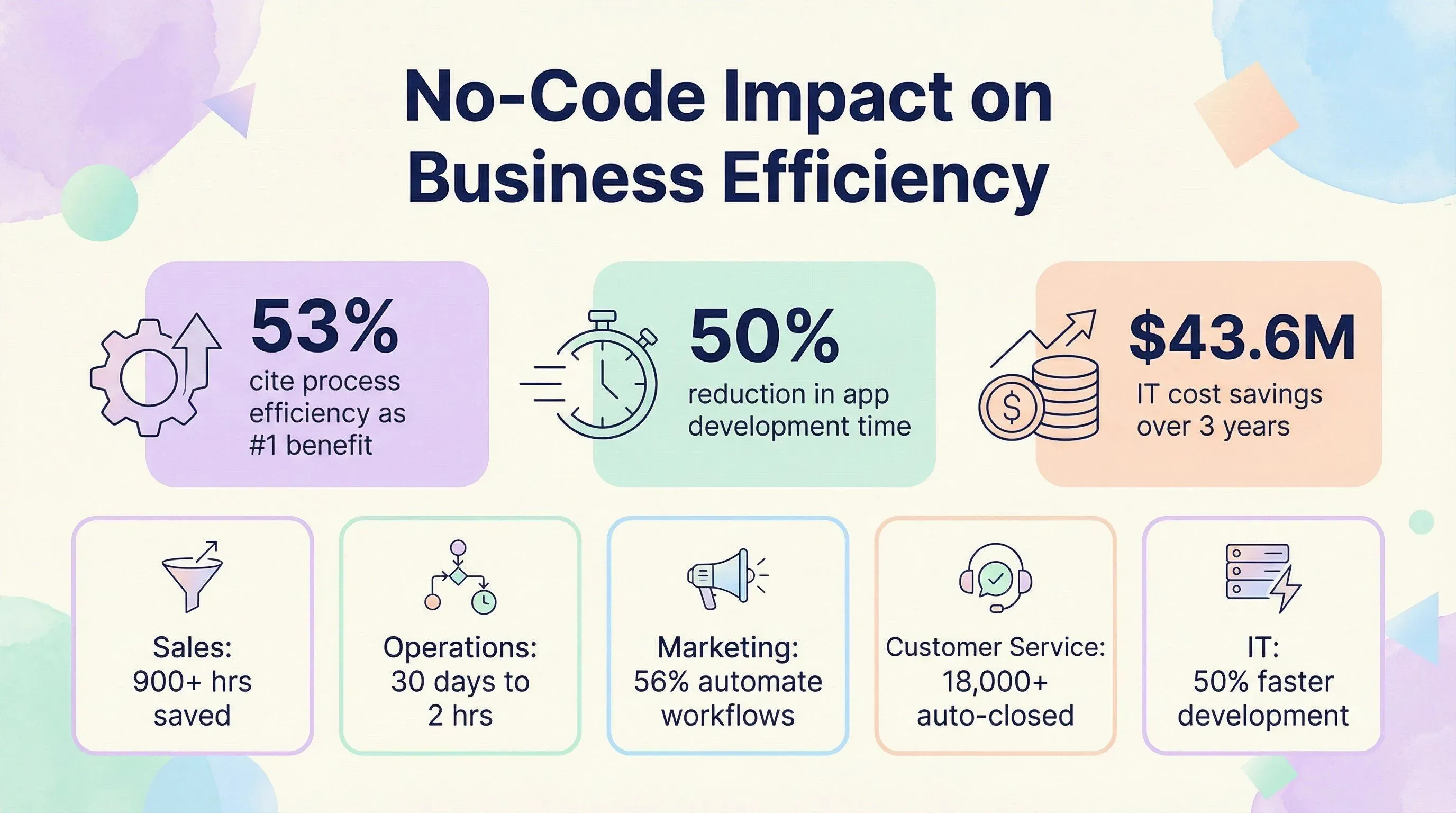
- Process efficiency: 53% of companies cite this as the #1 benefit of no-code adoption.
- Employee productivity: 51% report measurable productivity gains.
- Development time: Organizations using Microsoft Power Apps saw a 50% reduction in professional developer app development time.
- Cost savings: Microsoft Power Platform users reported $43.6 million in direct development/IT cost savings over three years (composite org).
- ROI: Forrester’s TEI studies show 224% ROI for Power Platform and 97% ROI for UiPath Automation, both with payback periods under 6 months.
Efficiency Gains by Department
Here’s how no-code automation is boosting efficiency across business teams:
| Department | Efficiency Impact (2026 Data) | Source |
|---|---|---|
| Sales | 62% of RevOps teams use multiple automations; 68% use AI with automation; 900+ hours saved in 6 months (Klue case) | Zapier |
| Operations | HR process cut from 30 days to 2 hours; $60,000 annual software savings (FranklinCovey case) | Make.com |
| Marketing | 56% of companies automate sales/marketing workflows with no-code | KPMG |
| Customer Service | 700+ automation scenarios, 151 hours saved, 18,000+ messages auto-closed (Stellantis &You UK) | Make.com |
| IT | 50% reduction in app development time; $43.6M IT cost savings (Power Platform TEI) | Forrester |
The impact isn’t just theoretical—these are real numbers from real companies.
Why 2026 Is a Pivotal Year for No-Code Workflow Adoption
So, why is 2026 the year no-code goes from “nice to have” to “must have”? There are a few key drivers:
1. Technology Maturity
No-code platforms have hit a tipping point in terms of reliability, scalability, and integration. The days of “toy” tools are over—today’s platforms are enterprise-ready, with 91% of decision-makers citing scalability as a top selection criterion.
2. Cost Reduction
The cost to build and maintain business apps has dropped sharply. With payback periods under 6 months and ROI north of 200% (Forrester TEI), no-code is now a CFO’s best friend.
3. Ecosystem Expansion
The number of platforms, integrations, and community resources has exploded. There are now robust marketplaces, templates, and even AI-powered assistants that make building workflows as easy as dragging and dropping.
4. Talent Shortages
With developer shortages still a reality, empowering “citizen developers” (aka, everyone outside IT) is a necessity. By 2026, 80% of low-code users are outside IT, and companies are investing heavily in training and governance.
5. AI Integration
AI is now baked into most leading no-code platforms, enabling smarter automation, predictive analytics, and natural language workflow building. (I mean, even my mom can build a workflow now—and she still calls me to ask how to copy and paste.)
Key Drivers Accelerating Adoption
- Digital transformation urgency: 81% of decision-makers say no-code is strategically important.
- Unified platform demand: Interest in unified automation platforms jumped 120% in a single year.
- Process automation as a priority: 48% of companies use no-code for workflow automation.
- AI and automation as future drivers: 58% of employers expect robotics and automation to transform their business by 2030.
No-Code vs. Traditional RPA: Deep Data Comparison
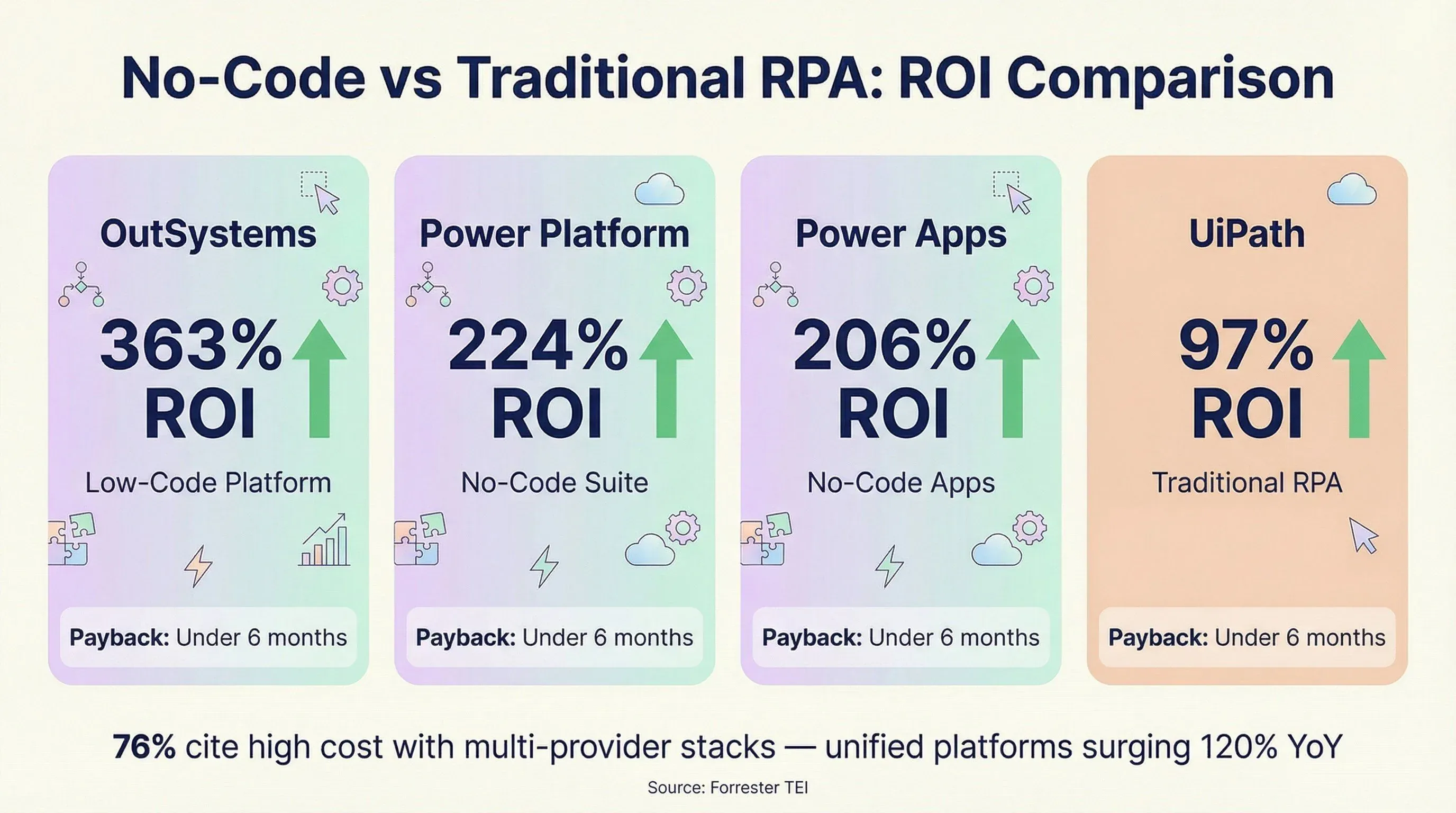
Let’s address the elephant in the room: how does no-code stack up against traditional RPA (Robotic Process Automation) tools like UiPath and Automation Anywhere? Here’s what the numbers say:
| Platform/Approach | ROI (%) | Payback Period | Key Benefits | Source |
|---|---|---|---|---|
| Microsoft Power Platform | 224 | <6 months | Time savings, IT cost reduction, rapid deployment | Forrester TEI |
| Microsoft Power Apps | 206 | Not stated | 50% reduction in dev time, business agility | Forrester TEI |
| UiPath (Traditional RPA) | 97 | <6 months | Large hour savings, process automation | Forrester TEI |
| OutSystems (Low-code) | 363 | <6 months | Rapid app delivery, high ROI | OutSystems TEI |
Why Businesses Are Migrating to No-Code
- Integration and maintenance: 76% of enterprises cite high total cost of ownership with multi-provider automation stacks.
- Unified platforms: Interest in unified, no-code-centric platforms is surging, with 120% year-over-year growth.
- Governance and scalability: No-code platforms now offer enterprise-grade security, scalability, and governance—making them a safer bet for long-term investment.
In short: RPA is still great for UI-level, rules-based tasks, but no-code workflow automation is winning for business process orchestration, integration, and scale.
Business Use Cases: Real-World No-Code Workflow Success Stories
Let’s get concrete. Here are a few real-world examples of how no-code automation is transforming business efficiency:
Sales & Revenue Operations
- Klue: Ran 8,000+ automated workflows and saved over 900 hours in just two quarters using no-code automation (Zapier).
Operations & HR
- FranklinCovey: Cut an HR process from 30 days to just 2 hours, avoided a $60,000 annual software expense, and saved hundreds of thousands of dollars with no-code tools (Make.com).
Customer Service
- Stellantis &You UK: Built 700+ automation scenarios, saved 151 hours in a year, and auto-closed over 18,000 messages—with a boost in customer satisfaction (Make.com).
IT & Support
- Zapier’s own support team: Built an internal ticket summarizer that cut average handle time in half—all with no-code and AI (Zapier).
These aren’t just “nice to haves”—they’re competitive advantages.
Key Takeaways: No-Code Automation in 2026
Let’s wrap up with the big lessons for business leaders:
- No-code is mainstream: With 75% of new apps built on no-code/low-code by 2026, this is no longer just for early adopters.
- Efficiency is real and measurable: Companies are seeing 50%+ reductions in workflow time, 224%+ ROI, and massive productivity gains.
- Adoption is accelerating everywhere: From SMBs to global enterprises, and across every department—not just IT.
- Unified, AI-powered platforms are the future: The winners are consolidating on platforms that blend no-code, automation, and AI.
- 2026 is the inflection point: If you’re not investing in no-code automation now, you risk falling behind.
As someone who’s spent years helping teams automate with tools like Thunderbit, I can tell you: the future of business efficiency is no-code, and that future is already here.
FAQs on No-Code Workflow Adoption and Business Efficiency
1. What is the current adoption rate of no-code automation in business?
By 2026, 75% of new business apps will be built with no-code or low-code tools, and 31% of companies have already made no-code a central part of their software strategy.
2. How much can no-code automation improve business efficiency?
Companies report 50%+ reductions in workflow completion time, 53% cite process efficiency as the top benefit, and 51% see measurable productivity gains.
3. Which business departments benefit most from no-code automation?
Sales, operations, marketing, IT, and customer service are all seeing major gains. For example, sales and RevOps teams are saving hundreds of hours per year, while HR and support teams are automating processes that used to take weeks.
4. How does no-code compare to traditional RPA tools?
No-code platforms deliver higher ROI (224% vs. 97%), faster payback, and better scalability for most business workflows. RPA is still valuable for UI-level automation, but no-code is winning for orchestrated, integrated business processes.
5. What are the main challenges with no-code adoption?
Top challenges include security (42%), complexity (41%), and skills gaps both inside and outside IT (41–40%). However, the rapid growth of training, governance, and unified platforms is helping businesses overcome these hurdles.
Further Reading & Data Sources
- Gartner Low-Code Market Forecast (InfoWorld)
- KPMG Low-Code Adoption Study (PDF)
- Forrester TEI of Microsoft Power Platform (PDF)
- Forrester TEI of UiPath Automation (PDF)
- Everest Group: Unified Automation Platforms Report (PDF)
- Zapier State of RevOps Automation Report (PDF)
- World Economic Forum: Future of Jobs Report 2025
- Thunderbit Blog: More on No-Code Automation
If you’re ready to see what no-code can do for your business, check out Thunderbit’s AI-powered automation tools—and join the wave of teams making 2026 their most efficient year yet.
Try AI Web Scraper for No-Code Automation Get Started Free




