
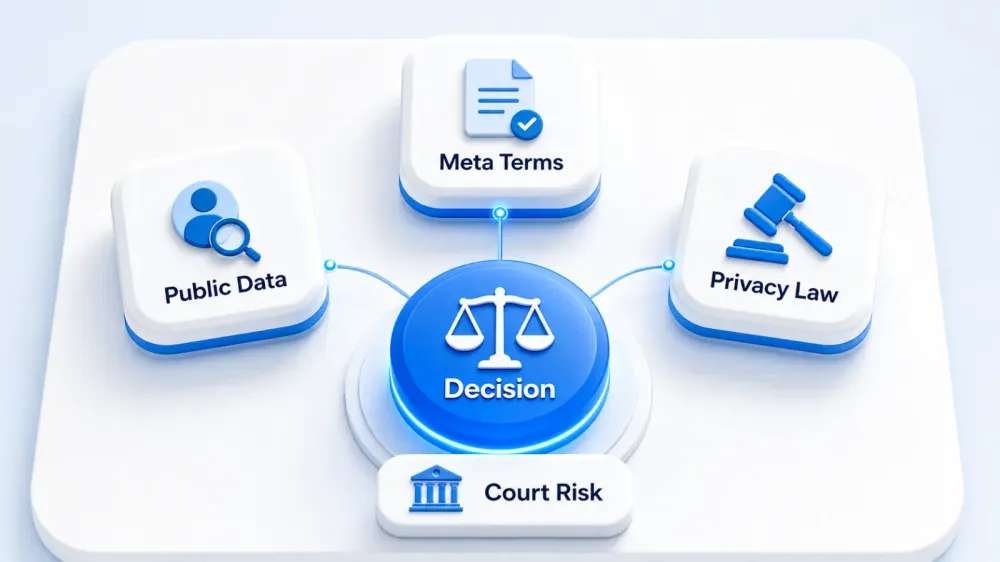
Every time someone asks me "is scraping Instagram legal?", the answers tend to split into three camps: "totally fine," "absolutely illegal," and "it depends." The third camp is the only useful one.
The confusion is real because the answer depends on what data you're collecting, where you and the people in the data are located, how you access it, and why you want it. This article cuts through the noise. I'll walk through the main court rulings, the difference between breaking a platform rule and breaking the law, a jurisdiction comparison, and a practical decision flowchart so you can assess your own situation. This is not legal advice — I'm a tech writer, not a lawyer — but it should give you a clearer map of the terrain.
What Does "Scraping Instagram" Actually Mean?
First, a definition.
Instagram scraping means using software to automatically collect publicly visible information from Instagram's website or app — things like profile bios, post captions, comments, hashtag usage, follower counts, and engagement metrics.
It is not the same as using Instagram's official Graph API, which has its own limitations, approval rules, and use-case restrictions. Scraping does not use that official API path; it collects data directly from web pages or app surfaces.
Common use cases:
- Lead generation: Finding potential customers or influencers based on public profiles and engagement patterns.
- Competitor monitoring: Tracking competitor post frequency, engagement rates, and content strategy.
- Market research: Analyzing hashtag trends, sentiment, or geographic patterns in public posts.
- Academic research: Studying public discourse, visual culture, or social network dynamics for a thesis or paper.
This article focuses on the legality question — not the technical how-to. If you're trying to figure out whether your specific use case could get you sued, banned, or fined, keep reading.
Is Scraping Instagram Legal? The Short Answer
Scraping publicly available Instagram data is generally not a federal crime under current U.S. case law — but "not a crime" and "totally fine" are very different statements.
Three distinct legal layers apply, and most of the confusion comes from people mashing them together:
- Computer access laws (e.g., the U.S. Computer Fraud and Abuse Act, or CFAA): Is accessing the data "unauthorized"?
- Privacy regulations (e.g., GDPR, CCPA): Does the data include personal information, and do you have a lawful basis to process it?
- Contract/Terms of Service: Does Instagram's TOS prohibit what you're doing, and what happens if you violate it?
Each layer has different consequences, enforcement mechanisms, and risk levels. A scrape can be perfectly fine under one layer and deeply problematic under another.
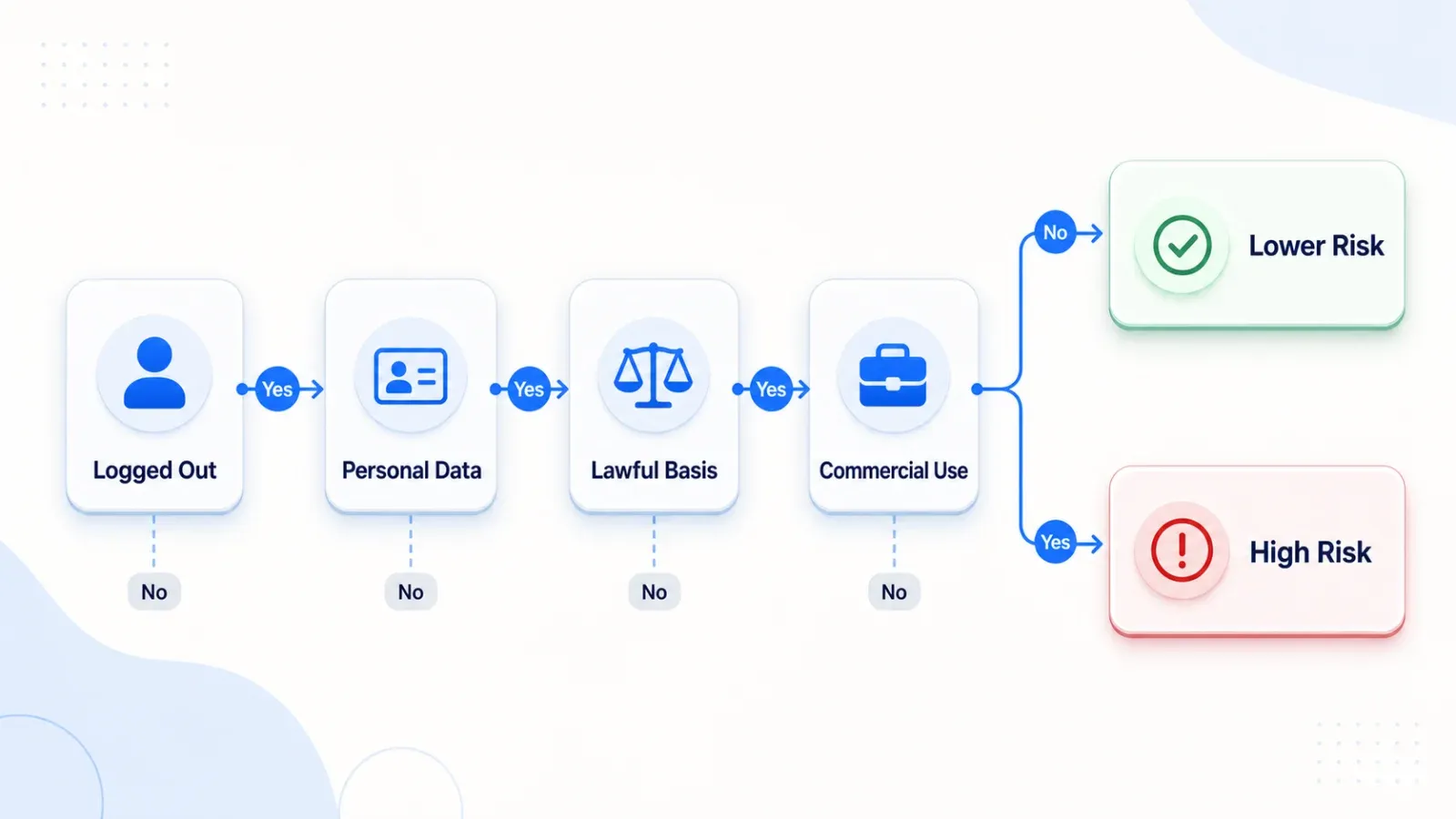
"Is My Scrape Legal?" — A Decision Flowchart You Can Actually Follow
I've read dozens of articles on this topic. They all list the same legal factors in dense paragraphs — and none give you a way to actually assess your own situation in under a minute. Here's a decision tree:
| Step | Question | If YES → | If NO → |
|---|---|---|---|
| 1 | Is the data publicly visible without logging in? | Go to Step 2 | ⚠️ High risk — likely implicates CFAA / access-control protections |
| 2 | Does the data include personal information (names, photos, bios, email addresses)? | Go to Step 3 (GDPR/CCPA applies) | Lower risk — go to Step 4 |
| 3 | Do you have a lawful basis under GDPR/CCPA (legitimate interest, consent, etc.)? | Go to Step 4 | ⛔ Do not proceed without legal counsel |
| 4 | Is the use commercial (reselling data, lead gen, SaaS product)? | Higher enforcement risk — review TOS exposure & cease-and-desist precedents | Lower risk — especially for personal/academic use |
| 5 | Are you avoiding technical bypasses and excessive automated access? | Lower practical risk | Increases legal, platform, and account risk |
This isn't a free pass — it's a risk-assessment framework. If you answered "yes" to steps 1, 3, and 5, and "no" to step 4, you're in a lower-risk zone. If you're logged in, collecting personal data with no lawful basis, reselling it commercially, and ignoring platform controls, you're stacking risk on top of risk.
For business workflows, the lower-risk path is often to avoid Instagram collection altogether and use allowed public sources such as company websites, creator landing pages, ecommerce pages, directories, or licensed datasets. The flowchart applies regardless of what tool you use.
Step 1: Is the Data Publicly Visible?
The incognito browser test: open a private window (no Instagram login), navigate to the page, and look. If you can see the data, it is public in a practical access sense. U.S. cases such as hiQ v. LinkedIn treat publicly available, logged-out data differently from data behind access controls for CFAA purposes — but that is not the same as a universal permission slip.
Instagram also changes what is visible without login over time. Verify what is actually public today before assuming your target data is accessible without an account.
Step 2: Does It Include Personal Information?
Personal data is defined broadly under GDPR and CCPA: usernames, profile photos, bios, email addresses, location tags, and even inferred attributes from images or captions. If you're scraping Instagram profiles, you're almost certainly collecting personal data.
Public visibility does not exempt you from privacy law — one of the most persistent misconceptions in this space.
Step 3: Do You Have a Lawful Basis?
Under GDPR Article 6, you need a documented lawful basis before processing personal data. "Legitimate interest" is the most commonly cited basis for scraping, but it requires a formal balancing test — your interest versus the data subject's rights. Consent is another option, but impractical for scraping at scale.
Under CCPA, California residents have rights related to their personal information, including the right to know, delete, and opt out of sale/sharing. If you're a qualifying business collecting data on CA residents, these obligations apply.
No lawful basis + personal data = stop and get legal advice.
Step 4: Is the Use Commercial?
Commercial use — reselling datasets, building lead-gen products, feeding a SaaS tool — draws the most enforcement attention from Meta. Personal projects and academic research carry lower practical risk, though they're not zero-risk.
Step 5: Are You Respecting Rate Limits and Platform Guardrails?
Do not bypass CAPTCHAs, login walls, anti-bot controls, or account restrictions. Even when data looks public, aggressive automated access increases platform-enforcement, contract, privacy, and operational risk.
Public vs. Private Data: The Line That Matters Most
Everything hinges on one distinction: public versus private data.
| Generally Lower Risk to Scrape | Do Not Scrape |
|---|---|
| Public profile bios, display names | Private account posts/stories |
| Public post captions and comments | Direct messages (DMs) |
| Public hashtag usage | Content behind login walls |
| Public engagement counts (likes, comment counts) | Data from fake/purchased accounts |
| Public profile photos (with privacy-law caveats) | Follower lists at scale (grey area) |
Grey areas abound. Follower/following lists, tagged location data, and children's accounts all sit in legally ambiguous territory. Even if technically visible, scraping them at scale can trigger privacy concerns or platform enforcement. When in doubt, err on the side of not collecting it.
The U.S. computer-access-law reasoning here comes from cases such as hiQ v. LinkedIn, but keep the scope narrow: it is about access authorization under the CFAA, not a finding that every public social-media profile can be collected and reused freely. Privacy regulations like GDPR operate on a different framework.
ToS Violation vs. Criminal Liability: The Biggest Misconception About Scraping Instagram
I'll say it plainly:
Violating Instagram's Terms of Service is not a crime.
Instagram's Terms of Use state that users cannot create accounts or access/collect information in unauthorized ways, including automated collection without Instagram's express permission. Meta's Automated Data Collection Terms similarly require express written permission.
These are contractual rules — agreements between you and Instagram. Breaking them can lead to account bans and, in extreme cases, civil lawsuits. They are not criminal statutes.
Here's the legal hierarchy, simplified:
| Legal Layer | What It Is | Consequence of Violation |
|---|---|---|
| Contract Law (TOS) | Agreement between you and Instagram | Account ban, civil lawsuit for breach of contract |
| Statutory Law (CFAA) | Federal computer access law | Potential criminal liability — but significantly narrowed by Van Buren v. US (2021) |
| Regulatory Law (GDPR/CCPA) | Privacy regulations | Fines up to 4% of global revenue (GDPR); various penalties under CCPA |
That's the key distinction: a platform rule can create account and civil-contract exposure without automatically becoming a computer-crime statute.
The nuance matters because Meta v. Bright Data (January 2024) came out in Bright Data's favor on Meta's breach-of-contract theory for logged-off scraping of public Facebook and Instagram data. But that ruling was narrow: logged-off access, public data, a specific factual record, and one U.S. district court. It did not bless scraping behind login walls, fake-account collection, private data, privacy-law violations, or every commercial reuse of Instagram data.
What Actually Happens If You Scrape Instagram: A Risk Matrix
People ask "Can Instagram sue me?" and "Will my account get banned?" constantly. Here's the honest breakdown:
| Consequence | What Happens | Severity | Likelihood |
|---|---|---|---|
| Account ban/suspension | Immediate, typically no appeal | Low-Medium impact | HIGH for aggressive scraping |
| Cease & desist letter | Legal notice from Meta's counsel | Medium impact (legal costs to respond) | MEDIUM for commercial use |
| Civil lawsuit (TOS breach) | Damages claim, injunction | High impact | LOW (reserved for high-volume/commercial operations) |
| CFAA prosecution | Criminal charges | Very High impact | VERY LOW (narrowed significantly post-Van Buren) |
| GDPR fine | Up to 4% of global revenue | Very High impact | LOW-MEDIUM for EU personal data scraping |
The two most likely consequences are account restrictions and cease-and-desist letters. The best control is not a technical workaround; it is scope discipline: avoid logged-in or gated collection, minimize personal data, document the purpose and lawful basis, and use official or consented routes where possible.
Meta has stated on its privacy progress page that it blocks billions of suspected unauthorized scraping actions per day across Facebook, Instagram, and WhatsApp. That's Meta's own claim, and I can't independently verify the number, but it signals how seriously they take enforcement.
Country-by-Country: Where Is Scraping Instagram Legal?
Legality depends on jurisdiction, and no two countries treat this identically. Here's the comparison table that, as far as I can tell, no one else has published in a scannable format:
| Jurisdiction | Key Law(s) | Public Data Scraping | Personal Data Scraping | TOS-Only Risk | Notable Case/Ruling |
|---|---|---|---|---|---|
| US | CFAA, state CFAA variants | Lower CFAA risk for logged-out public data in some cases, but fact-specific | CCPA/CPRA may apply to qualifying businesses and California residents | Contract/account/civil exposure can still remain | hiQ v. LinkedIn (2022), Van Buren v. US (2021), Meta v. Bright Data (2024) |
| EU | GDPR, Database Directive | Lower privacy risk when no personal data is involved; other rights can still matter | Requires lawful basis under Art. 6 | Contract and platform enforcement can still matter | GDPR enforcement actions; special-category data risk in images/bios |
| UK | UK GDPR, DPA 2018 | Similar to EU | Requires lawful basis; ICO guidance updated April 2026 | Contract and platform enforcement can still matter | ICO guidance documents |
| Canada | PIPEDA, provincial laws | Lower risk when no personal information is involved | Consent and other privacy obligations can apply | Contract and platform enforcement can still matter | Limited scraping-specific precedent |
| Brazil | LGPD | Lower risk when no personal data is involved | Requires legal basis | Contract and platform enforcement can still matter | Emerging enforcement; no major scraping case yet |
| Australia | Privacy Act 1988 | Lower risk when no personal information is involved | Australian Privacy Principles (APPs) can apply | Contract and platform enforcement can still matter | Limited scraping-specific precedent |
A pattern emerges across all six jurisdictions. In every jurisdiction, scraping non-personal public data is the lowest-risk scenario. The moment personal data enters the picture, privacy law kicks in — and "the data was publicly visible" is not a defense under GDPR, UK GDPR, or LGPD. It's a factor, but not a lawful basis by itself.
For readers thinking about data residency and cross-border collection: where data is collected, processed, and stored can matter. If you use any third-party tool or vendor for allowed public sources, review its region, retention, and privacy controls before collecting personal data.
Key Legal Milestones for Instagram Scraping Risk
A few legal and platform-policy milestones explain why the answer is still nuanced:
- 2017: hiQ v. LinkedIn — District court issues preliminary injunction preventing LinkedIn from blocking hiQ's scraping of public profiles. First major U.S. ruling favoring public-data scraping.
- 2018: GDPR takes effect in the EU, establishing the most comprehensive personal data protection framework globally.
- 2020: CCPA takes effect in California. Meta files Meta v. BrandTotal, targeting scraping of Facebook data.
- 2021: Van Buren v. United States — U.S. Supreme Court narrows the CFAA's "exceeds authorized access" provision. This is a watershed moment for scraping law.
- 2022: hiQ v. LinkedIn — 9th Circuit issues final ruling affirming that scraping public data does not violate the CFAA.
- 2024: Meta v. Bright Data — Northern District of California holds that Facebook/Instagram Terms did not bar Bright Data's logged-off scraping of public data. Narrow but significant.
- 2024 and after: Meta continues public anti-scraping enforcement. Its privacy progress page says Meta blocks billions of suspected unauthorized scraping actions per day across Facebook, Instagram, and WhatsApp. Treat that as Meta's own enforcement claim, not an independently verified benchmark.
How Van Buren v. US Changed the Calculus for Public Data Scraping
Before Van Buren, there was a real argument that scraping any website against its wishes could be a federal crime under the CFAA. The statute's language about "exceeds authorized access" was broad enough that some prosecutors and plaintiffs tried to stretch it to cover TOS violations.
The Supreme Court shut that down. In Van Buren, the Court adopted a "gates up vs. gates down" framework: the CFAA applies when someone bypasses a technological access barrier (like a login wall or password), not when they simply access information that is freely available but that the website owner wishes they wouldn't.
For scraping, the practical impact is significant. If the data is behind a login wall or other access control, CFAA risk can rise quickly. If the data is on a public page that anyone can visit in an incognito browser, the CFAA argument is generally weaker, though privacy, contract, IP, and platform-enforcement risks can remain.
Most competitor articles cite hiQ but underexplain Van Buren. They're complementary rulings, and Van Buren is arguably more important because it's a Supreme Court decision with nationwide authority, not a circuit-court ruling.
Meta's Enforcement Playbook
Meta has not been sitting still. Based on Meta's own public statements, its enforcement toolkit includes:
- Rate limits and data limits to reduce automated collection.
- Pattern detection for unusual collection behavior.
- Account restriction or disabling when Meta believes automation violates its terms.
- Cease-and-desist letters, lawsuits, and takedown requests for high-volume or commercial scraping operations.
Even if you only care about legal risk, platform enforcement matters. Meta's public position is clear: automated collection from its platforms without permission violates its rules, and it invests heavily in stopping it.
Scraping Instagram for Academic Research: What Students and Researchers Need to Know
Graduate students and academic researchers sit in a different risk category — often lower than commercial data resale, but not zero.
Lower risk than commercial scraping, yes. Automatically exempt, no.
Fair Use Analysis for Instagram Data
In the U.S., the fair use doctrine (17 U.S.C. § 107) considers four factors:
- Purpose and character of the use: Non-commercial, educational, and transformative use favors fair use. Academic research generally scores well here.
- Nature of the copyrighted work: Factual data (follower counts, post dates) is less protected than creative content (photos, captions). Scraping creative content is riskier.
- Amount used: Scraping an entire public profile is different from scraping a few data points. Minimize what you collect.
- Effect on the market: If your research doesn't compete with Instagram's commercial offerings, this factor favors you.
Academic research typically lands on the favorable side of this analysis, but it's not a guarantee — especially if you're scraping large volumes of creative content (images, videos, full captions).
IRB Considerations
If your research involves identifiable human subjects data — and Instagram profiles are identifiable by definition — your university's Institutional Review Board (IRB) may need to review and approve your data collection plan. This is true even if the data is publicly visible. Check with your IRB before you start scraping.
Platform-Specific Research Programs
Meta offers the Content Library and API for approved researchers, providing access to publicly accessible content from Facebook, Instagram, and Threads. Applications are independently reviewed. If you're eligible, this is a lower-risk official path for academic Instagram research.
(Note: Meta's CrowdTangle tool, which was popular among researchers, has been largely sunset. The Content Library/API is its successor.)
Data Minimization for Researchers
Practical guidance:
- Collect only the data points you need for your research question. Don't scrape entire profiles "just in case."
- Anonymize datasets as early as possible — strip usernames, blur profile photos, aggregate rather than report individual-level data.
- Establish a data retention policy: how long will you keep the data, and when will you delete it?
- Document your methodology and lawful basis (for GDPR compliance if applicable).
For research outside Instagram-specific collection, apply data minimisation: collect only the fields needed for the stated purpose, avoid storing unnecessary raw text, and document retention and access controls.
Lower-Risk Checklist Before Collecting Instagram Data
With the legal landscape mapped, here's the practical checklist for reducing your risk:
- Only scrape publicly visible data. Use the incognito browser test. If you can't see it without logging in, don't scrape it.
- Never bypass login walls or use fake accounts. This is where CFAA, contract, and platform-enforcement risk spikes.
- Treat technical and account controls as stop signs. CAPTCHAs, login walls, account restrictions, and anti-bot systems are bright red warning signs.
- Minimize personal data collection. Only collect what you actually need. If you don't need usernames, don't collect them.
- Have a data retention and deletion policy. Know how long you'll keep the data and when you'll delete it.
- Document your lawful basis if you're collecting personal data (especially under GDPR). "Legitimate interest" requires a written balancing test, not just a vague intention.
- Use official, licensed, consented, or non-Instagram sources where they fit. The lowest-risk collection is often the collection you can avoid doing on Instagram.
A Note on Tools and Alternatives
Thunderbit is designed for permitted public-web workflows outside Meta products. It does not provide Facebook, Instagram, Threads, Messenger, WhatsApp, or Meta Ad Library data collection, account connection, or bypass functionality.
For many business questions, public business websites, directories, ecommerce pages, licensed datasets, and other non-Meta sources provide the information needed with clearer terms and privacy obligations. Choose a source that explicitly permits the intended use, then minimise the information you retain.
Key Takeaways
- Scraping publicly available Instagram data is not automatically illegal under current U.S. case law, but "not illegal" and "risk-free" are very different things.
- Three legal layers matter: computer access laws (CFAA), privacy regulations (GDPR/CCPA), and contract/Terms of Service. Don't conflate them.
- TOS violations are not crimes. They can lead to account bans and civil lawsuits, but not criminal prosecution (post-Van Buren).
- Privacy law applies even to public data. If you're collecting personal information, you need a lawful basis — especially under GDPR and CCPA.
- Jurisdiction matters. The legal landscape varies significantly between the US, EU, UK, Canada, Brazil, and Australia.
- The decision flowchart is your friend. Walk through it for every data-collection project: public access → personal data → lawful basis → use case → platform controls.
- Academic researchers have lower but non-zero risk. Use Meta's Content Library/API if eligible, minimize data collection, anonymize early, and check with your IRB.
- Consider alternative data sources. For many business use cases, public websites, directories, and creator pages provide the data you need without Instagram-specific platform risk. Choose a source that explicitly permits the intended use.
- Consult legal counsel for high-stakes commercial use. This article is a map, not a legal opinion.
FAQs About Scraping Instagram Legally
Can Instagram sue me for scraping public data?
Meta can send a cease-and-desist letter or file a civil lawsuit for breach of its Terms of Service. However, U.S. courts — including in Meta v. Bright Data (2024) — have ruled that Instagram's Terms did not bar logged-off scraping of public data in specific contexts, and Van Buren v. US (2021) significantly narrowed CFAA liability for accessing public information. The likelihood of a lawsuit is low for small-scale, non-commercial use, but it's not zero — especially for commercial operations.
Is scraping Instagram legal in Europe?
Scraping publicly available, non-personal data is usually a lower privacy-risk scenario, but Instagram data often includes personal data. If personal data is involved, you need a lawful basis under GDPR Article 6 — such as legitimate interest with a documented balancing test. Fines for non-compliance can reach up to 4% of global annual revenue. The ICO's guidance (updated April 2026) requires organizations to determine and document their lawful basis before processing.
Will my Instagram account get banned for scraping?
Account restrictions are one of the most likely consequences of aggressive scraping. Instagram's account restriction policy describes unauthorized scraping as automation used to collect information in violation of its Terms. Avoiding personal-account scraping reduces account-ban exposure, but it does not make Instagram collection legally or contractually risk-free.
Is scraping Instagram legal for academic research?
Generally lower risk than commercial resale, especially for non-commercial research on public data, but not automatically exempt. Fair use or fair dealing may be relevant, yet researchers should check IRB requirements when dealing with identifiable human subjects data, practice data minimization, and consider using Meta's Content Library and API if eligible.
What is the difference between scraping Instagram and using the Instagram API?
The official Instagram Graph API provides structured access for approved business and creator account use cases, but it has limits, review requirements, and policy restrictions. Scraping collects website-visible data outside that official API path. Both routes have legal considerations: API use is governed by Meta's developer terms, while logged-off public scraping has received favorable treatment in some narrow U.S. cases but can still trigger terms, privacy, IP, and platform-enforcement issues. For most business use cases, the official API, consented data, licensed data, or non-Instagram public sources are lower-risk paths.
Learn More




