
Every week, someone on a dev forum or a sales Slack channel asks the same question: "Can I scrape Facebook?" The answers range from "totally fine, it's public data" to "you'll get sued into oblivion."
Most people conflate two very different things — violating Meta's Terms of Service and actually breaking a law. That conflation is the source of almost all the anxiety. Forum users say it plainly: "TOS ain't law" and "Illegal and against TOS are two very different things." They're right, but the nuance matters enormously. Meta's family of apps reaches 3.56 billion daily active people as of Q1 2026, making Facebook one of the largest public data surfaces on the planet. Businesses want that data for leads, market research, pricing intelligence, and competitive analysis. This article will cut through the noise by looking at what courts have actually ruled — not just what Meta's terms say — and give you a practical framework for assessing your own risk.
What Facebook Scraping Means and Why Businesses Want It
Facebook scraping is using automated tools or scripts to extract publicly visible data from Facebook — posts, page info, Marketplace listings, event details, business contact info, comments, and more.
More precisely, it's programmatically requesting Facebook web pages and parsing the HTML (or intercepting API responses) to pull structured data fields: business names, addresses, phone numbers, listing prices, post text, engagement counts, and so on.
Think of it like a very fast clerk copying data from Facebook pages into a spreadsheet — except the clerk is software running at machine speed.
Facebook scraping is not the same as hacking into Facebook's servers. It accesses the same pages any browser visitor would see. But (and this is a big "but") the method, the data type, and whether you're logged in change the legal picture dramatically.
Why do businesses care? The use cases are everywhere:
- Lead generation: Pulling contact info from public business pages or Marketplace seller profiles.
- Competitive intelligence: Monitoring competitor Pages, ads, events, and brand activity.
- Pricing and market research: Tracking Marketplace listings for real estate, vehicles, or products.
- Sentiment analysis: Aggregating public comments and reactions to gauge brand perception.
- Academic research: Studying public discourse, misinformation, or social trends.
The demand is real. So are the risks — and they vary depending on facts most articles gloss over.
Breaking TOS Is Not the Same as Breaking the Law
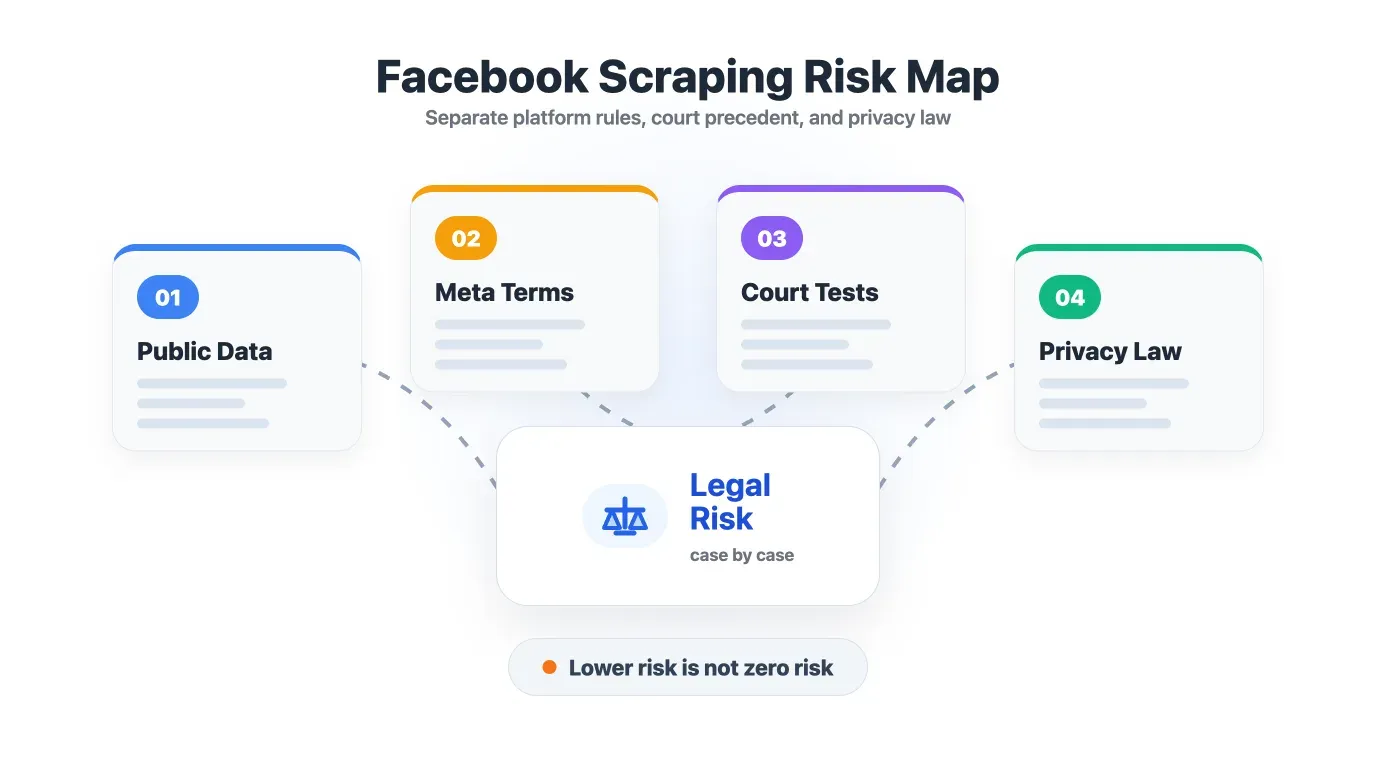
Most of the anxiety around Facebook scraping comes from people who don't separate these two categories. Get this distinction wrong and everything downstream — your risk assessment, your tooling choices, your sleep quality — is off.
Meta's Terms of Service explicitly prohibit automated data collection without prior permission. The terms bar accessing or collecting data using automated means, regardless of whether the collection happens while logged in. Meta also prohibits circumventing, bypassing, or overriding technological measures used to control access.
Clear enough. But violating a company's terms is not the same as violating a statute.
| Dimension | Terms of Service Violation | Legal Violation |
|---|---|---|
| Who enforces it? | Meta (account ban, IP block, cease-and-desist) | Courts, regulators, prosecutors |
| Can it lead to a lawsuit? | Possibly (breach of contract claim) | Yes (statutory liability — CFAA, GDPR, CCPA, BIPA) |
| Does public data change the analysis? | No — Meta's TOS still prohibits it | Often yes — U.S. courts treat public data differently |
| Is jail time possible? | No | Theoretically under CFAA, though extremely rare for scraping |
| Typical consequence | Account disabled, legal letter | Injunction, damages, regulatory fines |
Courts have repeatedly found that a TOS violation, standing alone, does not necessarily equal a legal violation — especially when the data in question was publicly accessible. But a TOS violation can support a breach-of-contract claim, which is a civil matter between you and Meta. And if privacy laws apply (they often do), the legal layer gets thicker.
Keep this dual lens in mind for everything that follows: what does Meta's policy say, and what does the law actually say?
What U.S. Courts Have Actually Ruled: A Facebook Scraping Legal Timeline
I couldn't find a single article that consolidates the full chronological history of Facebook/Meta scraping enforcement. So here it is in one place.
| Case / Event | Year | What Happened | Key Takeaway |
|---|---|---|---|
| Facebook v. Power Ventures | 2009–2016 | Court found scraping behind login + impersonation violated CFAA after cease-and-desist | Credentialed access + ignoring a cease-and-desist letter = legally dangerous |
| Van Buren v. United States | 2021 | Supreme Court narrowed CFAA's "exceeds authorized access" provision | CFAA targets bypassing access gates, not misusing accessible data |
| hiQ Labs v. LinkedIn | 2017–2022 | 9th Circuit: scraping public profiles ≠ CFAA violation | Public data scraping has strong legal footing in the U.S. |
| Facebook 533M scraping incident | 2021 | Scrapers exploited contact import feature; data on ~533M users leaked | Irish DPC fined Meta €265M for insufficient data protections |
| Meta v. Bright Data | 2023–2024 | Court ruled logged-out scraping of public data did not violate Meta's TOS | TOS cannot easily prohibit access to data available without login |
| Clearview AI settlements | 2020–2024 | Multiple lawsuits/fines for scraping facial data from social platforms | Biometric/personal data scraping triggers severe regulatory action |
The legal landscape is still evolving — future rulings, legislative changes (including potential U.S. federal privacy law and the EU AI Act's implications for training data), and updated Meta terms could shift the picture. But as of July 2026, this timeline captures where things stand.
Disclaimer: This article provides legal information, not legal advice. Consult an attorney for your specific situation.
hiQ v. LinkedIn: The Ruling That Changed Public Data Scraping
Public-data scrapers cite hiQ Labs v. LinkedIn like scripture.
hiQ Labs built a business analyzing publicly available LinkedIn profile data to predict employee turnover. LinkedIn sent a cease-and-desist letter and blocked hiQ's access. hiQ sued for an injunction, arguing LinkedIn couldn't use the CFAA — a federal anti-hacking statute — to prevent scraping of public web pages.
The CFAA (Computer Fraud and Abuse Act) was originally designed to combat computer hacking. Its key provision makes it illegal to access a computer "without authorization" or in a way that "exceeds authorized access." The question: does scraping a public website count as "without authorization"?
The Ninth Circuit said no — twice. After the Supreme Court's 2021 Van Buren decision narrowed the CFAA's scope (adopting a "gates up or down" framework where the statute targets bypassing access barriers, not merely using accessible data for disapproved purposes), the Ninth Circuit reaffirmed that scraping publicly available data does not violate the CFAA.
The reasoning was straightforward: LinkedIn profiles were public. No login required. No gate to bypass. The CFAA doesn't reach information that's freely accessible to anyone with a browser.
How does this map onto Facebook? Carefully — and incompletely. LinkedIn profiles were fully public by default. Facebook has a mix of public and private data, with privacy settings that vary per user and per content type. The hiQ precedent is strongest when applied to Facebook data that is genuinely public — visible to any logged-out visitor without any authentication. It's weakest when applied to content behind a login wall, in private groups, or on profiles with restricted visibility.
One important caveat: hiQ survived the CFAA challenge, but LinkedIn later prevailed on breach-of-contract grounds. The CFAA and contract claims are separate legal theories, and winning on one doesn't guarantee winning on the other.
Meta v. Bright Data: When the Court Sided with the Scraper
Meta v. Bright Data is the most directly relevant Facebook-specific case — and the one most articles underreport.
Bright Data (a data collection company) scraped public Facebook and Instagram data while logged out. Meta sued, primarily on a breach-of-contract theory — arguing that Bright Data violated Meta's Terms of Service.
In January 2024, Judge Edward Chen granted summary judgment for Bright Data on Meta's breach-of-contract claim. The court's reasoning:
-
Meta's TOS applies to users of Meta's services. Bright Data's relevant scraping was conducted while logged out. The court found that logged-out scraping of public data did not constitute "use" of Facebook/Instagram services as defined by the terms.
-
CAPTCHAs are not login walls. Meta argued that its anti-bot measures (CAPTCHAs, rate limits) showed Bright Data was circumventing access controls. The court distinguished between a CAPTCHA (which deters automation) and a login requirement (which restricts access to authorized users). As legal commentators noted, the court essentially said Meta "left the gate open" for public data.
-
The ruling is narrow and fact-specific. It addressed Meta's contract claim on the record before the court. Other claims (tortious interference, unjust enrichment) were still pending. Meta could update its terms. And the ruling doesn't address privacy law obligations at all.
What this means in practice: if data is publicly accessible without a login, Meta's TOS-based contract claim is significantly weaker — at least under these facts and this court's reading. But "weaker" is not "nonexistent," and this is one district court ruling, not a Supreme Court precedent.
Lowenstein Sandler's analysis emphasizes the unanswered questions: what about data behind login, updated terms, or other legal theories? Meta later moved to drop the case rather than appeal, which some interpret as a strategic retreat rather than an endorsement of the ruling's logic.
The 2021 Facebook Data Breach: 533 Million Records and What It Means for Scrapers
In April 2021, a dataset containing personal information on roughly 533 million Facebook users across 106 countries surfaced online. The data included phone numbers, Facebook IDs, full names, locations, birthdates, bios, and (in some cases) email addresses.
The scrapers had exploited Facebook's contact import feature — a tool designed to help users find friends by uploading their phone contacts. By systematically feeding phone numbers into the tool, they matched numbers to profiles and extracted the associated data.
The regulatory response was significant. The Irish Data Protection Commission (DPC) opened an inquiry and found Meta in breach of GDPR Article 25(1) and 25(2) — data protection by design and by default. The DPC imposed administrative fines totaling €265 million on Meta Platforms Ireland, along with corrective measures.
The twist that matters for scrapers: Meta was fined, not the scrapers. The DPC's action targeted Meta for failing to adequately protect user data from scraping. But the broader lesson is clear — scraping personal data at scale draws regulatory attention. Even if you personally aren't prosecuted, the data subjects and regulators are watching. And if you're the one holding or distributing scraped personal data, you could face your own regulatory exposure.
This incident is especially relevant for anyone whose intent is commercial — say, building a searchable database of leads from Facebook profiles. The scale and nature of the data matter enormously. Scraping 50 public business page addresses is a very different risk profile than scraping 500,000 user phone numbers.
GDPR, CCPA, and International Privacy Laws: The Layer Most People Forget
Clearing the CFAA hurdle is only half the problem. Privacy regulations add a separate — and often more consequential — layer of risk.
GDPR (EU/UK)
If you scrape data about people in the EU or UK, GDPR applies regardless of where you're located. Key provisions:
- Article 6 requires a lawful basis for processing personal data. "It was public" is not a lawful basis by itself — you need legitimate interest, consent, or another recognized ground.
- Article 14 requires you to inform data subjects when you collect their personal data from a source other than them directly. Scraping thousands of profiles without notification is a compliance problem.
- Article 9 imposes stricter rules for special-category data: political opinions, religious beliefs, health data, biometric data for identification. Facebook data can reveal or imply all of these.
"Publicly visible" does not mean "free to process for any purpose" under GDPR. It's the single biggest misconception in scraping discussions, and it trips up otherwise careful teams constantly.
CCPA / CPRA (California)
California's privacy law applies to for-profit businesses doing business in California that meet certain thresholds (e.g., gross annual revenue over $25 million, or buying/selling personal information of 100,000+ California residents). If you scrape Facebook data that includes California residents' personal information and you meet those thresholds, CCPA obligations kick in.
BIPA (Illinois)
If your workflow touches facial images, profile photos, or any biometric identifiers, Illinois' Biometric Information Privacy Act creates severe liability. Clearview AI's experience (discussed below) is the cautionary tale here. Don't collect facial data from Facebook. Just don't.
Jurisdiction Complexity
Where you operate, where the data subjects are located, and where you store the data all matter. A scraper based in Texas collecting data about German Facebook users is still subject to GDPR for that data. This isn't a hypothetical — it's how enforcement works.
Is YOUR Facebook Scraping Legal? A Step-by-Step Decision Framework
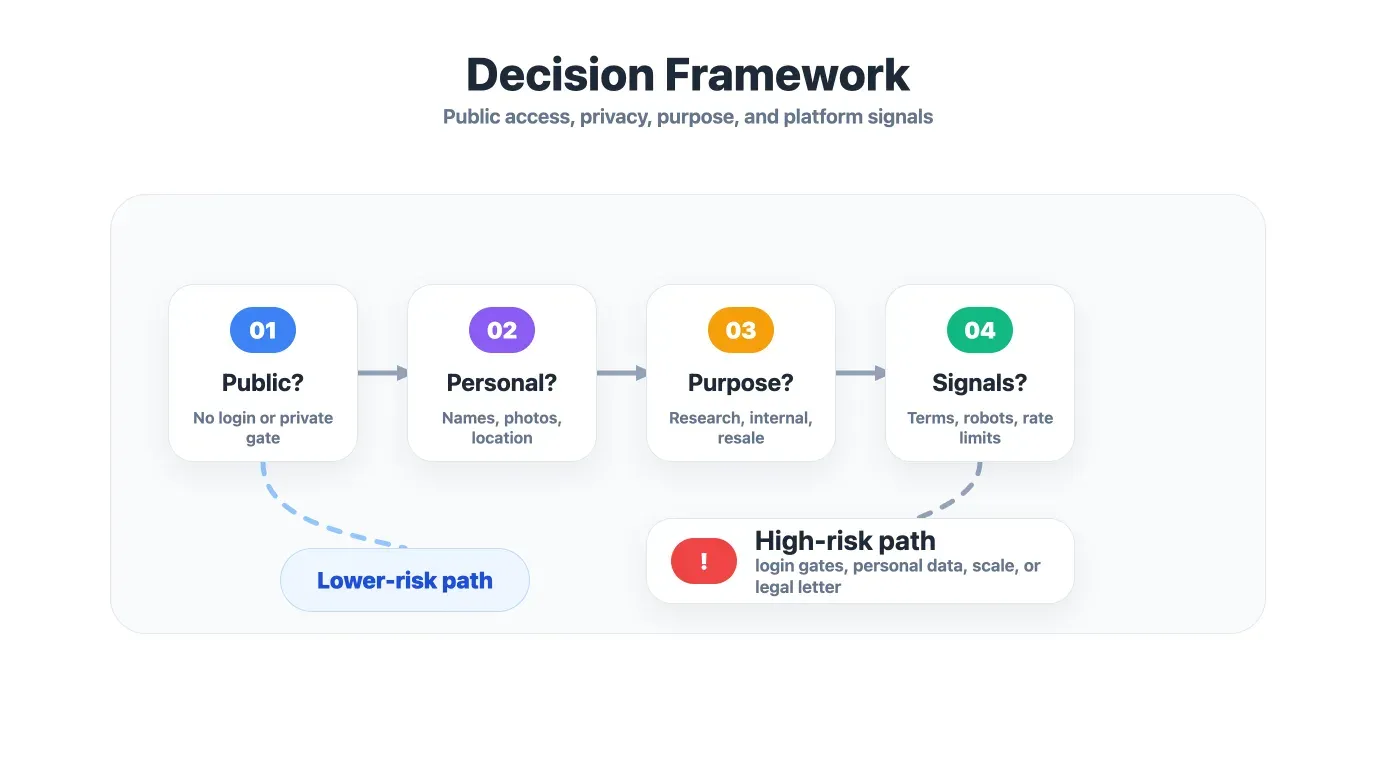
After reviewing forum discussions and SERP patterns on this topic, the pattern is obvious: people want a practical way to assess their own situation, not another "it depends" hedge. So here's a structured decision framework. (This is a risk-assessment tool, not legal advice.)
Step 1: Is the Data Publicly Accessible Without a Login?
- If NO (requires login, group membership, friend connection, or authentication): HIGH risk. Potential CFAA exposure, strong TOS breach claim, possible criminal liability in extreme cases.
- If YES (visible to any logged-out browser visitor): Lower CFAA risk. Proceed to Step 2.
Step 2: Does the Data Include Personal Information?
- Names, emails, phone numbers, photos, birthdates, user IDs, location data = personal data.
- If YES: GDPR, CCPA, BIPA, and other privacy law obligations apply. You need a lawful basis for processing. Risk level: moderate to high, depending on scale and sensitivity.
- If NO (e.g., aggregate business-level data, product prices, event dates without attendee info): Lower privacy risk.
Step 3: What Is Your Jurisdiction?
- U.S.: CFAA + state privacy laws (CCPA, BIPA, state computer crime statutes).
- EU/UK: GDPR / UK Data Protection Act + Computer Misuse Act.
- Other: Local data protection and computer crime laws vary. Research your jurisdiction.
- Remember: the data subjects' location matters, not just yours.
Step 4: What Is Your Intended Use?
- Academic research (non-commercial, public interest): Lower risk profile, especially with IRB approval and anonymization.
- Internal competitive intelligence (not resold): Moderate risk.
- Commercial SaaS / data broker / lead database: Highest scrutiny. Regulatory and litigation risk increases sharply.
- AI/LLM training: Emerging area with additional copyright and privacy questions.
Step 5: Are You Respecting Rate Limits and robots.txt?
- Facebook's robots.txt states that automated data collection is prohibited and references Meta's Automated Data Collection Terms.
- Compliance with robots.txt and rate limits strengthens your legal defense. Aggressive scraping that disrupts the platform's operations creates additional liability.
- Ignoring robots.txt doesn't automatically make scraping illegal, but it makes you look less reasonable if the issue ever reaches a courtroom.
Bottom line: The more "yes" answers you give to the risk factors (login required, personal data, commercial use, high volume, ignoring technical signals), the higher your legal and practical risk. No single factor is a bright-line rule — it's the combination that matters.
What Happens If You Get Caught: Real Consequences
Consequences range from mildly annoying to business-threatening, depending on the facts.
- Technical blocks: CAPTCHAs, IP bans, rate limits, browser fingerprinting. Meta's anti-scraping team has over 100 people dedicated to detecting and blocking automated collection.
- Account suspension: If you're using a logged-in account, expect it to be disabled.
- Cease-and-desist letters: Meta has a track record of sending these. Ignoring one significantly increases your legal exposure (see Power Ventures).
- Civil lawsuits: Meta has sued scrapers directly — Power Ventures, Bright Data, and others. Even if you ultimately prevail (as Bright Data did on the contract claim), defending a federal lawsuit is expensive and time-consuming.
- Regulatory fines: GDPR fines can reach up to 4% of global annual revenue or €20 million, whichever is higher. The Italian data protection authority fined Clearview AI €20 million. The Dutch DPA fined Clearview €30.5 million in 2024.
- Criminal prosecution: Extremely rare for scraping, but theoretically possible under CFAA for accessing data behind authentication, especially after a cease-and-desist.
- Reputational damage: If your company is publicly associated with a scraping lawsuit or data breach, the business impact extends well beyond legal costs.
Even when the legal theory is defensible, the cost of defense matters. A small business facing a Meta lawsuit is in a very different position than Bright Data, which has the resources to litigate for years.
Safer Alternatives to Collecting Facebook Data
Official Options
For assets your organisation administers, assess Meta's official management tools and APIs. Eligible researchers can also review Meta's research-access programmes. These routes have defined access models and are preferable to unauthorised automation.
Permitted Non-Meta Sources
For leads, pricing, local-business research, and market discovery, start with public business directories, merchant sites, government registries, publisher sites, or licensed datasets whose terms and privacy obligations can be assessed directly.
A Note on Product Boundaries
Thunderbit is designed for permitted public-web workflows outside Meta products. It does not provide Facebook, Instagram, Threads, Messenger, WhatsApp, or Meta Ad Library data collection, account connection, or bypass functionality.
So, Is Scraping Facebook Legal in 2026?
There's no binary yes-or-no. The answer depends on a combination of factors:
- Scraping publicly accessible, logged-out Facebook data is not automatically illegal under U.S. law. The hiQ and Bright Data precedents support this, and the Van Buren decision narrows CFAA exposure for public data.
- But it almost certainly violates Meta's Terms of Service, which can result in account bans, IP blocks, cease-and-desist letters, and breach-of-contract claims.
- Personal data triggers additional obligations under GDPR, CCPA, BIPA, and other privacy laws — regardless of whether the data was "public." "Publicly visible" is not a privacy-law safe harbor.
- The type of data, your jurisdiction, whether you use a login, and your intended use all affect the legal analysis. There is no one-size-fits-all answer.
- For many business needs, there are safer alternatives — official APIs for authorized use cases, or scraping public data from lower-risk sources using tools like permitted non-Meta public sources.
U.S. case law is trending toward protecting public data scraping from CFAA liability. Privacy regulation is trending the opposite direction — toward stricter protection of personal data, even when publicly accessible. Facebook scraping sits squarely at the collision point.
If you're gathering leads, monitoring competitors, or tracking pricing, my honest recommendation: check whether the data you need exists on public sources outside Facebook first. The legal risk is lower, the technical barriers are fewer, and permitted non-Meta public sources make extraction straightforward. Save Facebook scraping for the narrow cases where no alternative exists — and even then, review the decision framework above with a lawyer.
Key Takeaways
- TOS violation ≠ legal violation. Meta prohibits automated collection, but courts have ruled that scraping public, logged-out data is not automatically a CFAA crime.
- Public, logged-out data has the strongest legal footing in the U.S. under current case law (hiQ, Bright Data, Van Buren).
- Login-gated data, personal data, and biometric data carry significantly higher risk — both legally and regulatorily.
- Privacy laws (GDPR, CCPA, BIPA) apply independently of whether the data was public. "Public" ≠ "free to use."
- Meta actively enforces its anti-scraping policies with a team of 100+ people, legal action, and technical countermeasures.
- The 2021 breach (533M records, €265M fine) shows that personal data scraping at scale draws serious regulatory consequences — even for the platform, not just the scraper.
- Safer alternatives exist: official APIs for authorized use, Meta Content Library for researchers, and permitted non-Meta public sources for extracting equivalent business data from lower-risk public sources.
FAQs
Can I scrape Facebook Marketplace listings legally?
It depends. If the listings are publicly visible without logging in, you have a stronger legal position under U.S. CFAA precedent. However, Marketplace listings often include seller names, phone numbers, and location data — all personal data under GDPR and CCPA. Commercial use of that personal data creates privacy-law obligations. A lower-risk approach is to check whether the same listing data (product type, price range, location) is available from a public source outside Facebook.
Is scraping Facebook groups legal?
Most Facebook groups are private or closed, meaning they require login and group membership to access content. Scraping private group content carries high CFAA and TOS risk — you're accessing data behind an authentication gate. Public group content (visible to logged-out visitors) has a lower CFAA risk profile, but still violates Meta's terms and may involve personal data subject to privacy laws.
Does Facebook's robots.txt allow scraping?
No. Facebook's robots.txt explicitly states that automated data collection is prohibited and references Meta's Automated Data Collection Terms. Robots.txt is a technical/policy signal, not a statute — ignoring it doesn't automatically make scraping illegal, but it weakens your legal position if the issue is ever litigated.
Can I use scraped Facebook data for commercial purposes?
Commercial use significantly increases your risk profile. Under GDPR, using scraped personal data for commercial lead generation requires a lawful basis (and "legitimate interest" is not automatic). Under CCPA, selling or sharing personal information triggers additional obligations. Courts and regulators scrutinize commercial use more heavily than academic or personal use. If your commercial need is for business contact info or pricing data, consider sourcing it from public directories or ecommerce sites where the legal and TOS risk is lower.
What's the difference between scraping Facebook and using the Facebook API?
The Facebook Graph API is Meta's authorized data access path — you request permission, Meta reviews your app, and you access data within defined scopes and rate limits. Scraping bypasses this authorization process and collects data directly from web pages. The API is compliant by design (within its terms); scraping is not authorized by Meta and violates its TOS. The tradeoff: the API is heavily restricted and doesn't cover many data types businesses want, while scraping offers broader access but carries legal, technical, and policy risk.
Learn More




