

The cheapest listing is not the cheapest purchase. That single sentence probably saves you more money than the rest of this article combined — but stick around anyway.
I've spent a lot of time helping our team at Thunderbit research sourcing platforms, and the pattern I keep seeing in forums, seller communities, and our own product data is the same: someone finds a $0.40 phone case on Alibaba, gets excited, then discovers that shipping, customs brokerage, and minimum order quantities push the real cost above what they'd pay on AliExpress for the same item. One Reddit user put it bluntly: "added items to my basket on AliExpress instead and it's working out considerably cheaper."
Another flagged that Alibaba "shipping was prohibitively expensive because they insisted on express shipment." The truth is, "cheaper" depends on your order size, product category, shipping method, and where you are in your business journey. This guide breaks down the real cost comparison — with worked examples, category-specific recommendations, and 2026 platform updates — so you can make a decision based on landed cost, not listing price.
What Is Alibaba and What Is AliExpress?
Both platforms are owned by Alibaba Group, but they serve fundamentally different buyers.
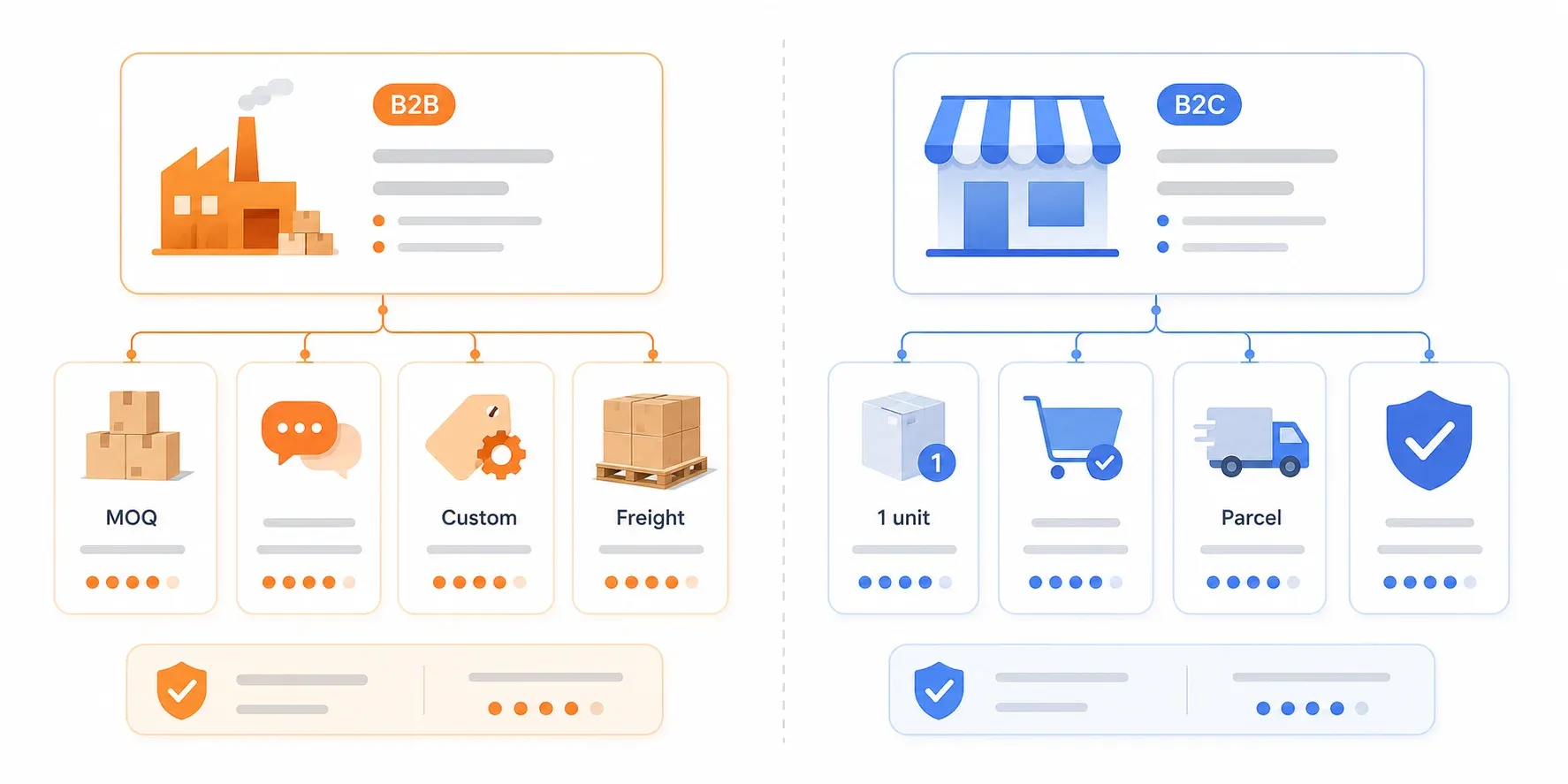
Think of Alibaba.com as the factory floor showroom: a B2B wholesale marketplace where businesses negotiate prices, place bulk orders, customize products, and build supplier relationships. AliExpress is the retail storefront — a B2C marketplace where anyone can buy a single item at a fixed price with parcel-level delivery.
The confusion comes from the shared parent company and overlapping product catalogs. But the buying experience, cost structure, and logistics are different enough that picking the wrong one can cost you hundreds on a single order.
How Alibaba Works for Business Buyers
Alibaba.com is built for sourcing. Listings show minimum order quantities (MOQs), sample pricing, customization options, supplier certifications, and shipping terms. MOQs typically range from 50 to 500+ units for standard products, and 500 to 1,000+ for private-label or custom-packaged goods. Buyers can negotiate unit price, packaging, lead time, and Incoterms (more on those later).
The platform's buyer protection mechanism is Trade Assurance, which covers quality and delivery claims — but only when the order is placed and paid through the Trade Assurance flow with documented specs. The typical Alibaba buyer is a small or midsize business stocking inventory, building a private label, or establishing a recurring manufacturing relationship.
How AliExpress Works for Individuals and Small Sellers
AliExpress strips away most wholesale friction. There's usually no MOQ, pricing is fixed (with coupons and platform discounts), checkout accepts cards and PayPal in many markets, and delivery tracking is built in. AliExpress Buyer Protection generally lets buyers open disputes if an order doesn't arrive or doesn't match the listing.
The AliExpress Choice program is worth noting for 2026: Choice items are selected for faster fulfillment, easier checkout, and more standardized service. In many markets, Choice products show faster delivery promises and simplified returns compared with ordinary listings. The typical AliExpress buyer is an individual consumer, a dropshipper, a small seller testing demand, or a business operator who needs small quantities before committing to wholesale.
Alibaba vs AliExpress: Key Differences at a Glance
Here's a quick-reference comparison. Fair warning: this table alone won't tell you which platform is cheaper. The landed-cost math below does that.
| Dimension | Alibaba.com | AliExpress |
|---|---|---|
| Business model | B2B wholesale sourcing | B2C/small-order retail |
| MOQ | Typically 50–500+ units | Usually 1 unit |
| Pricing model | Negotiated quotes, tiered pricing, RFQ | Fixed retail price, coupons, Choice deals |
| Negotiation | Expected and common | Limited |
| Customization | Strong: logos, packaging, specs, private label | Limited; mostly ready-made goods |
| Buyer protection | Trade Assurance (on protected orders) | Buyer Protection / dispute process |
| Shipping options | Express, air cargo, sea freight, DDP/FOB/CIF | Cainiao, AliExpress Standard, Choice logistics |
| Customs handling | Often buyer-managed or forwarder-managed | Often simplified; duties may be collected at checkout |
| Typical buyer | SMBs, importers, private-label sellers | Consumers, dropshippers, product testers |
| 2026 evolution | Accio AI for sourcing, stronger Trade Assurance | Choice fast delivery, business buying features |
Alibaba gives you more control and lower production pricing at scale. AliExpress gives you lower friction and lower risk for small orders. But the real question is total cost — and that's where most guides stop short.
The Landed Cost Reality Check: Unit Price Alone Is Misleading
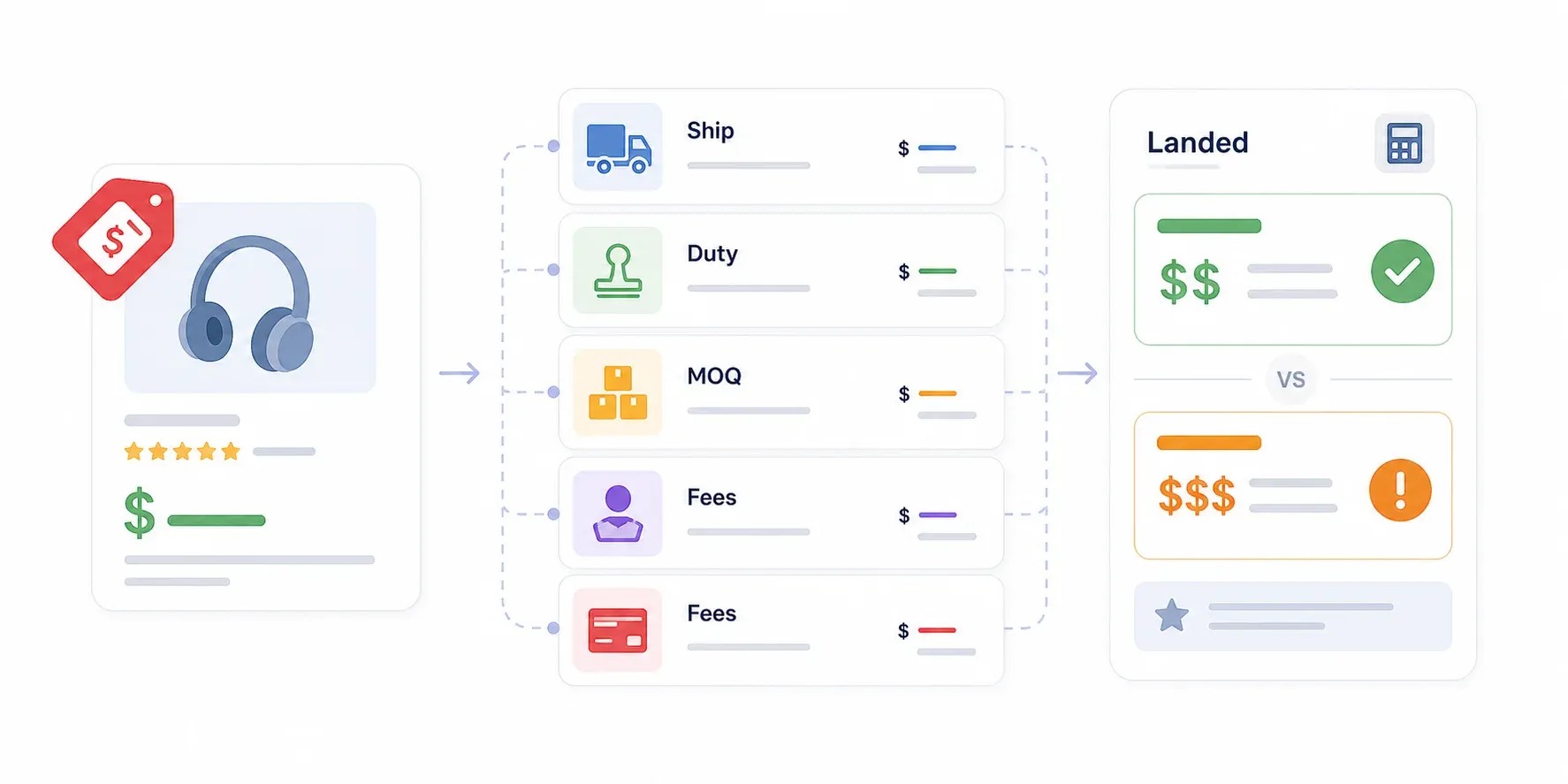
"Landed cost" is what you actually pay to get a product to your door: unit price + shipping + customs duties + brokerage fees + payment fees. Most Alibaba vs AliExpress comparisons only look at the first number.
That's like comparing apartment rents without checking if utilities are included.
Shipping Costs: Where the Alibaba vs AliExpress Gap Narrows
Alibaba shipping is flexible but complicated. Buyers may see options like DHL, FedEx, UPS, air freight, sea freight, or forwarder-arranged DDP. Express couriers are fast but expensive for small batches. Sea freight is cheap per unit, but only when there's enough volume to fill meaningful cargo space.
AliExpress shipping is simpler and often appears "free" — but the cost is embedded in the retail price. That embedded model is exactly why AliExpress can beat Alibaba for small orders: you're buying a parcel product, not arranging an import shipment.
Cainiao, AliExpress Standard Shipping, and Choice fulfillment flows handle the logistics behind the scenes.
Customs, Duties, and Brokerage Fees
On Alibaba, the buyer is typically responsible for customs clearance. Depending on the shipment, you may need a customs broker, which can cost $50–$150+ per entry. Courier disbursement and entry-related charges can add $30–$100+ on top of that. For first-time importers, these costs are often a surprise.
On AliExpress, duties and import taxes are frequently bundled into the checkout price or collected at the point of sale, especially for Choice sellers and in markets with tax-collection agreements. That doesn't mean duties disappear — it means you see fewer separate invoices.
A quick Incoterms primer (because Alibaba suppliers will use these terms):
- EXW (Ex Works): Supplier makes goods available at the factory. You handle everything after that. Looks cheap; rarely beginner-friendly.
- FOB (Free On Board): Supplier gets goods to the port. You pay main freight, import clearance, and delivery.
- CIF (Cost, Insurance, Freight): Supplier pays freight and insurance to the destination port. You still handle import clearance.
- DDP (Delivered Duty Paid): Seller or forwarder handles shipping, duties, and delivery. Simpler, but the cost is baked into the quote.
The Break-Even Math: When Alibaba Actually Becomes Cheaper
Here's a worked example for a lightweight consumer item (like a phone case) shipped to the US. These are 2026 estimates to show the cost mechanics, not supplier quotes.
| Quantity | Alibaba unit price | Alibaba shipping/clearance | Alibaba landed total | Alibaba per unit | AliExpress checkout price | AliExpress landed total | AliExpress per unit | Cheaper? |
|---|---|---|---|---|---|---|---|---|
| 10 units | $0.40 | $65 express + no broker | $69 | $6.90 | $4.20 each (shipping bundled) | $42 | $4.20 | AliExpress |
| 100 units | $0.10 | $180 air + $30 handling | $220 | $2.20 | $3.80 each (coupons applied) | $380 | $3.80 | Alibaba |
| 500 units | $0.78 | $420 air/sea + $120 broker | $930 | $1.86 | $3.20 each (bulk coupons) | $1,600 | $3.20 | Alibaba |
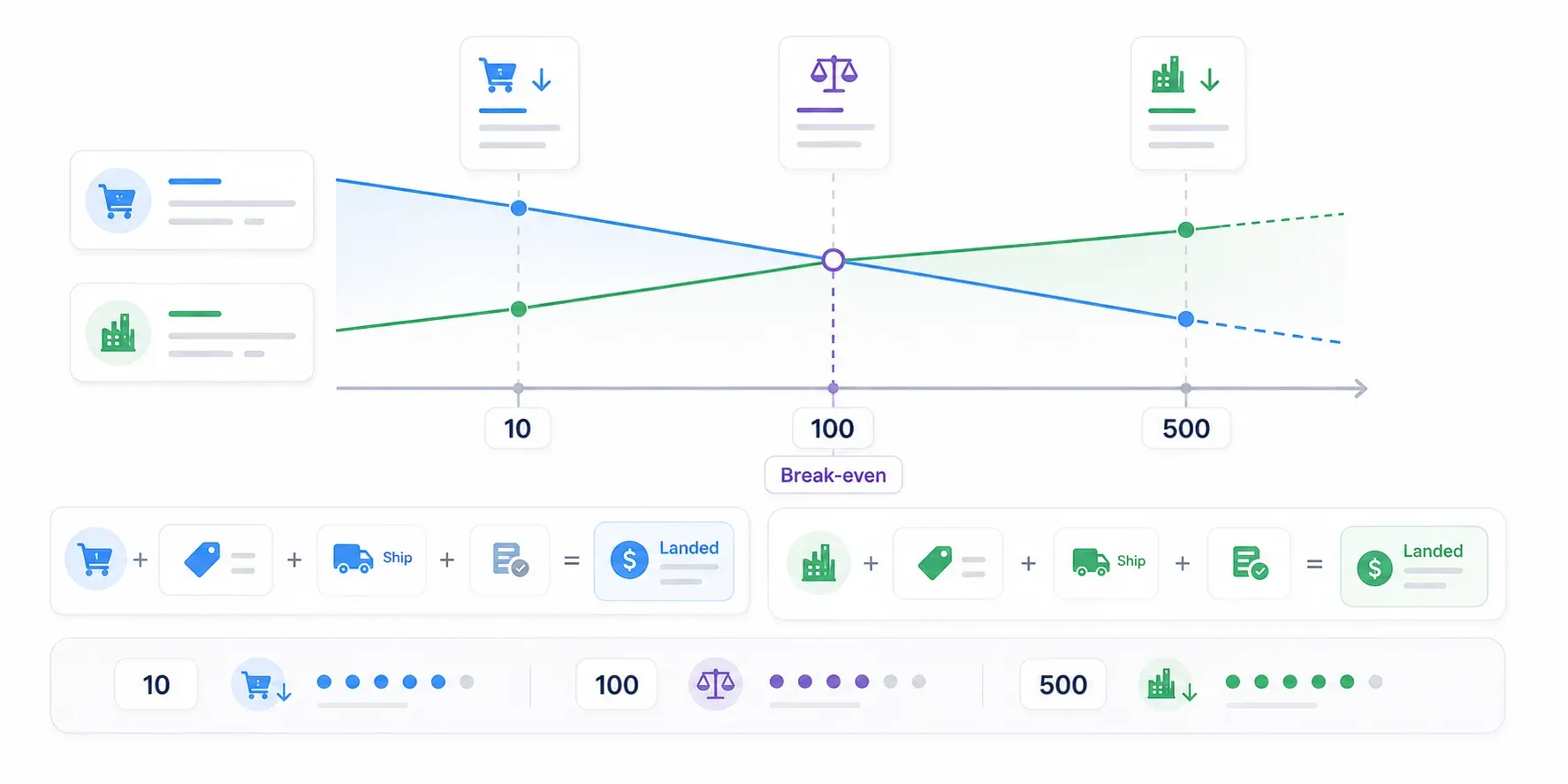
The break-even in this model lands around 75–120 units. But that threshold shifts by category:
- Lightweight accessories: Alibaba may win at 100–200 units.
- Bulky home goods: Alibaba may not win until 500+ units because dimensional weight and freight minimums dominate.
- Fashion and trend goods: AliExpress stays attractive longer because it lets you test many SKUs without dead inventory.
For orders under roughly 100 units, AliExpress often wins on total cost. Above 200–500 units, Alibaba's wholesale pricing advantage kicks in.
Alibaba vs AliExpress by Product Category: Which Platform Wins?
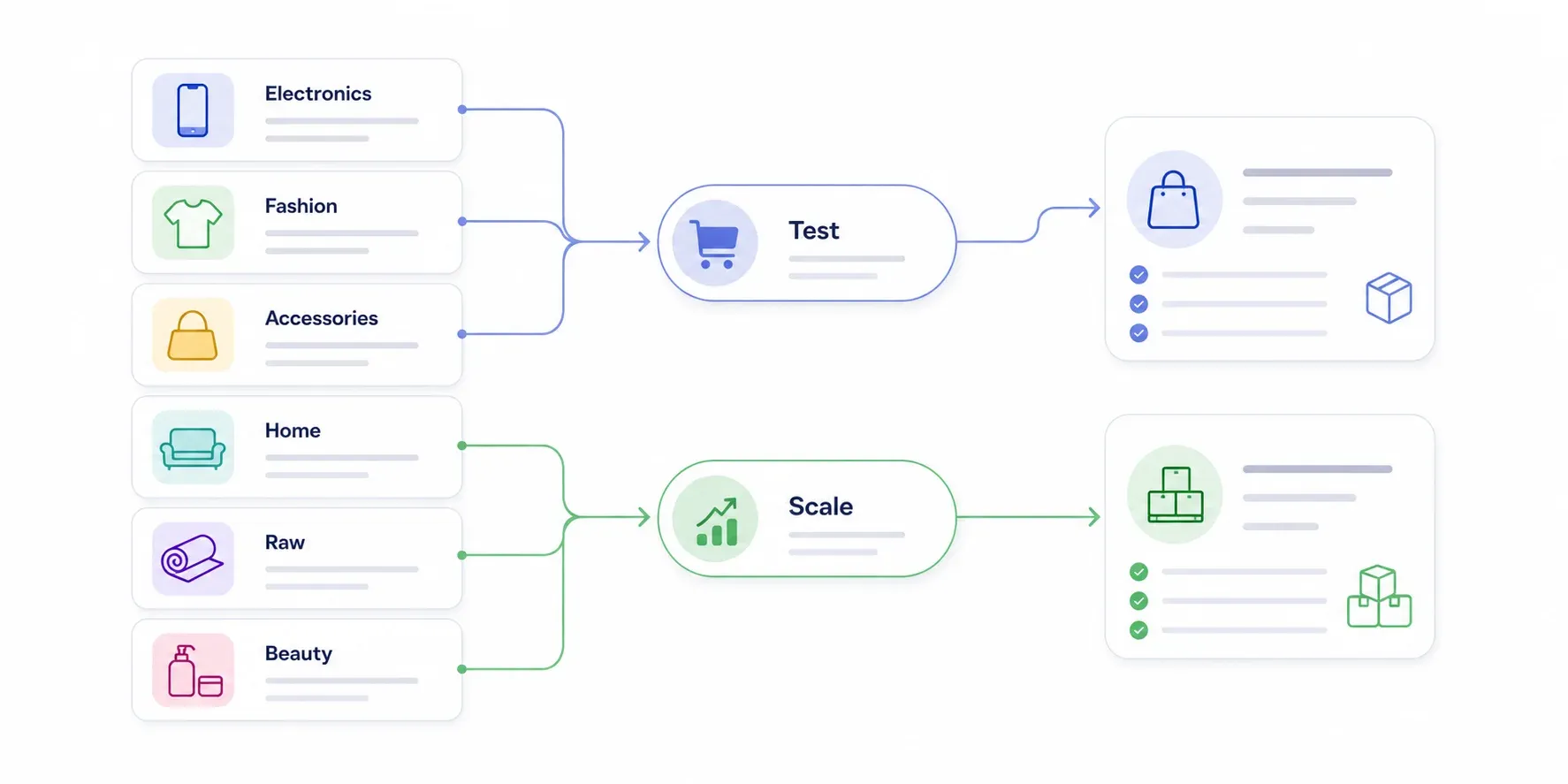
I haven't found a single top-ranking article that breaks this down by product niche. That's a problem, because the right platform depends heavily on what you're sourcing.
| Product Category | Better for Testing | Better for Scaling | Why |
|---|---|---|---|
| Electronics (components) | Alibaba | Alibaba | Specs, certifications, datasheets, factory relationships |
| Electronics (consumer gadgets) | AliExpress | Alibaba after validation | Single-unit testing, buyer protection on AliExpress; private-label batches on Alibaba |
| Fashion / Apparel | AliExpress for trends | Alibaba for custom runs | Sizing, fabric, and QA risks; test demand before MOQ |
| Fashion accessories (low MOQ) | AliExpress | Alibaba at 100–500+ units | Lightweight, trend-driven; AliExpress is strong for discovery |
| Home goods / décor | AliExpress for small items | Alibaba for bulky wholesale | Shipping density and breakage decide economics |
| Raw materials / industrial | Alibaba | Alibaba | AliExpress isn't built for industrial sourcing |
| Beauty / salon supplies | Both | Alibaba for branding | Ready-to-ship tools fit AliExpress; formulas, packaging, and equipment fit Alibaba |
Electronics: Components vs. Consumer Gadgets
For components like resistors, PCBs, or custom connectors, Alibaba is the better research and sourcing environment. Buyers can request specifications, certifications, and factory documentation. For consumer gadgets — chargers, earbuds, cables, smart accessories — AliExpress is often the better first test. You can order one unit, assess packaging and defects, and compare multiple sellers quickly.
A word of caution: quality variance is high in consumer electronics. Listings may use similar photos while internal components differ. Always test for certifications, plug standards, battery safety, and counterfeit branding risk before scaling.
Fashion and Apparel: Branding vs. Quick Testing
Fashion is where the "test on AliExpress, scale on Alibaba" playbook is easiest to see. AliExpress works for trend testing: sunglasses, hair accessories, jewelry, small bags, seasonal items. Alibaba becomes better when you need custom labels, packaging, fabric changes, size grading, and recurring replenishment.
The hidden cost in apparel: size inconsistency, returns, color mismatch, and fabric hand-feel can destroy margins. Alibaba lets serious sellers control more variables — but only after investing in samples, tech packs, measurements, and inspections.
Home Goods, Raw Materials, and Beauty Supplies
Small decor items and kitchen accessories are good AliExpress validation candidates. Furniture, large storage products, and fragile decor usually need Alibaba-style freight planning.
Raw materials and industrial goods belong on Alibaba. AliExpress may sell small quantities of tools or parts, but it's not a serious procurement channel for recurring industrial supply.
Beauty and salon supplies work on both. Ready-to-ship tools, nail supplies, and brushes can be tested on AliExpress. Private-label cosmetics, salon machines, and branded kits are better suited to Alibaba, where you can request compliance documentation and OEM/ODM support.
What Changed in 2026: Platform Updates That Shift the Decision
Most competing guides still reference 2024 or early 2025 data. The traditional framing — "Alibaba = slow bulk, AliExpress = fast single units" — doesn't hold up as well anymore. Both platforms are converging, and the 2026 landscape requires a more nuanced decision framework.
AliExpress 5-Day Delivery and Overseas Warehouses
AliExpress has invested heavily in Choice and logistics standardization. Choice products now ship from overseas warehouses with faster delivery promises in many markets. AliExpress is no longer automatically a 30-day wait. For small orders and consumer-ready goods, faster Choice items can compete with domestic marketplace delivery expectations.
Alibaba's Accio AI and New Discovery Tools
Alibaba launched Accio, an AI-powered B2B search and sourcing tool that reached 500,000 SME users shortly after launch. It helps business buyers discover products, analyze demand, and identify suppliers faster.
Does Accio make Alibaba cheaper? Not directly. But it reduces the time cost of supplier discovery — and for SMBs, time is a real cost.
AliExpress Business Tier: The New B2B-Lite Option
AliExpress has expanded business-oriented buying experiences with bulk discounts and business account flows. Think of it as B2B-lite: some bulk-style benefits and faster parcel logistics, without entering Alibaba.com's MOQ negotiation and freight world.
This option makes sense when you need 10–100 units, want a simple invoice/checkout flow, and don't need custom packaging or factory negotiation. It's less suitable when you need ODM/OEM, private label, or recurring wholesale contracts.
Updated Tariffs and Fee Structures
Tariffs are the cost variable most likely to change between when I write this and when you read it. For US buyers, the post-2025 treatment of China-origin small parcels, Section 301 tariffs, and de minimis rules are all in flux. For EU buyers, IOSS/VAT collection and the €150 customs duty threshold remain the framework, but reform proposals are ongoing. Check before you buy — tariff rules are too volatile for blanket claims.
The Scaling Playbook: When (and How) to Switch from AliExpress to Alibaba
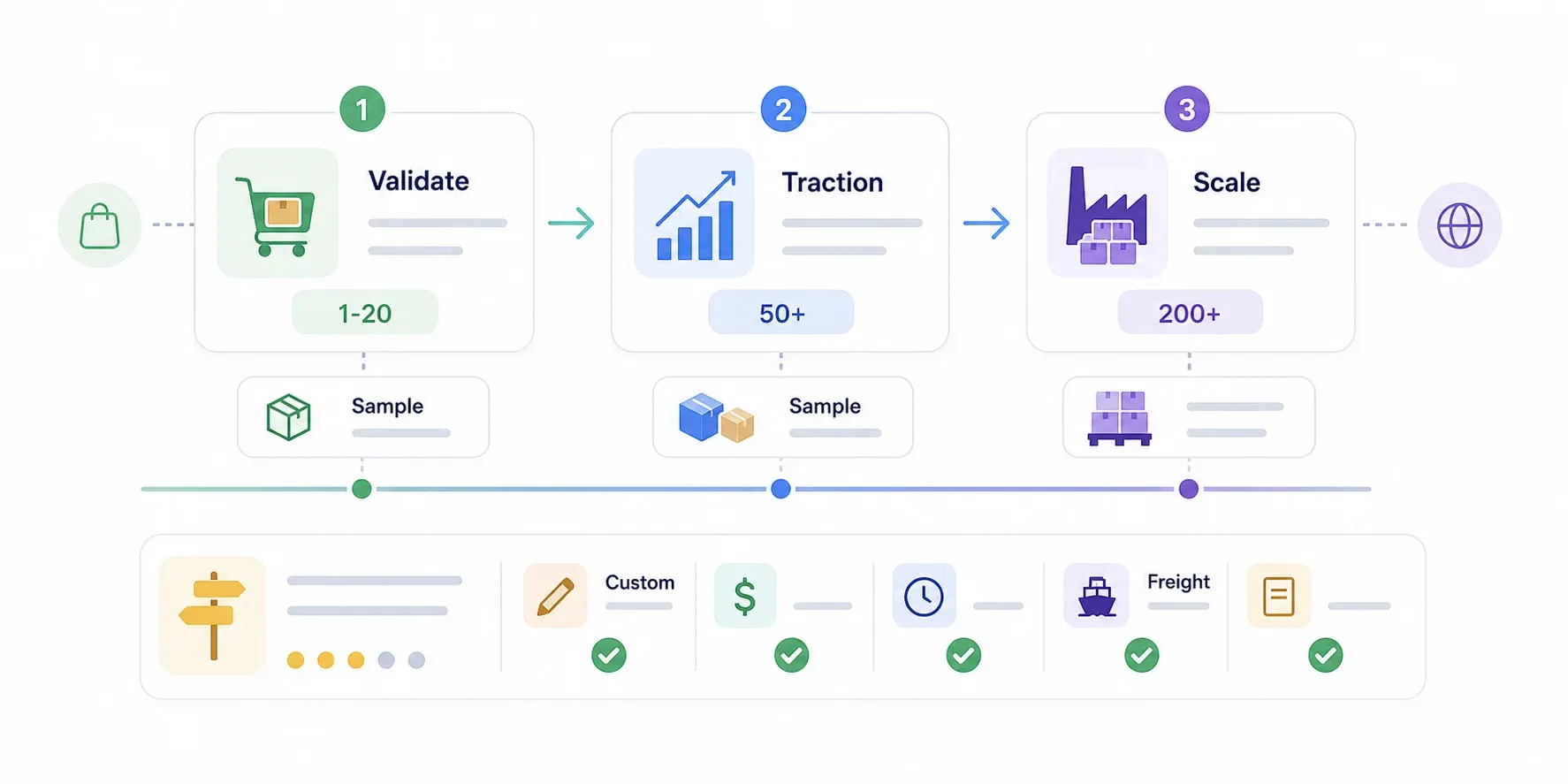
I've watched enough ecommerce sellers go through this cycle that the pattern is pretty clear. It breaks into three stages.
Stage 1: Validation on AliExpress (1–20 Units)
AliExpress is the right default when you're testing demand, product quality, packaging, and customer response. Order from at least 3–5 sellers to compare packaging, quality, shipping speed, and defect rates. Track the true delivered cost, not the list price. Save product photos, listing claims, and packaging notes — you'll need them later.
One thing to keep in mind: don't assume the AliExpress seller is the manufacturer. Many are resellers.
Stage 2: Traction (50+ Units per Month)
Once a product sells consistently, start requesting Alibaba samples. Compare AliExpress units against Alibaba samples side by side. Look for differences in material, color, packaging, labeling, defect rate, and lead time. This is also the right time to build a supplier comparison sheet — which is where structured data extraction starts to matter (more on that below).
Supplier-vetting advice:
- Prefer suppliers with documented business licenses, verification badges, transaction history, and detailed specs.
- Ask whether they're a manufacturer, trading company, or hybrid.
- Request factory photos or video calls for custom work.
- Use Trade Assurance and keep all agreed specs in the order contract.
- Always buy samples before placing a production order.
Stage 3: Scale on Alibaba (200+ Units per Month)
Alibaba makes financial sense when you need recurring inventory, custom branding, negotiated pricing, and control over packaging. At this stage, you should be ready for freight forwarding, customs brokerage, quality inspections, payment terms, and inventory planning. The hidden requirement isn't just money — it's operational maturity.
The Switch Signals Checklist
| Signal | Why It Matters |
|---|---|
| Consistent monthly sales volume | Reduces dead-inventory risk |
| Need for custom logo, packaging, or specs | AliExpress is mostly ready-made; Alibaba supports OEM/ODM |
| Enough capital for MOQ and freight | Wholesale savings require upfront cash |
| Ability to wait for production lead time | Alibaba orders often need production + freight time |
| Willingness to manage freight and customs | Logistics complexity is part of the savings |
| Repeatable quality requirements | Scaling requires documented specs, samples, and inspections |
How to Compare Products Across Alibaba and AliExpress (Without Losing Your Mind)
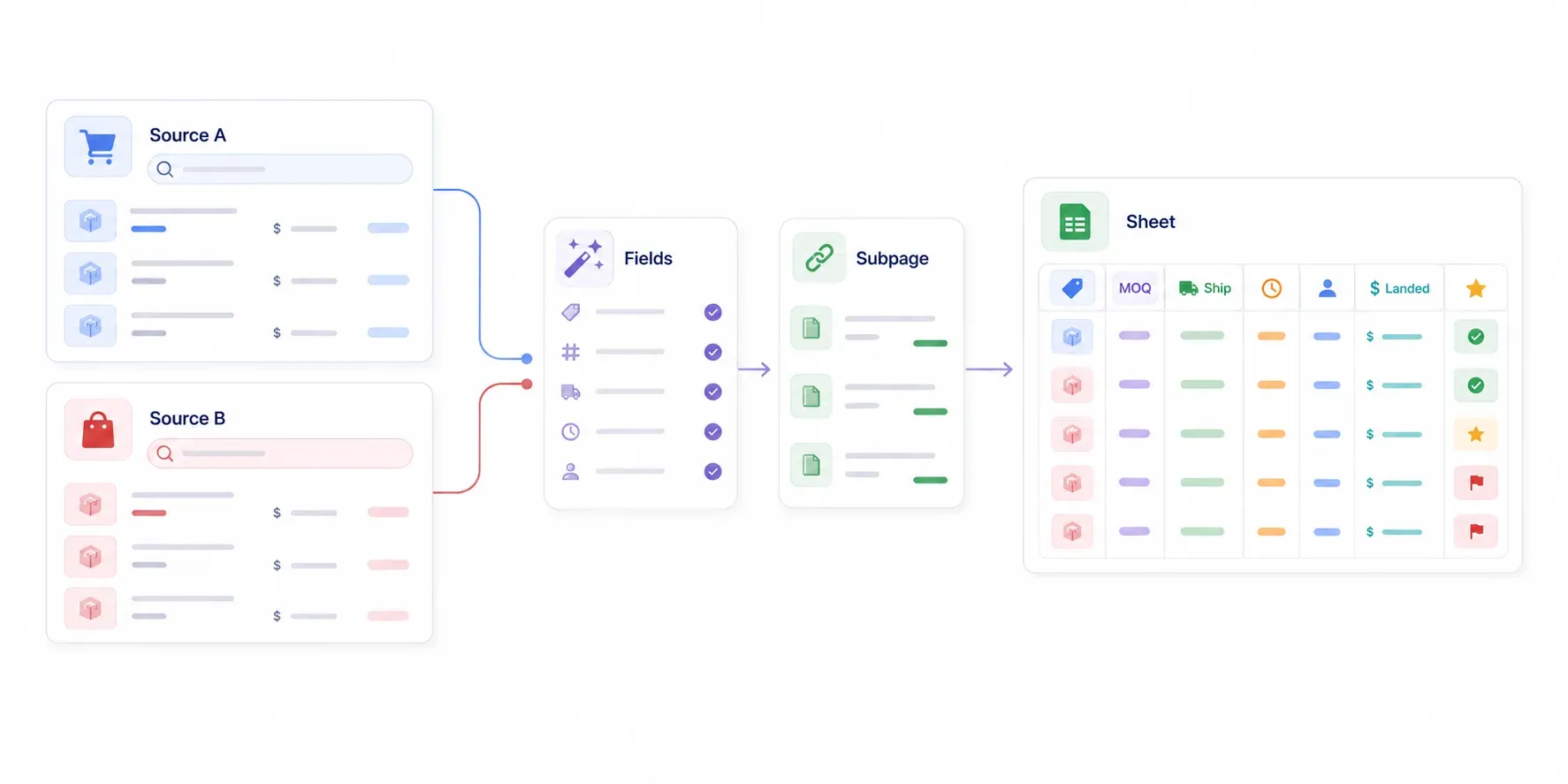
Most guides skip this part entirely: the actual workflow for comparing products across both platforms.
If you're sourcing a single product, a few browser tabs and a notepad might work. But if you're comparing dozens or hundreds of SKUs — which is common for ecommerce operators — the manual approach breaks down fast.
The Manual Approach (and Why It Breaks Down)
The typical workflow goes like this: search on both sites, open dozens of tabs, copy product names and prices into a spreadsheet, realize the fields don't line up, lose track of which tab is which, and eventually give up or settle for incomplete data.
Alibaba shows MOQ, supplier years, certifications, and sample pricing. AliExpress shows sold count, Choice badge, delivery promise, and coupons. Without structure, the comparison becomes a screenshot pile.
Using Thunderbit to Scrape and Compare Alibaba vs AliExpress Data
Scrape and compare marketplace data with AI Get Started Free
This is where Thunderbit fits naturally. The comparison problem is fundamentally a data-structuring problem — you need to turn messy marketplace pages into a clean, comparable spreadsheet. (I work here, so take the recommendation with appropriate seasoning, but the workflow genuinely solves this.)
Here's the practical workflow:
- Search your product keyword on both Alibaba.com and AliExpress.
- Open the Thunderbit Chrome Extension on each search results page.
- Click "AI Suggest Fields" — Thunderbit reads the page and proposes columns automatically (product name, price, MOQ, supplier/store, rating, sold count, badge, delivery estimate, listing URL).
- Use subpage scraping to open product detail pages and capture shipping options, customization availability, lead time, supplier verification, and specs.
- Export to Google Sheets, Excel, Airtable, or Notion for side-by-side analysis.
For ongoing monitoring, Thunderbit's Scheduled Scraper can track price changes, delivery promises, and stock/listing updates over time. And Field AI Prompts can automatically label products during extraction — "private-label candidate," "test only," "high shipping risk," or "requires compliance review."
The key fields to capture:
| Field | Alibaba.com | AliExpress | Why It Matters |
|---|---|---|---|
| Product title | Yes | Yes | Match comparable SKUs |
| Listed unit price | Yes | Yes | Starting point only |
| MOQ | Critical | Usually 1 | Determines feasibility |
| Sample price | Often available | N/A | Captures validation cost |
| Shipping cost | Quote or estimate | Checkout/listing | Major landed-cost driver |
| Delivery estimate | Supplier quote | Listing/Choice promise | Impacts stock planning |
| Supplier/seller name | Supplier | Store | Vetting and repeatability |
| Rating/reviews | Supplier/product | Product/store | Quality signal (not proof) |
| Verification/Choice badge | Verified, Trade Assurance | Choice, seller ratings | Service and protection signal |
| Customization | Logo, packaging, OEM/ODM | Usually limited | Determines scaling path |
You can't know which platform is cheaper for your product until you compare real listings and shipping details in a structured sheet. That's the gap most guides leave open.
Alibaba vs AliExpress: Buyer Protection and Payment Compared
Trade Assurance and Buyer Protection sound similar. They solve different problems.
| Area | Alibaba Trade Assurance | AliExpress Buyer Protection |
|---|---|---|
| Best for | B2B orders with documented specs | Consumer/small parcel orders |
| Coverage basis | Protected order terms, quality, delivery | Non-delivery, item not as described |
| Key limitation | Must place/pay through Trade Assurance; vague specs weaken claims | Must open disputes within allowed window with evidence |
| Payment options | Cards, bank transfer, financing (varies by country) | Cards, PayPal or local methods, platform checkout |
| Practical tip | Put specs, tolerances, packaging, inspection terms, and delivery date in the order | Screenshot listing claims, film unboxing for high-risk items |
Trade Assurance is most useful when you document expectations clearly. "500 good quality bags" is weak. Specifying material, dimensions, color tolerance, logo placement, acceptable defect rate, inspection standard, and delivery date is strong.
AliExpress Buyer Protection is simpler for consumers, but keep evidence. Avoid off-platform transactions, check recent reviews with photos, and open disputes promptly if something goes wrong.
Common Pitfalls When Sourcing from Alibaba and AliExpress
The same mistakes show up in forums and seller communities with depressing regularity:
- Comparing unit price instead of landed cost. This is the most common error. Alibaba's quote can look cheaper until shipping is added.
- Assuming an Alibaba supplier is always a factory. Many are trading companies or intermediaries. Not always bad, but you should know.
- Skipping samples. A cheap production quote means little if the first shipment has defects or wrong dimensions.
- Using off-platform payment. Both platforms' protections weaken or disappear when you move payment off-platform.
- Ignoring Incoterms. FOB, CIF, EXW, and DDP can shift hundreds of dollars of responsibility.
- Trusting reviews too literally. AliExpress photo reviews are useful signals, but sellers can change product quality over time. Alibaba supplier ratings are signals, not guarantees.
- Underestimating returns. Returning a few AliExpress items may be possible. Returning a custom Alibaba production order is much harder.
Practical vetting for Alibaba: Check verification badges, years on platform, transaction history, and response rate. Ask whether the supplier is a manufacturer or trading company. Request samples from multiple suppliers. Keep all specs inside Trade Assurance order terms. Consider third-party inspection for larger orders.
Practical vetting for AliExpress: Prefer recent reviews with photos and repeat buyer comments. Compare seller rating, order count, and delivery estimates. Be careful with branded goods and implausibly low prices. Use Choice or well-rated sellers when delivery speed and refund handling matter.
So, Which Is Actually Cheaper — Alibaba or AliExpress?
It depends — and I know that's annoying. But the data makes the answer clear once you know your situation:
| Situation | Usually Cheaper | Reason |
|---|---|---|
| Personal purchase or 1–10 units | AliExpress | No MOQ, parcel shipping, buyer-friendly checkout |
| Testing 10–50 units across multiple SKUs | AliExpress | Avoids dead inventory and supplier negotiation |
| Reordering 100+ units of a lightweight item | Depends | Alibaba may win if freight is reasonable |
| 200–500+ units with private label | Alibaba | Wholesale pricing and customization matter at this scale |
| Bulky or fragile goods | Depends, often Alibaba at scale | Freight planning and packaging control matter |
| Raw materials / industrial | Alibaba | Better supplier fit and spec negotiation |
| Fast ready-to-ship consumer goods | AliExpress Choice | Faster parcel logistics and easier buyer experience |
The old binary — "Alibaba is cheap, AliExpress is expensive" — is a 2019 take.
In 2026, both platforms are converging. AliExpress is getting faster and more business-friendly. Alibaba is getting more AI-assisted and structured for SMB sourcing. The smart approach: match the platform to your stage. Validate on AliExpress, compare samples, and scale on Alibaba when the math works.
And if you want to make that comparison data-driven instead of gut-feel, tools like Thunderbit can help you pull structured product data from both platforms into a single sheet — so you're comparing real numbers, not assumptions. You can check out more sourcing and scraping workflows on the Thunderbit YouTube Channel or explore pricing options to see what fits your workflow.
Try Thunderbit for marketplace scraping
FAQs
Is AliExpress cheaper than Alibaba for small orders?
Yes, in many cases. For orders under roughly 20–100 units, AliExpress can be cheaper after shipping, customs handling, and brokerage fees are included. Alibaba's low unit prices usually need volume to pay off.
Can I buy from Alibaba as an individual (not a business)?
Technically yes — Alibaba.com allows individual buyers to contact suppliers and place orders. But MOQs, shipping logistics, customs clearance, and supplier communication make it impractical for most personal purchases. AliExpress is almost always the better choice for individual buying.
Is it safe to buy from Alibaba and AliExpress?
Both can be safe when used correctly. Use Trade Assurance on Alibaba, Buyer Protection on AliExpress, keep communication and payment on-platform, and document product expectations. Protection mechanisms are not a substitute for due diligence — always vet suppliers and test with samples.
What is the minimum order on Alibaba?
It varies by supplier and category. A practical 2026 rule of thumb: 50–500+ units for standard products, 500–1,000+ for custom packaging or private-label runs, and lower quantities for sample orders (though sample pricing is often much higher than production pricing).
Can I use both platforms together?
Yes — and many successful ecommerce sellers do exactly that. They validate products on AliExpress, compare samples from Alibaba suppliers once demand is proven, and switch to Alibaba when volume, branding, and landed cost justify it. Using both platforms strategically is often smarter than committing to one.
Try Thunderbit for AI marketplace scraping Get Started Free
Learn More




