
What We Wanted to Know
A lot of business advice sounds reasonable until you put it next to actual behavior data.
Real estate YouTube is a good example. Agents are told to build a personal brand, post market updates, film listings, share buyer tips, and stay consistent. None of that is bad advice. But I kept wondering: when real estate teams publish on YouTube, what actually gets watched?
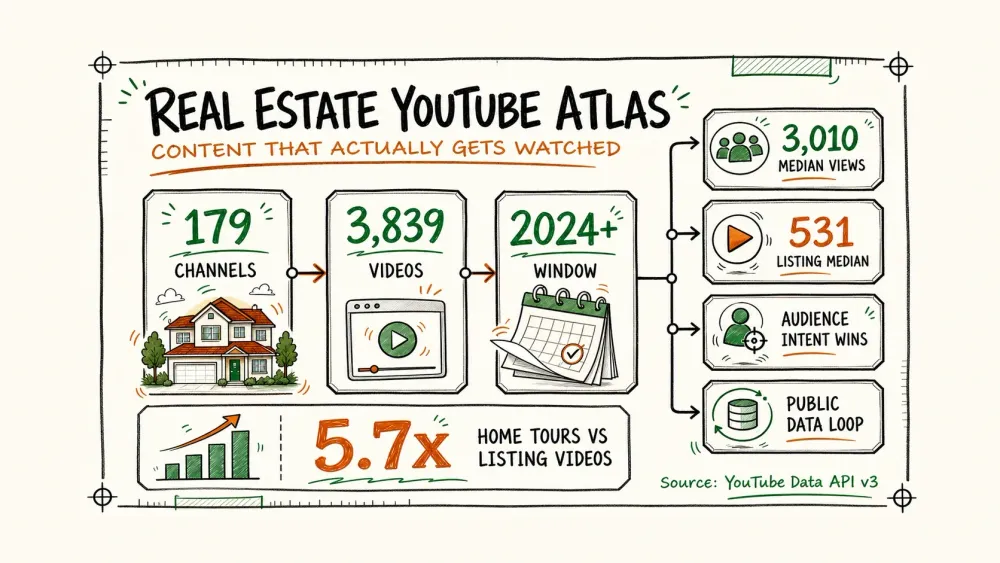
So we analyzed public YouTube Data API v3 data from 179 US real-estate-adjacent channels and 3,839 videos published since January 2024. The snapshot date was May 12, 2026. This was a Thunderbit research project, but not a Thunderbit product walkthrough. We wanted to use public data to answer a very practical operating question: are real estate teams making the kind of videos YouTube actually rewards?
The full dataset, scripts, charts, and publishing assets are archived in the Thunderbit Operations Data repository for readers who want to inspect the source material or rerun the analysis.
The short answer: often, no.
The longer answer is more interesting. YouTube does not reward agent identity. It rewards creator-format content: videos that people choose to watch even when they are not ready to buy a home.
That distinction explains most of the dataset.
The Headline Findings
Here are the numbers I would start with if I were explaining this study to a brokerage marketing team:
| Finding | Data Point |
|---|---|
| Channels analyzed | 179 |
| Videos analyzed | 3,839 |
| Snapshot date | 2026-05-12 |
| Median channel subscribers | 2,030 |
| Channels under 10k subscribers | 68.2% |
| Median views for home tours | 3,010 |
| Median views for listing or sale videos | 531 |
| Home tour vs. listing gap | 5.7x |
| Median views for first-time-buyer videos | 71 |
The biggest gap was between two video types that often show the same thing: a house.
Home tour videos had a median of 3,010 views. Listing or sale videos had a median of 531 views. That is a 5.7x gap.
Same object. Different framing.
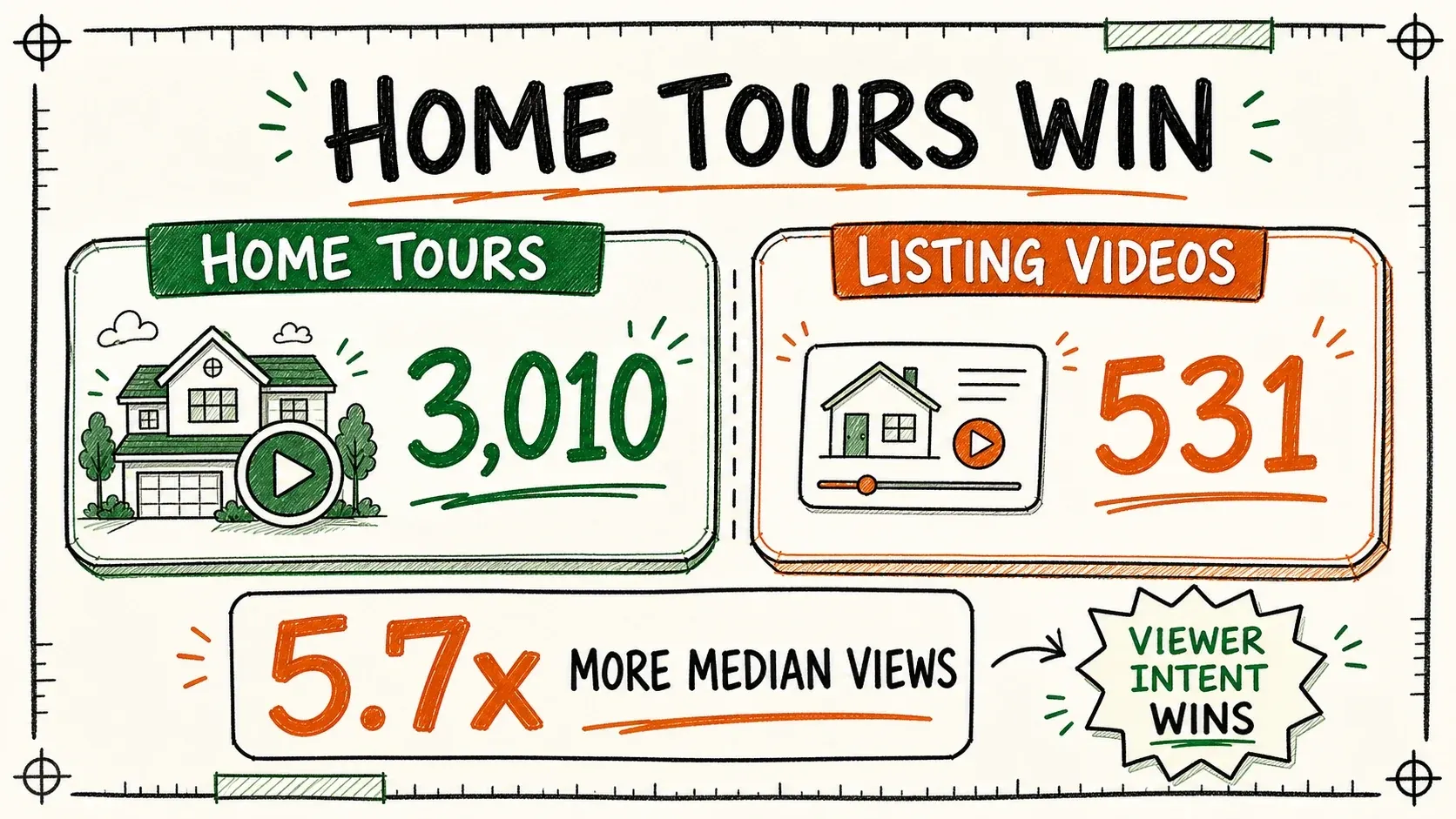
A home tour says: come look inside this interesting place.
A listing video says: this is for sale, contact me.
One behaves like content. The other behaves like an ad.
And YouTube is not especially kind to ads people did not ask to watch.
Same House, Different Framing
The most useful chart in the dataset is the content-type ranking.
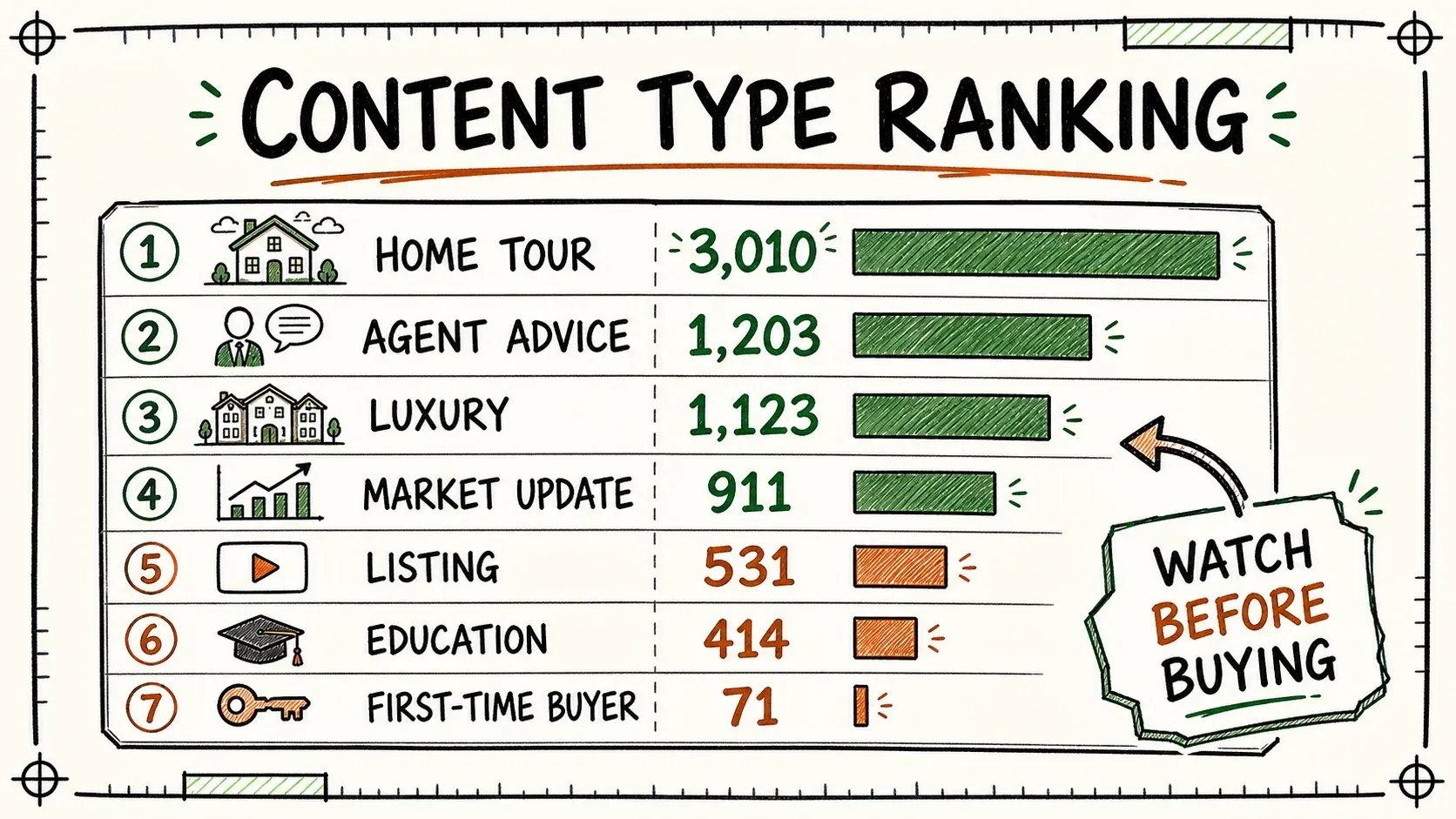
We classified videos into nine content types using transparent title and description rules. The classifier is imperfect, and I will get into the limitations later, but the pattern is clear enough to be useful.
| Content Type | Videos | Share of Videos | Median Views |
|---|---|---|---|
| Home tour | 270 | 7.0% | 3,010 |
| Agent advice | 23 | 0.6% | 1,203 |
| Luxury | 595 | 15.5% | 1,123 |
| Market update | 624 | 16.3% | 911 |
| Investing | 166 | 4.3% | 804 |
| Other | 995 | 25.9% | 591 |
| Listing or sale | 217 | 5.7% | 531 |
| Education | 859 | 22.4% | 414 |
| Personal brand | 28 | 0.7% | 215 |
| First-time buyer | 62 | 1.6% | 71 |
The table says something real estate marketers may not want to hear: the default agent playbook is not the strongest YouTube playbook.
Many agents naturally start with listing videos. They already have the house. They already need marketing assets. They already want buyers to see the property. So they turn the listing into a video and publish it on YouTube.
That logic makes sense from the seller's side of the table. It makes less sense from the viewer's side.
A viewer who is not actively shopping for that exact property has very little reason to care. Once the video feels like inventory promotion, the audience narrows immediately. The agent may see a property asset. The viewer sees a brochure.
Home tours work differently. A good tour gives viewers access, taste, curiosity, comparison, and sometimes a little fantasy. People watch because they want to see how a house is laid out, how a neighborhood feels, what a renovation looks like, or what a certain price buys in a specific market.
The home tour does not require immediate purchase intent. That is why it can travel.
This is the first big lesson from the data: real estate content needs a reason to watch before it needs a reason to buy.
The First-Time Buyer Trap
The weakest category in our sample was first-time-buyer content, with a median of 71 views.
That surprised me at first. The topic sounds obvious. First-time buyers have questions. They search online. They need help understanding down payments, inspections, contingencies, mortgage pre-approval, closing costs, and all the other delightful paperwork that makes adulthood feel like a group project run by banks.
But the behavior is transactional.
A first-time buyer watches a few explainers, gets oriented, and moves on. They do not usually come back every week for more "what is escrow" content. The need is real, but the repeat-viewing behavior is weak.
There is also a supply problem. A huge number of agents can make a generic first-time-buyer video. Most of those videos answer the same questions in the same format. On YouTube, useful is not enough. Useful and interchangeable is still a hard place to build distribution.
This does not mean buyer education is worthless. It can be a good trust asset for prospects who are already evaluating an agent. But as a YouTube growth format, generic first-time-buyer content looks weak in this sample.
The better version is usually more specific:
- "What $750,000 buys in Austin in 2026"
- "Three inspection issues I keep seeing in 1970s homes in Phoenix"
- "Why condos in this part of Miami are sitting longer"
- "How much cash buyers actually need in the Bay Area right now"
Those topics still educate, but they are grounded in local context, current market tension, and specific viewer curiosity.
YouTube Rewards Creator Format, Not Real-World Status
The top channel in our 16-month view window was Erik Van Conover, with 46.5 million recent views.
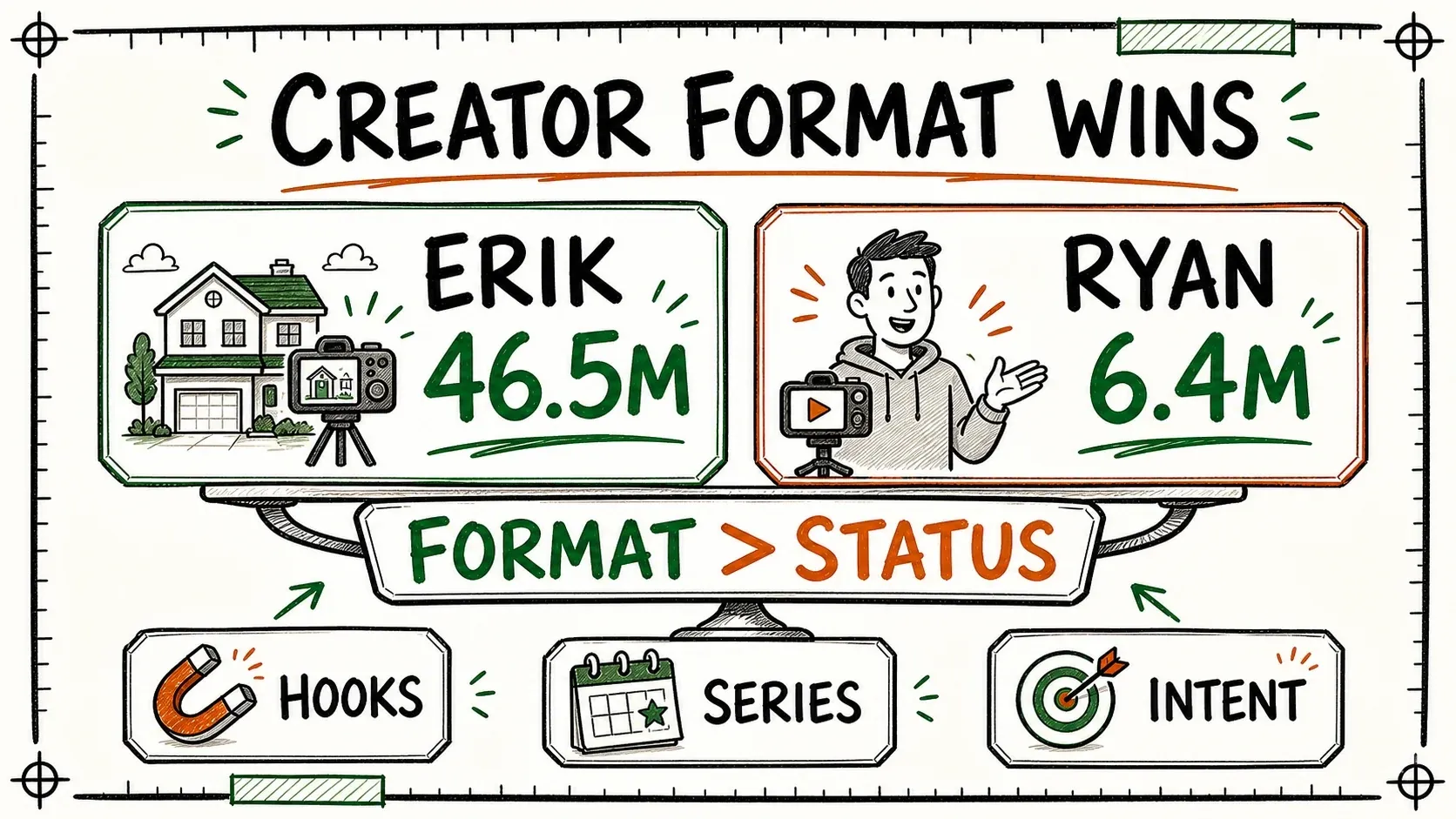
Erik Van Conover has a real estate license, but the YouTube format is not "local agent explains the market." It is luxury property entertainment: cinematic walkthroughs, strong visual hooks, expensive homes, tight packaging, and a host who understands the rhythm of YouTube.
That distinction matters.
Over the same period, Erik Van Conover generated more than 7x the recent views of Ryan Serhant. Ryan Serhant is one of the most recognizable real estate professionals in the United States: a Bravo TV personality, founder of SERHANT, and a major New York luxury brokerage figure.
This is not a criticism of Ryan Serhant. It is a useful signal about the platform.
YouTube does not give automatic distribution credit for offline authority. It does not care how many deals an agent has closed, how long they have been licensed, how premium their brokerage is, or how polished their listing presentation looks. The system mostly cares whether people click and whether they keep watching.
That means putting a more credentialed person on camera does not solve a weak format.
In the top 15 channels by recent views, less than half are straightforward working realtor channels. The list includes luxury creators, investing educators, media-style channels, and content operators whose business model is closer to publishing than brokerage.
That is the second big lesson: real estate expertise is an advantage only after the video earns attention.
Real Estate YouTube Is a Micro-Creator Market
The subscriber distribution was also telling.
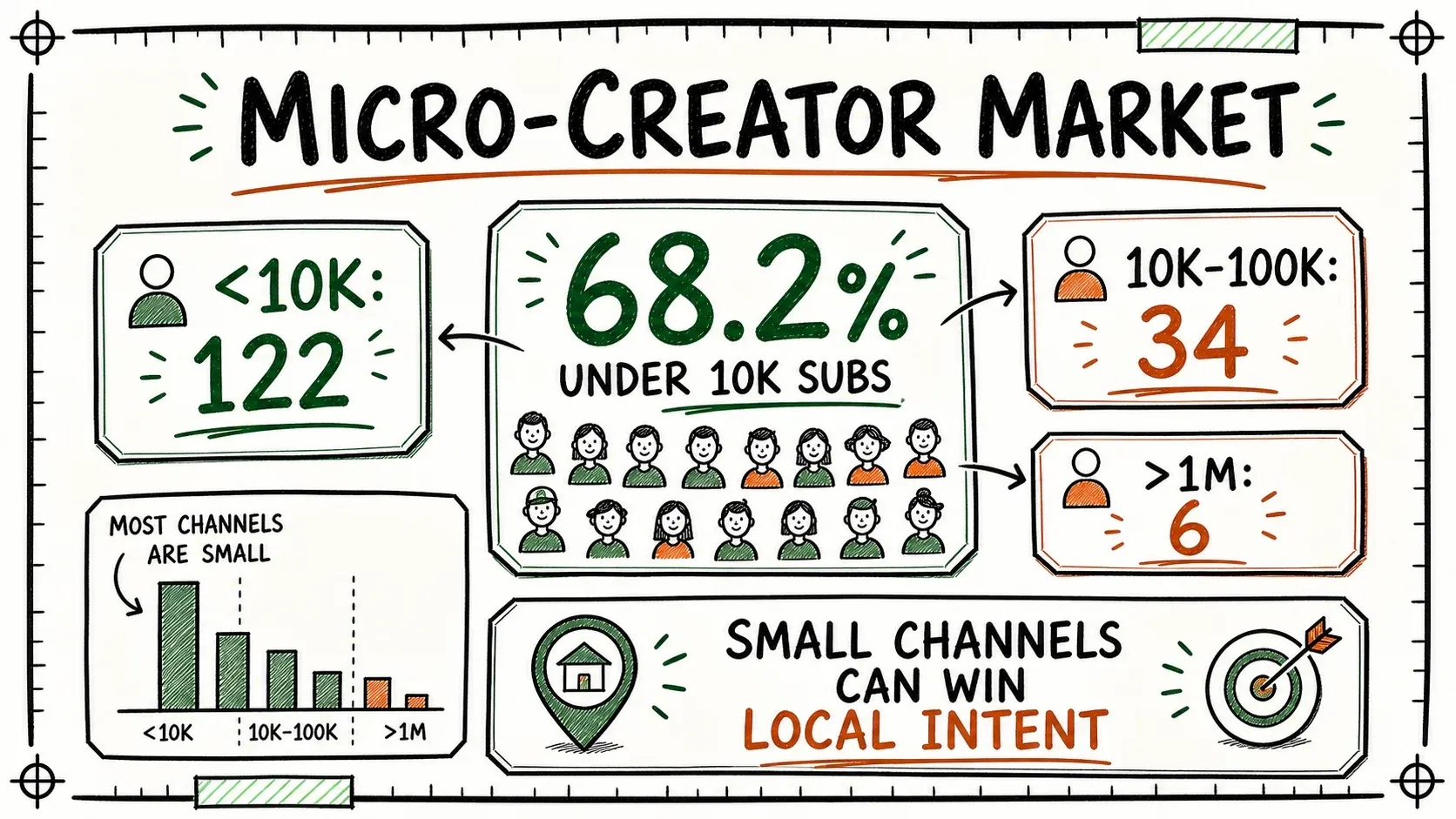
Of the 179 channels in the sample, 122 had fewer than 10,000 subscribers. That is 68.2% of the dataset. The median channel had 2,030 subscribers.
This is very different from how people often imagine YouTube. In many business categories, people benchmark against huge creator accounts and assume the whole market is dominated by media-scale channels. Real estate YouTube is more local, more fragmented, and more long-tail than that.
That is good news and bad news.
The good news: an agent does not need a million subscribers for YouTube to be useful. A small but credible channel can help when a prospect searches the agent's name, checks their market knowledge, or compares them with another local team.
The bad news: most channels are publishing into a very small audience. Many are stuck in the middle: too much work to ignore, not enough distribution to feel like momentum.
I do not think the main failure mode is laziness. Real estate agents are not exactly known for having empty calendars. The more common failure mode is format-market mismatch.
They make videos that make sense as sales collateral, but not as YouTube content.
They make videos for people who are ready to transact, but YouTube reach is built on people who are willing to watch before they transact.
They make videos to prove the agent is competent, but the viewer first needs a reason to click.
Subscribers Are Not the Same as Reach
One of the oddest channels in the dataset was Roots Investment Community.
It had only 2,620 subscribers, but nearly 10 million recent views in our window. That is about 3,805 views per subscriber.
That ratio is not normal for traditional long-form YouTube. It strongly suggests a Shorts-led dynamic, where short videos are pushed to viewers who never subscribed to the channel.
This matters because many teams still use subscriber count as the main proxy for channel health. That is increasingly incomplete. In the Shorts era, reach can detach from subscribers.
But the takeaway is not "just post Shorts."
Short-form distribution has its own rules. It needs fast visual payoff, clear hooks, native pacing, and a reason for someone to keep watching in a feed where the next video is one thumb movement away.
For a real estate team, Shorts can be useful, but mostly when they are cut from actual field work:
- A surprising detail from a showing
- A 20-second neighborhood comparison
- A price-change observation
- A before-and-after renovation moment
- A quick explanation of a local market change
The raw material matters. A short video that feels like a compressed ad is still an ad.
What Real Estate Teams Should Actually Do
If I were running content for a real estate team, I would stop treating YouTube as a pure lead-generation machine.
The common fantasy is:
Stranger watches video, books consultation, buys house.
That can happen, but it is not the base case. Most viewers do not live in the agent's market. Many are browsing, comparing, learning, or simply watching homes because homes are interesting.
The more realistic path is:
Prospect hears your name, searches you, sees a credible video presence, and feels safer choosing you.
That makes YouTube brand infrastructure. It is a trust asset.
From the data, I would build around five principles.
1. Make the Property the Main Character
The strongest repeatable format is property-led storytelling.
That does not mean every video has to be a luxury mansion tour. It means the viewer needs a concrete thing to look at, compare, or learn from. A modest home with an interesting layout can work. A neighborhood street with three price points can work. A renovation with tradeoffs can work.
The agent can still be present, but the agent should not be the only reason the video exists.
2. Use Market Updates as Authority, Not Viral Bait
Market update videos had a median of 911 views in our sample.
That is not a viral number, but it can still be useful. Market updates age better than listing promotions because they answer a recurring question: what is happening in this city right now?
For local SEO and trust, monthly market updates can be valuable. The mistake is expecting them to behave like entertainment content.
Use them to show competence. Do not build the whole channel around them unless the format is unusually strong.
3. Be Careful With Generic Education
Education was the largest category in our dataset, with 859 videos, but the median was only 414 views.
The problem is not that education is bad. The problem is that generic education is crowded.
"How to buy a house" is less interesting than "What first-time buyers in Seattle are getting wrong in 2026." One is a commodity topic. The other has geography, timing, and stakes.
If an educational video could be made by any agent in any city, it probably needs a sharper angle.
4. Do Not Confuse Listing Promotion With Content Strategy
Listing videos have a place. Sellers expect marketing. Buyers want to see the property. A polished listing video can help on a listing page, in email, or in a paid campaign.
But organic YouTube is different.
If the video only offers availability, the audience is small. If it offers access, taste, comparison, story, or local intelligence, the audience gets bigger.
That is the difference between "this house is for sale" and "here is what $1.2 million actually buys in this neighborhood."
5. Build a Repeatable Content Loop
The best operating loop is not complicated:
- Pick a few formats.
- Publish consistently for a defined window.
- Track views, retention, click-through rate, and search behavior.
- Compare by format, not just by video.
- Double down on what creates repeat viewing.
Most teams do this backward. They publish for a quarter, look at views, and then try to explain what happened.
Public data can make the starting point sharper. Before publishing another 20 videos, teams can look at what is already working in their market, which formats competitors use, which channels are growing, and which topics actually attract repeat attention.
That is the broader reason I like this kind of research. It turns a vague content debate into an operating decision.
Posting Cadence and Video Length
The median channel in our dataset posted 7.4 videos per month.
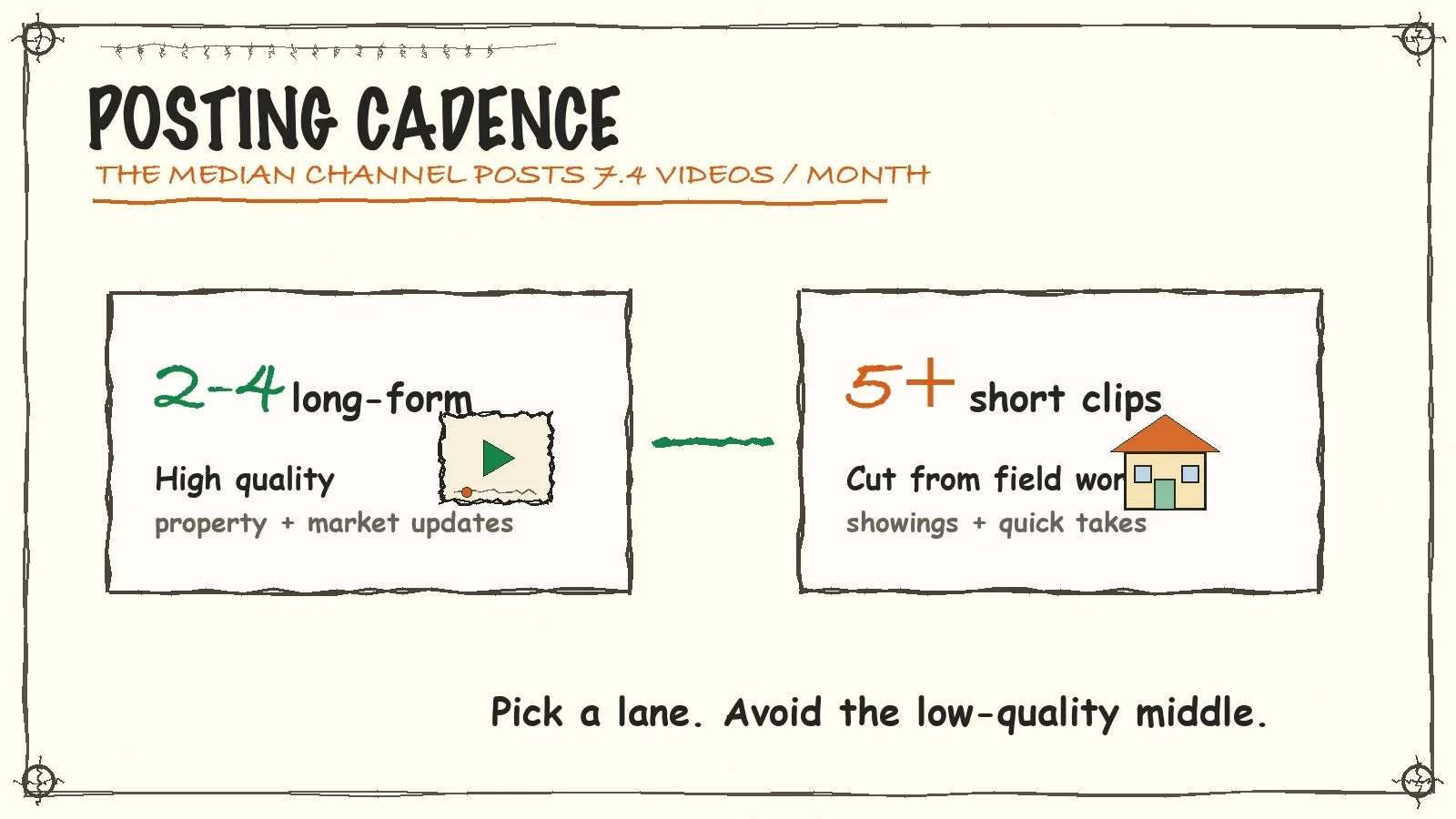
That does not mean every solo agent should publish twice a week. Some of the highest-cadence channels are media operations, Shorts-heavy channels, or teams with more production support.
For a solo agent, I would rather see a realistic cadence sustained for 12 months than an ambitious calendar that collapses after six weeks.
A reasonable starting point might be:
- One local market update per month
- One property-led video per month
- Several short clips cut from those shoots
- One LinkedIn or blog recap that turns the video into written market commentary
The key is to avoid the dead middle: one low-quality phone video per month with no clear format, no packaging, and no follow-up distribution.
Video length also depends on format. In our sample, median duration varied a lot:
| Content Type | Median Duration |
|---|---|
| Home tour | 13:08 |
| Market update | 15:58 |
| Education | 8:23 |
| Agent advice | 7:35 |
| Luxury | 5:21 |
| Listing or sale | 3:04 |
| First-time buyer | 1:12 |
There is no universal perfect length. The better question is whether the video length matches the viewer's expectation.
A home tour can be longer because viewers expect to see the house. A market update can run longer if the information is specific and current. A listing video that runs three minutes but feels like an ad can still be too long.
Length is not the strategy. Format is.
How We Built the Dataset
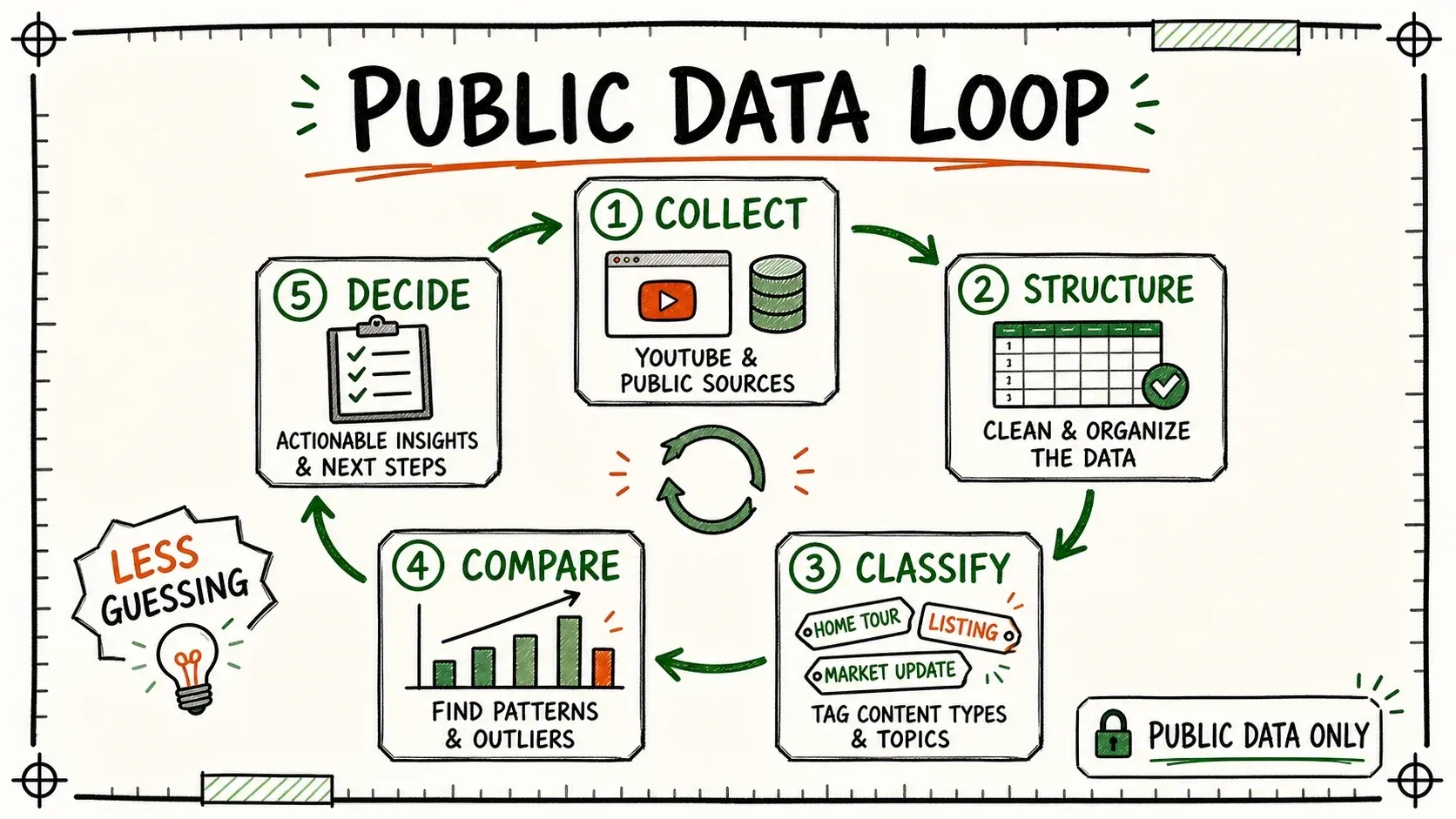
This analysis used public YouTube Data API v3 data. We did not download videos, thumbnails, or private data.
The workflow was:
- Start with a seed list of known US real-estate and investing YouTube creators.
- Expand the pool with YouTube channel search queries such as realtor, real estate agent, real estate investing, home tour, luxury home tour, first time home buyer, market update, buyers agent, and listing agent.
- Deduplicate channels.
- Filter for US-tagged channels or channels with real-estate-related signals in the channel title or description, while keeping seed channels.
- Pull recent public channel statistics and upload playlists.
- Pull recent video-level public metrics: views, likes, comments, duration, title, description, and publish date.
- Filter videos to those published on or after January 1, 2024.
- Classify content type with regex rules over title and description.
- Compute channel-level and content-type statistics.
The final dataset contains 179 channels and 3,839 videos. Total views across the sample were 111,579,888.
The analysis was conducted at Thunderbit because this is a question we care about: how can business teams turn public information into structured operating intelligence? In this case, the source was YouTube's official API. In other workflows, similar questions might involve public websites, directories, listings, marketplaces, or review pages.
The common pattern is the same: collect public signals, structure the messy data, classify the patterns, and turn the result into a decision.
What This Report Does Not Claim
This part is important.
This report is not a census of every real estate agent in the United States. It is a sample of active, visible, US real-estate-adjacent YouTube channels found through seed channels and keyword expansion.
It also does not prove that every agent should copy the top channels. Erik Van Conover is an outlier, not a normal benchmark. Ryan Serhant is also an outlier. Most local agents should not build a plan around becoming either one.
It does not prove that first-time-buyer content is useless. It only shows that, in this sample and with this classifier, first-time-buyer videos had very low median views.
It does not separate Shorts from long-form. YouTube's public viewCount field aggregates views across formats. Some channels, especially Roots Investment Community, appear to be heavily influenced by short-form distribution.
It does not use a perfect content classifier. Our rules are transparent and reproducible, but not as nuanced as human review. The "Other" bucket is 25.9%, which is a reminder that real content is messy.
The safest claim is this:
Across our 179-channel sample of US real-estate-adjacent YouTube channels, home tour videos had 5.7x the median views of listing or sale videos.
That is a strong enough signal to change a content calendar.
The Bigger Lesson
The more I look at this dataset, the less I think the lesson is only about YouTube.
The lesson is about operating by evidence.
A real estate team might debate for months whether to make more listing videos, buyer education, market updates, Shorts, neighborhood tours, or agent brand videos. Everyone in that conversation can sound reasonable. The seller expects listing videos. The agent wants personal brand. The marketing team wants consistency. The coach says to post daily. The platform rewards something else.
Public data does not remove judgment, but it improves the conversation.
It shows where intuition is wrong.
It shows which formats deserve more testing.
It shows when "best practice" is really just habit wearing a nice jacket.
For real estate teams, the practical takeaway is simple:
Do not use YouTube as a shelf for video brochures. Use it to create property-led, locally specific, viewer-first content that builds trust before the buyer is ready to transact.
That shift sounds small. In the data, it is the difference between 531 median views and 3,010.
And that is why we do original public-data research in the first place. Not to make a prettier spreadsheet. To make the next decision less dependent on vibes.




