

Executive Summary
This research compares the May 2025 and May 2026 Hacker News "Ask HN: Who is hiring?" threads to measure how fully remote, hybrid, and on-site work modes changed inside a developer-heavy hiring channel. The combined sample contains 619 top-level hiring postings.
The headline finding is that fully remote remains the largest single work-mode label in the HN hiring community. In May 2026, fully remote accounted for 46.3% of classified postings, excluding unknowns. That is down from 48.1% in May 2025, a decline of 1.8 percentage points, not a collapse.
Hybrid rose from 22.5% to 26.1%, a 3.6 percentage-point increase, while on-site moved from 29.4% to 27.7%. The pattern looks less like a mass return to office and more like a slow convergence toward hybrid from both ends of the work-mode spectrum.
Salary disclosure moved faster than work mode. The share of postings with salary information rose from 20.5% to 27.4%, while visa-sponsorship mentions stayed almost flat. For recruiting and employer-brand teams, the broader story is that technical hiring copy is becoming more explicit about compensation and operating model.
The Most Shareable Findings
- Fully remote is still the largest work mode in the HN hiring sample: 46.3% of classified May 2026 postings.
- Fully remote fell only 1.8 percentage points year over year, from 48.1% to 46.3%.
- Hybrid rose 3.6 percentage points, from 22.5% to 26.1%, the largest work-mode movement in the report.
- On-site also declined, from 29.4% to 27.7%, which suggests hybrid is gaining from both fully remote and on-site.
- Salary disclosure rose from 20.5% to 27.4%, a larger movement than any work-mode category.
- Visa-sponsorship mentions barely moved, from 2.6% to 2.8%.
- The sample describes a self-selected, remote-friendly technical hiring channel, not the whole US labor market.
If the only signals you follow are big-company memos, the remote-work story in 2026 looks nearly settled: large employers are pulling people back, structured office weeks are returning, and the fully distributed company is starting to sound like a pandemic-era exception. That story is not false, but it is incomplete. It describes the posture of well-known incumbents, not the hiring language of small and mid-stage software teams still competing for engineers in public.
This report looks at that quieter layer. Hacker News hiring threads are not perfect labor-market samples, and they should never be treated as a census. But they are useful precisely because the audience is hard to impress. A company posting there is talking directly to engineers, founders, and technical operators; vague employer-brand language does not travel well. If a team says "fully remote," "hybrid," or "on-site" in that venue, it is usually saying something it expects candidates to take literally.
The blog version of the finding is therefore simple: the RTO wave is real, but it has not erased remote-first hiring in the startup-adjacent tech market. The shift looks less like a hard reversal and more like a slow migration toward hybrid, with salary transparency rising even faster than office-policy change.
Amazon mandated 5 days back in office. Salesforce pushed "team agreements." Goldman Sachs declared permanent 5-day in-office. Over the past 18 months, RTO (Return to Office) has been a near-monthly headline, with major companies announcing the end of remote work one after another. If you read those headlines, the reasonable inference is that remote work as a concept is ending.
We wanted to test that conclusion against a different kind of data. Hacker News runs a fixed monthly thread — "Ask HN: Who is hiring?" — posted on the 1st of each month by the whoishiring account. What makes this thread special is that it isn't a PR signal from public companies. It's recruiting copy written by engineers, startup founders, and small teams. A few hundred comments per month, each a hiring posting from one company. We pulled the May 2025 and May 2026 threads — 619 postings total — and looked at how the fully-remote / hybrid / on-site distribution changed.
The result isn't complicated, but it doesn't match the big-company PR narrative. Fully remote remains the single largest work mode in the HN hiring community — 46.3% excluding the unclassified bucket, down from 48.1% twelve months earlier. That's a 1.8 percentage point decline. A drop, but not an extinction.
Conversely, hybrid is up 3.6 percentage points (excluding unknowns, from 22.5% to 26.1%). It's the single clearest movement in the data. Hybrid is taking share — but not just from fully remote. It's also taking share from on-site (on_site -1.7 pp). The migration isn't a simple "fully remote-to-hybrid" flip. Both extremes are converging toward the middle.
There's also a number we didn't expect. Salary-disclosure rate went from 20.5% to 27.4% — +6.9 percentage points. The fastest-moving metric in the entire dataset. Visa-sponsorship mention, in contrast, barely moved (2.6% to 2.8%). One indicator rising fast, the other flat — and the explanation involves two different mechanisms. Salary disclosure is being pushed by state pay-transparency laws (California, Colorado, New York, Washington all enacted or strengthened such laws during 2023-2025), and HN's hiring culture is aligning accordingly. Visa-sponsorship reflects H-1B policy, which has been tightening through 2024-2026, so flat-to-pressured mention rate is consistent with the actual constraint.
Pulling all of this together, the data is telling one story: RTO inside the HN hiring community isn't a revolution; it's a rebalancing. Fully remote remains dominant. Hybrid is rising quietly. On-site is contracting slowly. Meanwhile, the entire hiring market is shifting toward salary transparency at an accelerating pace. We walk through each layer below.
1. The current distribution: fully remote still leads at 46.3%
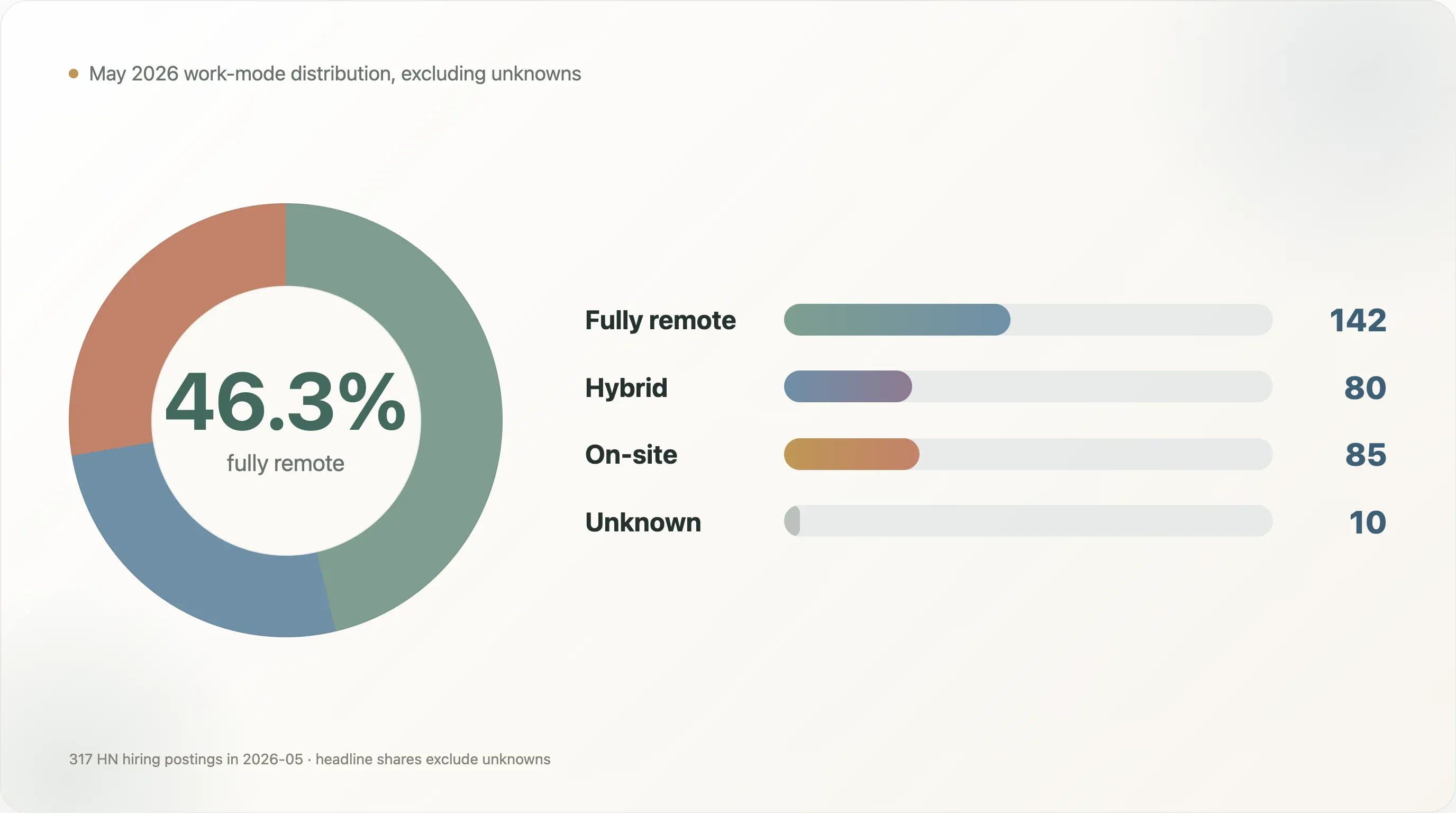
In the 2026-05 thread, 317 hiring comments parsed into the following distribution:
| Work mode | Postings | Share of all | Share excl. unknown |
|---|---|---|---|
| Fully Remote | 142 | 44.8% | 46.3% |
| Hybrid | 80 | 25.2% | 26.1% |
| On-site | 85 | 26.8% | 27.7% |
| Unknown | 10 | 3.2% | — |
The unknown bucket sits at 3.2% — comments whose first paragraph doesn't explicitly mark a remote / hybrid / on-site posture, usually because the poster used a non-standard format or only linked to a careers page. All downstream analysis uses share excluding unknowns to keep month-to-month comparisons clean.
Excluding unknowns, fully remote remains the largest single mode — 46.3%. Roughly 1.8x larger than hybrid (26.1%), and 1.7x larger than on-site (27.7%).
How to read this number? Inside the HN hiring community — a sample dominated by developers, startups, and early engineering teams — nearly half of postings still openly mark fully remote. To accept the "remote is dead" narrative requires explaining why the share of fully remote can stay at 46% inside a subset commonly described as "early-adopter, remote-friendly tech."
One reading is that the HN subset is non-representative and the broader market has already moved beyond remote. That reading treats the sample boundary as an escape hatch. But it also has to acknowledge two things. First, the HN subset is genuinely a subset, but it covers a meaningful slice of software hiring — particularly small and mid-stage firms, early-stage startups, and independent engineers who don't have the budget for LinkedIn Premium or Indeed sponsored slots. Second, the stability of fully remote inside this subset is itself a signal — within the population of "companies actually capable of running remote," remote is far from extinct.
2. What changed in twelve months: hybrid quietly added 3.6 pp
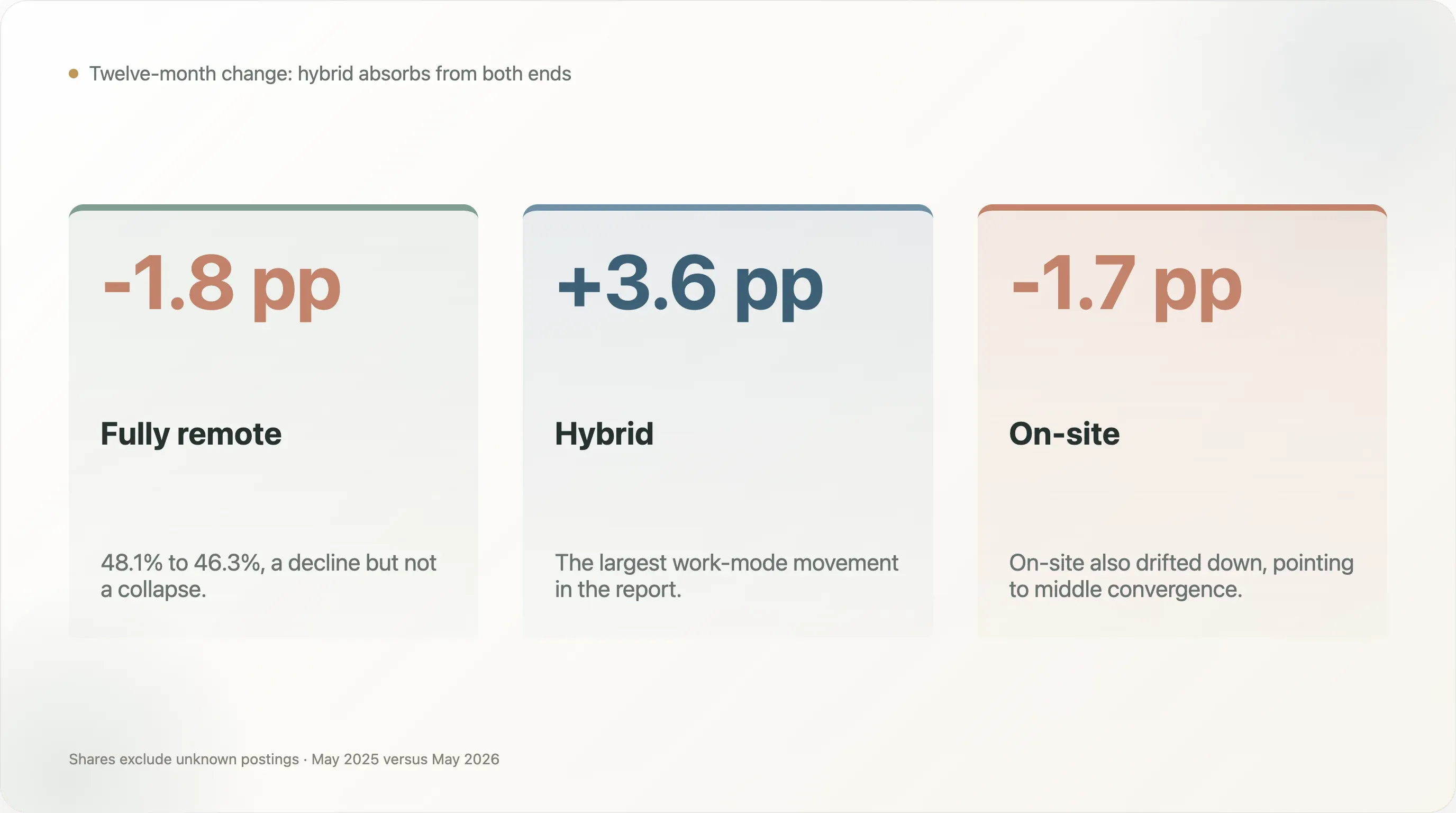
Stacking the two threads, excluding unknowns:
| Work mode | 2025-05 | 2026-05 | Change |
|---|---|---|---|
| Fully Remote | 48.1% | 46.3% | -1.8 pp |
| Hybrid | 22.5% | 26.1% | +3.6 pp |
| On-site | 29.4% | 27.7% | -1.7 pp |
Hybrid's +3.6 pp is the single largest movement in the data. Fully remote dropped 1.8 pp; on-site dropped 1.7 pp. Both extremes gave up a little ground, and the give-up went to hybrid. The migration pattern is informative. If hybrid's gain came purely from fully remote conversion, on-site should be flat. Instead, on-site dropped too — by an almost equal amount. Hybrid is absorbing from both ends simultaneously.
This "both ends converging toward middle" migration is not the same story as the big-company PR narrative of "remote turning into on-site." What HN hiring shows is closer to a rebalancing of work modes — neither a remote retreat nor an on-site comeback, but a middle state (hybrid) absorbing share from both extremes and settling into permanence.
Why is hybrid particularly steady inside the HN circle? One mechanism-level explanation: HN posting friction is higher than LinkedIn. You need an HN account, your post is publicly visible to peers, and any exaggeration gets called out in replies immediately. Under that public peer-review filter, a company writing "hybrid (3 days in office)" has typically already been running that policy for a while, with concrete details about how it works — not a buzzword. That's why the 26.1% hybrid share here is probably "real hybrid" with specifics, not LinkedIn's softer "Hybrid (Flexible)" hedge.
For operators in growth or recruiting, this means: the "Hybrid is the new normal" narrative is partially supported by HN data, but hybrid is still only 26% of postings. If your employer-brand narrative is anchored on "we're a hybrid company," the addressable market for that positioning is one notch smaller than you might assume — fully remote is still 1.8x larger.
3. Companies still publishing fully remote hiring posts
A sample of companies that posted fully-remote roles in the 2026-05 thread — the top 15:
| Rank | Company | Fully-remote postings |
|---|---|---|
| 1 | Doubling | 1 |
| 2 | Emergences Labs (emergences.ai) | 1 |
| 3 | CodeWeavers | 1 |
| 4 | OpenVPN Inc. | 1 |
| 5 | Amplify Renewables | 1 |
| 6 | IPinfo.io | 1 |
| 7 | In The Loop (intheloop.engineering) | 1 |
| 8 | Deep Core Technology | 1 |
| 9 | Loophole Labs | 1 |
| 10 | PostHog | 1 |
| 11 | Railway | 1 |
| 12 | Enveritas (YC S18, non-profit) | 1 |
| 13 | Form AI | 1 |
| 14 | PlantingSpace | 1 |
| 15 | SEEKING FREELANCER | 1 |
This list isn't shaped like a viral creator top-10 — HN's hiring norm is one posting per company per month, so the distribution is flat. But the existence of companies still openly publishing fully remote postings in 2026-05 is itself a signal in this data. These are firms that, through the RTO wave of 2024-2026, chose to preserve a remote-friendly employer brand and to write that choice into their hiring text.
PostHog is a company worth singling out from this list. An open-source product-analytics company with UK + US teams, long remote-first. Their presence in the May 2026 thread says remote-first startups can still attract engineering candidates through the RTO wave, and they still choose HN as the engineer-to-engineer channel. CodeWeavers (the open-source Wine company), IPinfo, Loophole Labs all fit a similar profile — technically driven mid-size firms with developer-leaning customer bases, naturally remote-first.
For employer branding, the existence of this list matters more than the ranking within it. It says "publicly marking fully remote in hiring" remains a strong signaling move in 2026 — it attracts candidates who care about remote-first culture, a differentiation big RTO-pivoting incumbents can no longer offer.
4. Salary disclosure +6.9 pp — the fastest-moving metric in the entire report
Two metrics, side by side:
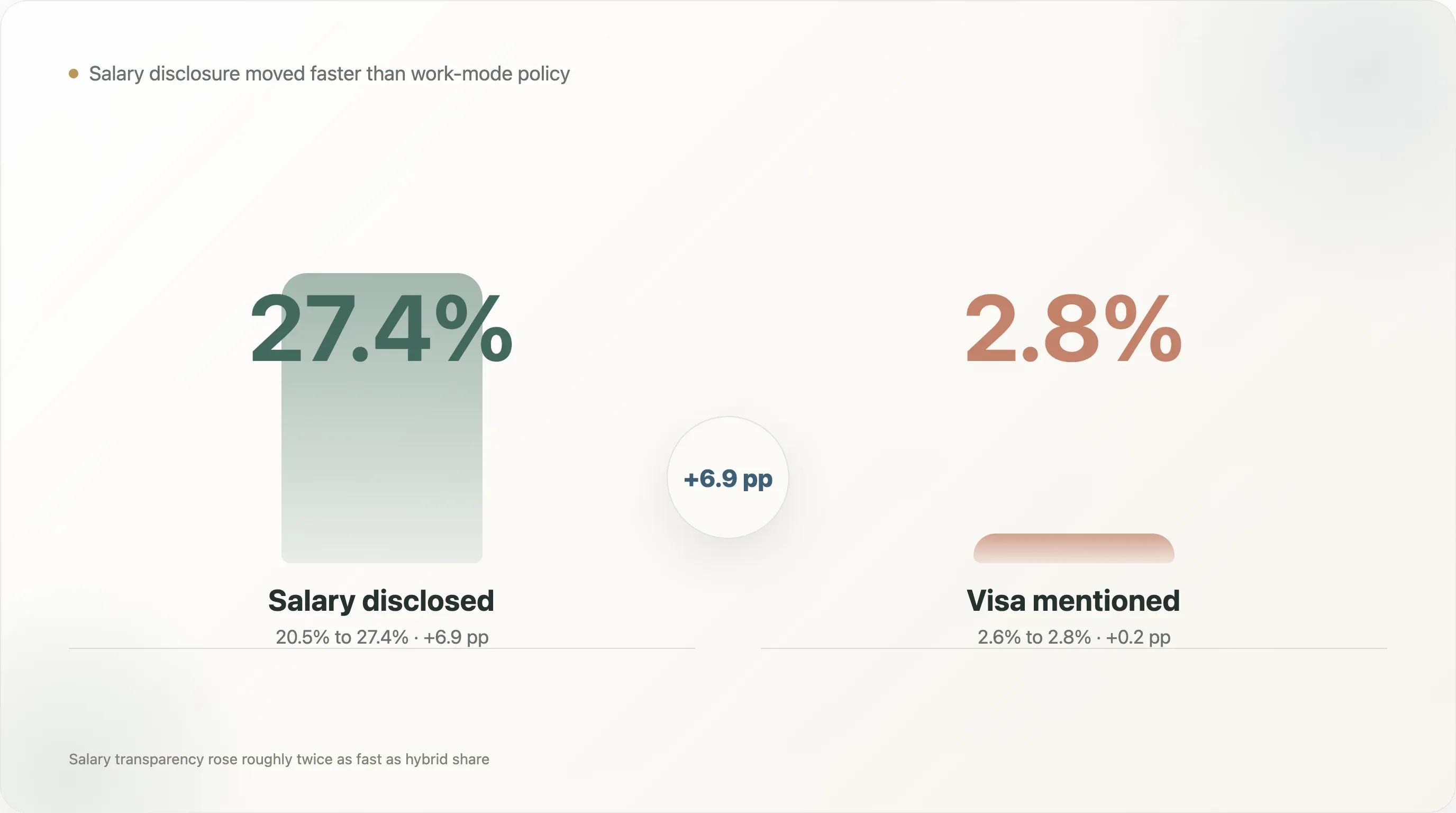
| Metric | 2025-05 | 2026-05 | Change |
|---|---|---|---|
| Salary disclosed | 20.5% | 27.4% | +6.9 pp |
| Visa sponsorship mentioned | 2.6% | 2.8% | +0.2 pp |
Salary disclosure jumped from 20.5% to 27.4% — +6.9 pp over twelve months, the fastest-moving metric in this dataset. Roughly twice the speed of the hybrid +3.6 pp shift. The driver is US state pay-transparency law — California's SB 1162 (effective 2023), Colorado's Equal Pay for Equal Work Act (strengthening through 2021-2023), New York (effective September 2023), Washington (effective January 2023). These laws require employers above certain size thresholds to disclose salary ranges in job postings. Once compliance kicked in, cross-state employers were effectively forced to disclose in every posting — because not disclosing violates these states' laws.
HN's hiring culture has long favored salary transparency on its own. But a 6.9 pp jump in a single year almost certainly isn't culture-driven alone — it's regulatory compliance.
Visa-sponsorship mention barely moved (2.6% → 2.8%). This metric reflects H-1B / TN / O-1 policy environment. Through 2024-2026, US immigration policy toward technical-worker visas has been tightening, not loosening. So flat-to-mildly-rising visa mention is consistent with companies not wanting to commit publicly to sponsorship they may not deliver. This data point provides the cross-check: HN's salary-disclosure rise is institutionally driven, and visa's flatness is institutionally driven — neither is random cultural preference drift.
Practical read for operators: if your employer brand wants to highlight "transparency," salary disclosure has more leverage than visa-policy messaging. The pay-transparency laws force you to disclose anyway — reframe the compliance requirement as proactive transparency, and the brand return is highest.
5. Why this dataset is credible, and where its boundaries lie
Over the past 18 months, the RTO conversation has been driven by headline cases — Amazon's 5-day return, Salesforce "team agreements," Goldman's permanent in-office policy. These stories are real, but they describe PR signals from large incumbents, not the hiring reality of the wider tech ecosystem.
HN's "Who is hiring?" thread captures the opposite end: small and mid-stage tech companies, startups, and solo founders self-reporting their hiring needs in a public, peer-reviewed forum. Many of these companies don't post on LinkedIn, don't pay for Indeed slots, and don't use recruiters — because the candidates they want (engineers, early hires) are already reading HN. Every comment gets watched and replied to by HN readers in real time. That public peer-review filter makes HN hiring text a relatively clean sample of genuine employer intent.
So the fully remote share of 46.3% (excluding unknowns) is not "the US labor market." It is "the publicly-stated working model of companies that self-select into the HN hiring community." The gap between those two readings is huge:
- The Bureau of Labor Statistics estimates fully remote roles sit at roughly 10-15% of all US employment (2024)
- But HN is a self-selected sample — companies choosing HN are disproportionately remote-friendly to begin with
- Therefore our 46.3% number describes a self-selected remote-friendly tech subsample, not the macro labor market
This boundary matters in two ways for readers.
For growth and content teams: if you publish "remote is still alive" content, this report is a defensible citation, but always tag the sample boundary. A reasonable phrasing: "In HN's hiring community — a sample skewed toward remote-friendly early-stage tech — fully remote still accounts for 46%, with YoY decline of only 1.8 pp." That framing passes peer review.
For recruiting and HR teams: this report's hybrid share (26.1%, inside a remote-friendly subsample) is a counter-over-correction data point for the "hybrid is the new normal" narrative. If hybrid hasn't even crossed 30% inside a remote-friendly subsample, the wider labor market is more skewed against pure-hybrid as dominant model than LinkedIn marketing would suggest. The employer-brand narrative built around "we're a hybrid company" may be over-corrected — within your target candidate pool, true hybrid preference may be smaller than the marketing literature implies.
6. Stability checks & peer-dataset cross-reference
Any YoY report invites the obvious reader question: is this 3.6 pp hybrid uplift a real trend or sampling noise? Three stability checks.
The unknown bucket barely moved. 3.0% to 3.2%, just +0.2 pp. This means HN's posting-convention compliance was stable across both threads, so the redistribution among the three meaningful buckets reflects real composition change, not a parsing-artifact "more posts had clear labels this year."
On-site also drifted down slightly. If hybrid grew purely by cannibalizing fully remote, we'd expect on-site to stay flat. Instead, on-site moved -1.7 pp while fully remote moved -1.8 pp and hybrid moved +3.6 pp. That's consistent with "hybrid eating a little from both ends" — a textbook middle-ground emergence pattern, rather than a violent flip between extremes.
The denominator is roughly stable. 2025-05 total: 302 postings. 2026-05 total: 317 postings. A difference of only 15 postings means the HN hiring community's hiring volume stayed flat year-over-year. Share movements reflect real distribution change, not denominator drift.
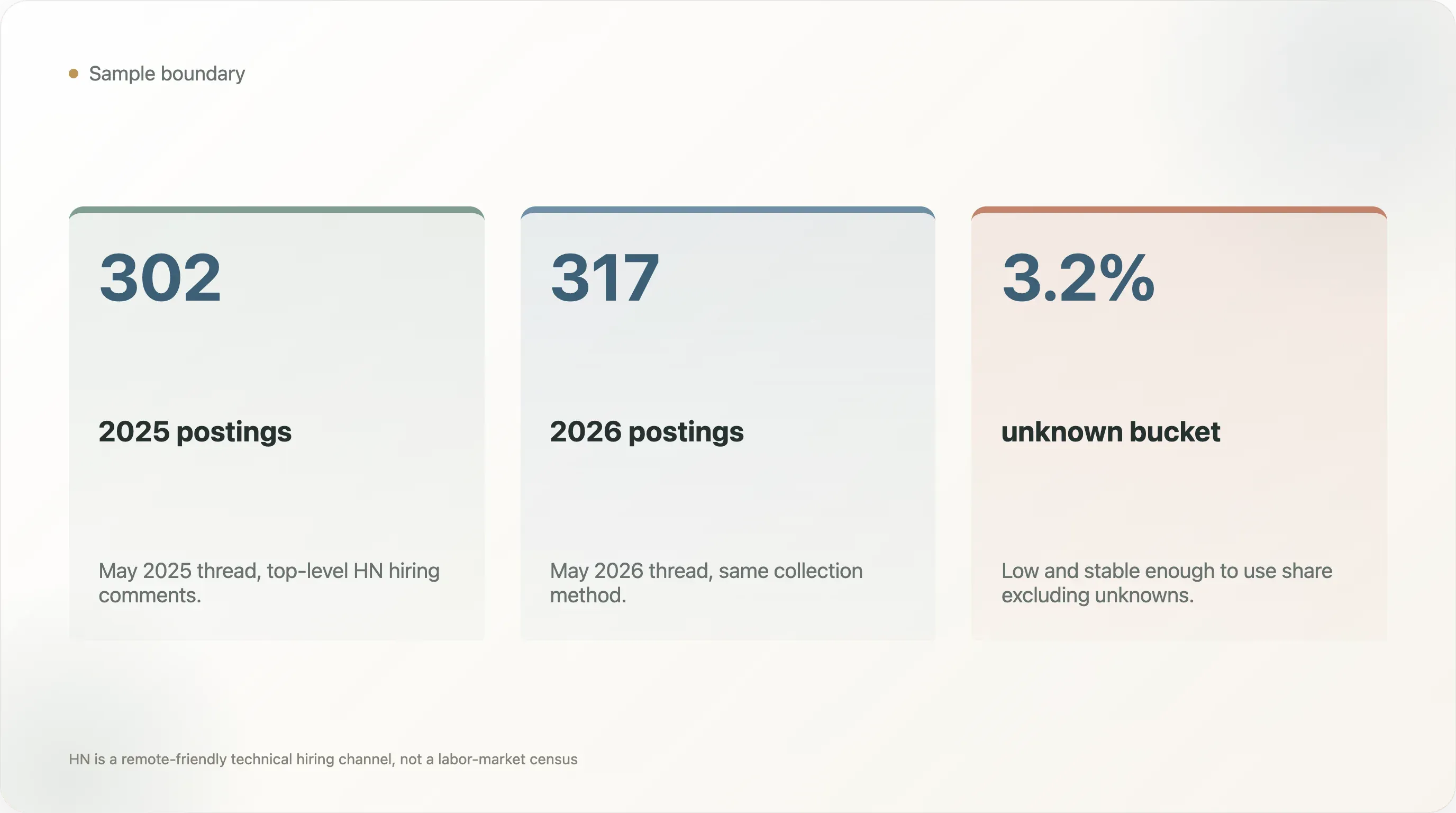
The cleaner read: The hybrid uplift in this report is reasonably robust, but ±2-3 pp sampling noise is realistic. For a PR pitch you can defensibly say "hybrid postings rose meaningfully, roughly 3 pp, in the HN hiring community year over year." Don't write it as "Hybrid surges 50% YoY" — HN postings are a stable sample, not suited for second-order percent-of-percent inflation.
Multiple public datasets cover the RTO question, and at first glance their numbers look contradictory. Viewed through the lens of sample boundary, they're complementary — each measures a different facet of the same underlying reality.
| Source | Coverage | Typical reading (2024-2025) |
|---|---|---|
| Stanford WFH Research | 5,000+ US workforce survey | US overall fully-remote ~14%, hybrid ~28% |
| Flex Index (Scoop) | 9,000+ US company policy tracker | 32% fully-flexible, 55% structured hybrid, 13% full-time office |
| Kastle System | Office card-swipe data, US top 10 metros | 50-55% office occupancy (vs 100% pre-pandemic) |
| Bureau of Labor Statistics | US-wide employer survey | Fully-remote ~10-15% of total employment |
| This report (HN Who's Hiring) | HN hiring community, 619 postings | Fully-remote 46.3% inside sample (excluding unknowns) |
These aren't contradictory. Stanford measures employee behavior (days-at-home perspective). Flex Index measures employer policy (HR / careers-page perspective). Kastle measures physical occupancy (real-estate perspective). BLS measures macro employment composition (labor-market perspective). This report measures publicly-stated working models in one hiring channel (recruiting-channel perspective). Five viewpoints produce five different numbers — but they all point at the same underlying reality: fully-remote is contracting but nowhere near dead, hybrid is the steadily-growing middle path, and full-time on-site is structurally declining at a slow pace. Any writer making a generalized "the industry is doing X" claim should cross-reference at least two perspectives — no single report (this one included) is enough to characterize "the industry."
Methodology
Data source: Hacker News Firebase API (https://hacker-news.firebaseio.com/v0/item/{id}.json). Threads compared: 2025-05 (item id 43858554) and 2026-05 (item id 47975571). Each top-level comment treated as one hiring posting (HN convention). Snapshot collected: 2026-05-12 (UTC). Sample size post-clean: 2025-05 302 postings, 2026-05 317 postings, total 619.
HN-community bias (the most important caveat): HN's hiring community is dominated by developers, startup founders, and early-stage engineering teams. The sample skews heavily toward SaaS, AI tooling, and remote-friendly companies. This report cannot be read as a portrait of US or global RTO trends. Traditional industries (finance, manufacturing, retail, healthcare, education) post on-site at much higher rates than what shows up here, and most of those firms do not recruit on HN at all. The fully remote share described in this report is a portrait of a self-selected remote-friendly tech subset, not a macro labor-market sample.
Sample-size boundary: 619 postings combined — not "N companies." The same company may post multiple roles (typically once per thread, but possibly across threads). The denominator is "postings," not "unique employers." Company-level analysis would require deduplication, which we don't perform — but cite is at the posting level.
Parsing accuracy: HN's posting-convention compliance rate is roughly 70%; rule-based parsing captures another ~15-20%; the unknown bucket absorbs the rest. We use share-excluding-unknown as the headline metric to neutralize convention-compliance drift. The unknown bucket's own YoY movement (+0.2 pp) reflects evolution in posting conventions, not the underlying RTO trend.
Year-over-year vs long-run trend: this report is a single-point YoY comparison. It does not infer a long-run trajectory. A long-run study would need at least 5 years × 12 monthly threads (60 data points) — HN threads exist going back to 2011, so this is a viable follow-up project, but it is not what this report claims.
Snapshot timing: collected at 2026-05-12. HN comments are functionally immutable after posting (the community discourages edits), so this dataset is stable and reproducible — unlike website-snapshot reports where targets shift between runs. Long-term reproducibility is a positive feature of this data source.
Legal and copyright: the HN API is a public, read-only API; fetching is permitted without authentication. Comment text is the copyright of the original author; this report uses aggregate counts and short-phrase frequency only — no full-comment quotation. Named companies (Top leaderboard) appear in positive context only (highest fully-remote posting counts); no negative findings are attributed to any named firm. No raw CSV/JSON dataset download is published, but every number in this report is reproducible from the public HN API end-to-end.
Caveats
What this report does NOT support:
- Not "all US tech companies have X% fully-remote postings"
- Not "Company X stopped posting remote jobs" (we don't track companies longitudinally in this report)
- Defensible: "Inside the HN hiring community's 2025-05 and 2026-05 threads, fully-remote postings moved from 46.7% to 44.8% of total (48.1% to 46.3% excluding unknowns)"
Data source & versioning
Collection scripts: return_to_office_index_2026/00_fetch_hn_who_hiring.py and downstream pipeline (this repo). Collection date: 2026-05-12 (UTC). Report version: v1.0 (single-point YoY). Data license: HN comments are copyright of their authors; aggregate-statistics usage falls under fair use. Shares HN data with the AI Required Position Rate 2026 report — both can be cross-cited, looking at the same 619 HN postings from two different lenses (work mode vs AI tool penetration).
What SEO and Content Teams Can Cite
This research creates several citation angles for blog intros, data callouts, social posts, comparison pages, and follow-up explainers:
- Fully remote is still the largest work mode in the HN hiring sample: 46.3% of classified May 2026 postings.
- Fully remote fell only 1.8 percentage points year over year, from 48.1% to 46.3%.
- Hybrid rose 3.6 percentage points, from 22.5% to 26.1%, the largest work-mode movement in the report.
- On-site also declined, from 29.4% to 27.7%, which suggests hybrid is gaining from both fully remote and on-site.
- Salary disclosure rose from 20.5% to 27.4%, a larger movement than any work-mode category.
- Visa-sponsorship mentions barely moved, from 2.6% to 2.8%.
- The sample describes a self-selected, remote-friendly technical hiring channel, not the whole US labor market.
The caveat should travel with the citation. These numbers describe the specific sample and collection method used in this report. They should not be reframed as a full-market census, an internal adoption measure, or a claim about every company in the category.
For editorial use, the strongest framing is the one that pairs the headline statistic with the sample boundary. That makes the claim more durable and easier for readers to trust. For example, write "in this HN hiring sample," "in this DTC home-page static scan," or "across this YouTube channel sample" before turning the number into a broader trend discussion.
Reproducibility Notes
The delivery folder includes the following process files copied from the original local report packages. These are included so the published report can be checked against the actual scripts, intermediate outputs, charts, and source drafts used in the reporting workflow.
process_files/out/analysis_stats.jsonprocess_files/out/hn_jobs_parsed.csvprocess_files/out/hn_jobs_reclassified.csvprocess_files/out/hn_threads_meta.csvprocess_files/scripts/00_fetch_hn_who_hiring.pyprocess_files/scripts/01_parse_hn_jobs.pyprocess_files/scripts/02_classify_unknowns.pyprocess_files/scripts/03_compute_stats.pyprocess_files/scripts/04_make_figs.pyprocess_files/scripts/05_build_data_brief.pyprocess_files/scripts/06_build_report_bilingual.pyprocess_files/scripts/07_module_i_check.py
Download all scripts and datasets
Methodology corrections, dataset issues, and follow-up analyses are welcome at support@thunderbit.com. This report is based on public web or public API signals collected in May 2026 and should be read with the sample boundaries stated above.
Try AI Web Scraper Get Started Free




