
Executive Summary
This research scans 1,148 DTC brand home pages for visible customer-support widgets and vendor fingerprints. The goal is to understand what support tooling looks like in DTC commerce, rather than assuming the market behaves like B2B SaaS.
The strongest contrast is Intercom. Intercom is central to SaaS support, but appears on only 0.6% of the DTC home pages in this static scan. Gorgias, by contrast, appears on 23.3% of the sample, although that number must be discounted because the brand pool includes Shopify-ecosystem case-study sources.
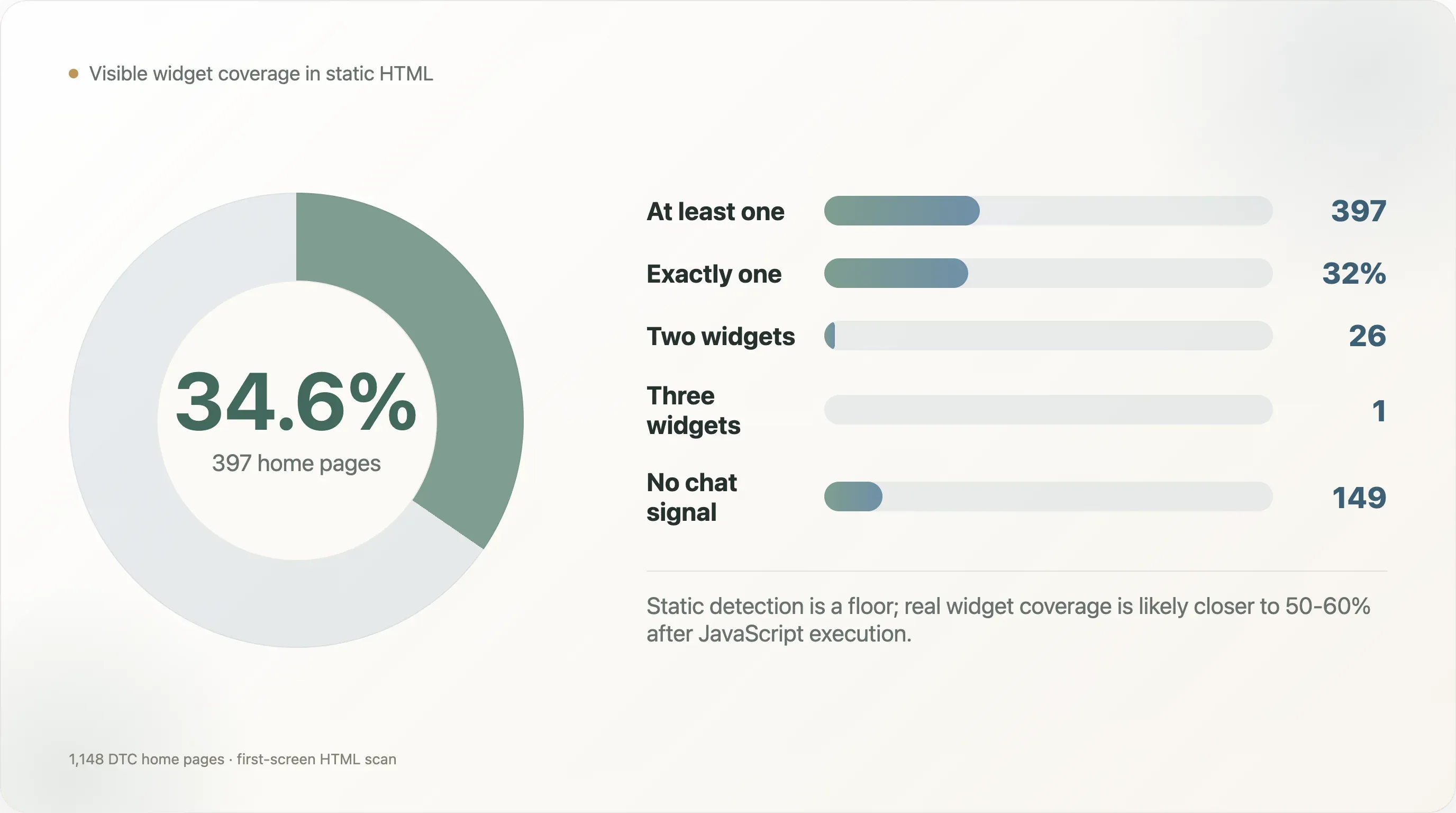
Widget coverage itself is not universal. Only 34.6% of scanned home pages expose at least one support widget in static HTML. Because many widgets load through JavaScript, that should be read as a lower bound, not a true total adoption rate.
AI customer support is even earlier as a public storefront signal. Only 13 brands, or 1.1% of the sample, publicly surface AI-chat language on the home page. The gap between AI in hiring text and AI in DTC storefront support is large, but it likely reflects public positioning as much as backend adoption.
The Most Shareable Findings
- 397 of 1,148 DTC home pages exposed at least one support widget in static HTML.
- Gorgias led the sample at 267 detected brands, or 23.3%, with important sample-echo caveats.
- Zendesk ranked second at 49 brands, or 4.3%.
- Intercom appeared on only 7 brands, or 0.6% of the DTC sample.
- WhatsApp Button appeared on 19 brands, outranking several traditional chat SaaS tools.
- Only 13 brands, or 1.1%, publicly surfaced AI customer-support language.
- The report measures visible home-page signals, not the full support backend.
Most people who work around software carry a SaaS-shaped map of customer support. Intercom owns the messenger in the product, Zendesk owns the helpdesk category, and AI agents are becoming the next layer. That map works well enough for B2B software. It breaks down fast when you point it at DTC commerce.
The DTC support problem is not "a user is stuck inside the product." It is "a buyer wants to know where the package is, whether the coupon worked, how to start an exchange, whether the item is returnable, or why the shipment is late." The center of gravity is not a product session. It is the order record. That is why the vendor landscape looks strange if you approach it from SaaS: the tools that win are the ones that make Shopify, fulfillment, returns, email, SMS, and agent workflow feel like one surface.
Scrape support widgets from any website using AI Get Started Free
This blog version keeps that structural point front and center. The most important finding is not only who leads. It is why the market filtered toward those winners, and why the public AI signal is still tiny even when the hiring market is loudly moving toward AI.
We scanned 1,148 DTC brand home pages and read what customer-support widget — the chat button or messenger bubble a visitor sees the moment a page loads — sits behind each one. The result is uncomplicated, but it doesn't fit the mental model most people walk in with, which is that whoever dominates SaaS support also dominates DTC.
The most interesting line isn't Gorgias at 23.3% — that number needs a discount before you can read it, and we'll explain why shortly. The most interesting line is this: Intercom, the undisputed leader of SaaS customer support, sits at 0.6% in DTC. Seven brands out of 1,148. A product built around an in-product messenger paradigm has been almost completely filtered out of a market where the customer was never inside the product.
Two questions to answer here. First, what shape is DTC customer-support tooling — who wins, who runs the mid-pack, who fails to land? Second, how far has AI customer support actually penetrated DTC — the AI Required Position Rate report we published on 2026-05-11 found that 35.6% of HN hiring posts name specific AI tools; what about live DTC pages?
Start with the second question because the contrast is the cleanest.
1. AI in hiring text: 35.6%. AI on DTC home pages: 1.1%.
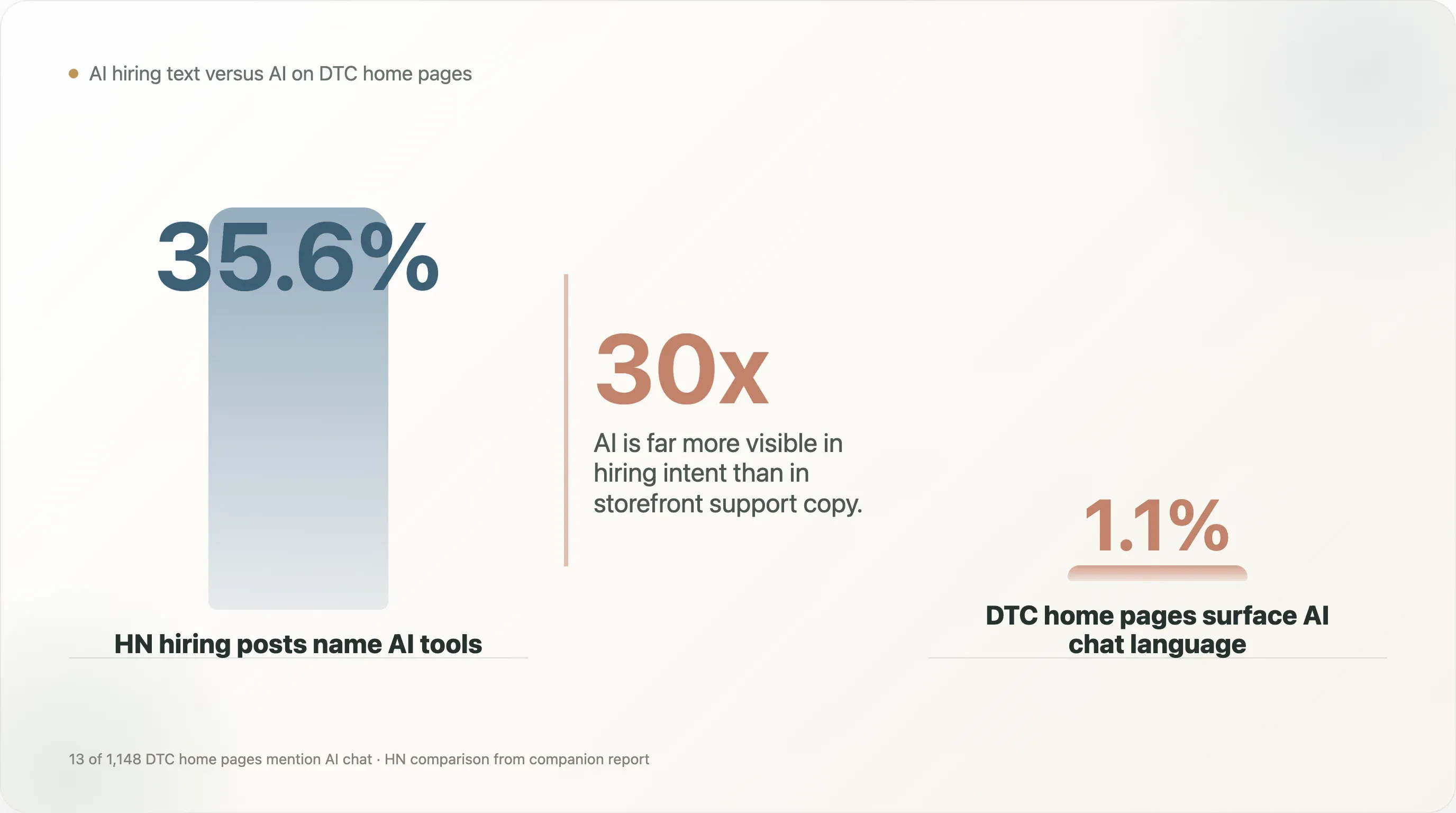
Scanning 1,148 DTC home pages, only 13 surface anything in the family of "AI chatbot / AI assistant / AI agent / GPT-powered / Intercom Fin / Gorgias AI Agent." That's 1.1%.
Set that next to the adjacent AI Required Position Rate report we published 2026-05-11. Same time window, HN hiring community, 619 postings — 35.6% mention specific AI tools or LLM keywords (36.7% excluding unknowns). Both samples are "broader tech in May 2026." In hiring text, AI shows up in roughly one of every three postings. On live DTC home pages, AI shows up in roughly one of every hundred brands. A 30x gap.
The gap isn't "DTC is behind" the way it might first read. Hiring text reflects two things: skills currently needed, and skills the company plans to need over the next 12-18 months. A meaningful share of that 35.6% is "we want to hire people to build AI," not "all our roles use AI today." HN is in that sense a leading indicator — it shows what companies are planning, not what's shipped.
The reverse holds on DTC pages. The 1.1% does not mean DTC backends don't use AI. Many DTC brands have likely already enabled Gorgias Automate or Intercom Fin on the backend to auto-resolve tickets — they just don't surface "AI-powered" on the home page because their end-customers (regular consumers) don't care. Marketing copy and deployed automation run on different tracks. The 1.1% measures whether brands publicly market AI, not whether they use it.
But the commercial conclusion is the same regardless of which interpretation you favor: for AI customer-support vendors — Gorgias Automate, Intercom Fin, Zendesk AI Suite, Reamaze AI Inbox, plus newer entrants like Cresta, Decagon, Sierra, Forethought — DTC is an untaught market. Customers don't use it publicly. The customers who use it don't talk about it. Whoever owns the narrative for AI customer support in DTC will likely lock in category-defining positioning before broader adoption arrives in 2027-2028.
The 13 DTC brands publicly signaling AI customer chat are an early-marketer subsample worth naming — fillingpieces.com, hikoco.com, livingproof.com, olly.com, truelinkswear.com and several others:
Read this as "brands brave enough to put AI on the storefront," not "DTC's top 13 AI-chat champions." Those are different lists.
2. 35% show a widget, 65% don't — and 65% is a floor
Back to the customer-support tooling itself. Of 1,148 DTC home pages, 397 (35%) expose at least one customer-support widget in static HTML. 32% have exactly one, 2.3% have two, exactly one brand has three. The two-widget cases are mostly "primary helpdesk + secondary channel" combinations; we'll come back to those.
The remaining 65% don't show a widget on first scan, but that number deserves a discount. Three possibilities.
First, JS-loaded widgets escape static detection. Many helpdesk vendors — including Gorgias and Zendesk — inject their scripts via chunk-loaded JS. Static scans only see the vendor host visible in the first-screen HTML bytes. If a vendor loads via GTM, Segment, or a delayed chunk, our method misses it. A Thunderbit Chrome-extension pass that executes JS recovers this layer.
Second, chat-on-demand UX. Many brands deliberately put the chat widget on product or checkout pages only, keeping the home page as pure brand-narrative + CTA. That's a real UX decision, not "not installed."
Third, no chat at all. 149 brands (13%) show no "chat / live chat / contact us" language signal anywhere on the home page. These very likely don't run live chat — only an email contact path.
Putting the three together, real widget coverage is probably 50-60%. Our 35% is a conservative floor. The point is, "do you put a chat widget on the home page" isn't industry consensus in DTC — it's closer to a 50/50 split. The decision should hinge on where your conversion friction sits and what voice you want your home page to carry, not on "everyone else does it."
3. Vendor share: Gorgias leads, with a discount
Top 15 detected vendors:
| Rank | Vendor | Brands | Share |
|---|---|---|---|
| 1 | Gorgias | 267 | 23.3% |
| 2 | Zendesk | 49 | 4.3% |
| 3 | WhatsApp Button | 19 | 1.7% |
| 4 | Reamaze | 17 | 1.5% |
| 5 | HubSpot Chat | 12 | 1.0% |
| 6 | Kustomer | 11 | 1.0% |
| 7 | Crisp | 10 | 0.9% |
| 8 | Intercom | 7 | 0.6% |
| 9 | Facebook Messenger Plugin | 7 | 0.6% |
| 10 | Help Scout | 5 | 0.4% |
| 11 | Tidio | 5 | 0.4% |
| 12 | LiveChat | 4 | 0.3% |
| 13 | Tawk.to | 3 | 0.3% |
| 14 | Front | 3 | 0.3% |
| 15 | Freshchat | 2 | 0.2% |
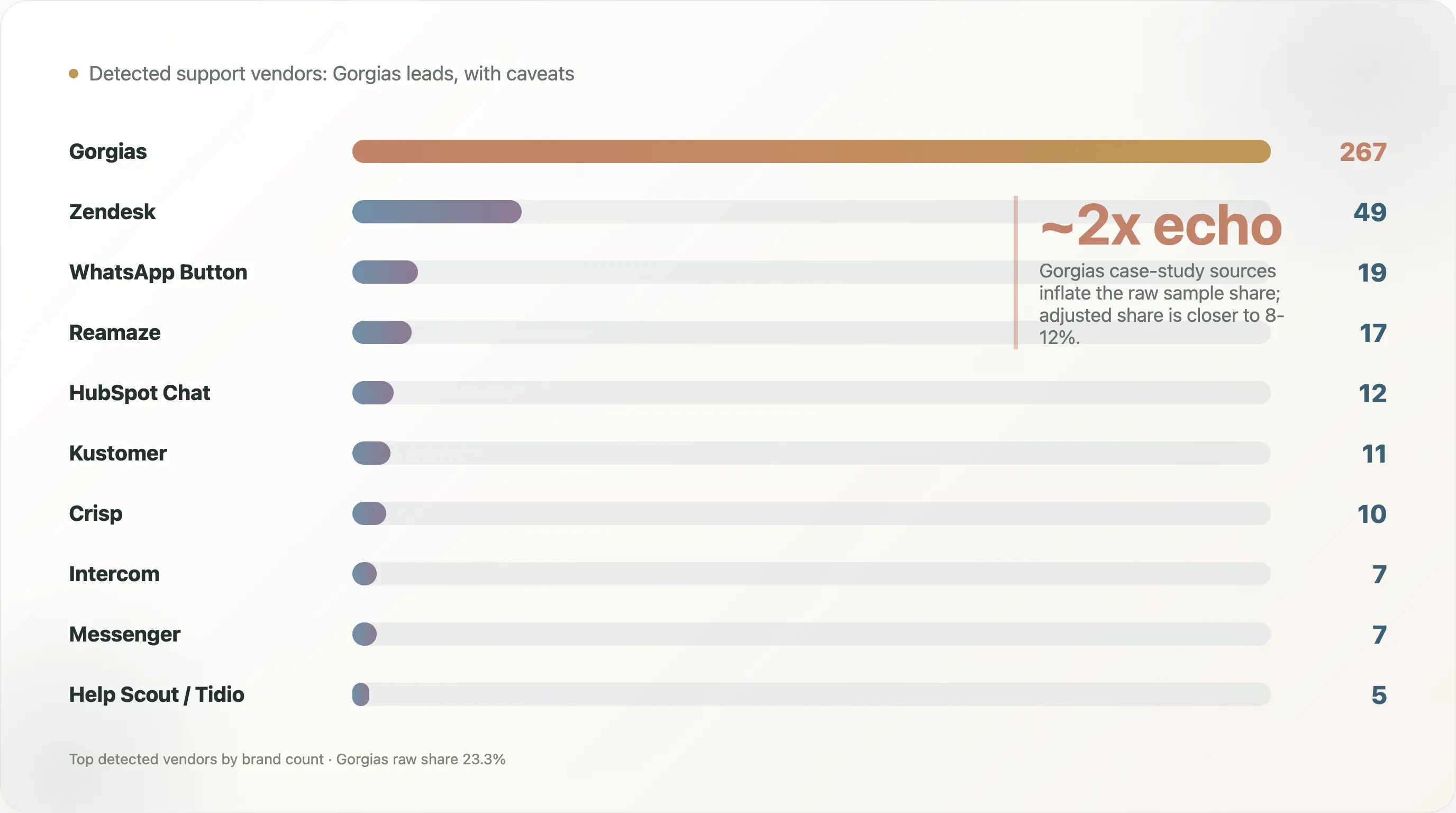
Gorgias at 23.3% with 267 brands. Zendesk #2 at 4.3%. WhatsApp Button #3 at 1.7%. Gorgias looks dominant — but you can't read the raw number.
When we built the brand pool, 1,597 candidate brands came partly from Shopify-ecosystem customer case-study sitemaps. Gorgias' own case-study sitemap is one of those sources. Every DTC brand Gorgias chose to showcase was automatically pulled into our pool — and Klaviyo, Postscript, Shopify Plus, and Skio case studies contribute similarly. So "Gorgias 23.3%" includes substantial sample echo, not pure industry share.
Independent estimators land much lower. BuiltWith (technographics of all e-commerce sites) puts Gorgias at ~3-5%. Wappalyzer (Chrome-extension user sampling on Shopify sites) puts it at ~4-7%. Gorgias' own 2024 financial disclosures cite 14,000+ merchants. Triangulating these, Gorgias' realistic DTC share is in the 8-12% range, and our 23.3% reads as "true share × roughly 2x sample echo." Remember the discount when reading any Gorgias number — assume you've already taken it.
Even after the discount, the rest of the leaderboard is informative.
Zendesk at 4.3% is interesting. In SaaS, Zendesk is dominant — it's hard to find a mid-market or larger B2B SaaS company that doesn't run it. In DTC, only 4.3%. This isn't "Zendesk didn't try" — DTC customer-contact models differ from SaaS in ways that don't fit Zendesk's generic helpdesk paradigm.
WhatsApp Button at 1.7% (19 brands) is the surprise. A plain wa.me/... link, in DTC, outranks Reamaze, HubSpot Chat, Crisp, and Intercom — and every other proper customer-support SaaS in the long tail. It reflects DTC customer preference, especially for international brands, cross-border commerce, and low-AOV / high-repeat categories. Users already have WhatsApp; you give them a link; they message you with no signup, no cookie banner, no chat-widget loading delay. Zero cost, trivial deploy, effective.
Intercom at 0.6% (7 brands) is the line that made us stop and look twice. The SaaS customer-support category leader, almost absent in DTC. We dedicate the next section to this because it explains a real, deep structural difference between two markets that look similar from a distance.
Reamaze 1.5%, Kustomer 1.0%, HubSpot Chat 1.0%, Crisp 0.9% — the mid-tail. Each holds a niche. Reamaze is the Shopify-native helpdesk, narrowly DTC-positioned. Kustomer pivoted after Meta acquisition toward omnichannel large brands. HubSpot Chat is free-tier reach into marketing-led DTC brands. Crisp is rooted in European early-stage startups. None of them is positioned to challenge Gorgias' DTC lead.
4. Why Gorgias won DTC and Intercom barely exists here
Gorgias 23.3% (8-12% adjusted) versus Intercom 0.6%. A SaaS native looking at this ratio thinks it doesn't make sense. Intercom is the customer-support SaaS — how could DTC use so little of it?
The answer isn't product quality. It's customer-contact architecture. SaaS and DTC have genuinely different customer-arrival paths, ticket types, and agent needs — and Intercom built its core paradigm around the SaaS half. It doesn't translate.
SaaS customers come through a B2B funnel: demo request → trial → onboarding → expansion. A user touches the product dozens of times before paying. Tickets are mostly technical — "my account is broken," "API integration is failing," "permissions are wrong." Intercom's moat is the in-product messenger — a chat surface embedded inside the SaaS app, merging support + in-app guidance + product tours into one experience. When a customer has a problem inside the product, Intercom appears inside the product. Seamless.
DTC customers come from an entirely different funnel: Meta / TikTok / Google ad → land on page → add to cart → check out. A buyer's total time-in-product before purchase might be 5 minutes once. Tickets are mostly order-related — "where is my package," "how do I return this," "my coupon doesn't work," "can I swap the code." These tickets don't need an in-product messenger. They need deep Shopify-order-data integration — the support agent opens a ticket and sees the Shopify order ID, tracking number, refund authorization, and customer order history right inside the agent UI. No tab switching across eight systems. That is Gorgias' core value proposition.
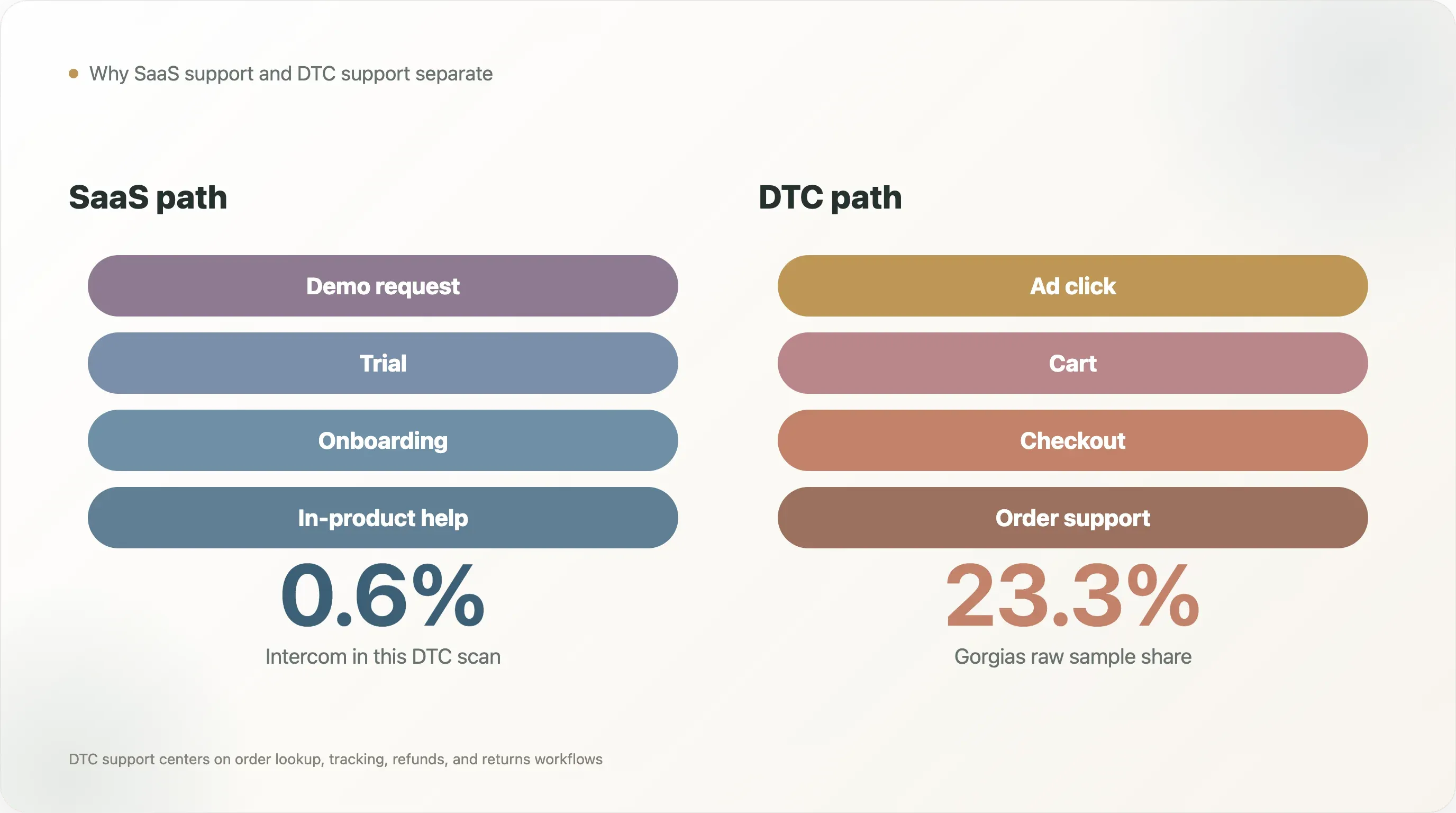
Layer it deeper: at most DTC companies, Support + Returns + Fulfillment share one system. Gorgias unifies tickets + Shopify refunds + tracking-number lookups in a single workflow. Intercom can integrate Shopify, but its product DNA is messenger, not helpdesk-with-deep-Shopify-data. Different paradigms.
Gorgias' DTC moat isn't "prettier chat UI." It's Shopify-data depth. Any vendor trying to enter DTC customer-support has to solve order lookup, refund execution, and exchange workflow — the three ticket types making up 80% of volume — not just "FAQ auto-answer."
Two direct implications. For DTC operators: select a helpdesk by depth of integration with Shopify, the order system, and your returns SaaS — not by chat-UI elegance. Reamaze and Kustomer compete on the same axis. Crisp and HelpScout are cheaper but order-data-light; fine for early-stage DTC but you'll outgrow them at scale. For AI customer-support vendors: "FAQ auto-answer" alone isn't enough to enter DTC. You have to crack order-class workflow — that's what Gorgias Automate and Reamaze AI Inbox are pushing, but the 1.1% public-marketing penetration in our data confirms that AI replacing order-class support remains early in 2026.
One more architectural note: support tooling is sticky once installed in DTC — the tool sits between the order system, the returns SaaS, and the email-receipt workflow. Migration is a real project, not an afternoon's work. That stickiness compounds Gorgias' early lead and means any new entrant needs a wedge stronger than "we have better AI" — a workflow story that justifies migration friction.
5. The 26 multi-widget brands aren't running messy stacks — they're running strategy
2.3% of brands (26) ship two or more chat widgets. Common combinations:
| Combination | Brands |
|---|---|
| Gorgias + Zendesk | 3 |
| Gorgias + HubSpot Chat | 2 |
| Crisp + Gorgias | 2 |
| Crisp + WhatsApp Button | 2 |
| Facebook Messenger Plugin + Gorgias | 2 |
| Crisp + Zendesk | 1 |
| HubSpot Chat + LiveChat | 1 |
| Gorgias + Reamaze | 1 |
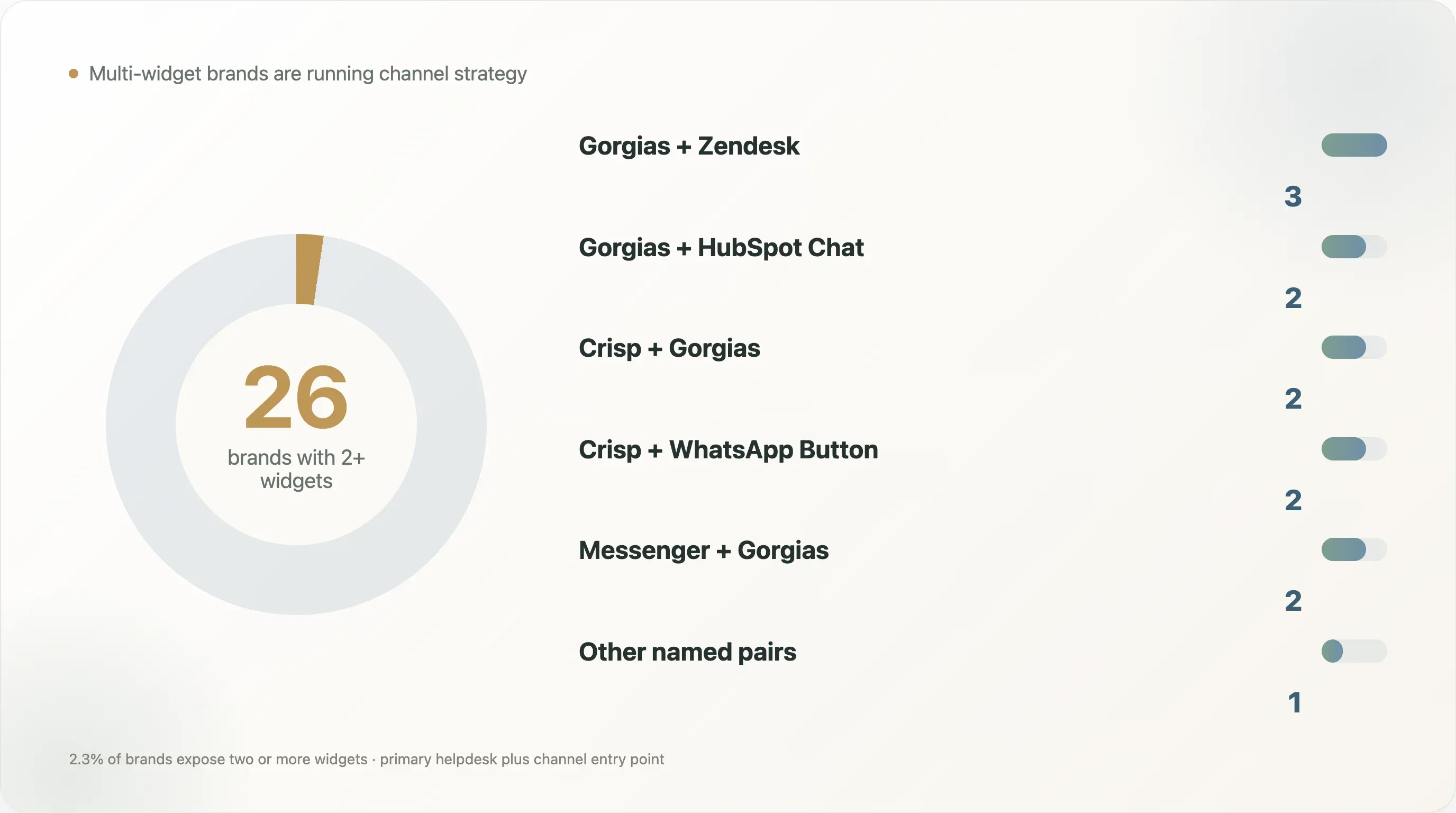
These aren't messy stacks. They're intentional multi-channel support — Gorgias handles tickets, WhatsApp handles international direct-DM, Facebook Messenger handles already-authenticated social customers. Each entry point serves a different customer-arrival pattern. The strategy is multi-channel by design, not bloat by accident.
For DTC operators, the implication is simple: if your audience lives on multiple channels, don't chase a single-tool answer. Nail your primary helpdesk (Gorgias or Zendesk), then layer direct-link widgets for the channels your customers actually use. The 26 multi-widget brands are a real counter-signal to "everyone uses single-widget" — the single-widget default isn't optimal for cross-border or high-repeat-purchase DTC, where customers expect to reach you on whatever app they already have open.
6. Practical guidance for DTC operators, CX teams, and AI-chat vendors
Flattening the data into actions for someone working DTC customer-support or growth.
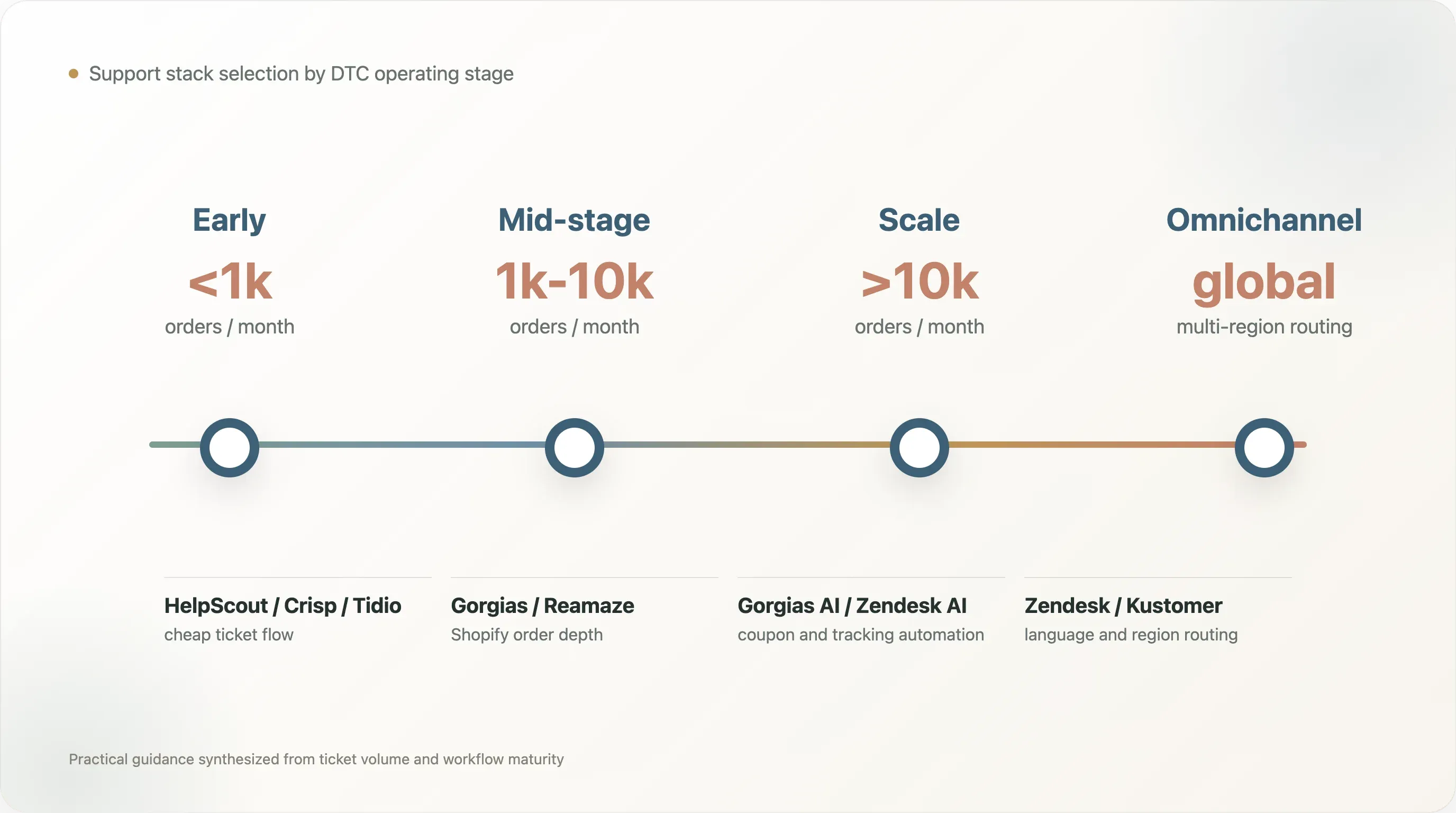
Helpdesk selection has a stage-by-stage path. Early-stage DTC (under 1,000 orders/month) — HelpScout, Crisp, or Tidio at under $15/seat. At this stage the founder + one contractor handles all tickets; no routing rules, no SLA precision, just get tickets flowing. Mid-stage (1,000-10,000 orders/month) — Gorgias or Reamaze. Shopify-order-data integration becomes the bottleneck, and $50-150/seat is reasonable when it buys back 30-40% of agent time. Scale stage (>10,000 orders/month) — Gorgias + AI Automate / Zendesk + AI Suite / Kustomer. AI auto-resolution of coupon and tracking-number tickets typically reduces human-agent load by 30-50%. This is where AI customer support actually pays off, and it's the stage almost no brand in our sample has reached (which explains why public AI signal sits at 1.1%). Beyond that, omnichannel multi-region brands typically need Zendesk or Kustomer with multi-language routing; Gorgias is weaker on international depth at this scale.
AI customer-support content is a wildly under-served writing angle. 1.1% public penetration isn't "nobody wants AI chat" — it's "nobody on the marketing side has owned this narrative yet." If you run DTC content — blog, case studies, newsletter — "how AI customer chat actually works, what the ROI looks like, what to expect in year one" is highly supply-constrained. Your readers don't know whether peers are using it, and don't know if it works. There's a 1-2 year window here. If you're an agency or consultant inside the Gorgias / Intercom / Zendesk ecosystem, "we'll help you turn on AI Agent" is a clean wedge — most competitors aren't pitching this yet.
Home-page chat is not a settled question. 35% show / 65% don't is close to 50/50. The decision is yours. If support tickets are friction in your conversion funnel, surface it. If brand visual cleanliness matters, hide it. A useful middle path: chat on cart and checkout pages only — catches hesitating customers at the critical conversion moments without diluting the home page's brand expression.
WhatsApp Button is the underrated channel. 19 brands (1.7%) ship a plain wa.me link — more than Reamaze, HubSpot Chat, and most legitimate chat SaaS. For international, cross-border, or low-AOV / high-repeat DTC, a direct WhatsApp link may beat fancy chat widgets — zero cost, trivial deploy, customers already have the app. Worth running as an A/B variant.
7. How stable is this data, and where does it stop being valid
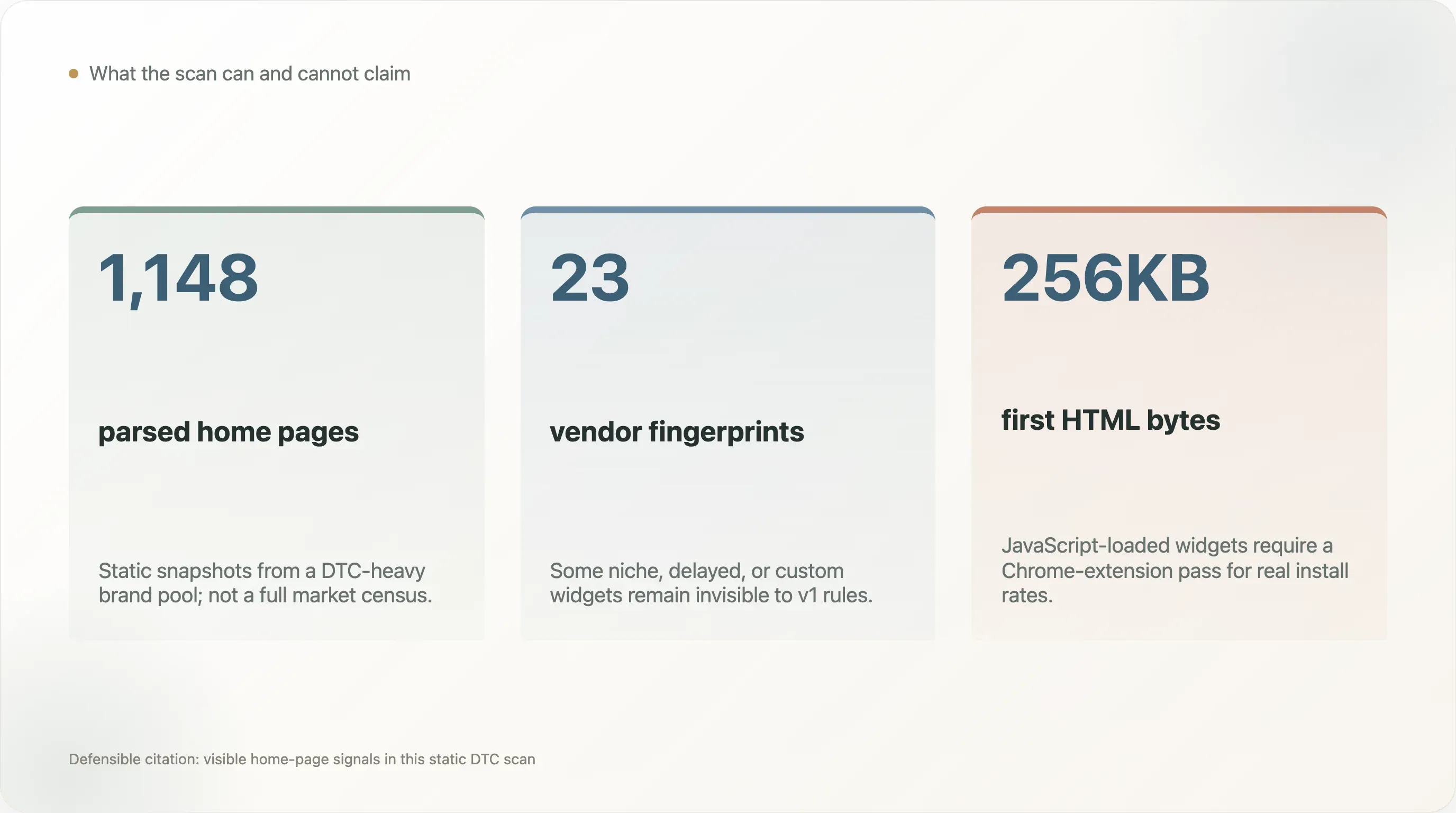
1,148 parsed home pages (from 1,429 raw home.html, dropping <1KB or unparseable). 23 vendor fingerprints; some niche or custom helpdesks are still missing. The long-tail share in reality is probably somewhat higher than what we report.
Static scan only inspects first-screen HTML bytes — this is a floor. JS-loaded widgets (parts of Intercom and Drift init patterns) escape. To recover real install rates, run Thunderbit's Chrome extension to execute JS and re-scan. We didn't do this for v1.
External cross-reference: BuiltWith estimates Gorgias at ~3-5% of e-commerce; Wappalyzer at ~4-7% of Shopify sites; Gorgias' 2024 disclosures cite 14,000+ merchants. Our 23.3% reads as "true share × ~2x sample echo." None of these are contradictory — BuiltWith looks at all e-commerce (large denominator), Gorgias self-reports merchant count (not share), and our sample is DTC-head + Shopify-ecosystem-leaning (narrow but dense). Three different views. The defensible cite from this report is "in DTC-heavy samples, Gorgias leads Zendesk meaningfully," not "Gorgias has 23% of the industry."
Boundary in one line: this report describes what happens inside our 1,148-brand DTC home-page static scan — not DTC industry market share, and not what DTC backends actually run. Backends are a black box; we can only see what shows up in the home-page HTML.
Methodology
Data source: 1,148 DTC home-page HTML snapshots from a 1,597-brand pool (filtered to home.html ≥ 1KB), with 23 customer-support vendor fingerprint rules (open in 01_detect_widgets.py). Snapshot date 2026-05-12 (UTC).
Gorgias sample echo (the most important caveat): our brand pool partly derives from Gorgias' own customer case-study sitemap (and that of other Shopify-ecosystem tools — Klaviyo, Postscript, Shopify Plus, Skio). By construction, brands Gorgias chose to showcase are in our sample. Gorgias 23.3% cannot be read as "23% market share" — independent estimators put Gorgias at 8-12%. Treat 23.3% as "#1 vendor in this sample, with roughly 2x sample echo," not industry share.
Brand pool tilts Shopify-ecosystem: ~67% of brands trace back to Shopify-stack case-study sources — so the sample over-represents Shopify-native, modern, marketing-led DTC and under-represents legacy retail / mom-and-pop e-commerce. This is not the full US DTC universe.
Static scan is a lower bound: first-screen 256KB HTML only. JS-loaded widgets escape — Intercom's and Drift's chunk-loaded init can be invisible to our scan. The 35% detected-widget rate is a floor; the real rate is probably 50-60%.
AI signal = marketing text, not backend reality: many DTC brands likely already run Gorgias Automate or Intercom Fin behind the scenes; they just don't market it on the home page. Our "AI signal 1.1%" reflects public marketing text only, not backend AI usage.
Multi-widget ≠ messy stack: the 26 multi-widget brands typically run a primary helpdesk + a side channel (WhatsApp / Messenger / Crisp). They aren't operating parallel support systems.
Legal and copyright: all home pages were publicly fetched. The report uses aggregate counts only — no full home-page text reproduction. The 13 brands named as AI-signal positive cases self-declared the marketing language on their own home pages. The 26 multi-widget brands are named in neutral, descriptive context. No raw HTML or CSV is published; every number is reproducible from the public brand pool + public rule set.
Caveats
What this report does NOT support:
- Not "Gorgias has 23.3% of the DTC market" (contains sample echo; real share ~8-12%)
- Not "only 1.1% of DTC uses AI customer support" (marketing-text signal only; backend AI is invisible to static scan)
- Not "65% of DTC brands don't run a chat widget" (static lower bound; real coverage probably 50-60%)
- Defensible: "In a static scan of 1,148 DTC brand home pages, Gorgias is the #1 detected vendor at 23.3% (with sample echo), and only 1.1% publicly market AI-powered chat"
Data source & versioning
Dataset: dtc_customer_support_map_2026/ (this repo). Snapshot date 2026-05-12 UTC, report version v1.0 (static-scan lower bound; v2 planned with Chrome-extension JS-executed scan). Shares the DTC brand pool with dtc_dual_report_2026 — both reports work from the same 1,148-brand subset. Companion report: AI Required Position Rate 2026 (HN hiring sample, released 2026-05-11) — the AI-in-hiring-text half of the same question; operators can triangulate intent versus shipped product by reading the two side by side.
What SEO and Content Teams Can Cite
This research creates several citation angles for blog intros, data callouts, social posts, comparison pages, and follow-up explainers:
- 397 of 1,148 DTC home pages exposed at least one support widget in static HTML.
- Gorgias led the sample at 267 detected brands, or 23.3%, with important sample-echo caveats.
- Zendesk ranked second at 49 brands, or 4.3%.
- Intercom appeared on only 7 brands, or 0.6% of the DTC sample.
- WhatsApp Button appeared on 19 brands, outranking several traditional chat SaaS tools.
- Only 13 brands, or 1.1%, publicly surfaced AI customer-support language.
- The report measures visible home-page signals, not the full support backend.
The caveat should travel with the citation. These numbers describe the specific sample and collection method used in this report. They should not be reframed as a full-market census, an internal adoption measure, or a claim about every company in the category.
For editorial use, the strongest framing is the one that pairs the headline statistic with the sample boundary. That makes the claim more durable and easier for readers to trust. For example, write "in this HN hiring sample," "in this DTC home-page static scan," or "across this YouTube channel sample" before turning the number into a broader trend discussion.
Reproducibility Notes
The delivery folder includes the following process files copied from the original local report packages. These are included so the published report can be checked against the actual scripts, intermediate outputs, charts, and source drafts used in the reporting workflow.
process_files/_shared/dtc_brand_pool_source/out/brand_pool_v2.csvprocess_files/_shared/dtc_brand_pool_source/out/detection.csvprocess_files/_shared/dtc_brand_pool_source/out/master.csvprocess_files/out/analysis_stats.jsonprocess_files/out/widget_stats.jsonprocess_files/out/widgets.csvprocess_files/scripts/01_detect_widgets.pyprocess_files/scripts/02_compute_stats.pyprocess_files/scripts/03_make_figs.pyprocess_files/scripts/04_build_report_bilingual.pyprocess_files/scripts/05_module_i_check.py
Download all scripts and datasets
Methodology corrections, dataset issues, and follow-up analyses are welcome at support@thunderbit.com. This report is based on public web or public API signals collected in May 2026 and should be read with the sample boundaries stated above.
Try AI Web Scraper for Public Web Data Get Started Free




