

Executive Summary
This research uses the same May 2025 and May 2026 Hacker News hiring corpus as the RTO Index report, but reads it through a different lens: how often companies mention AI tools, LLM capabilities, agentic workflows, and related requirements in hiring text.
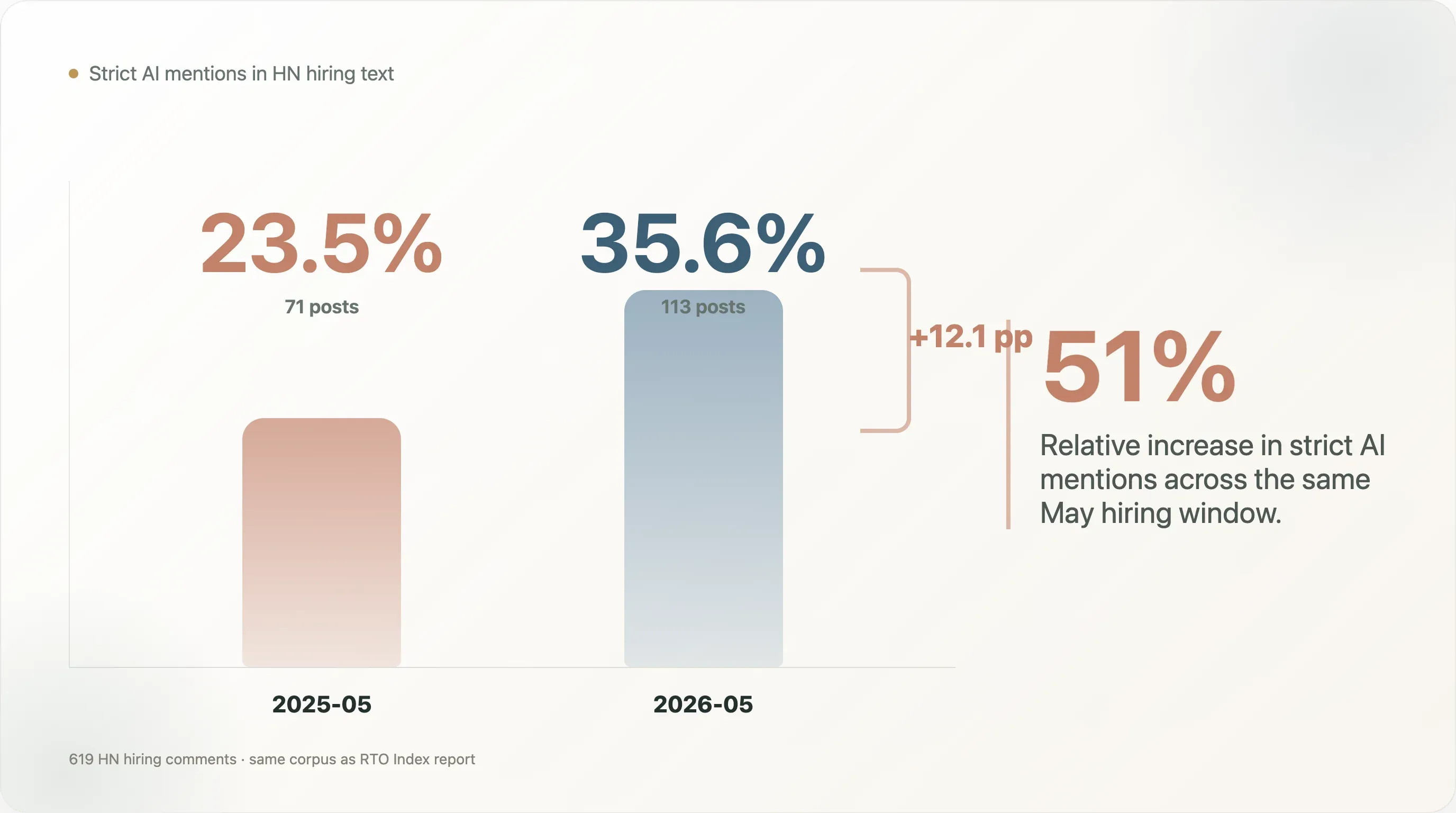
Strict AI keyword penetration rose from 23.5% in May 2025 to 35.6% in May 2026. In plain language, roughly one in four HN hiring posts named specific AI tooling or LLM concepts a year ago; by May 2026, more than one in three did.
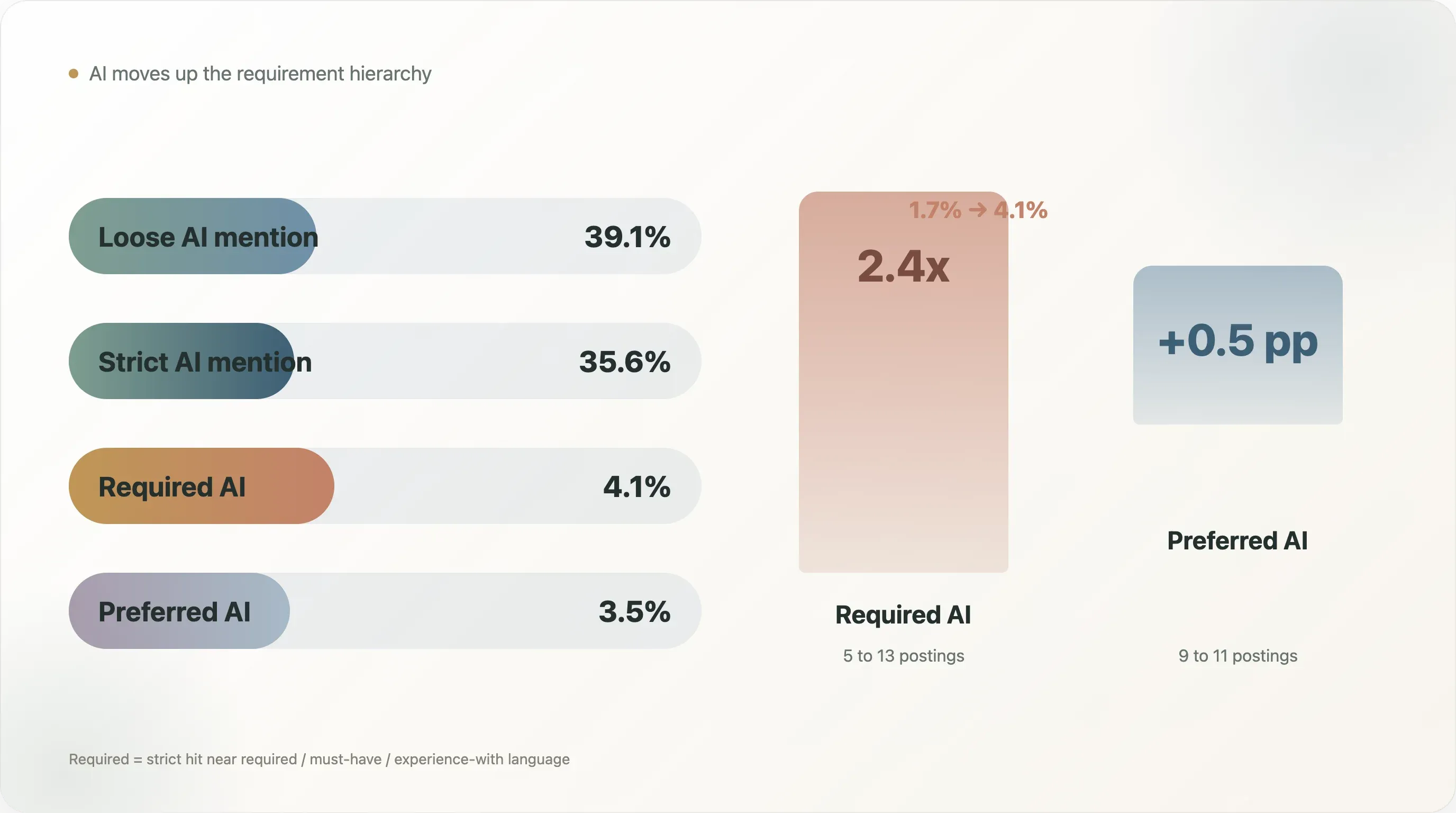
The most important movement is not just frequency. Required AI moved from 1.7% to 4.1%, while Preferred AI barely changed. That suggests AI language is moving from a nice-to-have signal into the must-have section of technical hiring.
The keyword mix also changed. "Agentic" became the top keyword in the 2026 sample, and Claude plus Claude Code together outpaced Cursor and Copilot in named-tool mentions. For developer marketing, recruiting, and career planning, this is a useful signal that AI workflow fluency is becoming part of the mainstream engineering stack.
Try Thunderbit for AI-powered web scraping
The Most Shareable Findings
- Strict AI mentions rose from 23.5% to 35.6%, a 12.1 percentage-point increase.
- Loose AI mentions rose from 29.5% to 39.1%.
- Required AI more than doubled, from 1.7% to 4.1%.
- Preferred AI barely moved, from 3.0% to 3.5%, which makes the Required increase more meaningful.
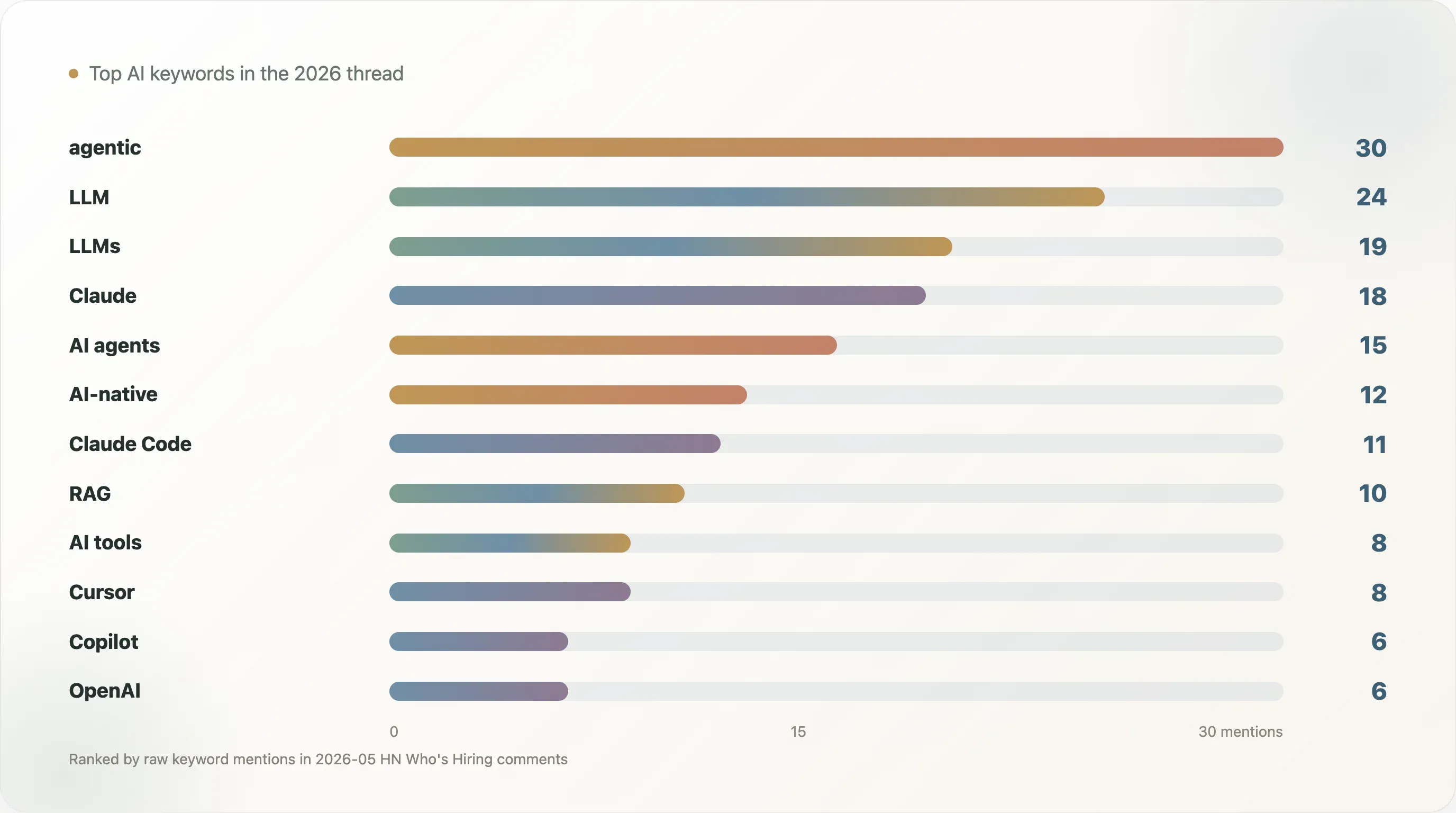
- "Agentic" rose from 7 mentions to 30 and became the top 2026 keyword.
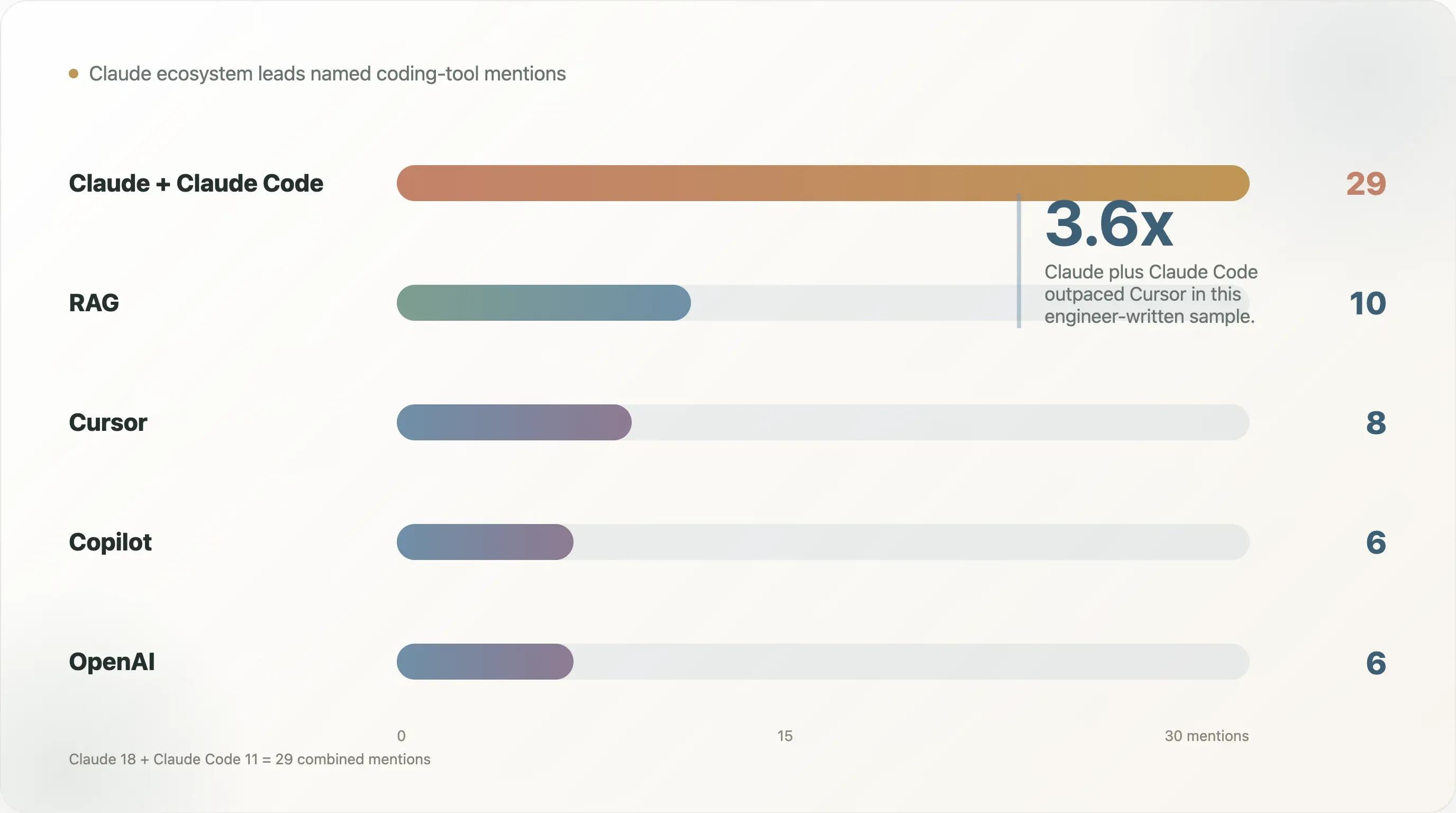
- Claude appeared 18 times and Claude Code appeared 11 times in 2026; combined, that is 29 mentions.
- Engineering roles drove the main movement, with AI keyword penetration rising from 22.1% to 36.3%.
There is a difference between a company saying "we are excited about AI" and a company writing AI tools into the job description a candidate has to meet. The first is a marketing posture. The second is an operating signal. This report focuses on the second kind of evidence: the words companies use when they are trying to hire technical people in a public, engineer-heavy forum.
That distinction matters for blog readers because AI adoption data is noisy. LinkedIn and Indeed can show explosive growth in AI language, but job boards also reward keyword stuffing. Company blogs can sound ambitious without proving much about the day-to-day work. Hacker News is a smaller and more biased sample, but the language tends to be less polished and more direct. A founder or engineer posting there is usually trying to attract peers, not optimize for a recruiter search algorithm.
So the headline is not merely that AI words appeared more often. The sharper story is that AI language moved up the hierarchy of hiring text: from broad interest, to named tools, to must-have requirements. That is the kind of shift readers can use when thinking about careers, developer tooling, recruiting, or the next wave of B2B content.
Hacker News runs a fixed hiring thread on the first of each month — "Ask HN: Who is hiring?". Companies drop a recruiting comment in the format company | role | location | REMOTE/HYBRID/ONSITE | description. We pulled the May 2025 and May 2026 threads, totaling 619 hiring comments, and scanned for mentions of specific AI tools and capability keywords.
The headline result is simple: in twelve months, mentions of AI tools in hiring text moved from 23.5% to 35.6%. That's a 12-percentage-point absolute increase, roughly 51% relative. Across all the trend reports we've done, this is one of the fastest structural changes in a comparable time window — roughly four times faster than the +3.3 pp hybrid-vs-remote shift documented in our adjacent RTO Index 2026 report.
But the 12 pp number itself isn't the most interesting part. Three things below it are.
One, "Required AI" doubled. Postings that explicitly write required / must have / experience with X AI tool moved from 1.7% in May 2025 to 4.1% in May 2026 — 5 to 13 postings against the same denominator. The share of companies treating AI as a must-have in hiring criteria more than doubled. AI's position in hiring descriptions is migrating from "nice-to-have bonus" toward "day-1 hard requirement."
Two, "agentic" went from near-absent to #1. In the May 2025 thread "agentic" appeared 7 times, barely making the top 20. In May 2026 it appeared 30 times and took the #1 spot. "Agentic" — AI agent / agentic workflow — moved from research jargon into standard hiring-text vocabulary in twelve months. In the last four tech waves (big data, blockchain, Web3, LLMs themselves), no concept made this transition this fast. The drivers are visible — Anthropic repositioning Claude as "agent that uses tools," OpenAI shipping Computer Use and GPT-5 agent demos, the Y Combinator W26 batch heavily weighted toward "agentic" startups. The technical narrative exploded in late 2024 through mid-2025, and the May 2026 thread is the sample where the wave reaches hiring.
Three, Claude leads the named-tool count, more than 2x Cursor and Copilot. "Claude" appears 18 times in May 2026 (vs 3 in May 2025 — a 4.5x jump). "Claude Code" appears separately 11 more times; combined, 29 mentions. Cursor is at 8, Copilot at 6. Copilot is the incumbent in this category — GitHub launched it in 2021, and five years of presence has built mainstream recognition among engineers. But in HN hiring text — a sample of engineers writing for other engineers — Anthropic's Claude has overtaken it. If you do developer marketing, Anthropic's penetration depth is far higher than it appears on the surface. This signal is invisible in LinkedIn or Indeed (those samples are SEO-stuffed by every vendor at once); it shows up only in the person-to-person register of HN.
Stacking the three observations together, the data tells one story: AI in hiring narrative is shifting from "we want to do AI" to "we already do AI, you need to be fluent." From the verb side, "build with," "automate via," "use" are increasingly common; "explore," "research," "prototype" are receding. From the tool side, Anthropic's Claude ecosystem (Claude + Claude Code + agentic frameworks) is challenging OpenAI's position in developer mindshare. Below we walk through each layer.
1. Overall: 24% to 36%
We scanned the full text of 619 hiring comments using a public AI keyword dictionary (full list below). Hits are classified into four tiers, loose to strict:
- Loose: any AI-related keyword (including broad terms like "machine learning")
- Strict: specific AI tools (Claude / Cursor / Copilot / OpenAI / Midjourney) or LLM-category terms (GenAI / LLM / RAG / agentic)
- Required: Strict hit + context contains
required / must have / experience with - Preferred: Strict hit + context contains
nice to have / preferred / bonus
| Metric | 2025-05 | 2026-05 | YoY (pp) |
|---|---|---|---|
| Loose AI mention | 29.5% (89) | 39.1% (124) | +9.6 |
| Strict AI mention | 23.5% (71) | 35.6% (113) | +12.1 |
| Required AI | 1.7% (5) | 4.1% (13) | +2.4 |
| Preferred AI | 3.0% (9) | 3.5% (11) | +0.5 |
The most informative row is Strict — it filters out the false positives from broad terms like "machine learning." Across twelve months, Strict moved from 23.5% to 35.6%, +12.1 pp absolute, ~51% relative. In plain terms: a year ago, roughly 1 in 4 HN hiring posts explicitly named AI tooling like Claude / Cursor / Copilot / LLM / RAG. Today, more than 1 in 3.
The Required row tells a sharper version of the same story. 5 to 13 postings — small in absolute count, large in implication. Naming an AI tool in the must-have section requires that the tool is already embedded in the workflow, not aspirational. "Required" doubled, faster than Loose and Strict, which is the cleanest signal that AI tools are migrating from hiring narrative into actual work-process expectation.
Preferred barely moved, which is itself signal. If the whole AI wave were just "add AI words to hiring copy," Preferred should rise in step with Required — "we'd love if you know AI tools, that's a plus." Preferred moved only +0.5 pp while Required moved +2.4 pp. AI tooling isn't being casually mentioned more; it's being promoted up the requirement hierarchy, from nice-to-have into must-have.
2. Which AI words get named: agentic, Claude, LLM lead
Ranked by mention count, top 12 AI keywords in the 2026-05 thread:
| Rank | Keyword | 2026-05 | 2025-05 | Type |
|---|---|---|---|---|
| 1 | agentic | 30 | 7 | New concept |
| 2 | LLM | 24 | 16 | Capability |
| 3 | LLMs | 19 | 23 | Capability |
| 4 | Claude | 18 | 3 | Tool / brand |
| 5 | AI agents | 15 | 14 | New concept |
| 6 | AI-native | 12 | 4 | New concept |
| 7 | Claude Code | 11 | 0 | Tool / brand |
| 8 | RAG | 10 | 6 | Capability |
| 9 | AI tools | 8 | 5 | Capability |
| 10 | Cursor | 8 | 0 | Tool / brand |
| 11 | Copilot | 6 | 3 | Tool / brand |
| 12 | OpenAI | 6 | 8 | Tool / brand |
A few notes worth keeping.
"agentic" jumped from 7 to 30 — the new-concept winner. A year ago barely anyone used it in HN hiring; today it's #1. "Agentic" — AI agent / agentic workflow — went from research jargon to standard hiring-vocabulary in twelve months. The last four tech waves (big data, blockchain, Web3, LLMs themselves) didn't show this kind of penetration speed in a single year. The drivers are clear: Anthropic repositioning Claude as "agent that uses tools," OpenAI shipping Computer Use and GPT-5 agent demos, the Y Combinator W26 batch heavily weighted toward agentic startups. The technical narrative exploded in late 2024 to mid-2025, and the May 2026 thread is precisely the sample where it lands in hiring text.
Claude leads named-tool mentions. 18 mentions plus Claude Code separately 11 more, for 29 combined. Cursor at 8, Copilot at 6. Copilot is the incumbent — GitHub launched it in 2021, and five years of mindshare should mean dominance. But in HN hiring text — engineers writing for engineers — Anthropic's Claude ecosystem has surpassed it. If you do developer marketing, Anthropic's penetration depth is far deeper than the surface suggests. This signal is invisible in LinkedIn or Indeed (SEO-stuffed by every vendor); it surfaces only in person-to-person registers like HN.
"LLM" + "LLMs" combined: 43 mentions. The largest capability category by a wide margin. "Working with LLMs" has become baseline context that no longer needs explanation — for the 2026 engineering candidate, it's the equivalent of "you need to know git" was in 2018.
"AI-native" hit 12, up from 4. This is a culture/organizational keyword — companies want not just tool fluency but candidates whose default mental model is AI-first. The very fact that this word appears in hiring text is a maturity signal: the market has progressed from "hire someone who knows AI" to "hire someone who treats AI as default workflow."
"RAG" at 10, up from 6. Retrieval-Augmented Generation was research jargon in 2024; by 2026 it's in JD bullet points as an explicit engineering requirement. Vector databases and retrieval pipelines are now in many companies' actual production systems.
3. Who's writing "Required AI" on HN: the 13-company list
In the 2026-05 thread, 13 companies explicitly paired required / must have / experience with with AI tool keywords. The full list is in the chart; a representative sample:
- We The Flywheel (Role: Eng) — JD explicitly requires:
Claude;Claude Code;Cursor - SEEKING FREELANCER (Role: Eng) — JD explicitly requires:
Cursor;Lovable - Pathos AI (Role: Eng) — JD explicitly requires:
OpenAI - Brandfetch (https://brandfetch.com) (Role: Eng) — JD explicitly requires:
LLM;AI agent - Dablam (Role: Eng) — JD explicitly requires:
AI agents - Starbridge (Role: Eng) — JD explicitly requires:
Anthropic;OpenAI;Gemini;LangChain;LlamaIndex - INDATA (Role: Eng) — JD explicitly requires:
Claude;Claude Code;Anthropic;OpenAI;Copilot;Cursor - BIT Capital (Role: Eng) — JD explicitly requires:
LLM;RAG;agentic
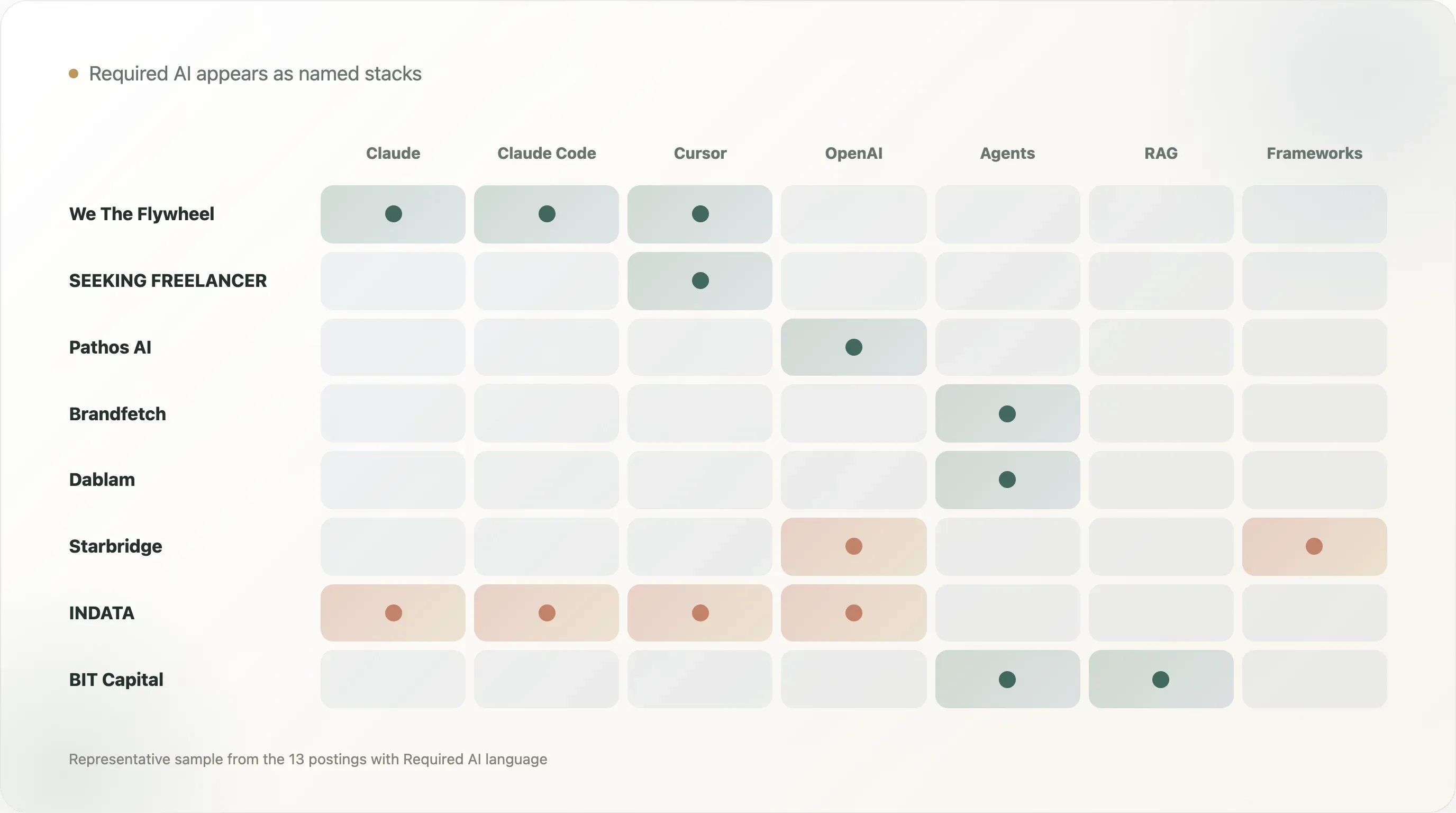
Read the profile. INDATA wants Claude / Claude Code / Anthropic / OpenAI / Copilot / Cursor — a full AI-tooling stack as day-1 expectation, not "please be familiar with AI." Starbridge lists Anthropic / OpenAI / Gemini / LangChain / LlamaIndex — model APIs plus retrieval frameworks. We The Flywheel asks for Claude + Claude Code + Cursor — pure coding-agent stack.
These companies share a common pattern: they chose a public channel like HN to recruit, and they chose to write AI tooling into the must-have section. Both choices matter. HN posting is higher-friction than LinkedIn — you need an account, your posting is publicly visible to peers, and any exaggeration gets called out in the comments immediately. Self-selection through that filter means companies still willing to write Required AI are almost certainly genuinely workflow-dependent on the named tools, not just keyword-padding.
For DTC operators, SaaS marketing, and employer-brand professionals, the second-order use of this list is reference: "AI fluent" employer-brand narrative is now empirically testable. Saying "we use AI" isn't enough — whether your job postings dare to write Required plus specific tool names reveals the actual depth of AI usage on your team. A careers page that says "we're an AI-first company" but doesn't name a tool stack in any JD reads as inconsistent to candidates.
4. Engineering went from 22% to 36% AI keyword penetration
By role bucket, AI hit rate for 2026-05 (only buckets with ≥3 postings):
| Role bucket | Total | AI hits | Hit rate | 2025-05 rate |
|---|---|---|---|---|
| Founding | 5 | 4 | 80.0% | 100.0% |
| Ops | 6 | 3 | 50.0% | 40.0% |
| Marketing | 8 | 4 | 50.0% | 16.7% |
| AI/Research | 8 | 3 | 37.5% | 33.3% |
| Eng | 237 | 86 | 36.3% | 22.1% |
| Other | 46 | 11 | 23.9% | 21.1% |
| Sales | 3 | 0 | 0.0% | 0.0% |
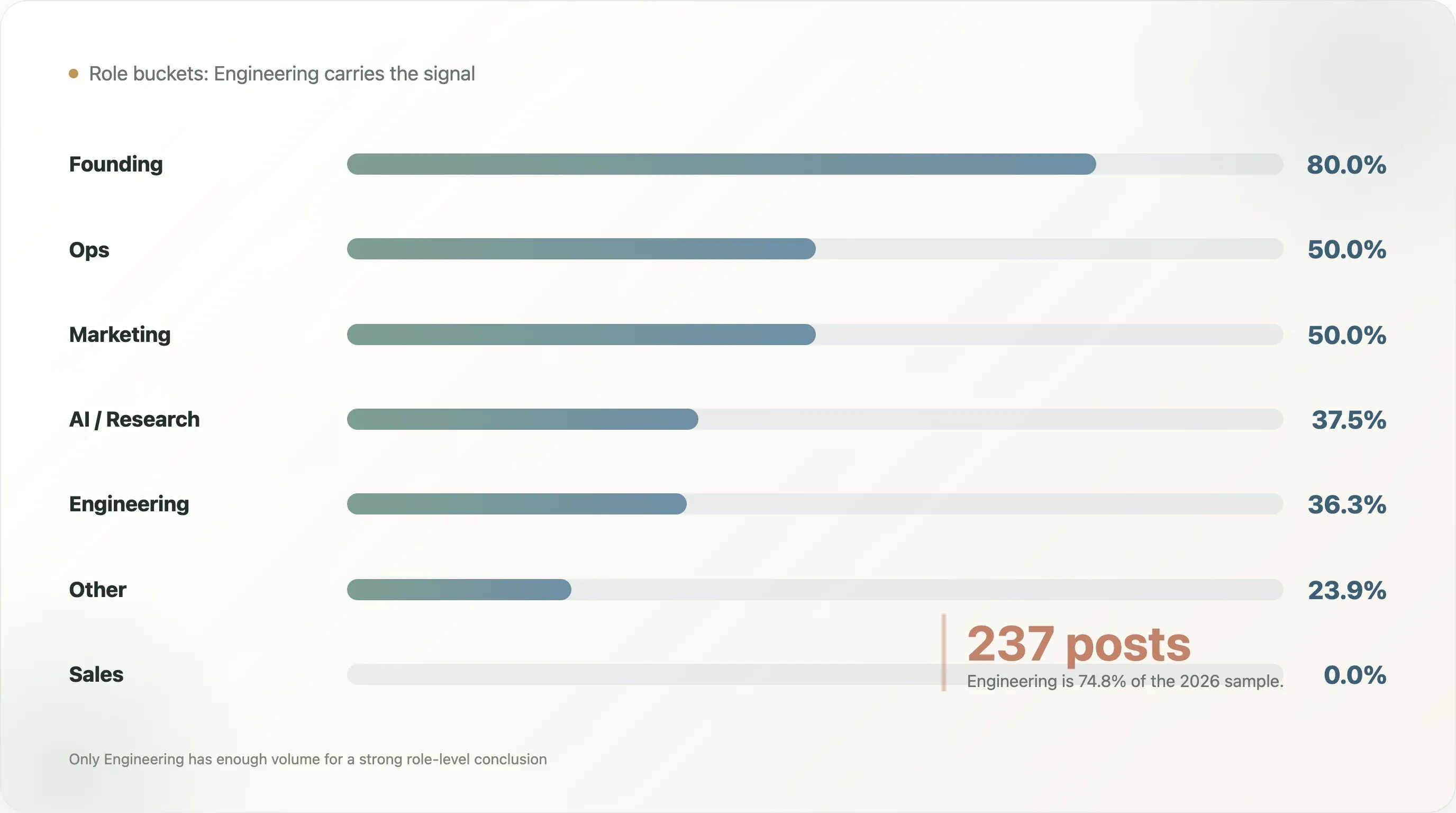
A few notes.
Engineering is the actual story. 74.8% of the sample (237 postings). Its AI hit rate moved from 22.1% in May 2025 to 36.3% in May 2026 — +14 pp absolute. Every macro "AI penetration" claim in this report rests primarily on this row. Roughly one of every three software-engineering postings now explicitly references AI keywords — the biggest structural change in software hiring text over the past 12 months.
AI/Research bucket sits at only 8 postings with 37.5% hit rate — lower than Engineering. That looks counter-intuitive. In theory "AI Research / AI Engineer" should hit near 100%. The reason it doesn't is that this bucket's JDs use heavily technical vocabulary ("transformer architecture / attention mechanism / pretraining objective") that our dictionary doesn't cover. The small sample size also adds noise. Don't read this as "AI research hiring uses AI words less" — it's a classifier-coverage gap, not an industry phenomenon.
Founding bucket (founding engineer / Chief of Staff / VP-level) hits 80% in 2026 — 4 of 5 sample postings. This reflects how founding-role JDs are written broadly — "founding engineer needs to wear many hats including AI tooling." But 5 samples is too few to over-interpret.
Marketing / Ops at 6-8 postings each, ~50% hit rate. Seems high; mostly a sample-size effect. In a larger sample these buckets would likely normalize to the 30-40% range. The sample contains too few Marketing / Sales / Ops / HR postings to draw role-specific conclusions; don't cite these buckets for role-level claims.
The only role-level conclusion safe to cite: Engineering AI keyword penetration moved from 22% to 36%. The sample is large enough; the change is large enough; the rest of the buckets are too small to support strong statements.
5. Why this matters, and where it stops
Over the past 18 months, debate around "is AI actually changing hiring" has split into two camps.
The optimist camp cites LinkedIn / Indeed reports — GenAI keyword frequency exploding (LinkedIn Economic Graph cites 21x YoY; Indeed Hiring Lab cites +330% YoY). The skeptic camp counters that these numbers reflect "companies stuffing AI keywords into JDs for SEO" rather than real workplace usage.
HN's value as a sample is that it isn't optimized for SEO / hiring-platform algorithms. HN comments are written by engineers and founders for their peers — no LinkedIn keyword padding, no Indeed CPC games, no recruiter templates. Every comment gets watched, replied to, and challenged by HN readers in real time. Any exaggerated AI-tool claim gets called out immediately. That public peer-review filter makes HN hiring text a relatively clean sample of genuine employer demand.
If a filtered sample like this shows +12 pp Strict AI rise in twelve months, that's a strong signal of real demand — not an artifact of platform algorithms.
But the sample boundary needs honest labeling. HN is a developer / early-engineering / startup community — heavily skewed toward early AI adopters. Engineering is 74.8% of the sample; representativeness for Sales / Marketing / HR / Finance / Legal is weak. Traditional industries (large finance, manufacturing, retail, healthcare, education) show far lower AI keyword penetration; most of those companies don't recruit on HN at all.
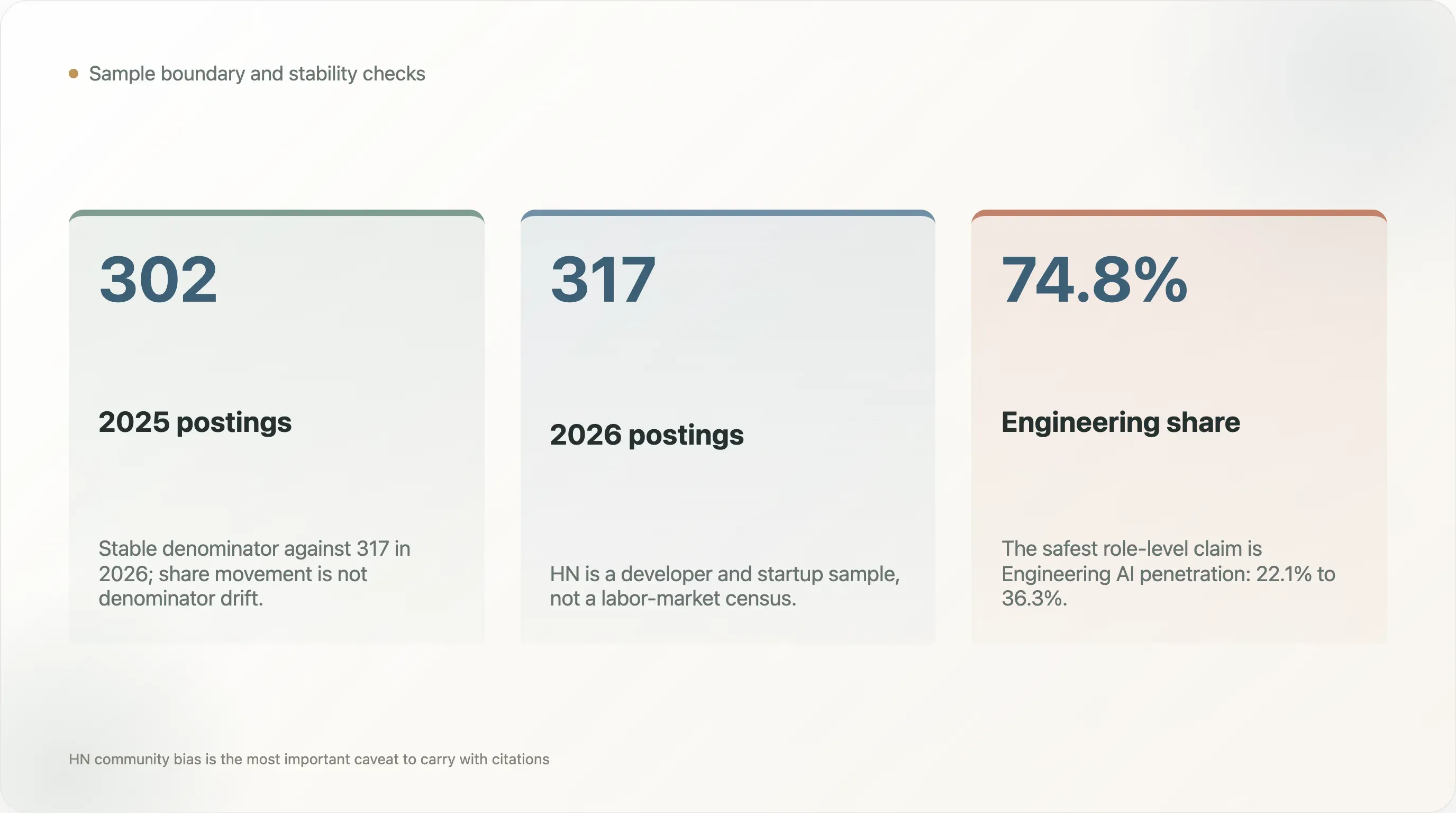
So this report cannot be read as "US labor market AI penetration is 35.6%" — it says "in a self-selected developer / startup sample on HN, hiring-text AI keyword penetration is 35.6%." Big difference.
6. Practical guidance for ops, content, and recruiting
Pulling the data into actions for anyone whose work touches these areas.
Developer marketing and employer brand. Move "familiarity with AI tools" from your careers-page nice-to-have section into day-1 expectation. The 35.6% Strict hit rate is your peer baseline — if your careers page's AI-tool visibility is materially below it, you're losing candidates to visibly-AI-fluent peers. Concrete action: in the "What you'll work with" section, list specific AI tools by name (Claude + Cursor + LangChain + ...), not vague phrases like "modern AI tools."
SaaS / tooling product positioning. The market window for products that support AI workflows is opening. "Agentic" went from 7 to 30 mentions, meaning agentic infrastructure / orchestration / observability tooling has real demand-side evidence in hiring text. GTM narrative for this product category can now lean on HN data as an empirical anchor instead of relying purely on Anthropic and OpenAI vision documents.
B2B content and SEO. "Claude vs Copilot vs Cursor" long-tail searches have risen noticeably over the past 18 months. This report's top-keyword list is a natural keyword anchor for editorial planning. "Agentic" is SEO greenfield — 2026 is still early enough to build authoritative pages on agentic workflows ("How to build agentic workflows" / "Agentic vs traditional automation" / etc.). First-mover advantage still works on this lane because SERPs aren't yet camped on by any dominant content.
Recruiting practice. Borrow HN's posting style — write Required plus specific tool names instead of "AI tool experience preferred." The 13-company sample in this report (INDATA, Starbridge, We The Flywheel, etc.) demonstrates the high-fidelity "Required + named stack" pattern. Beyond candidate signal accuracy, this style lets you verify candidates immediately in interviews — "You say you use Cursor; tell me how many production codebases you've shipped with it?"
Longitudinal tracking. This report's top-keyword list + Required-companies list can be re-run quarterly — HN Firebase API is fully public, dictionary maintenance is cheap, and the result functions as a hiring-market AI-penetration dashboard. Quarterly cadence yields a publishable trend update each cycle without large data-purchase budgets.
7. Stability checks & peer-dataset cross-reference
Any trend report invites the reader question: is the 12 pp shift real or noise? Three checks.
Sample size is stable. 2025-05 total: 302. 2026-05: 317. Difference of only 15 postings. A stable denominator means share shifts reflect real numerator restructuring, not denominator drift.
Loose and Strict move in the same direction, with Strict moving faster. Loose +9.6 pp, Strict +12.1 pp. Same direction, Strict moving faster, means the uplift isn't just "more AI words" — it's specifically "more named-tool and named-LLM mentions." That rules out fuzzy-word false-positive driving the loose number.
Required moves faster than Preferred. Required +2.4 pp (≈2.4x), Preferred +0.5 pp (essentially flat). AI tooling isn't being mentioned more casually — it's being promoted up the hierarchy from nice-to-have to must-have. This is the single cleanest signal that AI is shifting from bonus skill to baseline expectation.
Peer-data cross-reference:
| Source | Coverage | Typical reading (2024-2025) |
|---|---|---|
| LinkedIn Economic Graph | Global LinkedIn JDs | GenAI-tagged role growth ~21x YoY (2023-2024) |
| Indeed Hiring Lab | US Indeed JDs | GenAI keyword frequency +330% YoY in all JDs |
| Stanford AI Index 2025 | Global AI hiring composite | AI-class roles 1.7% (2024) → 2.5% (2025) |
| This report (HN Who's Hiring) | HN dev community, 619 postings | Strict AI mention 23.5% → 35.6% (+12.1 pp) |
These aren't contradictory. LinkedIn / Indeed's "GenAI 21x / 330%" refers to dedicated GenAI roles (AI Engineer / ML Engineer) — small denominator producing dramatic multiples. This report measures broad AI keyword penetration across all JDs — wider denominator, more modest absolute movement, but a much broader-based story. Stanford AI Index 2025's "AI-class roles 1.7% → 2.5%" is dedicated-role share, close to our "Required AI" (1.7% → 4.1%) but a different denominator. Multiple independent sources point at the same underlying trend, sliced from different angles.
Methodology
Data source: Hacker News Firebase API (https://hacker-news.firebaseio.com/v0/item/{id}.json). Threads compared: May 2025 (item id 43858554) and May 2026 (item id 47975571). Each top-level comment treated as one hiring posting (HN convention). Same 619-posting corpus as the Return to Office Index 2026 report — identical source data, different analytical lens. Snapshot date 2026-05-12 (UTC).
HN-community bias (the most important caveat): HN's hiring community is dominated by developers, early-stage engineering teams, and AI-adopter startups. This report cannot be read as a US or global hiring AI trend. Traditional industries (large finance, manufacturing, retail, healthcare, education) show much lower AI keyword penetration; most don't recruit on HN at all.
Engineering bucket dominates at 74.8%: findings about Engineering roles are well-supported; findings about Sales / Marketing / Ops / HR are not (each bucket N < 10). All role-specific conclusions in this report apply confidently only to Engineering. Other buckets are too small to support strong statements.
JD text ≠ actual job requirements: JDs contain marketing fluff — "Copilot familiarity" can be HR-keyword padding rather than a day-1 work requirement. The numbers describe "keyword presence in JD text," not direct workplace AI usage. They correlate but aren't the same.
Required vs Preferred accuracy ~75-85%: based on ±120-character context windows, edge cases get misclassified. Cited Required/Preferred numbers should be read as "under our rule set," not absolute truth.
Dictionary v1 false-negative risk: the dictionary is anchored to 2026-05's AI tooling ecosystem and may miss tools or terms emerging in late 2026. Reported AI hit rates are in effect "hit rate under v1 dictionary" — a lower bound.
Multi-posting companies are not deduplicated: same firms can appear multiple times (especially the 10+ postings ones). We use "postings" as the denominator, not "unique employers," because repeated postings of the same AI requirement is a meaningful signal of company-level AI depth that company-dedup would erase.
Legal and copyright: HN API is public, read-only, requires no authentication. Comment text is the copyright of original authors; this report uses aggregate counts and short keyword-frequency analysis only — no full-comment quotation. Named companies (the 13 Required-AI firms) appear in positive or neutral context only (they publicly self-declared AI as required). No raw CSV/JSON dataset download is published; every number is reproducible from the public HN API + the public dictionary.
Caveats
What this report does NOT support:
- Not "all US JDs are now demanding AI tools" (the sample is an HN subset, not the US labor market)
- Not "Company X doesn't use AI tools" (we don't track companies longitudinally)
- Defensible: "Inside HN hiring threads for 2025-05 and 2026-05, Strict AI mention rose from 23.5% to 35.6% (+12.1 pp)"
Data source & versioning
Dataset: ai_required_position_rate_2026/ (this repo). Snapshot date 2026-05-12 UTC, version v1.0 (single-point YoY, dictionary v1). Shares the HN data with the Return to Office Index 2026 report — both can be cross-cited.
What SEO and Content Teams Can Cite
This research creates several citation angles for blog intros, data callouts, social posts, comparison pages, and follow-up explainers:
- Strict AI mentions rose from 23.5% to 35.6%, a 12.1 percentage-point increase.
- Loose AI mentions rose from 29.5% to 39.1%.
- Required AI more than doubled, from 1.7% to 4.1%.
- Preferred AI barely moved, from 3.0% to 3.5%, which makes the Required increase more meaningful.
- "Agentic" rose from 7 mentions to 30 and became the top 2026 keyword.
- Claude appeared 18 times and Claude Code appeared 11 times in 2026; combined, that is 29 mentions.
- Engineering roles drove the main movement, with AI keyword penetration rising from 22.1% to 36.3%.
The caveat should travel with the citation. These numbers describe the specific sample and collection method used in this report. They should not be reframed as a full-market census, an internal adoption measure, or a claim about every company in the category.
For editorial use, the strongest framing is the one that pairs the headline statistic with the sample boundary. That makes the claim more durable and easier for readers to trust. For example, write "in this HN hiring sample," "in this DTC home-page static scan," or "across this YouTube channel sample" before turning the number into a broader trend discussion.
Reproducibility Notes
The delivery folder includes the following process files copied from the original local report packages. These are included so the published report can be checked against the actual scripts, intermediate outputs, charts, and source drafts used in the reporting workflow.
process_files/out/analysis_stats.jsonprocess_files/out/hn_jobs_ai_parsed.csvprocess_files/scripts/01_compute_stats.pyprocess_files/scripts/02_make_figs.pyprocess_files/scripts/03_build_data_brief.pyprocess_files/scripts/04_build_report_bilingual.pyprocess_files/scripts/05_module_i_check.py
Download all scripts and datasets
Methodology corrections, dataset issues, and follow-up analyses are welcome at support@thunderbit.com. This report is based on public web or public API signals collected in May 2026 and should be read with the sample boundaries stated above.
Try Thunderbit AI Web Scraper Get Started Free




