
If you’ve ever tried to keep up with today’s markets, you know it’s like chasing a moving train—blindfolded, with yesterday’s map. The pace of change is relentless, and the pressure to deliver faster, sharper insights is at an all-time high. In fact, according to , what was considered “innovative” in market research just a year ago is now the baseline. Automation isn’t a futuristic perk anymore—it’s the foundation for staying competitive.
I’ve spent years in SaaS and automation, and I’ve watched businesses wrestle with the old ways: endless surveys, manual spreadsheets, and those marathon meetings where everyone’s arguing over which number is “right.” But now, market research automation is flipping the script. With AI-powered tools, teams are collecting, analyzing, and acting on data at speeds that would make yesterday’s analysts spit out their coffee. Let’s break down what market research automation really is, why it matters, and how it’s transforming the way organizations make decisions—plus, I’ll share how we’re tackling this at Thunderbit.
Demystifying Market Research Automation: What Does It Really Mean?
Let’s ditch the jargon. Market research automation is simply the use of technology—especially AI and machine learning—to streamline and optimize the entire research process. That means automating data collection (think: scraping competitor prices or customer reviews from the web), analysis (like auto-categorizing feedback), and reporting (generating dashboards or summaries without manual number crunching).
The goal? Cut down on repetitive, manual work and let humans focus on the big-picture questions. Instead of spending hours copying data from websites or cleaning up spreadsheets, you can use automation to pull in fresh, structured data in minutes. For example, a retailer might use an automated tool to track competitor prices daily, rather than relying on a quarterly mystery shopper report. The result: faster insights, fewer errors, and a lot less caffeine required.
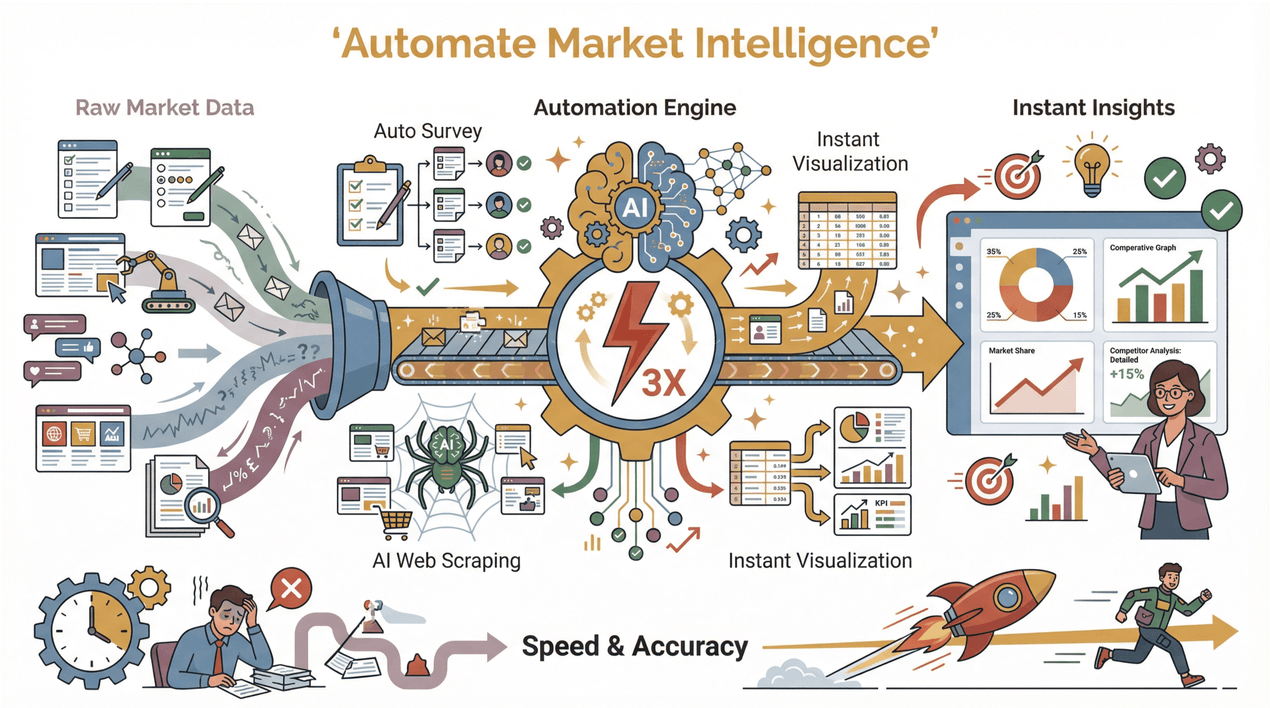 As puts it, automation is about “using technology to streamline, speed up, and improve the accuracy of market intelligence processes.” In practice, that means everything from automatic survey deployment to AI-driven web scraping and instant data visualization.
Traditional Market Research vs. Market Research Automation: What’s the Difference?
Let’s be honest—traditional market research has its roots in the analog world. Think phone surveys, in-person focus groups, and armies of interns entering data by hand. The process is slow, expensive, and—let’s face it—prone to human error and bias.
Traditional methods:
- Manual surveys and interviews
- Data entry into spreadsheets
- Weeks (or months) to collect and analyze results
- High costs for labor and logistics
- Results often outdated by the time they’re ready
Automated market research:
- AI-powered data collection (web scraping, social listening)
- Automated data cleaning and structuring
- Real-time dashboards and instant reporting
- Lower costs, higher speed, and scalable to any data volume
- Insights are timely and actionable
As notes, automation “takes care of repetitive tasks, delivers more bang for your buck, and gets you results faster.” No more waiting weeks for a report that’s already out of date.
The Key Benefits of Market Research Automation for Modern Businesses
Why are so many teams making the switch? Here’s what stands out:
| Benefit | Manual Research | Automated Research |
|---|---|---|
| Speed | Weeks or months | Minutes or hours |
| Cost | High (labor, logistics) | Lower (tech-driven) |
| Accuracy | Prone to human error | Consistent, AI-checked |
| Scalability | Limited by manpower | Handles massive datasets |
| Bias | Subjective, inconsistent | More objective, repeatable |
| Real-time Insights | Rare | Standard |
According to , automation is “reshaping market research by reducing errors and speeding up time to insight.” Teams using automation report saving 30–50% of the time compared to legacy research workflows ().
And it’s not just about speed. Automation supports better decision-making by delivering fresher, more accurate data—helping sales and operations teams react to market changes before the competition.
Real-World Applications: How Market Research Automation Powers Different Industries
Let’s get concrete. Here’s how automation is making waves across industries:
Retail: Consumer Behavior Analysis & Trend Spotting
Retailers are using automation to track what customers are saying online, monitor competitor prices, and spot emerging trends in real time. Instead of waiting for quarterly reports, they can adjust pricing or promotions on the fly. As points out, automated competitor price tracking helps retailers avoid losing sales and optimize margins.
Manufacturing: Automated Competitor Price Tracking
Manufacturers are automating the collection of competitor pricing and product specs from public sources. This lets them benchmark their own offerings, adjust pricing strategies, and respond to market shifts faster than ever.
Technology: Real-Time Trend Forecasting & Product Feedback
Tech companies use automation to scrape forums, social media, and review sites for feedback on their products and competitors. AI then analyzes sentiment and extracts key themes, helping product teams prioritize features and spot risks before they escalate.
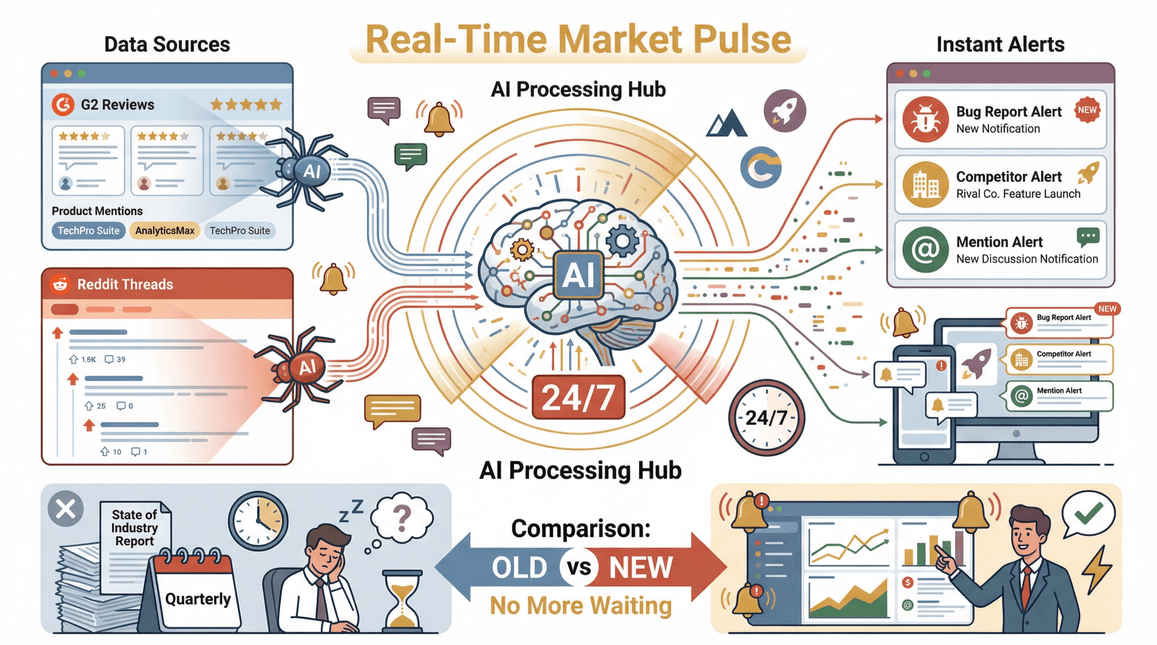 Mini-scenario: Imagine a SaaS company using an AI web scraper to monitor G2 and Reddit for mentions of their app. They get instant alerts when a new bug is reported or when a competitor launches a similar feature—no more waiting for the next “state of the industry” report.
Thunderbit’s Role in Market Research Automation
This is where I get to brag a little. is our answer to the headaches of manual research. We built it as an AI-powered web scraper Chrome Extension that anyone—sales, ops, marketing, you name it—can use to gather structured data from almost any website, directory, or forum.
Here’s what makes Thunderbit stand out:
- AI Suggest Fields: Just hit a button and Thunderbit reads the page, suggesting the best columns to extract (like “Company Name,” “Price,” “Sentiment”).
- Subpage Scraping: Need more details? Thunderbit can visit each subpage (say, individual product pages or LinkedIn profiles) and enrich your dataset automatically.
- Instant Data Export: Export your results directly to Excel, Google Sheets, Airtable, or Notion—no more copy-paste marathons.
- Multiple Data Types: Thunderbit handles text, numbers, dates, emails, phone numbers, images, and more.
- No Coding Required: If you can use a browser, you can use Thunderbit. Seriously.
Our users are scraping everything from business directories for lead gen, to social media for sentiment analysis, to competitor sites for price monitoring. And because the AI adapts to each site’s layout, you don’t have to worry about templates breaking every time a page changes ().
How Market Research Automation Works: A Step-by-Step Overview
Let’s walk through a typical automated market research workflow:
- Define Your Research Goals: What do you want to know? (e.g., competitor prices, customer sentiment, product trends)
- Select Data Sources: Identify relevant websites, directories, forums, or social platforms.
- Use Automation Tools: Fire up Thunderbit (or your tool of choice), describe what you want, and let AI collect and structure the data.
- Analyze & Visualize: Use built-in analytics or export to your favorite BI tool for deeper analysis.
- Export & Share: Instantly export your findings to Excel, Sheets, Notion, or Airtable, and share with your team.
It’s a far cry from the old days of “let’s hire a research firm and wait six weeks for a report.”
Overcoming Challenges in Market Research Automation
Of course, it’s not all sunshine and rainbows. Here are some challenges—and how to tackle them:
Data Privacy
Automated tools can collect a lot of data, fast. But with great power comes great responsibility. Always respect privacy laws (like GDPR and CCPA) and only scrape publicly available data. For more on compliance, check out .
Algorithm Bias
AI is only as good as the data it’s trained on. Biased data can lead to skewed results (). Always review and validate insights with a human touch, and combine multiple data sources for a fuller picture.
Over-Reliance on Technology
Automation is a tool, not a replacement for critical thinking. Use it to handle the grunt work, but keep humans in the loop for strategic decisions and context ().
Getting Started: Tips for Implementing Market Research Automation in Your Organization
Ready to get started? Here’s my quick-start guide:
- Assess Your Current Workflow: Where are the bottlenecks? What’s taking too long?
- Choose the Right Tools: Look for automation platforms that fit your needs—Thunderbit is a great place to start for web data.
- Train Your Team: Make sure everyone knows how to use the new tools. Start with small, low-risk projects.
- Pilot, Measure, Scale: Run a pilot project, measure the time and cost savings, then roll out to more teams.
- Stay Compliant: Review data privacy policies and ensure you’re following best practices.
A simple checklist:
- [ ] Identify key research questions
- [ ] List target data sources
- [ ] Select automation tools
- [ ] Train users
- [ ] Launch pilot
- [ ] Review results and iterate
The Future of Market Research Automation: What’s Next?
We’re just scratching the surface. Here’s what’s coming down the pipeline:
- Deeper Integration: Automation tools will plug directly into CRM and ERP systems, making insights instantly actionable.
- Real-Time Dashboards: Expect live, always-updating dashboards that pull from multiple sources.
- Predictive Analytics: AI won’t just tell you what happened—it’ll forecast what’s next, helping you spot trends before they go mainstream ().
- Agentic AI: Next-gen AI agents will handle more complex research tasks, from hypothesis generation to campaign optimization ().
The bottom line? Automation will keep raising the bar for what’s possible in market research—and the teams that embrace it will be the ones leading the pack.
Conclusion: Key Takeaways on Market Research Automation
Let’s wrap it up:
- Market research automation is transforming how businesses collect, analyze, and act on data—making insights faster, cheaper, and more accurate.
- Compared to traditional methods, automation slashes manual work, reduces bias, and delivers real-time results.
- Tools like make it easy for any team to gather structured data from the web, directories, and social platforms—no coding required.
- The future is bright: with deeper integrations, real-time dashboards, and predictive analytics, automation will keep redefining what’s possible.
- To get started, assess your workflow, pick the right tools, train your team, and start small—but think big.
If you’re ready to leave the old ways behind and unlock the power of market research automation, or check out the for more tips and guides.
FAQs
1. What is market research automation?
Market research automation is the use of technology—especially AI and machine learning—to streamline and optimize data collection, analysis, and reporting. It reduces manual work, speeds up insights, and helps teams make better, data-driven decisions.
2. How does market research automation differ from traditional methods?
Traditional research relies on manual surveys, interviews, and data entry, which are slow, costly, and prone to error. Automation uses AI tools to collect, clean, and analyze data in real time, delivering faster and more accurate results.
3. What are the main benefits of market research automation?
Key benefits include significant time and cost savings, improved accuracy, scalability, and the ability to generate real-time, actionable insights for sales, marketing, and operations teams.
4. How can Thunderbit help with market research automation?
Thunderbit is an AI-powered web scraper that lets users gather structured data from websites, directories, and social platforms with just a few clicks. Features like AI Suggest Fields, subpage scraping, and instant export make it easy to automate research without coding.
5. What challenges should I watch out for with market research automation?
Potential challenges include data privacy concerns, algorithm bias, and over-reliance on technology. To overcome these, follow best practices for data governance, use multiple data sources, and keep humans involved in the analysis process.
Learn More