Föreställ dig det här: du sitter med morgonkaffet, bläddrar i inkorgen och inser att hälften av mejlen du läser är skrivna av AI. Samtidigt har din favoritbutik precis rekommenderat ett par skor du inte ens visste att du ville ha (men, om vi ska vara ärliga, kommer du nog att köpa dem ändå). Välkommen till 2026, där artificiell intelligens inte längre bara är ett modeord — den är den osynliga motorn bakom allt från din kundvagn till din läkares diagnos.
Siffrorna bakom AI-revolutionen är hisnande. Den globala AI-marknaden väntas nå 617,62 miljarder USD 2026 och 1,42 biljoner USD till 2032, med en årlig tillväxttakt på cirka 14,8 % (Statista) — och på investeringssidan uppskattar Gartner att de globala AI-utgifterna når 2,59 biljoner USD 2026, en ökning med 47 % (Gartner). Oavsett om du är företagsledare, teknikproffs eller bara någon som vill ligga steget före, är de här AI-statistiken inte bara kuriosa — de är en karta över vart framtiden är på väg.
En snabb notis om källorna innan vi börjar. När den här texten uppdaterades i augusti 2026 fick flera siffror som byggde på blogginlägg eller skärmdumpar i stället för studier strykas — därför länkar varje påstående här till originalrapporten. Och där forskningen faktiskt går isär, som när det gäller om AI gör utvecklare snabbare, har jag låtit oenigheten stå kvar i stället för att snygga till den till vår fördel. Nu dyker vi ner i de mest ögonöppnande AI-siffrorna för 2026 — från generativ AI:s explosionsartade tillväxt till branscherna som skakas mest, jobben som förändras och trenderna som kommer att forma nästa kapitel i artificiell intelligens.
AI-statistik i korthet: 2026 års mest uppseendeväckande siffror
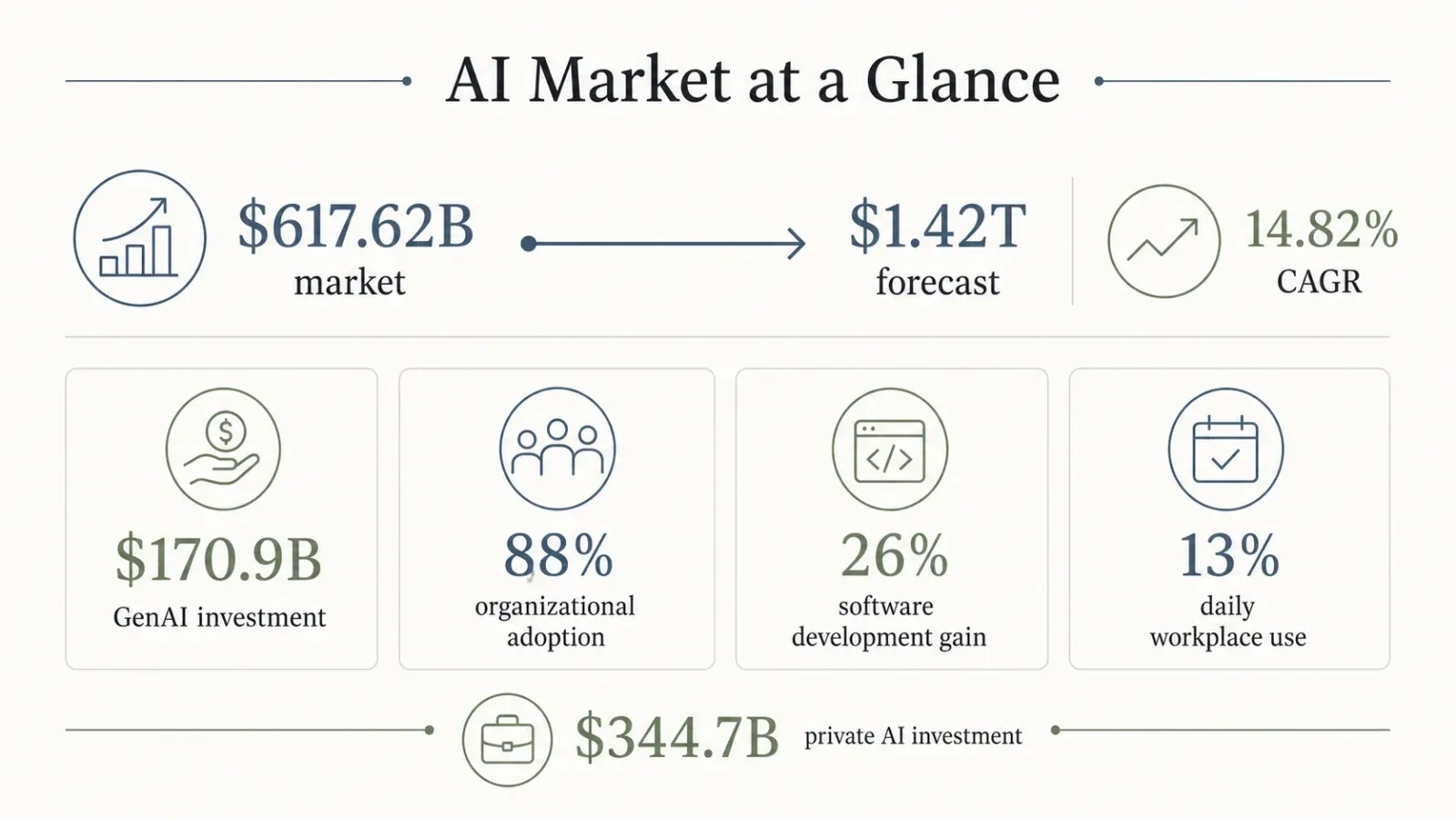
Ibland vill man bara ha fakta — inga utsvävningar, inget jargongprat, bara siffror som får en att tänka: “Va, på riktigt?” Här är huvudpunkterna som definierar AI 2026:
| Statistik | Värde / trend 2026 |
|---|---|
| Global tillväxt för AI-marknaden | 617,62 miljarder USD (2026) → 1,42 biljoner USD (2032), CAGR på 14,82 % (Statista) |
| Generativ AI-boom | 170,9 miljarder USD i privat investering 2025, upp 404 %; AI-mjukvaruutgifter 282,8 miljarder USD (2025) → 453,2 miljarder USD (2026) (Cargoson) |
| AI-användningen skjuter i höjden | 88 % av organisationer har infört AI i minst en affärsfunktion (2025) (McKinsey) |
| Generativ AI blir mainstream | 65 % av organisationer använder generativ AI regelbundet (2024), upp från 33 % 2023 (McKinsey) |
| Produktivitetseffekt | AI Index anger en vinst på 26 % för mjukvaruutveckling; en METR RCT visade att erfarna utvecklare blev 19 % långsammare (METR) |
| Ekonomiskt värde | AI kan bidra med 15,7 biljoner USD till global BNP till 2030 (World Economic Forum) |
| Jobbskapande och omställning | 92 miljoner jobb kan försvinna till 2030, men 170 miljoner nya jobb skapas (World Economic Forum) |
| Användning i arbetslivet | 50 % av amerikanska anställda har använt AI på jobbet (Q1 2026), men bara 13 % dagligen (Stanford HAI) |
| Branschledare | 85 % av finansbolag använder AI; 60–70 % adoption i datarika sektorer (RGP) |
| Konsumenträckvidd | Bara ChatGPT nådde 900 miljoner veckovisa användare i februari 2026 — en milstolpe som analytiker tidigare trodde skulle inträffa först 2031 (Cargoson) |
| Investeringsmönster | 344,7 miljarder USD i privat AI-investering globalt (2025, +127,5 %); USA stod för 285,9 miljarder USD (Stanford AI Index) |
| AI inom vården | 25,88 miljarder USD (2025) → 194,79 miljarder USD (2031), CAGR på 39,7 % (DemandSage) |
| AI inom retail | 48,9 % av amerikanska detaljhandelsföretag använder AI i marknadsföring (SellersCommerce) |
| AI inom tillverkning | 35 % av tillverkarna använde AI 2024; över 50 % till 2026 (ArtSmart) |
| AI och hållbarhet | AI kan minska koldioxidutsläppen med 3,2–5,4 gigaton per år till 2035 (LSE) |
Och det där är bara toppen av AI-berget. Nu går vi djupare in i trenderna, sektorerna och berättelserna bakom siffrorna.
Den globala AI-marknaden: tillväxt, utgifter och investeringstrender
AI-marknadens storlek och tillväxtprognoser
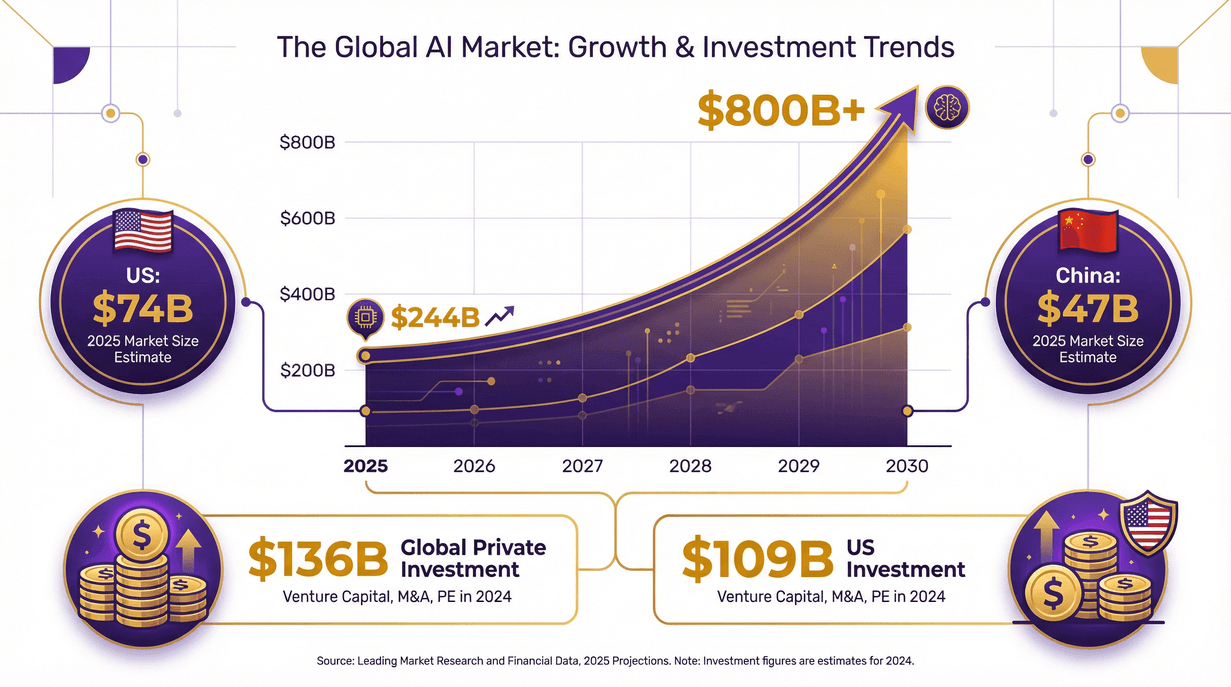
Om du undrar om hajpen kring AI är verklig, följ bara pengarna. Den globala AI-marknaden väntas nå 617,62 miljarder USD 2026 och 1,42 biljoner USD till 2032, med en CAGR på 14,82 % (Statista). Det är en annan — och mer aktuell — utveckling än den äldre uppskattningen på $244B → $827B som fortfarande dyker upp i sekundära sammanfattningar.
När det gäller investeringar är gapet ännu tydligare än vad marknadsstorleken antyder: privata AI-investeringar i USA nådde 285,9 miljarder USD 2025 jämfört med Kinas 12,4 miljarder USD — 23 gånger mer (Stanford AI Index). Europa är mindre, men tar igen snabbt, med en AI-marknad som väntas överstiga 190 miljarder euro till 2030. Vad driver utvecklingen? Molnbaserade AI-tjänster, explosionen av AI-hårdvara — särskilt chips — och en obeveklig efterfrågan på smartare mjukvara.
Och vi får inte glömma AI-chipmarknaden, som växer med omkring 30 % per år fram till 2028. Som någon som tillbringat många år i automation- och SaaS-världen kan jag säga: törsten efter beräkningskraft blir bara större.
Extrahera AI-marknadsdata med AI Använd Thunderbit för att hämta de senaste AI-marknadssiffrorna från vilken webbplats som helst på några sekunder. Get Started Free
Trots oron på teknikmarknaden är AI-investeringar hetare än någonsin. 2025 nådde privata AI-investeringar 344,7 miljarder USD globalt — upp 127,5 % på ett år — och de totala företagsinvesteringarna i AI steg till 581,7 miljarder USD (Stanford AI Index). Riskkapitalet är helhjärtat med: global VC-finansiering till AI översteg 40 miljarder USD 2023, och bara generativa AI-startups lockade 33,9 miljarder USD 2024 (Stanford HAI).
Vi ser en guldrusch inom områden som stora språkmodeller, AI-chip och branschspecifika lösningar. Och det är inte bara Silicon Valley — AI-unicorns dyker upp i Europa, Israel och Kanada. Även regeringar hakar på, med EU:s InvestAI-program som siktar på 200 miljarder euro i AI-investeringar över Europa (European Commission), och mer därtill i årliga AI-investeringar till 2027.
AI-användning: vem använder AI och hur?
AI i företag: adoption och användningsfall
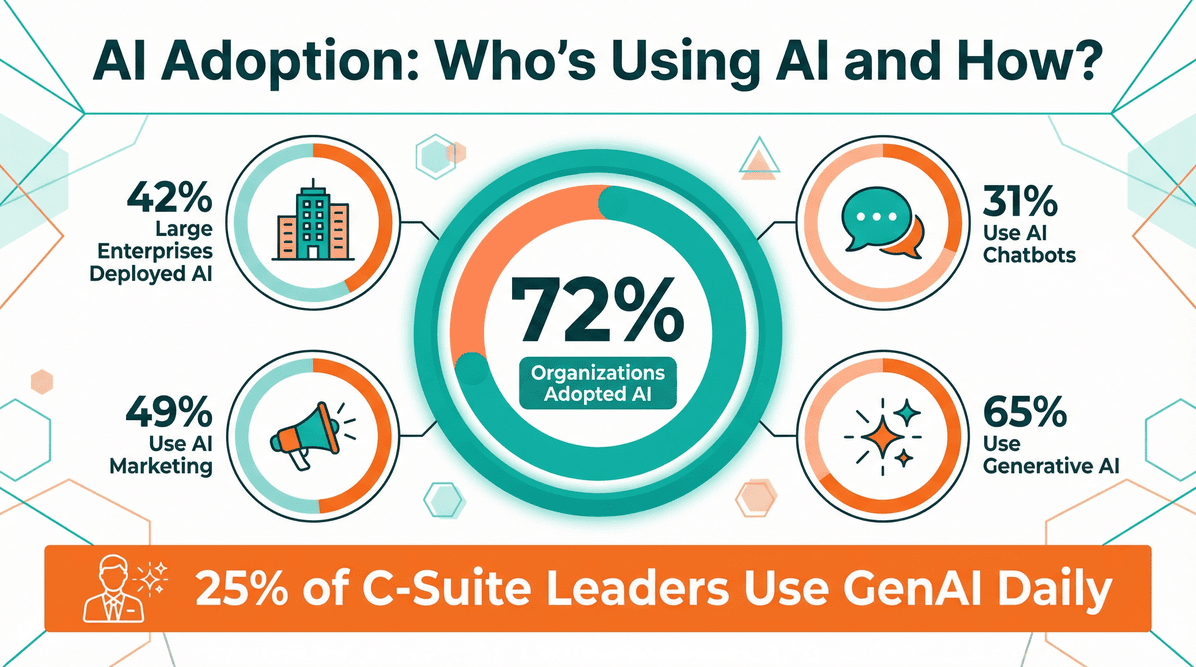
AI är inte längre bara något för teknikjättarna. I mitten av 2025 hade 88 % av organisationer infört AI i minst en affärsfunktion (McKinsey), och bland stora företag (1 000+ anställda) hade 42 % aktivt implementerat AI (IBM). De vanligaste affärsfunktionerna som använder AI? Kundservice (tänk chattbottar och virtuella agenter), marknadsföring (personalisering och kampanjoptimering), drift (analys av leveranskedjor) samt IT/säkerhet (avvikelsedetektering).
Till exempel använder 31 % av företag AI-chattbottar eller virtuella agenter (SellersCommerce), och nästan 49 % använder AI-driven marknadsföringsautomation. Inom e-handel tillskrivs personaliseringsalgoritmer intäktsökningar på 5–15 %. Även HR är med i leken och använder AI för CV-granskning och prediktiv analys av personalomsättning.
En trend jag personligen är extra glad över? Framväxten av no-code- och low-code-verktyg för AI. De här plattformarna demokratiserar AI och gör tekniken tillgänglig även för små och medelstora företag — inte bara Fortune 500-bolag.
Testa Thunderbit AI Web Scraper gratis Samla in marknadsdata bakom sådana här siffror själv — klicka en gång så räknar AI ut tabellstrukturen åt dig. Get Started Free
Generativ AI: från trend till vardag
Generativ AI har gått från nyhet till nödvändighet på rekordtid. Till 2025 använde cirka 70 % av organisationer generativ AI i minst en affärsfunktion (Stanford AI Index). Ledningen har noterat det också — 25 % av ledningsgruppen säger att de själva använder generativa AI-verktyg i arbetet.
De populäraste användningsområdena? Marknadsföring, mjukvaruutveckling, kundservice och kreativt arbete. AI Index sammanfattar en produktivitetsökning på 26 % i mjukvaruutveckling, men en randomiserad kontrollerad METR-studie fann att erfarna open source-utvecklare blev 19 % långsammare med AI-stöd — ett bevis på att effekten beror starkt på uppgift och erfarenhet (METR). Kundtjänstmedarbetare med AI-assistenter löste 14 % fler ärenden per timme i en annan studie (Stanford HAI).
Men när adoptionen ökar gör även oron det — kring noggrannhet, dataintegritet och bias. Bara 21 % av företagen som använde AI hade etablerade policyer för medarbetares användning av generativ AI i mitten av 2023 (McKinsey). Kappan för styrning och governance är i full gång.
AI och arbetsmarknaden: jobb, kompetens och produktivitet
AI-driven jobbtillväxt och undanträngning
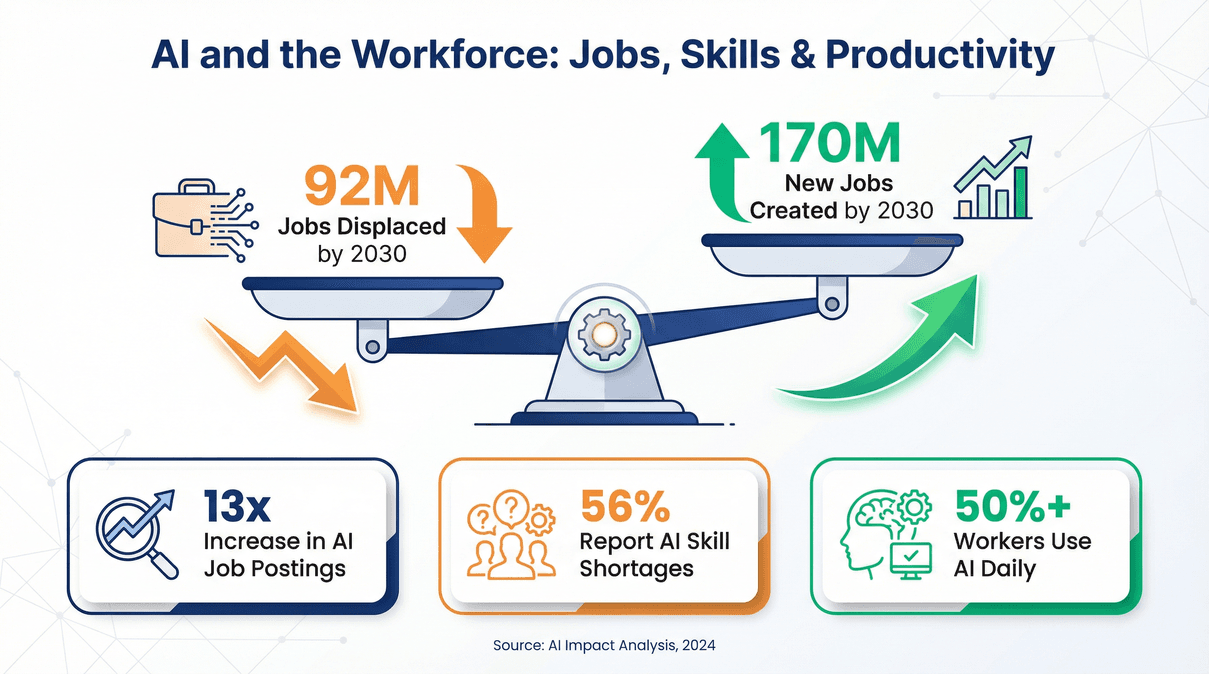
Låt oss tala om elefanten i rummet: jobben. World Economic Forums aktuella prognos sträcker sig till 2030: 92 miljoner jobb kan försvinna, samtidigt som 170 miljoner nya roller växer fram (World Economic Forum).
De jobb som löper störst risk? Rutinarbete med data, administrativa uppgifter och kundsupport. Men nya roller växer fram — AI prompt engineers, dataetiker, MLOps-specialister och fler därtill. Nettoeffekten? Omställning av arbetet, inte bara att jobb försvinner.
AI-kompetens och utbildning: att minska talangklyftan
Det pågår ett rejält kompetensrace inom AI. LinkedIn rapporterar en 13-faldig ökning av AI-jobbannonser de senaste fem åren, medan tillgången på talang bara vuxit åtta gånger. Omkring 42 % av stora företag har infört AI, men 56 % uppger att brist på AI-kompetens är ett stort hinder (Deloitte). Företag svarar genom att vidareutbilda medarbetare — Amazon har till exempel avsatt 700 miljoner USD för att omskola 100 000 arbetstagare till tekniska roller.
Universitet och onlineplattformar utökar sina AI-program, men efterfrågan överstiger fortfarande utbudet. Om du funderar på ett karriärbyte är roller som AI/ML engineer konsekvent bland de mest växande jobben.
Branschdjupdykning: AI-trender och statistik per sektor
AI inom vården: diagnos, patientvård och mer
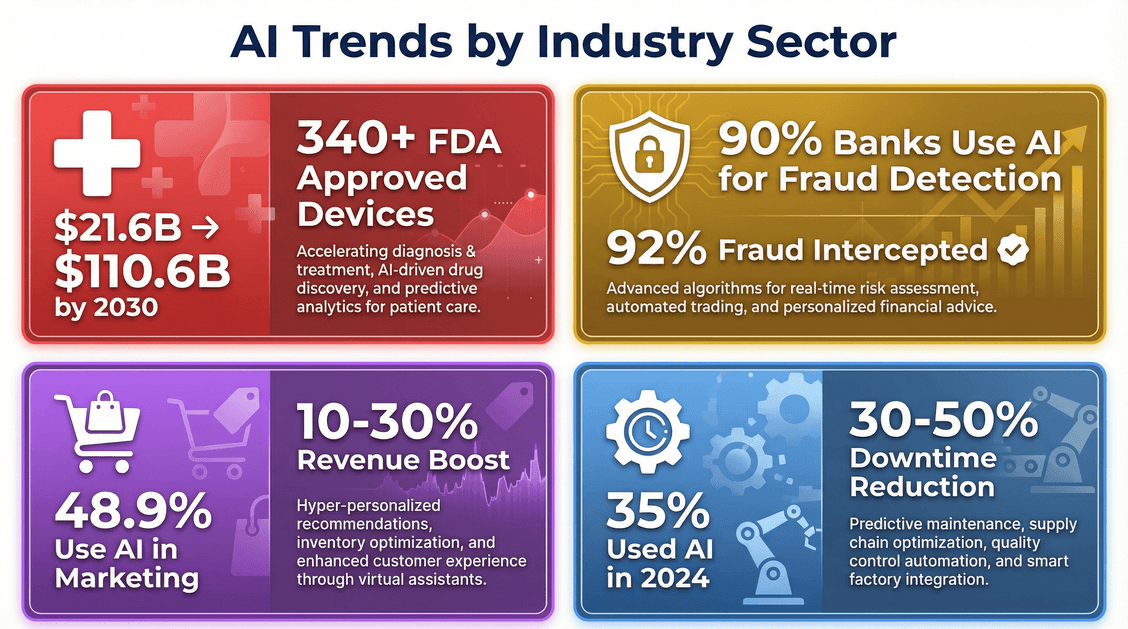
Vården är en av de snabbast växande AI-fronterna. 2025 hade 22 % av vårdorganisationer implementerat domänspecifika AI-verktyg, upp från bara 3 % 2023 (Paubox). Marknaden för AI i vården väntas växa från 25,88 miljarder USD 2025 till 194,79 miljarder USD 2031, en CAGR på 39,7 % (MarketsandMarkets).
- Diagnostik: Omkring 1 450 AI-baserade medicintekniska produkter hade godkänts av FDA vid slutet av 2025, och hade ökat till cirka 1 524 listningar i mars 2026 (FDA), och AI-system matchar eller överträffar i vissa fall mänskliga radiologer när det gäller cancerdetektion.
- Effektivitet: Sjukhus som använde AI för faktureringsautomation ökade andelen transaktioner från 36 % till 61 % på bara ett år (Paubox).
AI inom finans: risk, bedrägerier och personalisering
Finanssektorn är en AI-kraftcentral. 90 % av bankerna använder AI för bedrägeridetektering, vilket stoppar 92 % av bedrägliga transaktioner innan godkännande (Pitechsol). AI driver också algoritmisk handel (cirka 70 % av den amerikanska aktiehandelsvolymen) och gör kundupplevelser mer personliga.
- Effektivitet: AI i lånehantering kan korta handläggningstiden från dagar till minuter.
- Kundlojalitet: Storbanker rapporterar 14 % bättre kundretention efter att ha infört AI-driven analys.
AI inom retail och e-handel: personalisering och drift
Handlare satsar hårt på AI för personalisering, rekommendationer och logistik. 48,9 % av amerikanska detaljhandelsföretag använder AI i marknadsföring (SellersCommerce), och 74 % av e-handelsföretag har program för webbplatsanpassning (Cimulate).
- Intäktseffekt: AI-drivna produktrekommendationer kan öka intäkterna med 10–30 %.
- Lagerhållning: AI-baserad lageroptimering kan minska bristsituationer med 35 % och överlager med 20 %.
Bygg din egen datamängd med ett klick Peka Thunderbit mot en Amazon-listning och klicka en gång — AI räknar ut produkt- och recensionsfälten åt dig. Get Started Free
Tillverkare använder AI för prediktivt underhåll, kvalitetskontroll och optimering av leveranskedjan. 35 % av tillverkarna använde AI 2024, och över 60 % har strategier för AI-integration (ArtSmart).
- Prediktivt underhåll: Kan minska oplanerade driftstopp med 30–50 % och förlänga maskinernas livslängd med 20 %.
- Marknadstillväxt: Marknaden för industriell AI väntas nå 153,9 miljarder USD till 2030 (IoT Analytics).
Generativ AI: data, trender och affärseffekt
Generativ AI i siffror
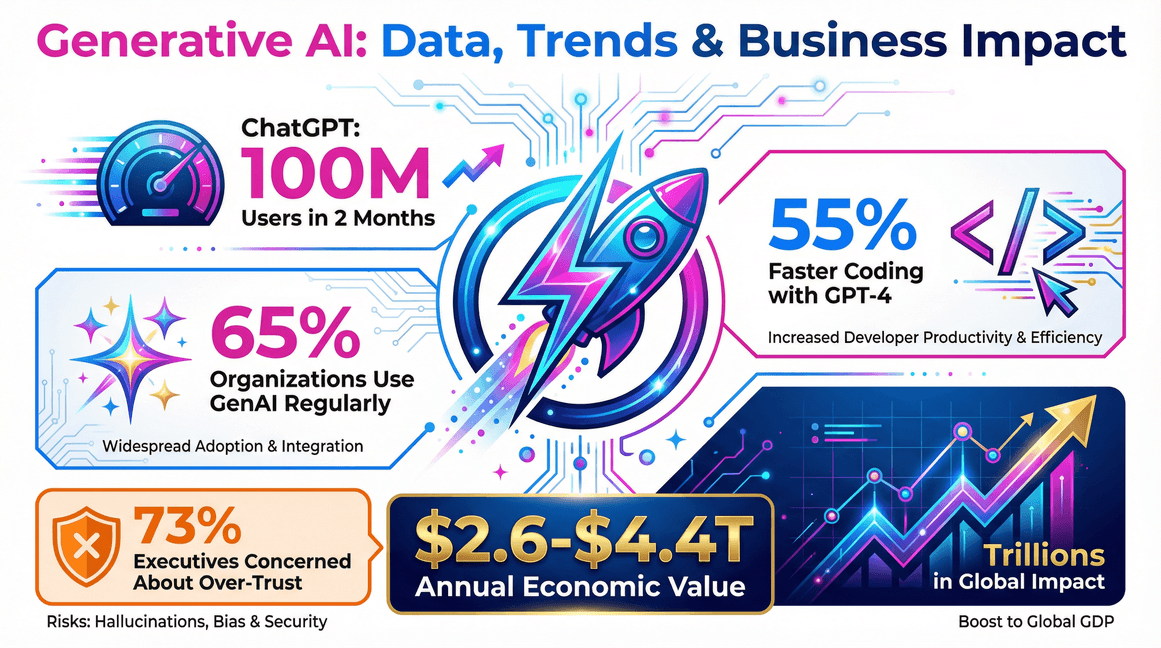
Generativ AI är inte bara en fluga — den förändrar hur vi arbetar. ChatGPT nådde 100 miljoner användare på bara två månader. I början av 2024 använde 65 % av organisationer generativ AI regelbundet (McKinsey).
- Produktivitet: AI Index anger en vinst på 26 % i mjukvaruutveckling — men en randomiserad kontrollerad METR-studie fann att erfarna open source-utvecklare blev 19 % långsammare med AI-stöd, samtidigt som de trodde att de var 20 % snabbare, så behandla alla enstaka siffror med viss försiktighet (METR).
- Ekonomiskt värde: Generativ AI kan tillföra 2,6–4,4 biljoner USD i ekonomiskt värde per år (McKinsey).
Generativ AI på jobbet
Generativ AI förändrar arbetsflöden i hela organisationen:
- Skrivande: Medarbetare använder AI för att skapa första utkast och redigerar sedan vidare — vilket sparar timmar varje vecka.
- Kodning: Utvecklare använder AI som en parprogrammerare, vilket ökar produktiviteten och kunskapsdelningen.
- Möten: AI-verktyg sammanfattar mötesanteckningar och skapar åtgärdspunkter, vilket frigör tid för mer strategiskt arbete.
- Utbildning: Generativ AI anpassar medarbetarutbildning och gör lärandet mer effektivt och engagerande.
Men allt är inte solsken — 73 % av cheferna oroar sig för att medarbetare litar för mycket på AI:s resultat (Medium). Behovet av styrning och kritiskt tänkande är större än någonsin.
AI-data, etik och governance: att bygga förtroende för AI
AI-bias och förklarbarhet: statistik och lösningar
AI är kraftfullt, men inte perfekt. Studier visar tydlig köns- och rasbias i stora språkmodeller (AIPRM). Till exempel föredrog en AI-baserad CV-granskare manligt klingande namn 52 % av gångerna, jämfört med bara 11 % för kvinnligt klingande namn.
- Allmän oro: Cirka 60 % av amerikanska vuxna oroar sig mer för att staten reglerar AI för lite än för mycket (Pew Research).
- Förklarbarhet: Till 2025 kommer 30 % av stora organisationer att kräva att deras AI-modeller är förklarbara för att få godkännande för användning.
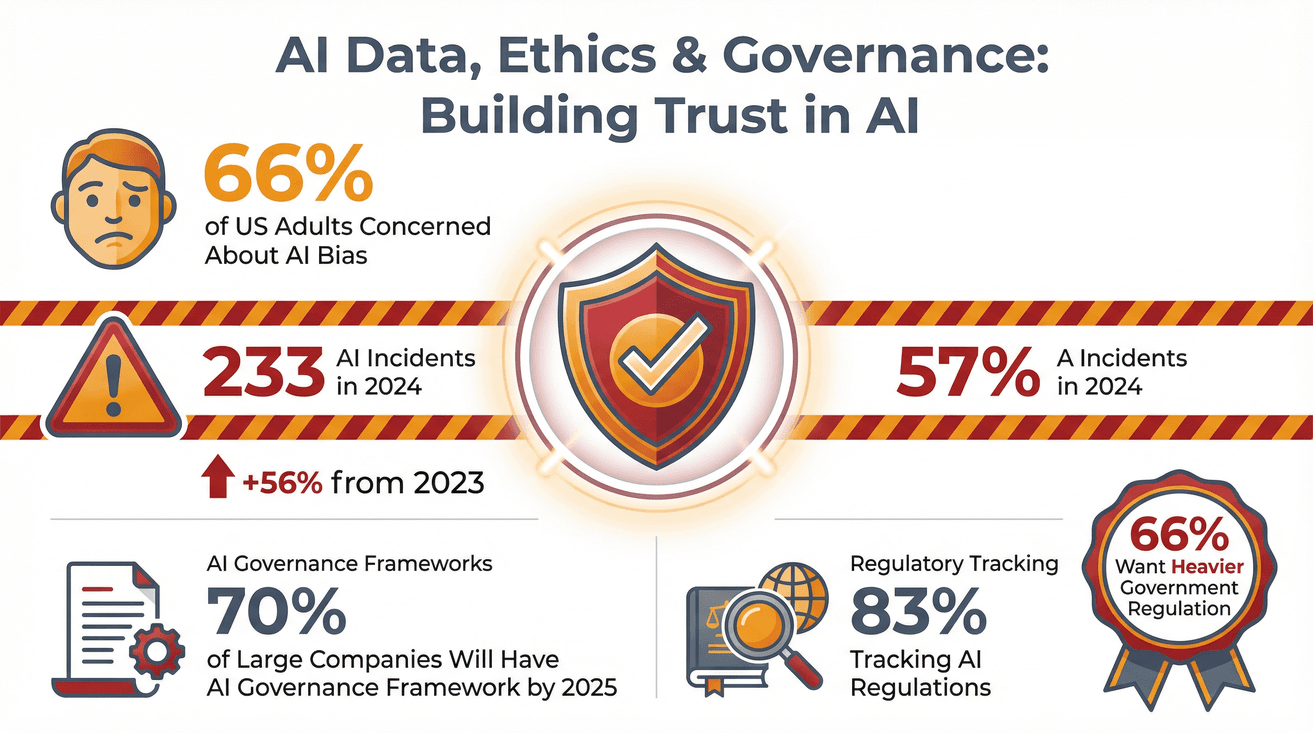
Den goda nyheten? Fler företag inför rättvisegranskningar, verktyg för explainable AI och mer diversifierade datapraktiker. Men med 362 rapporterade AI-incidenter 2025, upp från 233 år 2024, är behovet av robust governance tydligt (Stanford HAI).
AI-styrning och reglering
Reglering är på väg — snabbt. EU:s AI Act trädde i kraft den 1 augusti 2024, med transparenskrav som börjar gälla den 2 augusti 2026; Digital Omnibus som trädde i kraft den 27 juli 2026 sköt de flesta fristående högriskkrav till 2027 (European Commission). Den inför strikta krav för högrisk-AI, inklusive dokumentation, bias-testning och mänsklig kontroll. Till 2025 kommer 70 % av stora företag att ha ett ramverk för AI-governance eller etiska riktlinjer på plats.
- Efterlevnad: 83 % av företagen följer AI-reglering (Deloitte), och 50 % har bromsat vissa AI-satsningar i väntan på tydligare regler.
- Allmän efterfrågan: Cirka 60 % av amerikanska vuxna oroar sig mer för att staten underreglerar AI än överreglerar det (56 % bland AI-experter) (Pew Research).
AI-trender att hålla koll på: vad väntar artificiell intelligens?
Multimodal och edge AI
Nästa våg av AI handlar om mångsidighet och överallt-närvaro.
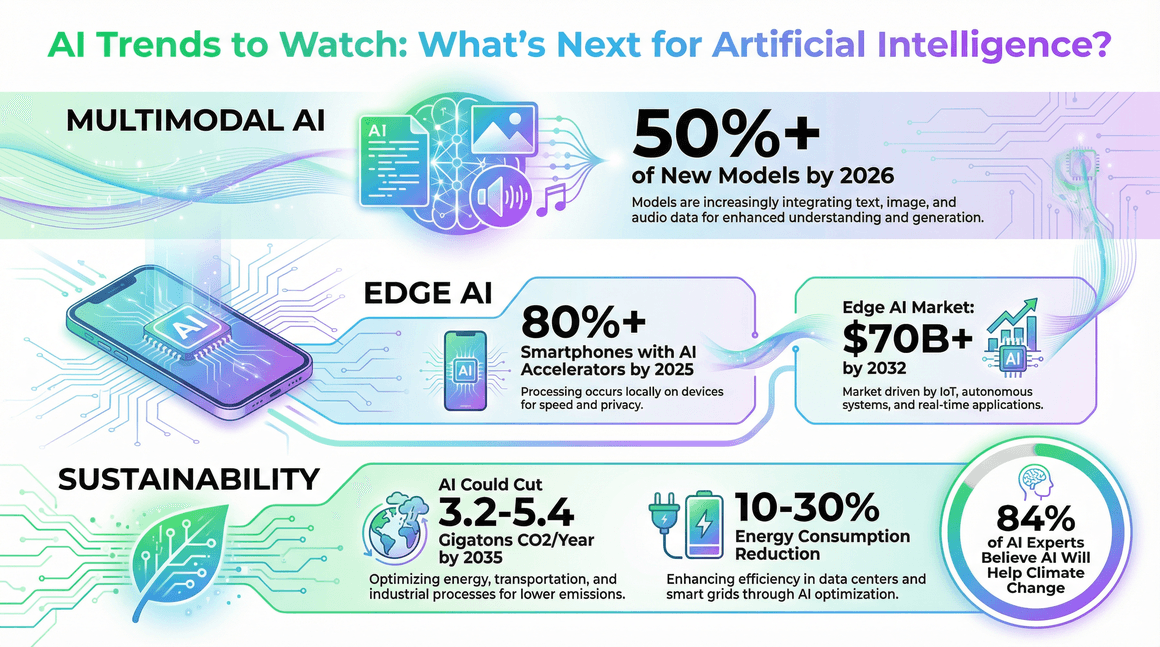
- Multimodal AI: Till 2026 kommer över hälften av alla nya djupinlärningsmodeller att vara multimodala och kunna bearbeta text, bilder, ljud och video tillsammans.
- Edge AI: Till 2025 kommer mer än 80 % av smartphones ha dedikerade AI-acceleratorer som möjliggör intelligens direkt i enheten (Fortune Business Insights).
- Marknaden för edge AI: 35,81 miljarder USD 2025 → 47,59 miljarder USD 2026 → 385,89 miljarder USD 2034 (Fortune Business Insights).
Det betyder att AI kommer att finnas överallt — tyst i din telefon, bil, kylskåp och kanske till och med i din brödrost (okej, kanske inte brödrosten … än).
AI för hållbarhet och samhällsnytta
AI handlar inte bara om vinst — det är också ett kraftfullt verktyg för att lösa globala utmaningar.
- Klimatpåverkan: AI kan minska 3,2–5,4 gigaton CO2-utsläpp per år till 2035 (LSE).
- Energieffektivitet: AI-driven fastighetsstyrning kan minska energiförbrukningen med 10–30 %.
- Jordbruk: AI-baserat precisionsjordbruk kan öka skördarna och minska användningen av kemikalier.
84 % av AI-experter tror att AI kommer att vara ett nyckelverktyg för att hantera klimatförändringar och hälsoutmaningar. Om AI bara också kunde hjälpa mig att komma ihåg var jag lade nycklarna …
Viktiga slutsatser: vad den senaste AI-statistiken visar
Låt oss avsluta med de mest handlingsbara insikterna från den här AI-statistiken:
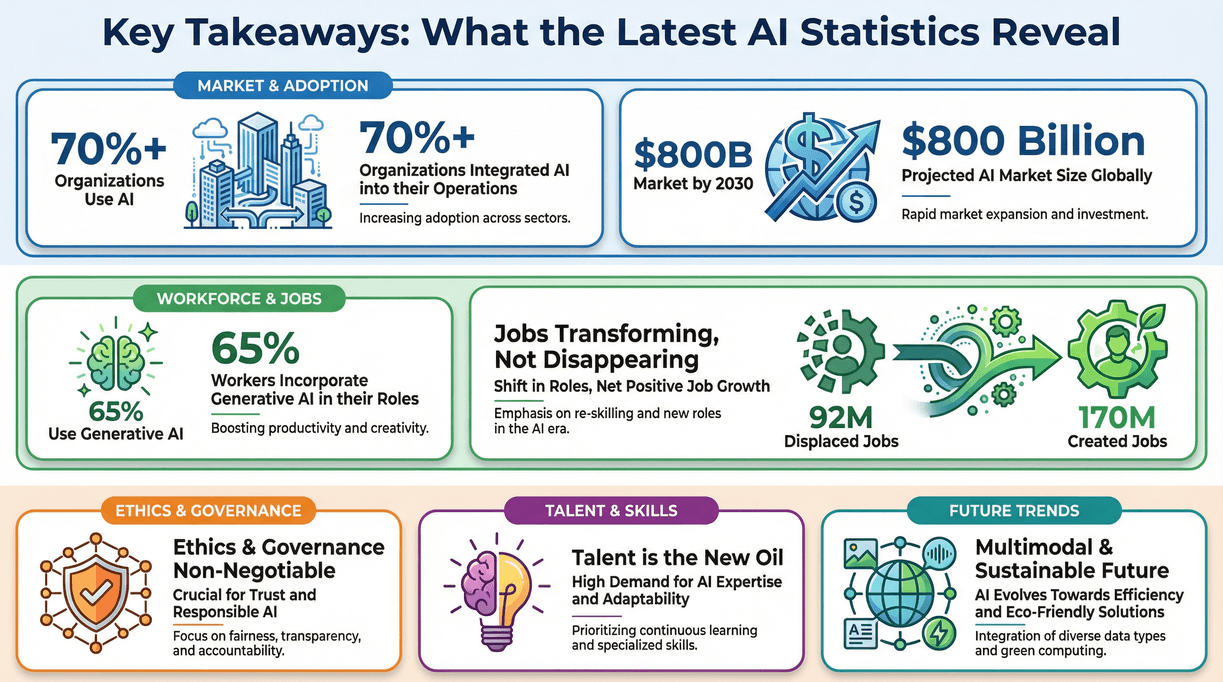
- AI finns överallt: Över 70 % av organisationer använder AI, och den globala marknaden väntas överstiga 800 miljarder USD till 2030.
- Generativ AI är mainstream: 65 % av organisationer använder generativ AI, vilket driver produktivitet och kreativitet i alla branscher.
- AI ger verklig avkastning: Från bedrägeridetektering i finans till prediktivt underhåll i tillverkning — den ekonomiska effekten är enorm.
- Jobben förändras, inte bara försvinner: Ja, AI automatiserar vissa roller, men den skapar ännu fler nya — om du är beredd att lära dig.
- Skillnader mellan sektorer spelar roll: Finans, tech och telekom leder, men vård, tillverkning och retail kommer snabbt ifatt.
- Etik och governance är inte förhandlingsbart: Med fler incidenter och ökad oro hos allmänheten är ansvarsfull AI både en affärs- och samhällsfråga.
- Reglering är på väg: Få ordning på governance, dokumentation och compliance.
- Talang är det nya guldet: Investera i människor, inte bara i teknik.
- Framtiden är multimodal och hållbar: AI blir mer människolik och mer inbäddad i vardagen, samtidigt som fokus på samhällsnytta ökar.
Citerbar AI-statistik: underlag för research
Letar du efter siffror att använda i nästa styrelsemöte, pitchdeck eller forskningsrapport? Här är några av de mest citerbara datapunkterna för 2026:
| Statistik | Värde / källa |
|---|---|
| Globalt värde på AI-marknaden | 617,62 miljarder USD 2026, väntas nå 1,42 biljoner USD till 2032 (Statista) |
| AI-investeringar i USA | 285,9 miljarder USD i privata AI-investeringar 2025, jämfört med Kinas 12,4 miljarder USD (Stanford AI Index) |
| Enterprise-adoption av AI | 88 % av organisationer använde AI i minst en affärsfunktion 2025 (McKinsey) |
| Användning av generativ AI | 65 % av organisationer i slutet av 2023 (McKinsey) |
| Produktivitetslyft med AI | Kundsupportmedarbetare med AI såg en produktivitetsökning på 14 % (Stanford HAI) |
| AI inom vården | Marknaden väntas växa från 25,88 miljarder USD 2025 till 194,79 miljarder USD 2031, CAGR 39,7 % (MarketsandMarkets) |
| AI inom finans | 90 % av bankerna använder AI för bedrägeridetektering (Pitechsol) |
| AI inom retail | 48,9 % av amerikanska detaljhandelsföretag använder AI i marknadsföring (SellersCommerce) |
| AI och hållbarhet | AI kan minska 3,2–5,4 gigaton CO2-utsläpp per år till 2035 (LSE) |
Källor och vidare läsning
Om du är en sådan som gillar att dubbelkolla kvittonen (det gör jag), kan du gräva vidare här:
- Cargoson: How Big is the AI Market?
- Stanford HAI: 2025 AI Index Report
- McKinsey: The State of AI in 2023 and 2024
- IBM Global AI Adoption Index 2023
- World Economic Forum: Future of Jobs Report 2025
- DemandSage: AI in Healthcare Stats
- SellersCommerce: AI in E-commerce Statistics
- LSE Grantham Institute: AI and Climate Impact
- AIPRM: Bias in AI Statistics
- IoT Analytics: Industrial AI Market Insights
- Fortune Business Insights: Edge AI Market
För fler AI-insikter, tips och det senaste inom AI-driven produktivitet, kolla in Thunderbit Blog.
Utforska Thunderbit AI Web Scraper Gratisnivån täcker 6 sidor i månaden, inget kort behövs. Exportera till Excel, Google Sheets, Airtable eller Notion utan extra kostnad. Get Started Free
Testa Thunderbit AI Web Scraper gratis Get Started Free