
Tänk dig det här: Det är 2026 och startupvärlden surrar högre än någonsin. Varje vecka verkar ännu ett AI-bolag ta in en runda på miljarder, och ordet “enhörning” börjar kännas mindre som ett mytiskt väsen och mer som en återkommande gäst på ditt lokala kafé. Siffrorna är svindlande – AI-startups står nu för nästan hälften av alla nya enhörningar, och den globala flocken har tredubblats i storlek sedan 2020. Riskkapitalet strömmar in i rekordvolymer, och techjättarna slåss om nästa stora genombrott. Oavsett om du är grundare, investerare eller bara tekniknörd är det inte bara intressant att följa de senaste trenderna inom AI-statistik, AI-startups och AI-enhörningar – det är avgörande.
Se hur Thunderbit använder AI för att automatisera dataflöden Get Started Free
Varför? För att artificiell intelligens inte bara är ännu en teknikvåg. Den driver en ny era av affärer, innovation – och ja, en hel del galna finansieringsrundor. Oavsett om du letar efter nästa investering, bygger nästa stora grej eller bara försöker förstå AI-guldruschen, är det bästa sättet att hänga med att förstå landskapet så att du inte lämnas bakom – eller blir nedtrampad av en flock enhörningar. En viktig brasklapp innan vi tittar på siffrorna: värderingar i den här delen av marknaden har en livslängd som mäts i veckor. Jag kontrollerade om alla bolag och rundor här i augusti 2026 mot bolagens egna tillkännagivanden – sex av de tio största hade då mer än fördubblats sedan den förra versionen av artikeln.
AI-enhörningsboomen: Läget 2026 i korthet
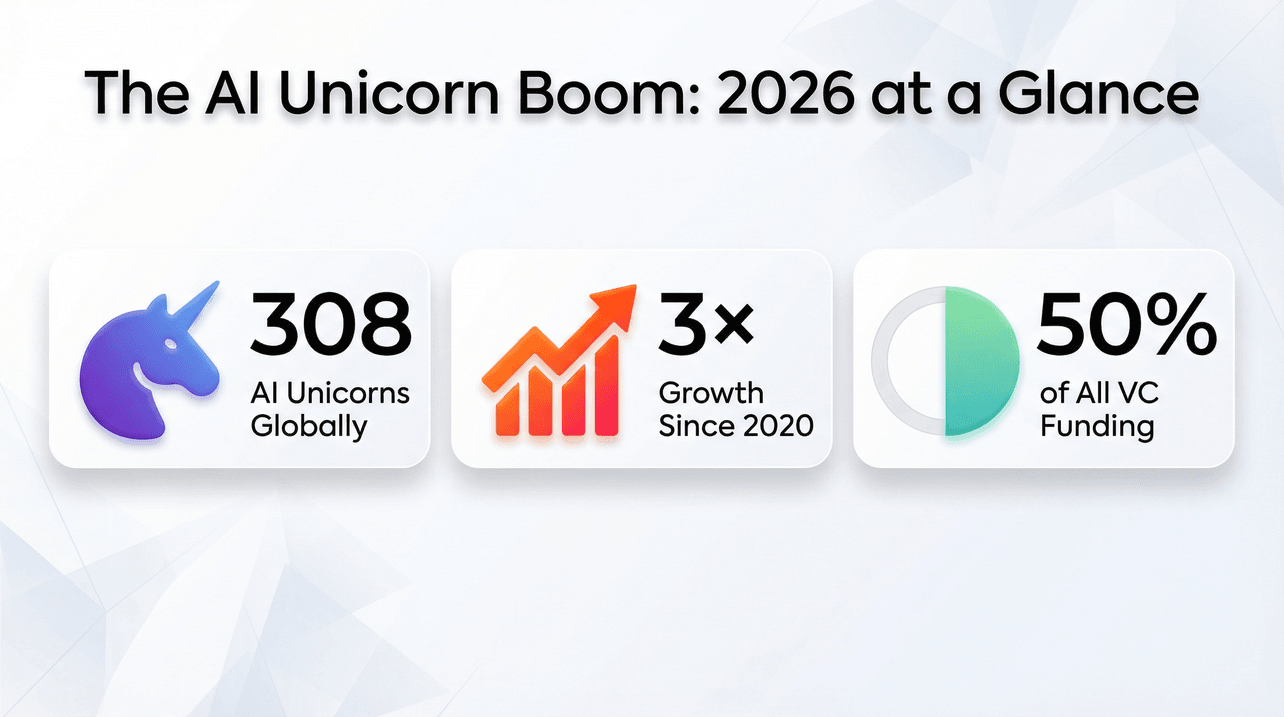
Låt oss börja med en snabb överblick av AI-enhörningsvärlden när vi går in i 2026. Här är vad siffrorna visar:
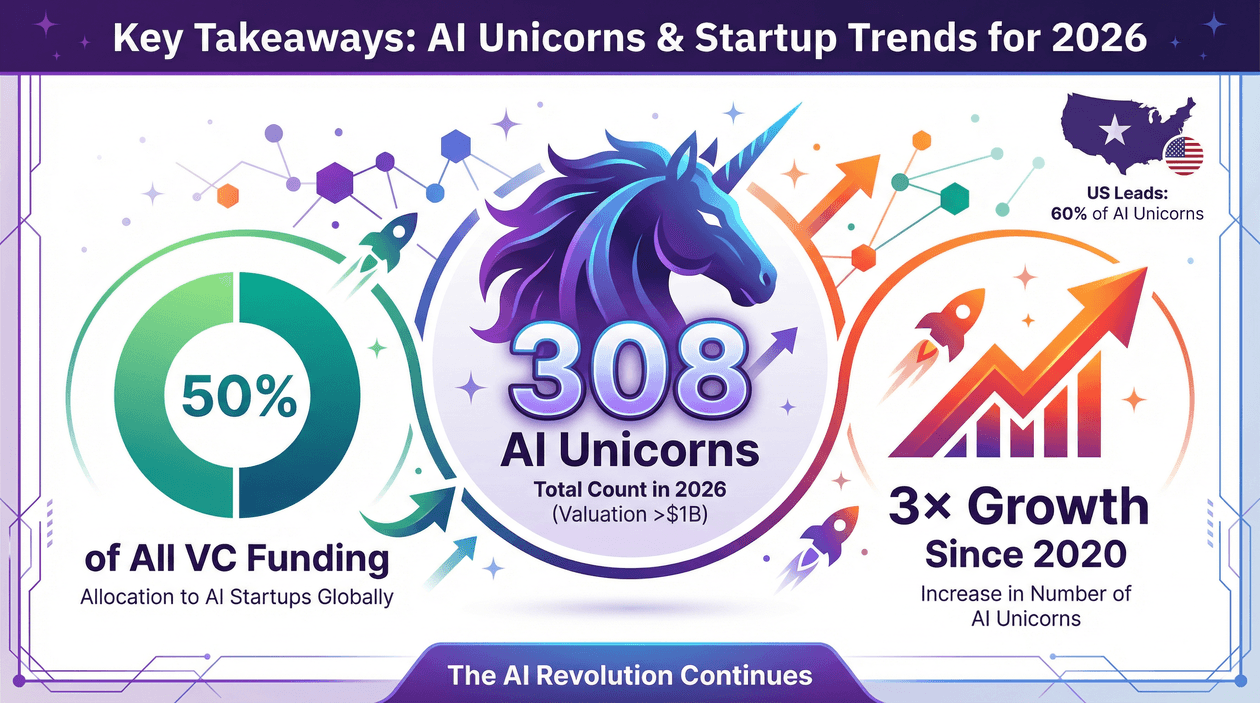
- Totalt antal AI-enhörningar: 308 globalt (upp från 245 i slutet av 2024 – en ökning med 25 % på bara ett år)
- Tillväxt sedan 2020: Nästan 4× tillväxt (från 78 år 2020 till 308 i indexet från slutet av 2025)
- Andel av global riskkapitalfinansiering: 50 % av alla VC-dollar 2025 gick till AI-startups
- Totalt AI-startupkapital (2025): $202 miljarder (upp 75 % jämfört med året innan)
- Mega-rundor (≥$500M): 58 % av AI-finansieringen gick till mega-rundor
- Största AI-enhörningsvärdering: Anthropic på $965B, följt av OpenAI på $852B
- Geografiskt nav: Över 60 % av AI-enhörningarna finns i USA, och bara Bay Area tog in $122B i finansiering
Om du tänker visuellt, föreställ dig bara en världskarta där USA lyser som en julgran, Europa och Kina tänds upp snabbt, och resten av världen springer ikapp.
Topp AI-enhörningar: Vem leder ligan?
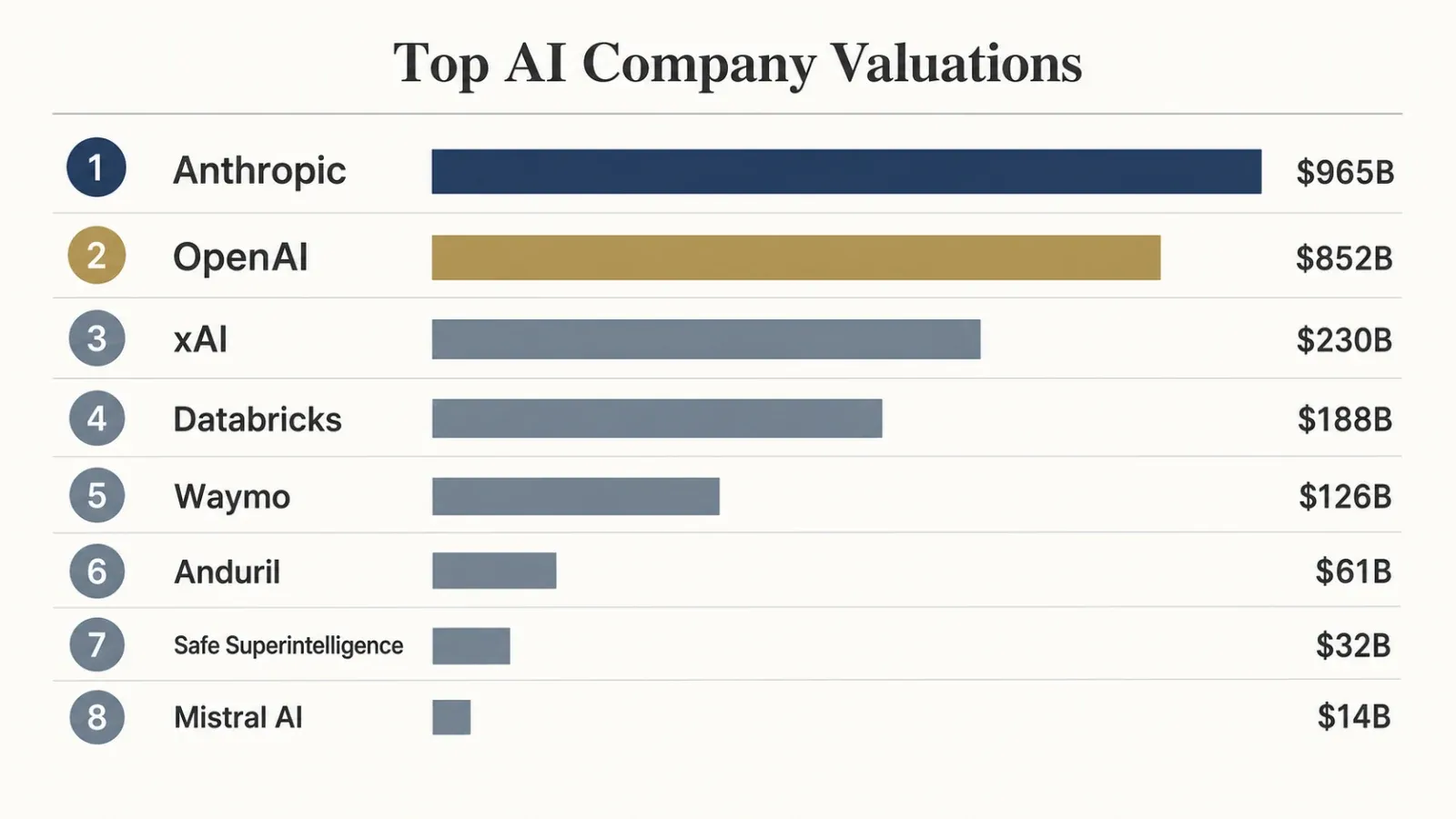
AI-enhörningarnas topplista börjar likna Fortune 500 – förutom att alla är under 15 år gamla och besatta av stora språkmodeller. Här är de tio mest värdefulla AI-enhörningarna 2026, och vad som gör dem så starka:
| Företag | Huvudkontor / Grundat | Värdering | Fokusområde / Varför de sticker ut |
|---|---|---|---|
| Anthropic | San Francisco, 2021 | $965B | Säker AI/LLM:er (Claude); ledande inom AI-säkerhet och alignment |
| OpenAI | San Francisco, 2015 | $852B | Stora språkmodeller (ChatGPT); ansiktet utåt för generativ AI |
| xAI | Boca Raton, 2023 | $230B | Generativa AI-modeller (Grok); Elon Musks AI-satsning |
| Databricks | San Francisco, 2013 | $188B | Enterprise data lakehouse; ryggraden i AI-drift |
| Waymo | Mountain View, 2009 | $126B | Självkörande fordon; driver autonomi i stor skala |
| Anduril Industries | Irvine, 2017 | $61B | Försvars-AI (autonoma system); omdefinierar säkerhetsteknik |
| Canva | Sydney, 2013 | $42B | AI-drivna designverktyg; gör kreativitet tillgängligt för alla |
| Figure | Kalifornien, 2022 | $39B | Humanoidrobotik; leder revolutionen med “robotar som jobbar” |
| Safe Superintelligence | Palo Alto & Tel Aviv, 2024 | $32B | Forskning om AI-säkerhet; snabbaste enhörningen till $30B+ |
| Mistral AI | Paris, 2023 | $14B | Generativa AI-LLM:er; Europas svar på OpenAI |
Några saker sticker ut: grundmodell-labb dominerar toppen, generativ AI finns överallt, och robotik får äntligen sin “Jetsons”-stund. För hela listan över 308 AI-enhörningar, kolla in Failorys AI-enhörningsindex.
AI-startupfinansiering: Rekordrundor och trender
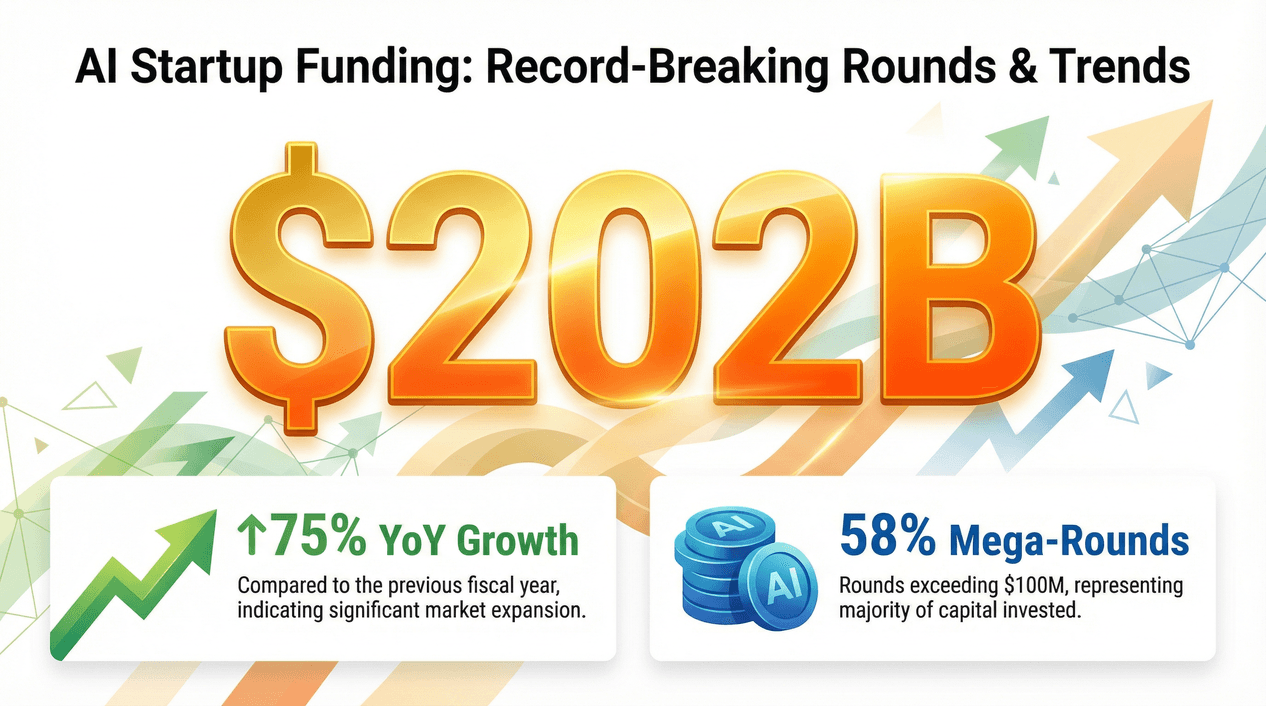
Om du tyckte att SaaS-boomen 2021 var vild, så är AI:s finansieringssiffror 2025–2026 på en helt annan nivå. Här är vad som händer:
- Totalt AI-startupkapital (2025): $202B (upp 75 % YoY från $114B)
- Andel av global VC: 50 % av allt riskkapital gick till AI
- Nordamerika: Cirka 60 % av startupfinansieringen ($168B av $280B) gick till AI-bolag
- Mega-rundor: 58 % av AI-finansieringen gick till rundor på $500M eller mer
- Största affärerna: $40B till OpenAI, $13B till Anthropic
Pengarna kommer inte bara från riskkapitalbolag, utan också från stora private equity-aktörer och techjättar. SoftBank ledde till exempel en runda på $40B för OpenAI, medan Meta investerade $14B i Scale AI. Om du är en investerare som blinkade och missade senaste rundan är du inte ensam – jag har sett fler än några försöka hoppa på tåget igen.
Mega-rundor och kapitalets koncentration
Här är en rolig – eller kanske skrämmande – siffra: 58 % av all AI-finansiering 2025 gick till mega-rundor på $500M eller mer. Ja, den största delen av kapitalet är koncentrerad allra högst upp, där fyra bolag (OpenAI, Anthropic, xAI, Safe Superintelligence) tog in några av de största affärerna i startup-historien.
Vad betyder det för nya AI-startups? Det är ett tveeggat svärd. Det finns mer pengar än någonsin, men ribban för att resa mega-rundor är skyhög. Den goda nyheten: snabbrörliga startups fortsätter ändå att slå etablerade aktörer inom nischade AI-områden, särskilt där deep tech och arbetsflödesintegration spelar stor roll.
Geografiska hotspots: Där AI-enhörningar trivs
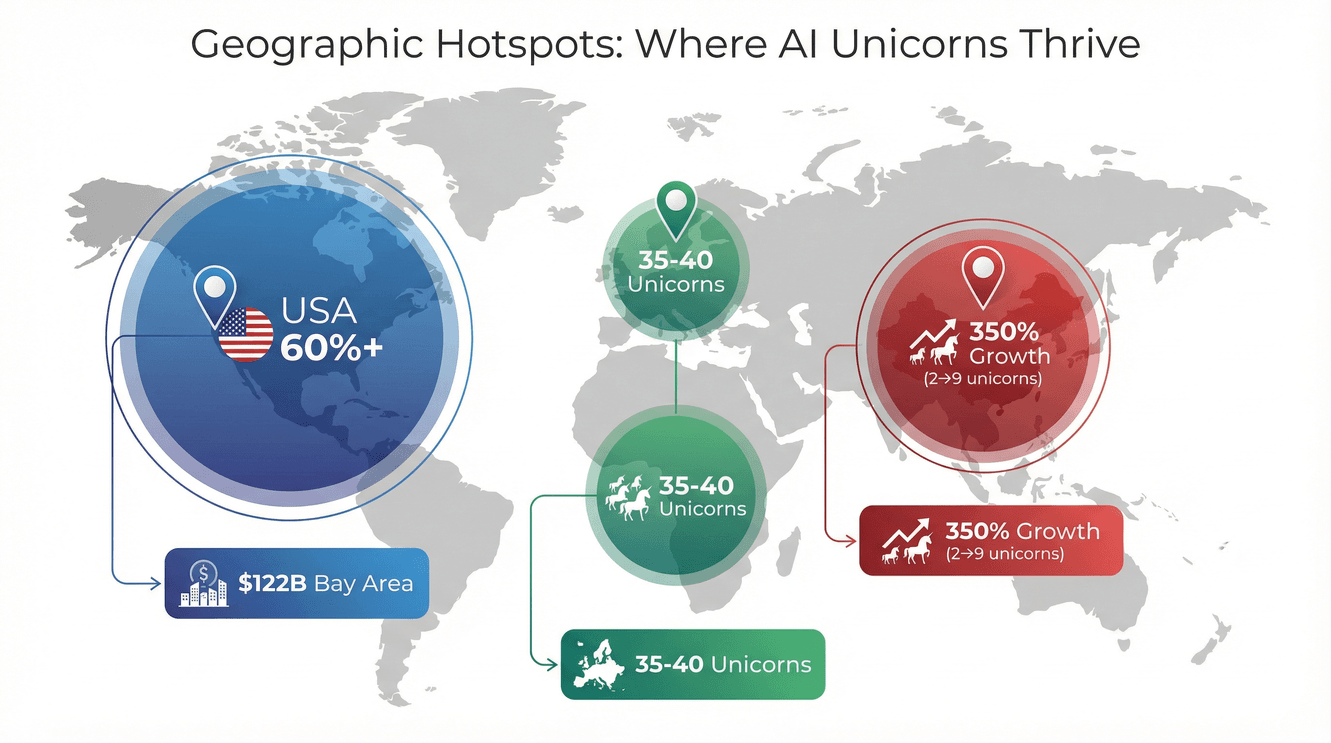
USA är fortfarande den oomtvistade tungviktsmästaren bland AI-enhörningar, men resten av världen kommer ikapp – snabbt.
- USA: Över 60 % av AI-enhörningarna; bara Bay Area tog in $122B i finansiering
- Kina: Antalet AI-enhörningar ökade från 2 till 9 under 2025 (en ökning på 350 %), med jättar som Yuanfudao ($17B) och Zuoyebang ($10B)
- Europa: 35–40 AI-enhörningar, där Frankrike (Mistral AI), Tyskland (Helsing) och Israel är stigande stjärnor
- Asien utanför Kina: Indien och Sydkorea bygger framstående AI-bolag, till exempel Rebellions i Sydkorea
Investerare följer talangen, och regeringar tävlar om att bygga sina egna AI-mästare. Om du funderar på att starta ett AI-bolag är närhet till en stark talangpool och en gynnsam regleringsmiljö fortfarande en stor fördel.
AI-trender som formar startupframgång 2026
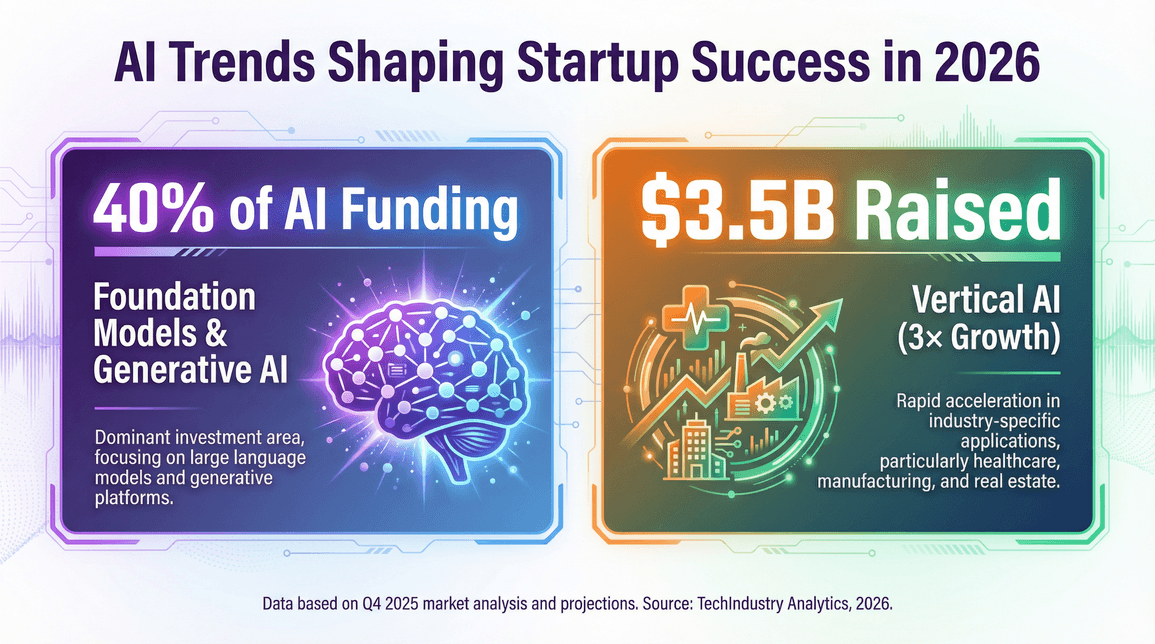
Så, vad är det egentligen som driver AI-enhörningsexplosionen? Här är de hetaste AI-trenderna som göder nästa generation av miljardbolag:
- Grundmodeller och generativ AI: Stora LLM:er (tänk OpenAI, Anthropic, Cohere, Mistral, xAI) står i centrum och står för 40 % av all AI-finansiering
- AI-infrastruktur: Chip, beräkningskraft och datalager – bolag som Groq och Snowflakes AI-funktioner tar in miljarder för att driva nästa våg (Cerebras noterades på NASDAQ som CBRS i maj 2026)
- Vertikal AI: Branschspecifika lösningar blomstrar; vertikala AI-startups tog in $3.5B under 2025, tre gånger mer än året innan
- Robotik och autonomi: Från humanoida robotar (Figure) till självkörande fordon (Waymo) och drönare (Anduril) – AI tar steget ut i den fysiska världen
- AI-native mjukvara: Arbetsflödesverktyg och kreativa plattformar (som Canva, Superhuman och ElevenLabs) bygger in AI i vardagsprodukter
Grundmodeller och generativ AI
Låt oss zooma in på trenden med grundmodeller och generativ AI. Dessa bolag drar in kapital i enorm skala – $80B bara under 2025 – och sätter takten för hela branschen. Anthropic:s $965B-värdering och OpenAI:s $852B ligger nu i toppen av listan över privata bolag. Europas Mistral AI tog in en Series C på €1.7B till en post-money-värdering på €11.7B (Mistral AI).
Vad är nytt? De här labben pushar nu “AI-agenter” (uppgiftsspecifika AIs för kod, bildanalys med mera) och till och med ekosystemstandarder, som Anthropic’s Model Context Protocol för interoperabilitet mellan agenter. Tempot i tekniska genombrott och marknadsadoption är hisnande. Om du bygger inom AI rider du antingen vågen – eller spolas undan av den.
AI-enhörningar per sektor: Mer än bara generell AI
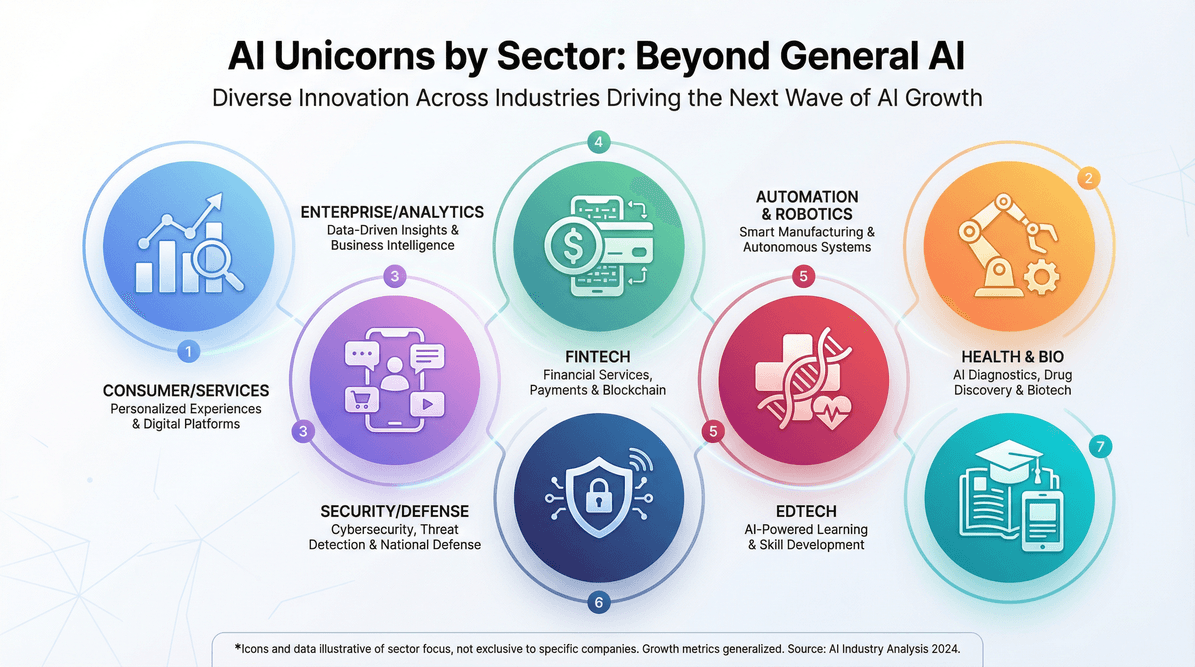
AI-enhörningar handlar inte bara om chattbotar och språkmodeller. Så här ser landskapet ut uppdelat per sektor:
- Enterprise/analys: Databricks, Celonis, Gong, Collibra, ClickHouse – AI för affärsflöden och analys
- Automation och robotik: Waymo, Nuro, Figure – AI för mobilitet, tillverkning och logistik
- Konsument/tjänster: Canva (design), Superhuman (skrivande, tidigare Grammarly), ElevenLabs (röst) – AI i kreativa verktyg och produktivitetsverktyg
- Fintech: Stripe, Klarna – AI för risk, bedrägerier och kundservice
- Hälsa och bio: Tempus, Insitro – AI för läkemedelsutveckling och vårdanalys
- Säkerhet/försvar: Anduril, Shield AI – AI för övervakning, försvar och nationell säkerhet
- EdTech (Kina): Yuanfudao, Zuoyebang – AI-drivna läxhjälps- och utbildningsplattformar
Det gemensamma temat? AI håller på att bli ett lager som möjliggör allt inom varje vertikal, där startups specialiserar sina modeller för specifika domäner och användningsfall.
Den nya playbooken för AI-startups: Det som skiljer enhörningar från mängden
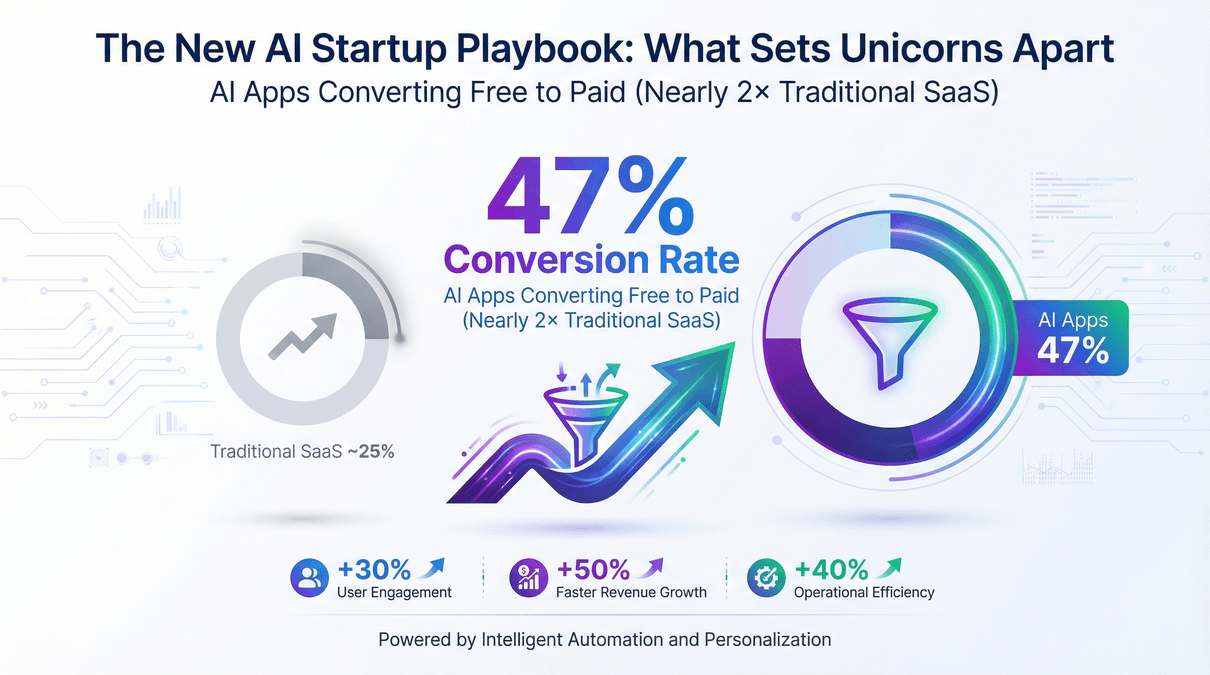
Vad är hemligheten bakom att bygga ett AI-startupbolag värt miljarder 2026? Det här ser jag gång på gång:
- Fokus på deep tech: Teamen är fulla av doktorer och före detta AI-labbprofiler som bygger egna modeller och datagravar
- Kapitaleffektivitet: Ja, det finns mycket pengar, men de bästa teamen balanserar tillväxt med burn rate (åtminstone i teorin)
- Product-market fit: Vinnarna löser riktiga problem och levererar mätbar avkastning – tänk automatisering av företagsuppgifter eller nya kreativa arbetsflöden
- Produktledd tillväxt: 47 % av AI-projekten går nu i produktion, jämfört med 25 % för traditionell SaaS
- Arbetsflödesintegration: Enhörningar bäddar in AI i befintliga system, inte bara bygger snygga demo-versioner
- Försvarbar teknik: Egna data, skräddarsydda modeller och djup integration i arbetsflöden är nyckeln till att stå emot kopior
Det handlar inte bara om att ta in en stor runda. Det handlar om att bygga något som håller – och kan skalas.
Risker och utmaningar: AI-bubbla eller hållbar tillväxt?
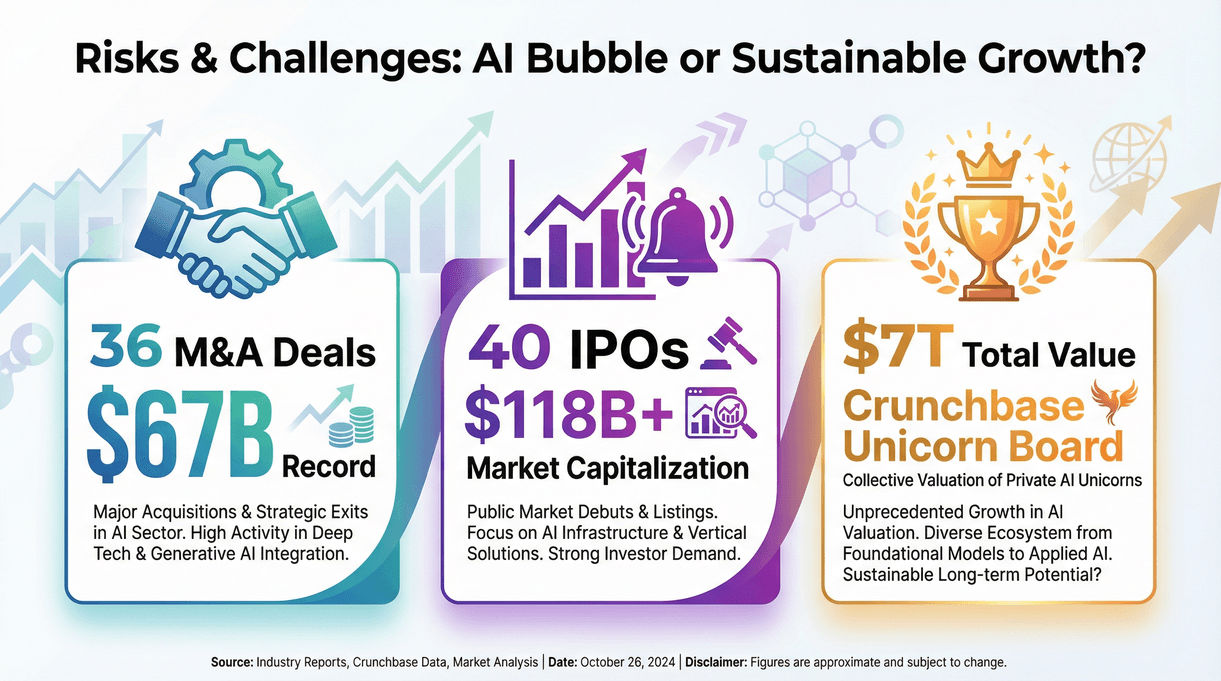
Med all hajp och allt kapital – är AI-enhörningsboomen en bubbla? Diskussionen pågår för fullt. Vissa analytiker menar att det snarare är en “riskbubbla” än en ren värderingsbubbla – AI-bolag skapar visserligen riktiga intäkter, men de bränner också igenom pengar i rekordfart (Crunchbase). Senfas-VC:er kastar ofta den traditionella riskanalysen överbord, rädda för att missa nästa OpenAI.
De flesta experter väntar sig en mjuk landning eller en mild korrigering, inte ett tvärkollaps. Inom alla enhörningssektorer 2025 blev 36 enhörningar uppköpta för rekordhöga $67B, medan omkring 40 bolag gick till börsen. Det är siffror för hela marknaden, inte bara AI. Crunchbase Unicorn Board närmar sig nu $7T i totalt värde, och många privata AI-jättar väntar fortfarande på sin IPO-stund.
Slutsatsen: Det finns verkligt innehåll bakom hajpen, men marknaden behöver en verklighetscheck. Om du bygger eller investerar i AI, håll blicken på hållbar tillväxt – inte bara nästa stora rubrikrunda.
Viktiga lärdomar: AI-enhörningar och startuptrender för 2026
Avslutningsvis – här är de största insikterna för grundare, investerare och operativa team:
- AI-enhörningar har nästan fyrdubblats sedan 2020, från 78 till 308 globalt (index senast uppdaterat i december 2025)
- AI-startups tog hem 50 % av allt riskkapital 2025
- Mega-rundor är det nya normalläget, men kapitalet är koncentrerat i toppen
- Grundmodeller, generativ AI och branschspecifika lösningar driver nästa våg
- USA leder, men Europa och Asien kommer snabbt ikapp
- Hållbar tillväxt, deep tech och arbetsflödesintegration är nycklarna till enhörningsframgång
- Bubbla eller inte – AI är här för att stanna, och nästa kapitel har precis börjat
AI-statistik och insikter att citera 2026
Här är en smidig lista med AI-statistik och insikter som du kan använda i egna rapporter, presentationer eller blogginlägg:
- 308 AI-enhörningar globalt i slutet av 2025 (Failory)
- AI-startups tog in $202B under 2025 (Crunchbase News)
- 50 % av allt riskkapital gick till AI 2025 (Crunchbase News)
- 58 % av AI-finansieringen gick till mega-rundor ($500M+) (Crunchbase News)
- Anthropic och OpenAI toppar värderingslistan bland privata bolag med $965B respektive $852B
- USA är hem för över 60 % av AI-enhörningarna (AltIndex)
- Vertikala AI-startups tog in $3.5B 2025 (Menlo Ventures)
- AI-“app”-startups stod för 63 % av intäkterna från enterprise AI-mjukvara 2025 (Menlo Ventures)
- Inom alla sektorer blev 36 enhörningar uppköpta 2025 för rekordhöga $67B (Crunchbase News)
- Crunchbase Unicorn Board närmar sig nu $7T i värde (Crunchbase News)
Metod och källor
All AI-statistik och alla enhörningsdata i det här inlägget har sammanställts från ledande branschdatabaser, nyhetsrapporter och marknadsanalyser, inklusive Crunchbase News, Failorys AI-enhörningsindex, AltIndex, Menlo Ventures och Bessemer Venture Partners. Antalet enhörningar baseras på sammanställda listningar per slutet av 2025. Tillväxttal och finansieringsandelar är beräknade år över år utifrån dessa källor. Alla siffror är direkt citerade från länkade referenser för maximal transparens.
Om du är lika entusiastisk inför AI-framtiden som jag är – och vill se hur automation, data och AI förändrar hur vi arbetar – kolla in vad vi bygger på Thunderbit. Vårt uppdrag är att göra AI-driven produktivitet tillgänglig för alla, oavsett om du skrapar webdata, automatiserar arbetsflöden eller bara försöker hänga med i nästa enhörningsvåg. Och om du vill ha fler djupdykningar som den här, missa inte Thunderbit Blog.
Testa Thunderbit AI Web Scraper gratis Get Started Free




