
Sales teams everywhere know the pain: you’ve got a great product, a qualified lead, and a pitch that lands… only for the deal to stall out in “maybe next quarter” limbo. It’s not just you—, and sales cycles are now . Buyers are overwhelmed with options, distracted by competing priorities, and—let’s be honest—sometimes just plain procrastinate. The result? Lost revenue, missed targets, and a lot of frustrated sales and operations teams.
But here’s the good news: urgency isn’t just a buzzword—it’s a science-backed lever that can dramatically accelerate your sales cycle and boost conversion rates. I’ve spent years in SaaS and automation, and I’ve seen firsthand how the right urgency techniques (used ethically!) can turn “maybe later” into “let’s do it now.” In this guide, I’ll break down the psychology of urgency, share proven tactics (from FOMO to social proof), and show you how to combine high-impact scripts with AI tools like to keep your pipeline moving. Whether you’re a sales pro or a business operator, these are actionable, research-backed strategies you can start using today.
What Does Creating Urgency in Sales Really Mean?
Let’s cut through the jargon: creating urgency in sales means giving your customer a compelling, time-sensitive reason to act now, not later. It’s not about high-pressure tactics or empty threats—it’s about helping buyers recognize that waiting comes with real consequences, whether that’s missing out on a discount, losing a spot, or falling behind competitors ().
Think about the last time you saw “Only 2 left in stock!” on an ecommerce site, or got an email with “Sale ends at midnight!” in the subject line. Those are urgency triggers in action. In B2B, it might sound like “We have two onboarding slots left this month,” or “Our pricing changes next quarter.” The goal isn’t to pressure—it’s to clarify the cost of waiting and help the buyer prioritize your solution.
Without urgency, even interested prospects can drift away, defaulting to inaction or endless research. With urgency, you elevate your offer in their mental priority list, making “now” the obvious choice.
Why Creating Urgency in Sales Matters for Business Growth
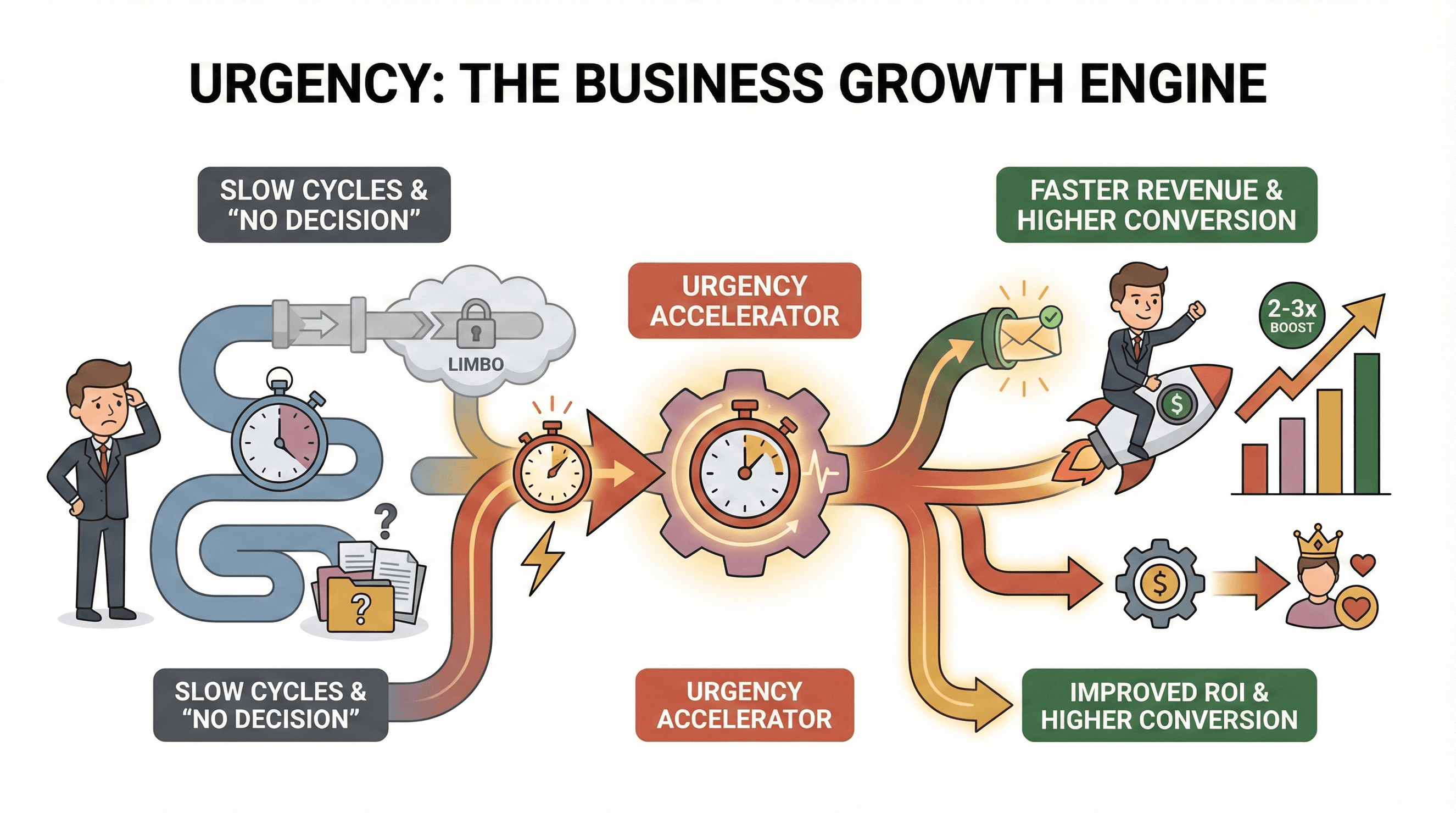 Urgency isn’t just a sales trick—it’s a growth engine. Here’s why:
- Shorter Sales Cycles: By giving prospects a reason to move quickly, you can . That means faster revenue and more deals closed per quarter.
- Higher Conversion Rates: Urgency tactics like limited-time offers or countdown timers have in real-world campaigns.
- Reduced “No Decision” Losses: When buyers see a clear cost to waiting, fewer deals die in limbo. That’s a direct lift to your win rate—no extra leads required.
- Improved Lead Generation ROI: Urgency in CTAs (“Download in the next 24 hours for a bonus!”) increases sign-ups and engagement, making your marketing spend go further.
- Better Inventory Turnover: For ecommerce and retail, urgency helps move stock, reduces holding costs, and improves cash flow.
- Higher Customer Lifetime Value: Customers who respond to genuine urgency often become your most engaged, loyal users.
Here’s a quick table to sum up the benefits:
| Benefit | How Urgency Helps | Example Use Case |
|---|---|---|
| Faster deal closures | Shortens decision timelines by up to 40% | SaaS vendor uses quarter-end discount to close deals |
| Higher conversion rates | Boosts conversions by 2–3x in campaigns | 48-hour flash sale triples daily sales |
| Fewer “no decision” losses | Compels action, reducing stalled deals | B2B team reframes offer in terms of cost of delay |
| Improved lead gen ROI | Increases response to CTAs and sign-ups | “24 hours left” email spikes downloads |
| Better inventory turnover | Clears stock with limited-time promos | Retailer runs “48-hour clearance” to move inventory |
| Enhanced value perception | Highlights unique, time-sensitive value | Real estate agent emphasizes rare features, high demand |
The bottom line: urgency is a force multiplier for every stage of your sales and marketing funnel.
The Psychology Behind How to Create Urgency in Sales
Why does urgency work so well? It taps into some deep-seated psychological triggers:
- Scarcity: When something is rare or almost gone, we want it more. Seeing “Only 2 left!” or “Limited seats available” triggers a competitive, must-act-now instinct ().
- Loss Aversion: We feel the pain of loss more than the pleasure of gain. Messaging like “You’ll lose $5,000 in savings if you wait” is more motivating than “You’ll save $5,000 if you buy now” ().
- FOMO (Fear of Missing Out): When we see others benefiting, we don’t want to be left behind. “Join 500+ clients who upgraded this month” or “20 people are viewing this hotel right now” stirs a powerful urge to act.
- Immediate Gratification: Time-limited deals trigger our brain’s reward system. when faced with an immediate, time-bound offer.
- Social Proof: Seeing others act (reviews, live sales notifications) reduces risk and adds a bandwagon effect—“if others are buying, I should too.”
When you combine these triggers—scarcity, loss aversion, FOMO, and social proof—you create a powerful cocktail that motivates action. The key is to use them authentically and ethically.
Proven Techniques for Creating Urgency in Sales
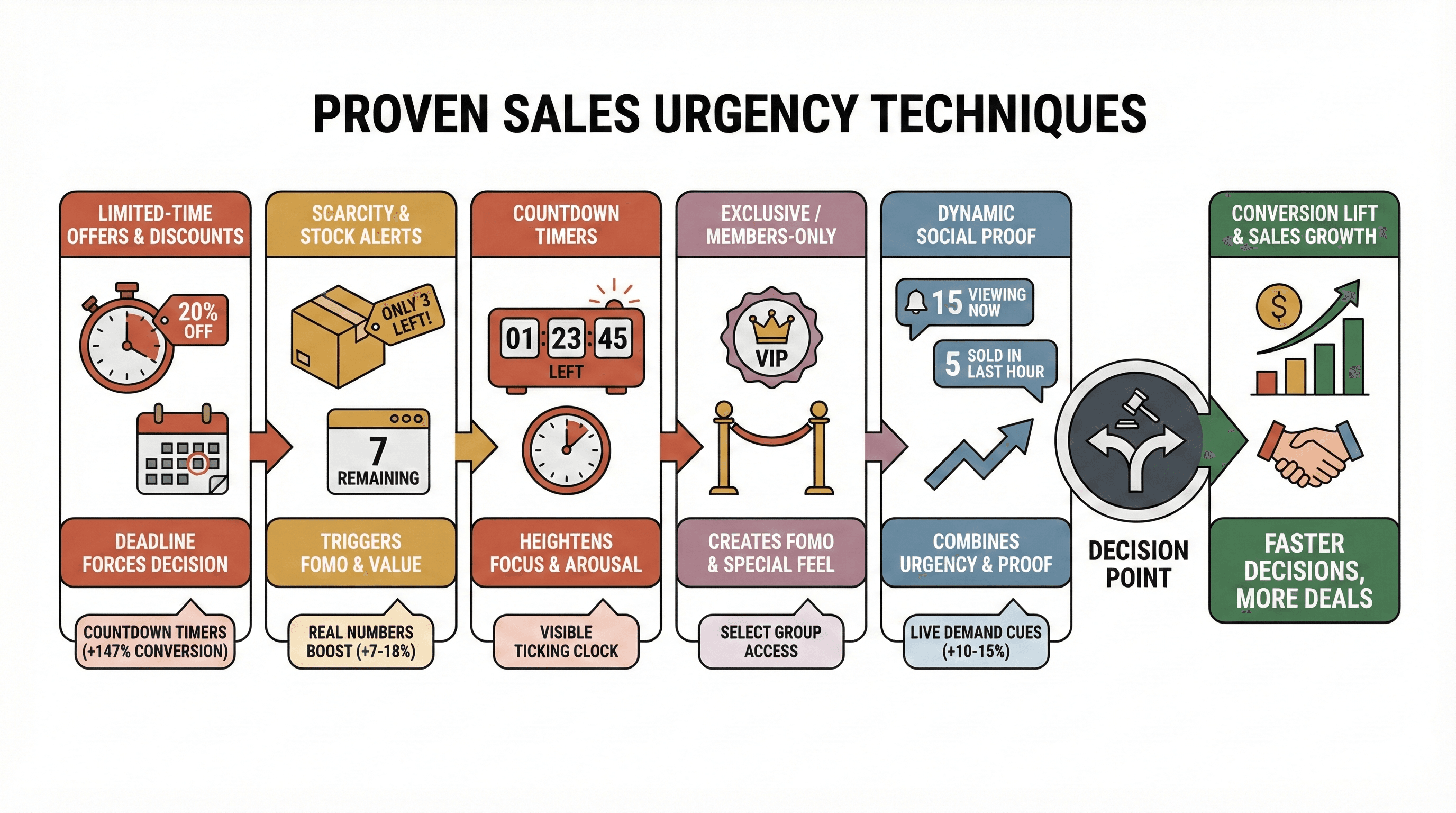 Let’s get tactical. Here are the most effective urgency techniques, why they work, and when to use them:
Using Limited-Time Offers and Discounts
What it is: A deal or discount that expires by a specific deadline (“20% off if you buy by Friday”).
Why it works: Deadlines force a decision. Buyers realize, “If I don’t act now, I lose this benefit.” It’s the classic “cramming before the exam” effect.
Best practices:
- Keep timeframes short (24–48 hours for flash sales, up to a week for bigger promos).
- Communicate the deadline clearly and often (“Offer ends at 11:59 PM Friday”).
- Use countdown timers for extra impact—.
- Don’t overuse—if every week is a sale, urgency loses its power.
Real-world results: Amazon, Groupon, and Expedia all rely on limited-time deals to drive conversions. One e-commerce study found that adding “Sale ends in 2 days” increased checkout rates significantly, with some campaigns seeing .
Leveraging Scarcity and Stock Alerts
What it is: Communicating limited availability (“Only 3 left in stock!” or “Limited seats remaining”).
Why it works: Scarcity triggers FOMO and loss aversion—if I don’t buy now, I might miss out. It also signals popularity and value.
Best practices:
- Use real numbers (“Only 3 spots left” beats “Limited spots”).
- Combine with time urgency for extra punch (“Only 5 units left at this price, offer ends tomorrow”).
- Show live updates if possible (“Inventory: 7 remaining”).
- Always be truthful—fake scarcity erodes trust.
Real-world results: A jewelry retailer saw a and by adding low-stock alerts. Booking.com’s “Only 1 room left!” messages contributed to an .
Countdown Timers
What it is: A visible countdown to the end of a deal or event.
Why it works: The ticking clock heightens emotional arousal and focuses attention. It’s a constant reminder that time is running out.
Best practices:
- Use on landing pages, in emails, or even in sales calls (“Our offer comes off the table Friday—that’s just 2 days from now”).
- Pair with a clear call to action.
Exclusive or “Members-Only” Offers
What it is: Deals available only to a select group (VIPs, early adopters, newsletter subscribers).
Why it works: Exclusivity creates FOMO and makes the offer feel special and fleeting.
Best practices:
- Highlight the exclusivity (“Only available to the first 50 customers”).
- Use for product launches, beta programs, or loyalty rewards.
Dynamic Social Proof & Popularity Cues
What it is: Showing real-time demand (“15 people are viewing this now,” “5 sales in the last hour”).
Why it works: Combines urgency with social proof—if others are buying, I should hurry.
Best practices:
- Use live sales notifications or activity feeds on product pages.
- Display customer counts or trending badges.
Results: .
FOMO Marketing: Driving Action with Fear of Missing Out
FOMO (Fear of Missing Out) is a turbocharged urgency trigger. It’s not just about missing a deal—it’s about missing an experience or being left behind by peers.
How to create FOMO:
- Exclusive Deals & Early Access: “Join our private beta—limited slots for early adopters.” Nike’s SNKRS app uses surprise drops and limited editions, driving .
- Limited Editions & One-Time Events: “This is the only time these experts will all be together.” People rush to avoid missing a unique opportunity.
- Social Proof: “Over 5,000 professionals have already signed up—don’t be left out.” In B2B, “X out of the Fortune 500 have already implemented this solution.”
- Community Cues: VIP groups, invite-only events, or “founding member” status.
Data: . FOMO campaigns see .
Social Proof: Building Trust and Urgency Together
Social proof isn’t just about trust—it’s also about urgency. When buyers see others acting, they’re more likely to act quickly themselves.
How to use social proof:
- Testimonials & Case Studies: Share stories of customers who benefited by acting fast (“We almost waited too long, but we’re so glad we signed up!”).
- Star Ratings & Reviews: Display ratings and review snippets. .
- Live Sales Notifications: “Jane from Chicago just purchased X.” .
- User/Customer Counts: “Trusted by 5,000 companies.” The more, the merrier—and the more urgent it feels to join.
- Peer Endorsements: “We’re already working with three of your close competitors.” A little competitive FOMO never hurts.
Pro tip: Place testimonials and social proof near your call-to-action buttons for maximum effect.
It’s not just what you say—it’s how and when you say it. Here’s how to weave urgency into your sales scripts and communications:
- Lead with Value, Then Urgency: “Based on what you told me, our solution can save your team 10 hours a week. We have a new onboarding slot next Monday—if we get you in before then, you’ll start seeing those savings right away.”
- Use Conditional Phrasing: “Let’s schedule our demo this week so you don’t miss the chance to evaluate before your budgeting cycle ends.”
- Ask Urgency-Driven Questions: “What would it mean for your team if this problem remains unsolved for another three months?”
- Tell Stories: “A client similar to you waited six months and lost a key account. They told me they wish they hadn’t waited.”
- Be Transparent with Deadlines: “Reminder: Our Q3 pricing incentive expires this Friday. I wanted to make sure you knew, as we won’t have this offer next month.”
Tone matters: Urgency should feel like helpful guidance, not desperation. Always tie urgency to the customer’s goals and timeline.
Integrating Thunderbit and AI Tools for Data-Driven Urgency
This is where things get really fun (at least for a data geek like me). AI-powered tools like can supercharge your urgency tactics:
- Real-Time Market Insights: Thunderbit can monitor competitor sites, news, or pricing pages. If a competitor announces a price hike or goes out of stock, you can reach out to prospects with a timely, urgency-driven message.
- Personalized Messaging at Scale: Scrape a prospect’s website or LinkedIn for triggers (like an upcoming event or product launch), then tailor your outreach: “I saw you’re gearing up for your holiday sale. Our platform can be implemented in two weeks—let’s connect so you don’t miss the rush.”
- Automated Follow-Ups: Use Thunderbit’s scheduled scraping to monitor for urgency signals (like a prospect’s new funding round), then trigger a personalized email: “Congrats on your funding! Now’s the perfect time to accelerate your rollout.”
- Workflow Automation: Thunderbit’s AI autofill can speed up paperwork and onboarding, keeping the sales process moving fast and maintaining momentum.
- Tracking and Optimization: Scrape your own analytics or CRM to see which urgency tactics are working best, then iterate your scripts based on real data.
Example in action: A sales rep uses Thunderbit to scrape a prospect’s ecommerce site and notices several best-sellers are out of stock. She emails: “I saw some of your top products are sold out, and the holidays are coming. Our inventory platform can be implemented in three weeks—let’s connect now so you don’t miss out on Black Friday sales.” That’s urgency, value, and personalization—all powered by AI.
Building Value Perception to Motivate Urgent Purchases
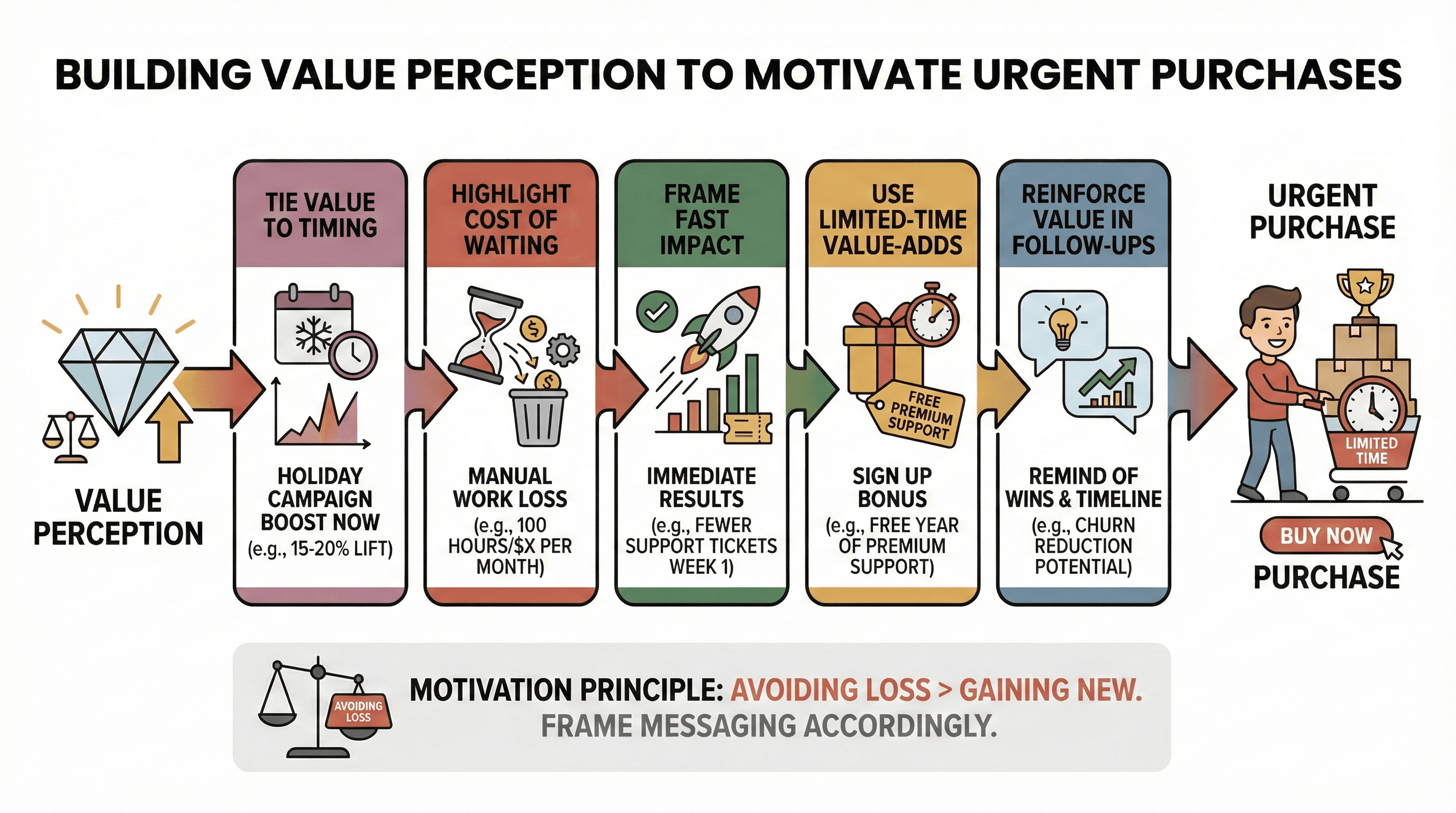 Urgency only works if the customer sees the value. Here’s how to make your offer feel both unique and time-sensitive:
- Tie Value to Timing: “Our analytics platform can boost your holiday campaign conversions by 15–20%. If you implement now, you’ll see results during your busiest season.”
- Highlight the Cost of Waiting: “Each month without automation, your team loses 100 hours to manual work. That’s $X per month left on the table.”
- Frame Value in Terms of Fast Impact: “You’ll start seeing fewer support tickets in the first week after go-live.”
- Use Limited-Time Value-Adds: “Sign up by the end of the month and get a free year of premium support.”
- Reinforce Value in Every Follow-Up: Instead of “Just checking in,” remind them of the value and the timeline: “Since our last call, I thought about how Client X saw a 20% churn reduction in their first month—at your scale, that’s dozens of customers retained if you start this quarter.”
Remember, people are more motivated by avoiding loss than by gaining something new. Frame your messaging accordingly.
Step-by-Step Guide: How to Create Urgency in Sales Conversations
Ready to put this into action? Here’s a practical workflow you can follow:
- Research Urgency Drivers: Use Thunderbit or manual research to find time-sensitive triggers (upcoming events, industry deadlines, competitor moves).
- Plan Value Messaging: Pair your value props with urgency hooks. “Increase efficiency by 15%—just in time for your Q3 ramp-up.”
- Initial Contact: Ask about timelines and deadlines. “When do you need to achieve this goal?” Listen for urgency cues.
- Tailor Your Proposal: Include a recommended timeline and any limited-time offers. Make deadlines clear and prominent.
- Execute Urgency Tactics: In follow-ups, recap value and stress timelines. Use social proof and stories to reinforce urgency.
- Handle Delays Directly: If a deal stalls, reach out: “I know timing was important—how can I help you get back on track?”
- Close with Urgency Reinforcement: “Signing today means you’ll be live by April 1 and see results this quarter.”
- Deliver Quick Wins: After the sale, deliver fast results to validate the urgency you created.
Checklist:
- [ ] Identify urgency triggers
- [ ] Pair value with timing
- [ ] Communicate deadlines clearly
- [ ] Use social proof and FOMO
- [ ] Personalize with AI tools like Thunderbit
- [ ] Follow up with value, not just reminders
- [ ] Measure and iterate
Measuring the Impact: How to Know Your Urgency Tactics Work
Don’t just set it and forget it—track your results:
- Sales Cycle Length: Are deals closing faster? Compare before and after implementing urgency tactics.
- Win Rate: Are you closing more deals, or reducing “no decision” losses?
- Deal Value: Are you maintaining healthy margins, or relying too much on discounts?
- Engagement Metrics: Are your urgency-driven emails getting higher reply rates?
- Customer Feedback: Do new customers mention your urgency messaging as a reason they acted?
- Revenue Performance: Are you hitting or beating your targets more consistently?
Use your CRM, sales engagement tools, and even Thunderbit to track and analyze these metrics. If you see positive trends, double down. If not, tweak your approach—urgency is a science, but it’s also an art.
Conclusion & Key Takeaways
Creating urgency in sales isn’t about pressure—it’s about clarity, timing, and value. In today’s world of endless options and distractions, urgency is your secret weapon to cut through the noise and help buyers make confident, timely decisions.
Top takeaways:
- Urgency is essential: . Urgency helps you overcome inertia and accelerate your pipeline.
- Leverage psychology: Use scarcity, loss aversion, FOMO, and social proof to motivate action—ethically and authentically.
- Tie urgency to value: Always connect your urgency tactics to the customer’s goals and timeline.
- Layer your techniques: Combine limited-time offers, scarcity, FOMO, and social proof for maximum effect.
- Use AI tools like Thunderbit: Monitor market signals, personalize messaging, and automate follow-ups to keep urgency alive.
- Measure and iterate: Track your results, learn what works, and keep refining your approach.
As the old saying goes, “Time kills deals.” But with the right urgency strategies, you can revive stalled opportunities, close more sales, and help your customers win sooner. So don’t wait—try these techniques in your very next conversation, and watch your results accelerate.
FAQs
1. What’s the most effective way to create urgency in sales without being pushy?
Focus on the customer’s goals and timeline. Tie your urgency to real deadlines (like upcoming events or limited availability), and use value-driven messaging (“Act now to hit your Q3 targets”) rather than generic pressure.
2. How can I use FOMO to increase sales conversions?
Highlight what others are gaining (“Join 500+ clients who upgraded this month”), offer exclusive deals or early access, and use social proof (testimonials, live sales notifications) to show that people like your prospect are already acting.
3. What role does social proof play in creating urgency?
Social proof builds trust and amplifies urgency by showing that others are buying, acting, or benefiting now. Display testimonials, reviews, and live activity feeds near your calls to action for maximum impact.
4. How can AI tools like Thunderbit help sustain urgency in sales?
Thunderbit can monitor competitor moves, scrape prospect websites for triggers, automate personalized follow-ups, and help you track which urgency tactics are working best—so you can keep your messaging timely and relevant.
5. How do I measure if my urgency tactics are working?
Track metrics like sales cycle length, win rate, deal value, and engagement rates. Use your CRM and analytics tools (or Thunderbit) to compare before and after implementing urgency strategies, and iterate based on what you learn.
Want more actionable sales insights? Check out the for deep dives on sales automation, AI-driven prospecting, and more proven ways to accelerate your growth. And if you’re ready to supercharge your sales workflow, and see how easy it is to put these urgency techniques into practice.
Learn More