
Picture this: you’re scrolling through your usual social feeds, dodging ads and algorithmic chaos, when suddenly you spot a friend’s post about Bluesky—a new, decentralized social network that promises a breath of fresh air. You think, “Is this just another flash-in-the-pan app, or is something bigger happening here?” Well, you’re not alone. In just two years, Bluesky has gone from a niche, invite-only experiment to a platform with over , making headlines as the alternative to X (formerly Twitter) and capturing the attention of everyone from techies to journalists to everyday users looking for a new digital home.
Why do Bluesky statistics matter? Because tracking the numbers behind this meteoric rise isn’t just about bragging rights—it’s a window into how social media is changing, what users want, and where the next big migration might land. Whether you’re a marketer, a developer, or just a curious observer, understanding Bluesky’s growth gives you a front-row seat to the future of online communities.
Bluesky Statistics at a Glance: Key Numbers for 2026
Let’s kick things off with a quick stats rundown. Here are the headline Bluesky numbers as of early 2026:
| Metric | Value (2026) |
|---|---|
| Total Registered Users | ~40–41 million |
| Annual User Growth | ~60% (from 26M at end of 2024) |
| Daily Active Users (DAU) | ~3.5 million |
| App Downloads | 26+ million (iOS + Android) |
| Monthly Website Visits | 118–130 million |
| Avg. Session Duration | 10 min 35 sec |
| Top Country | United States (~50% of users) |
| User Demographics | 57% under 35, 60% male |
| Moderation Reports (2025) | 9.97 million |
| Team Size | 25 employees, 100 contract moderators |
| Funding Raised | $23–28 million |
Some standout moments? Bluesky saw a , and its user base tripled from 13M to over 40M in just 13 months. That’s not just growth—it’s a stampede.
Bluesky’s User Growth: How Fast Is the Social Network Expanding?

Bluesky’s rise has been nothing short of wild. I’ve watched plenty of platforms come and go, but few have packed this much momentum in such a short time. The journey started with a modest invite-only beta in 2023, but after Bluesky’s public launch in February 2024, things really took off. It’s the kind of hockey-stick growth that makes VCs giddy and competitors nervous.
What fueled this? A perfect storm: pent-up demand from the invite phase, high-profile migrations (think journalists and politicians), and, let’s be honest, a fair bit of chaos on X/Twitter. The 2024 U.S. presidential election was a turning point—Bluesky added around that event alone.
Monthly and Yearly User Milestones
Here’s a quick timeline of Bluesky’s user milestones:
- Sep 15, 2024: 10 million users
- Oct 24, 2024: 13 million users
- Nov 20, 2024: 20 million users (post-election surge)
- Dec 19, 2024: 25.9 million users
- Jan 29, 2025: 30 million users
- June 2025: ~36–37 million users
- Nov 9, 2025: 40.2 million users
The growth wasn’t linear—it was more like a series of sprints, each triggered by external events or product changes. For example, Bluesky doubled from 10M to 20M users in just two months after the public launch and election buzz. That’s the kind of network effect most platforms only dream about ().
Bluesky App Downloads: Tracking Adoption on Mobile Devices
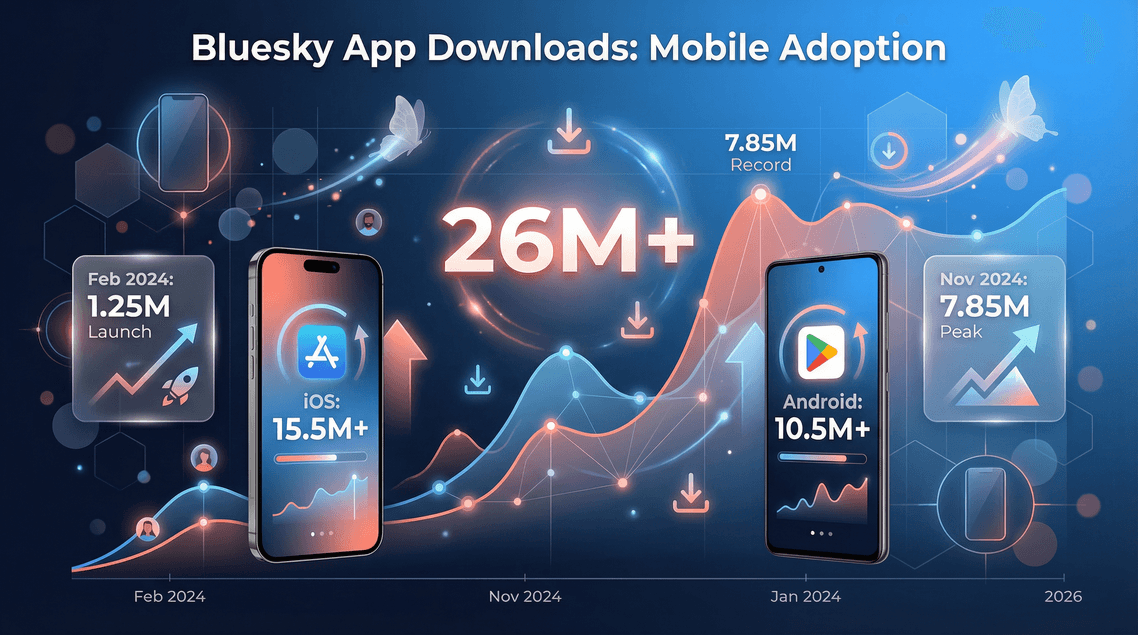
App downloads are a great proxy for real-world interest, and Bluesky’s numbers are impressive. Across iOS and Android, the Bluesky app has been downloaded over . But the real story is in the spikes:
- Feb 2024 (Public Launch): 1.25M downloads in a single month
- Sep–Oct 2024: Nearly 3M downloads per month as buzz built
- Nov 2024 (Election): 7.85M downloads—Bluesky’s all-time record
After the November surge, downloads settled into a steadier rhythm, with several hundred thousand new installs per month through 2025. That’s still a healthy clip for a platform that’s only just finding its mainstream footing.
Platform Breakdown: iOS vs. Android
Early on, Bluesky was an iOS darling—Apple’s App Store got the app first, and tech-savvy early adopters flocked there. For the first year, iOS outpaced Android in 12 out of 14 months (). But by mid-2024, the tables turned: Android downloads surged, nearly doubling iOS in some months as Bluesky opened up globally and hit Google Play. By the time of the big November 2024 spike, both platforms were neck-and-neck, showing Bluesky’s appeal wasn’t limited to one device ecosystem.
Daily Active Users and Engagement: How Active Is the Bluesky Community?
Registered users are one thing—daily active users (DAU) are where the rubber meets the road. As of late 2025, Bluesky averaged , or about 9% of all registered users. That’s lower than the 40–50% DAU/MAU ratio you’ll see on mature platforms like Facebook, but it’s typical for a network in hyper-growth mode where lots of people sign up “just to see.”
Interestingly, DAU peaked at 5.8–6 million right after the 2024 election, then settled back down as the initial excitement wore off (). This pattern—big event, big spike, then normalization—is classic social media.
Posting, Messaging, and Content Creation
How are people using Bluesky? Here’s what the numbers say:
- Total posts (March 2025): 1.18 billion (about 35 per user on average)
- Peak daily posts (Nov 2024): 1.48 million
- Typical daily posts (mid-2025): 500,000
Only a minority of users are regular posters—maybe 10–20% of daily actives. The rest? Classic lurkers. (Hey, we all know someone who’s never posted but has seen every meme.)
Direct messaging is still rolling out, so most engagement is public: posting, liking, and following. During the November 2024 frenzy, likes and follows hit record highs, then cooled off as things stabilized ().
Who Uses Bluesky? Demographics and User Distribution
Bluesky’s user base is a fascinating mix—think Gen Z and Millennials with a dash of tech and media pros. Here’s the demographic breakdown:
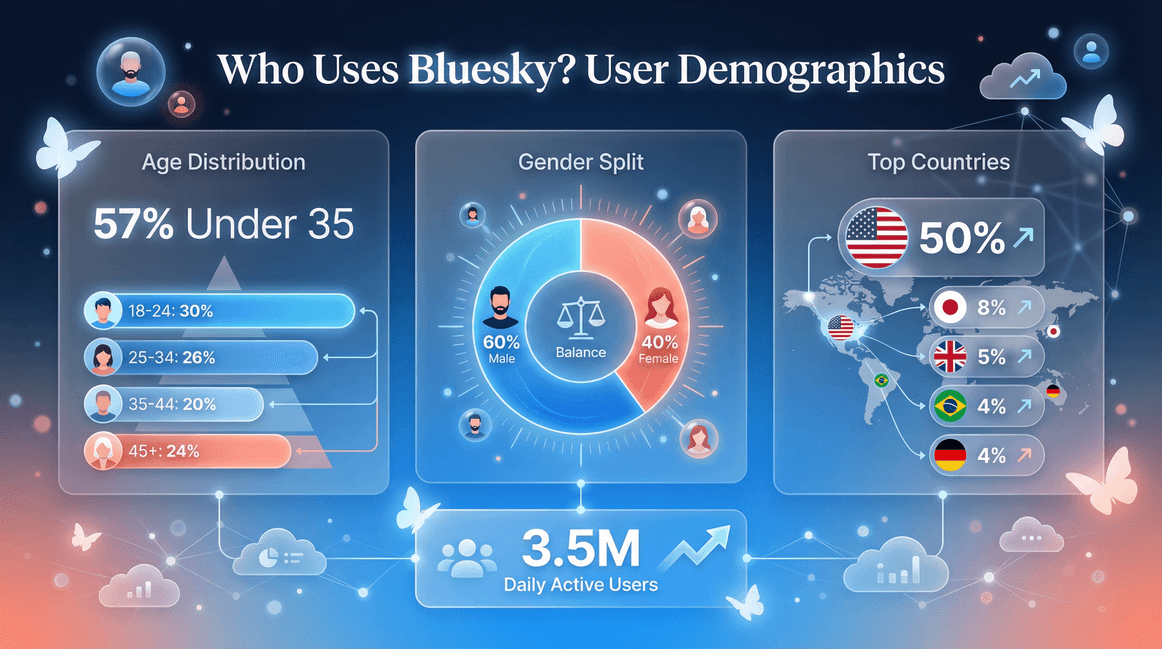
- Age: 57% under 35; 30% are 18–24, 26% are 25–34 ()
- Gender: 60% male, 40% female (similar to X/Twitter)
- Top countries: U.S. (~50–53%), Japan (6–8%), U.K. (4–5%), Brazil (4%), Germany (4%)
This is a much younger and more U.S.-centric crowd than you’ll find on Facebook or Instagram. Bluesky’s “ideal user” right now? A digitally savvy, English-speaking young adult—often with an interest in tech, media, or progressive politics.
Top Countries and Regional Trends
The U.S. is Bluesky’s home turf, making up over half the user base. Japan is the clear #2, which makes sense given Twitter’s historic popularity there. The rest of the top five (U.K., Brazil, Germany) round out a Western-centric, tech-forward audience. As Bluesky adds more languages and servers, expect to see growth in Europe, Latin America, and beyond ().
Age and Gender Breakdown
Bluesky is basically a Gen Z and Millennial clubhouse right now. Only about 7% of users are 65+, compared to Facebook’s much broader age spread. The gender split (60/40 male/female) is similar to Reddit and Discord, and a bit more male-skewed than Instagram or TikTok ().
Bluesky Website and App Traffic: How Much Attention Is It Getting?
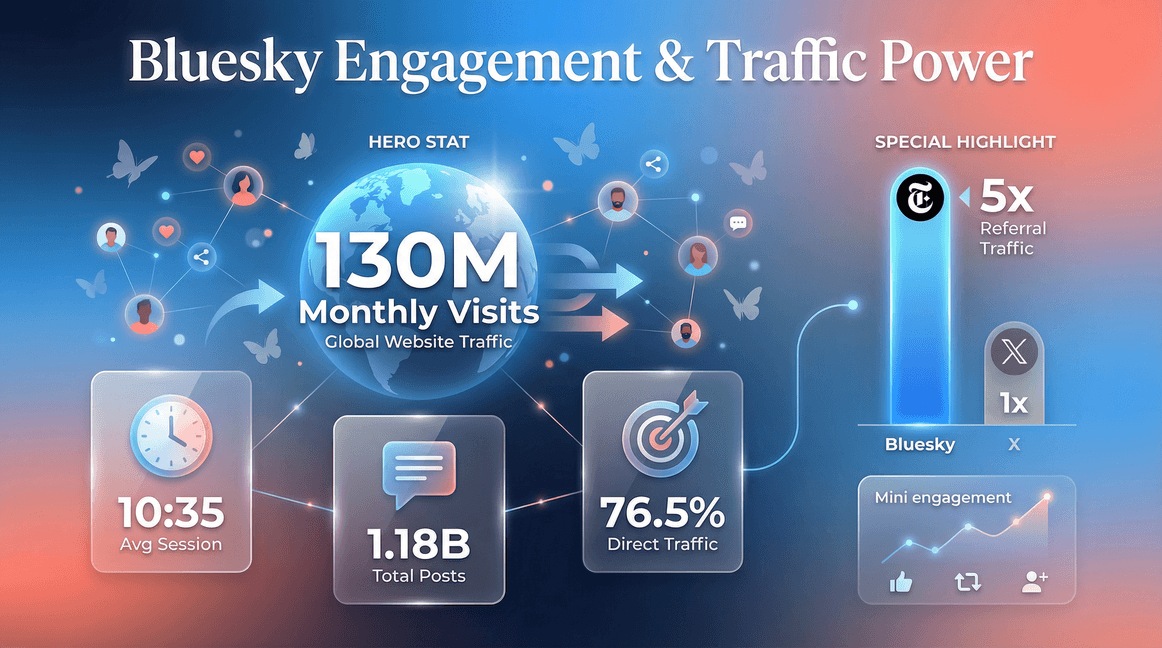
Beyond user counts, Bluesky’s web and app traffic tell a story of real engagement. In late 2025, Bluesky’s website was pulling in , with a peak of 157 million during the November 2024 election rush. That’s not Facebook-level, but it’s serious attention for a two-year-old platform.
- Average session: 10 min 35 sec (just shy of X/Twitter’s 12 minutes)
- Pages per visit: 8 (X averages 12)
- Bounce rate: 37.8% (pretty standard for social sites)
These numbers show that when people visit Bluesky, they stick around—scrolling, reading, and interacting, not just popping in and out ().
Traffic Sources: Where Are Users Coming From?
Most of Bluesky’s web traffic is direct—about 76.5% of desktop visits come from people typing the URL or using bookmarks (). The rest comes from organic search (people Googling “Bluesky” or specific profiles) and referrals from news/media sites.
Here’s the fun part: Bluesky users are click-happy. In some periods, Bluesky drove 5× more referral traffic to NYTimes.com than X (). That means Bluesky’s smaller but highly engaged community is punching above its weight in terms of influence.
Bluesky’s Place in the Social Media Landscape: Market Share and Awareness
Let’s put Bluesky in context. With 40 million users, it’s still a minnow compared to Facebook’s 2.9 billion or X’s 600 million monthly users. In fact, Bluesky’s global market share is well under 1% (). But in the world of decentralized and alternative social networks, Bluesky is a leader—outpacing Mastodon and rivaling Meta’s Threads in engagement.
Brand awareness? In the U.S., about 1 in 10 adults has used Bluesky (). That’s a big deal for a platform that was virtually unknown two years ago. Among younger, tech-savvy, and progressive users, awareness is even higher.
Bluesky’s influence goes beyond raw numbers. It’s become a go-to for journalists, politicians (AOC is the most-followed user with nearly 2 million followers), and communities seeking a fresh start. In media circles, Bluesky’s referral power is already outpacing much larger platforms.
Funding, Team, and Development: Behind the Scenes of Bluesky’s Growth
How does a platform scale to tens of millions of users on a shoestring? Bluesky’s answer: lean funding, a small team, and a lot of community energy.
- Funding: $23 million raised in two rounds (seed and Series A), with some reports suggesting up to $28 million ().
- Team: 25 full-time employees, 100 contract moderators ().
- Development: Focused on the AT Protocol, open-source tools, and community-driven features like custom feeds and content labeling.
Bluesky’s approach is the polar opposite of the “move fast and break things” playbook. Instead, it’s about building a stable, decentralized foundation and letting the community help shape the platform.
Moderation and Safety: How Bluesky Handles Community Challenges
With great growth comes great moderation responsibility. Bluesky’s trust & safety stats for 2025:
- Moderation reports: 9.97 million (up 54% from 2024)
- Unique reporters: 1.24 million users
- Account deletions (2024): 66,308
- Legal requests (2025): 1,470 (mostly from Germany, U.S., Japan)
- Content labels applied: 16.49 million (95% automated)
The top moderation issues? Misinformation (44% of reports), harassment (20%), and adult content (13.5%) (). Bluesky’s approach is a mix of automated labeling, user-driven reporting, and a dedicated (if small) moderation team.
What’s unique is Bluesky’s transparency and user empowerment: users can filter content by labels, and the platform publishes annual transparency reports. It’s a refreshing change from the black-box moderation of some incumbents.
Key Takeaways: What Bluesky Statistics Reveal About Social Media’s Future
So, what do all these numbers tell us? Here’s my take:
- People want alternatives. Bluesky’s rapid growth shows users are willing to jump ship when mainstream platforms stumble.
- Event-driven spikes are real, but retention is the long game. Bluesky’s biggest surges came during moments of social upheaval, but keeping users engaged day-to-day is the real challenge.
- Young, tech-savvy users are driving the future. Bluesky’s Gen Z/Millennial base is shaping new norms and expectations for social platforms.
- Decentralization and user control are more than buzzwords. Bluesky’s protocol-first, label-driven moderation, and open-source ethos are setting new standards.
- Trust & safety can’t be an afterthought. Bluesky’s investment in moderation (even with a small team) helped it avoid the pitfalls that doomed other upstarts.
- Influence > size. Bluesky’s ability to drive news traffic and attract key voices shows that small-but-mighty communities can have outsized impact.
Looking ahead, I’ll be watching how Bluesky handles monetization, federation with other networks, and the next wave of social media migrations. Will it hit 100 million users? Will it stay true to its decentralized roots? Only time will tell—but if the past two years are any indication, Bluesky is a platform worth tracking.
If you’re as fascinated by the intersection of data, tech, and social trends as I am, you might also enjoy diving into for more insights on how AI and automation are reshaping the digital world. And if you’re curious how AI can help you keep tabs on emerging platforms like Bluesky, check out —because in the fast-moving world of social media, sometimes you need a little help keeping up with the numbers.