
The web is bursting at the seams with products—literally billions of items, millions of retailers, and more new listings popping up every day than I can count on my fingers (and toes). If you’ve ever tried to compare prices or track inventory across different e-commerce sites, you know it’s not just a matter of matching apples to apples—it’s more like matching apples to “premium red fruit, 2023 harvest, organic, 3-pack.” The same product might have a dozen different names, codes, or descriptions depending on where you look. And with over 24 million online stores and 350+ million products on Amazon alone, it’s no wonder businesses are scrambling to keep their catalogs—and their sanity—in order.
Scrape product data from any website using AI Get Started Free
As someone who’s spent years in SaaS and automation, I’ve seen firsthand how the chaos of mismatched product data can slow down teams, mess up pricing, and frustrate customers. That’s why I’m so passionate about product matching—and why, at Thunderbit, we’ve made it our mission to make this process smarter, faster, and a whole lot less painful. So, what is product matching, why does it matter, and how can AI tools like Thunderbit help you stay ahead in the ever-evolving world of e-commerce? Let’s break it down, step by step, with real-world stories, practical tips, and a few laughs along the way.
What Is Product Matching? A Clear Definition
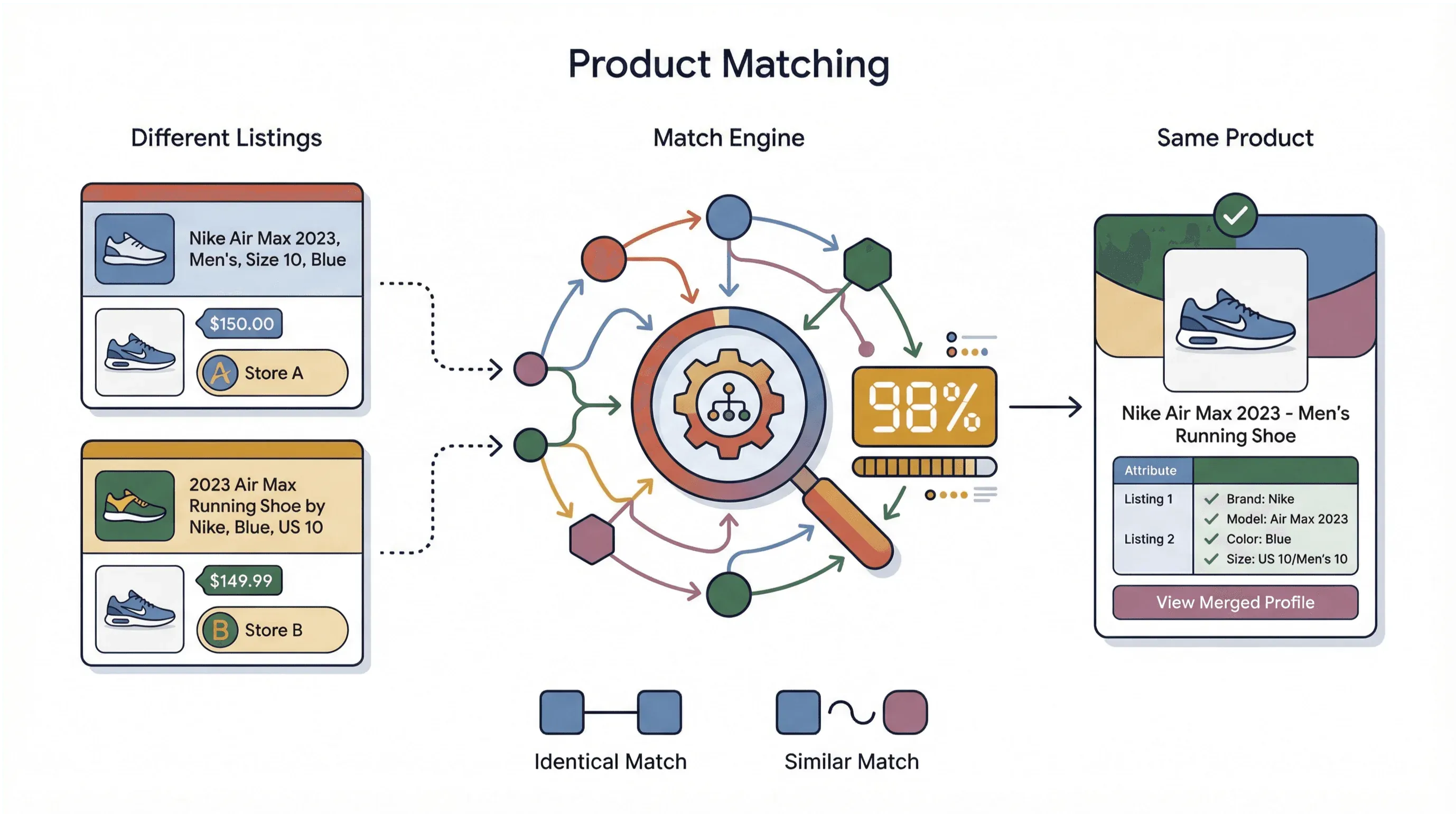 Let’s start with the basics: what is product matching? In plain English, product matching is the process of identifying when two or more product listings—often from different retailers or catalogs—actually refer to the same item, even if they’re described in totally different ways. Think of it as detective work for your product data.
For example, imagine you see these two listings:
- “Nike Air Max 2023, Men’s, Size 10, Blue”
- “2023 Air Max Running Shoe by Nike, Blue, US 10”
Different words, same shoe. Product matching is what links these together so you know they’re identical (or at least highly similar).
There are two main flavors of product matching:
- Identical product matching: Finding listings that are exactly the same—same brand, model, specs, maybe even the same UPC or SKU.
- Similar (equivalent) product matching: Identifying products that aren’t identical but serve the same purpose—like matching a 500 mL stainless steel water bottle to a competitor’s 16.9 oz insulated flask.
In both cases, the goal is to cut through the noise, unify your view of the market, and make smarter decisions—whether you’re a retailer, a brand, or just someone trying to find the best deal on a new TV.
Why Product Matching Matters in Modern Business
So, why should you care about product matching? Because it’s the secret sauce behind everything from competitive pricing to personalized recommendations. Here’s how it powers real business value:
| Use Case | Business Benefit |
|---|---|
| Competitive Price Monitoring | Real-time price comparison across competitors, enabling dynamic pricing and protecting margins |
| Assortment Optimization | Visibility into assortment overlap and gaps, helping you plan a unique and competitive product mix |
| Inventory Management & Data Quality | Consolidation of duplicate records, reducing errors and streamlining operations |
| Personalization & Recommendations | More relevant product suggestions, boosting customer loyalty and conversion rates |
Let’s make it real: imagine you’re a retailer selling Levi’s jeans. With product matching, you can instantly see how your price stacks up against every other store selling the same jeans—no more guesswork. Or, if you’re managing inventory, you can spot and merge duplicate listings, so you don’t accidentally order the same item twice under different codes. And for your customers? Better product matching means they see smarter recommendations and fewer confusing duplicates, making them more likely to buy (and come back for more).
In fact, e-commerce leaders like Amazon attribute around 35% of their revenue to product recommendations powered by accurate product matching. That’s not just a nice-to-have—it’s a competitive edge.
How Product Matching Works: Key Concepts and Steps
Product matching isn’t magic (though sometimes it feels that way when it works well). Here’s how the process typically unfolds:
- Data Collection: Gather product data from all relevant sources—titles, descriptions, specs, images, prices, SKUs, UPCs, and more. This might mean scraping websites, exporting from databases, or pulling from supplier feeds.
- Data Standardization: Clean and normalize the data. That means converting units (“16.9 oz” to “500 mL”), standardizing brand names (“P&G” vs. “Procter & Gamble”), and aligning attribute terms (“Sky Blue” vs. “Blue”).
- Attribute Comparison: Compare key attributes—like brand, model, size, color, and unique codes—to spot matches. For identical products, you might rely on a UPC or model number. For similar products, you’ll look at overlapping features and semantic meaning.
- AI and Machine Learning: Use advanced algorithms to analyze text, images, and attributes. AI can understand that “4K TV” and “Ultra HD Television” mean the same thing, or that two images show the same blender, even if the descriptions differ.
- Validation: Review the results, often with a human-in-the-loop for tricky cases. High-confidence matches can be auto-approved, while edge cases get flagged for manual review.
The end result? A unified, accurate map of which products are the same (or similar) across your catalogs and your competitors’. It’s like having a superpower for making sense of messy, ever-changing product data.
The Challenges of Traditional Product Matching Methods
Now, let’s talk about the old way of doing things—and why it’s often a recipe for headaches.
Traditional product matching methods usually rely on:
- Manual review: Someone (often an unlucky intern) compares listings by hand, line by line.
- Basic rules: Matching by SKU, UPC, or exact product name.
- Spreadsheets and copy-paste marathons: You know the drill.
The problems? Oh, where do I start:
- Messy, inconsistent data: Different naming conventions, missing attributes, and typos make it hard to spot true matches.
- Incomplete information: Sometimes the crucial details (like a model number) are missing, forcing you to guess.
- Slow and labor-intensive: Manually matching 1,000 products can take 16 hours—or more. An AI can do it in 2 minutes (QL2).
- Inconsistent criteria: Different team members might use different rules, leading to confusion and errors.
- Limited scalability: As your catalog grows, manual methods just can’t keep up.
- Outdated data: By the time you finish matching, the market has already changed.
In short, manual and rule-based matching is like trying to organize a library by reading every book cover-to-cover. It doesn’t scale, it’s prone to mistakes, and it can’t keep up with the pace of modern e-commerce.
AI-Powered Product Matching: Why It’s the Future
Enter AI—and suddenly, product matching gets a whole lot smarter (and less painful).
Here’s what AI brings to the table:
- Speed and scalability: AI can process thousands (or millions) of products in minutes, not days. Retailers using AI matching have seen a 30–40% reduction in manual workload.
- Higher accuracy: Natural language processing (NLP) and computer vision help AI understand context, spot semantic similarities, and even compare images for visual matches.
- Handling nuance: AI can judge degrees of similarity, not just exact matches—perfect for recommending substitutes or alternatives.
- Continuous learning: AI systems get smarter over time, learning from corrections and adapting to new product categories or naming conventions.
- Real-time updates: AI-driven matching can run continuously, keeping your data fresh and your decisions timely.
The bottom line? AI-powered product matching isn’t just faster—it’s more accurate, more flexible, and more aligned with the realities of today’s dynamic, data-rich marketplaces. It’s no wonder industry analysts call it a “strategic imperative”.
Boosting Product Matching Efficiency with Thunderbit
Here’s where I get to geek out a bit—because this is exactly the kind of challenge we built Thunderbit to solve.
Thunderbit is an AI-powered web scraper Chrome extension that makes collecting and structuring product data a breeze. Here’s how it supercharges your product matching workflow:
- AI Suggest Fields: With one click, Thunderbit’s AI scans any product page and suggests the best fields to extract—like “Product Name,” “Price,” “Image,” “SKU,” and more. No more fiddling with HTML or guessing at selectors.
- Subpage Scraping: Need more details? Thunderbit can automatically visit each product’s detail page and pull in extra attributes—like technical specs or reviews—enriching your dataset for better matching.
- Pagination and Templates: Scrape entire catalogs, even across multiple pages or infinite scroll. For popular sites like Amazon or Shopify, Thunderbit offers instant templates for one-click extraction.
- Structured Export: Export your data directly to Excel, Google Sheets, Airtable, Notion, or CSV—ready for comparison and matching.
- Scheduling: Set up recurring scrapes to keep your data fresh and your matches up to date.
Try Thunderbit for Product Matching
Step-by-Step: Using Thunderbit for Product Matching
Let’s walk through a real-world example:
- Scrape your own catalog: Open your product listing page, use AI Suggest Fields, and extract key attributes (name, SKU, price, etc.). Export to Google Sheets.
- Scrape a competitor’s catalog: Do the same on their site—Thunderbit handles pagination and subpages, so you get a complete dataset.
- Align and compare: In your spreadsheet, use model numbers or product names to match items. For fuzzy cases, Thunderbit’s AI prompts can help standardize or enrich the data.
- Analyze and act: See where your prices are higher or lower, spot assortment gaps, and make data-driven decisions.
- Automate: Set Thunderbit to re-scrape competitor data daily, so your matches and insights are always current.
With Thunderbit, what used to take days of manual effort can now be done in an hour or two—no coding required, and no more copy-paste marathons.
Product Matching and Personalization: Enhancing the Customer Experience
Learn more about data scraping with AI Get Started Free
Accurate product matching isn’t just good for your internal ops—it’s a game changer for your customers, too.
- No more duplicate listings: Customers see a clean, unified catalog, not the same product repeated under different names.
- Smarter recommendations: Your recommendation engine can suggest truly relevant alternatives and complements, not just random or redundant items.
- Personalized content: With unified product data, you can tailor emails, search results, and on-site experiences to each customer’s interests.
- Unified reviews and ratings: Combine feedback for identical products, giving shoppers a fuller picture and more confidence to buy.
It’s no coincidence that companies investing in personalization—powered by robust product matching—see conversion rates improve by 15–30% and average order values go up. When customers feel understood and see relevant options, they stick around (and spend more).
Real-World Applications: Product Matching in Action
Let’s look at how businesses are using product matching to drive real results:
- Competitive price monitoring: Retailers match their products to competitors’ listings, enabling real-time price adjustments. One grocery retailer cut data management costs by 40% and doubled their pricing insights after automating product matching.
- Assortment planning: Fashion retailers use matching to spot overlap with competitors and negotiate exclusive collections, keeping their assortment fresh and differentiated (Centric Software).
- Inventory optimization: Distributors match supplier catalogs to their own, preventing duplicate orders and streamlining supply chains.
- Personalized marketing: E-commerce platforms use matching to power “Frequently Bought Together” and cross-sell recommendations, driving higher engagement and sales.
In every case, the common thread is clear: better product matching leads to smarter decisions, happier customers, and a healthier bottom line.
Overcoming Common Product Matching Challenges
Even with the best tools, product matching isn’t always a walk in the park. Here are some common hurdles—and how to tackle them:
- Inconsistent data: Invest in data quality upfront—fill in missing attributes, standardize naming conventions, and enrich your catalog wherever possible.
- Catalog differences: Define clear matching criteria (what counts as “identical” vs. “similar”) and align your team on the rules.
- Product variations: Be variant-aware—match at the right level (SKU, model, color, size) and handle bundles or multipacks carefully.
- Data quality issues: Use AI tools like Thunderbit to extract structured, complete data from all sources, reducing manual errors.
- Ongoing updates: Treat product matching as a continuous process—set up automated scrapes and regular audits to keep your matches accurate over time.
And don’t forget the human touch: for tricky cases, a quick manual review (the “human-in-the-loop” approach) can catch edge cases and improve your AI’s learning over time.
Conclusion: The Future of Product Matching
Product matching has gone from a tedious, back-office chore to a strategic must-have for any business dealing with large product catalogs or competitive markets. Understanding what product matching is—and why it matters—can unlock new levels of efficiency, insight, and customer satisfaction.
With the explosion of online products and the speed of market change, manual methods just can’t keep up. The future belongs to AI-driven solutions that make product matching faster, smarter, and more accessible to everyone—not just data scientists or big tech teams. Tools like Thunderbit are democratizing this power, letting any business harness the benefits of accurate, real-time product matching.
As e-commerce keeps evolving, product matching will only become more critical—fueling everything from dynamic pricing to hyper-personalized shopping experiences. My advice? Don’t wait for the chaos to overwhelm you. Start exploring AI-powered product matching today, and turn your data into a competitive advantage.
Want to see Thunderbit in action or learn more about web scraping and data automation? Check out our Thunderbit Blog for more guides, tips, and real-world stories.
Download Thunderbit Chrome Extension
FAQs
1. What is product matching, in simple terms?
Product matching is the process of identifying when two or more product listings—often from different retailers or catalogs—actually refer to the same item, even if they’re described differently. It helps unify data, compare prices, and improve recommendations.
2. Why is product matching important for e-commerce and retail?
Product matching enables real-time price comparison, assortment optimization, inventory management, and personalized recommendations. It helps businesses stay competitive, reduce errors, and deliver better customer experiences.
3. What are the main challenges of traditional product matching methods?
Manual and rule-based methods struggle with messy data, incomplete information, slow speed, inconsistent criteria, and limited scalability. They can’t keep up with the volume and complexity of modern product catalogs.
4. How does AI improve product matching?
AI uses natural language processing, computer vision, and machine learning to analyze text, images, and attributes. It can process large volumes of data quickly, handle nuance, learn over time, and provide real-time updates—making product matching faster and more accurate.
5. How can Thunderbit help with product matching?
Thunderbit is an AI-powered web scraper that automates product data extraction and structuring. With features like AI Suggest Fields, subpage scraping, instant templates, and scheduled scrapes, Thunderbit makes it easy to collect, organize, and update product data for matching—no coding required.
Ready to transform your product data workflow? Download Thunderbit’s Chrome Extension and see how easy product matching can be.
Try AI Product Matching with Thunderbit Get Started Free
Learn More