
There’s a running joke in the tech world that if you stacked up all the data created every day, you’d need a ladder to the moon—and then some. By the end of 2025, the global datasphere had grown to roughly 181 zettabytes, and aggregator estimates for 2026 already point past the 200-zettabyte mark. That’s trillions of gigabytes pouring in from every corner—business transactions, social media, IoT sensors, you name it. With so much information swirling around, the real challenge isn’t collecting data; it’s figuring out what matters. That’s where data mining comes in, turning mountains of raw numbers into the golden nuggets that drive better business decisions.

Scrape data from any website using AI Get Started Free
As someone who’s spent years helping teams automate, analyze, and act on data (and yes, as the co-founder of Thunderbit), I’ve seen firsthand how data mining can transform the way businesses operate. In this guide, I’ll break down what data mining actually means, why it’s so important, the techniques that power it, and how tools like Thunderbit are making it easier than ever—even if you’re not a data scientist.
What Is Data Mining? A Simple Explanation
Let’s cut through the jargon: data mining is the process of discovering patterns, relationships, and useful information hidden within large datasets using statistical and machine learning techniques (IBM). Think of it like being a detective for your company’s data—sifting through mountains of numbers to find clues that help you make smarter decisions.
A classic analogy is digging for gold: just as miners sift through tons of rock to find precious nuggets, data mining uses algorithms to sift through massive datasets and uncover insights that aren’t obvious at first glance (Qlarant). These insights might reveal that customers who buy product A often buy product B, or that sales spike in certain regions after a particular marketing campaign.
But here’s the key: data mining isn’t just about summarizing data—it’s about unearthing hidden trends and relationships that can drive real business value. It’s the difference between knowing your average sales last quarter and discovering the specific factors that caused those sales to soar (or slump).
Why Data Mining Matters for Modern Businesses
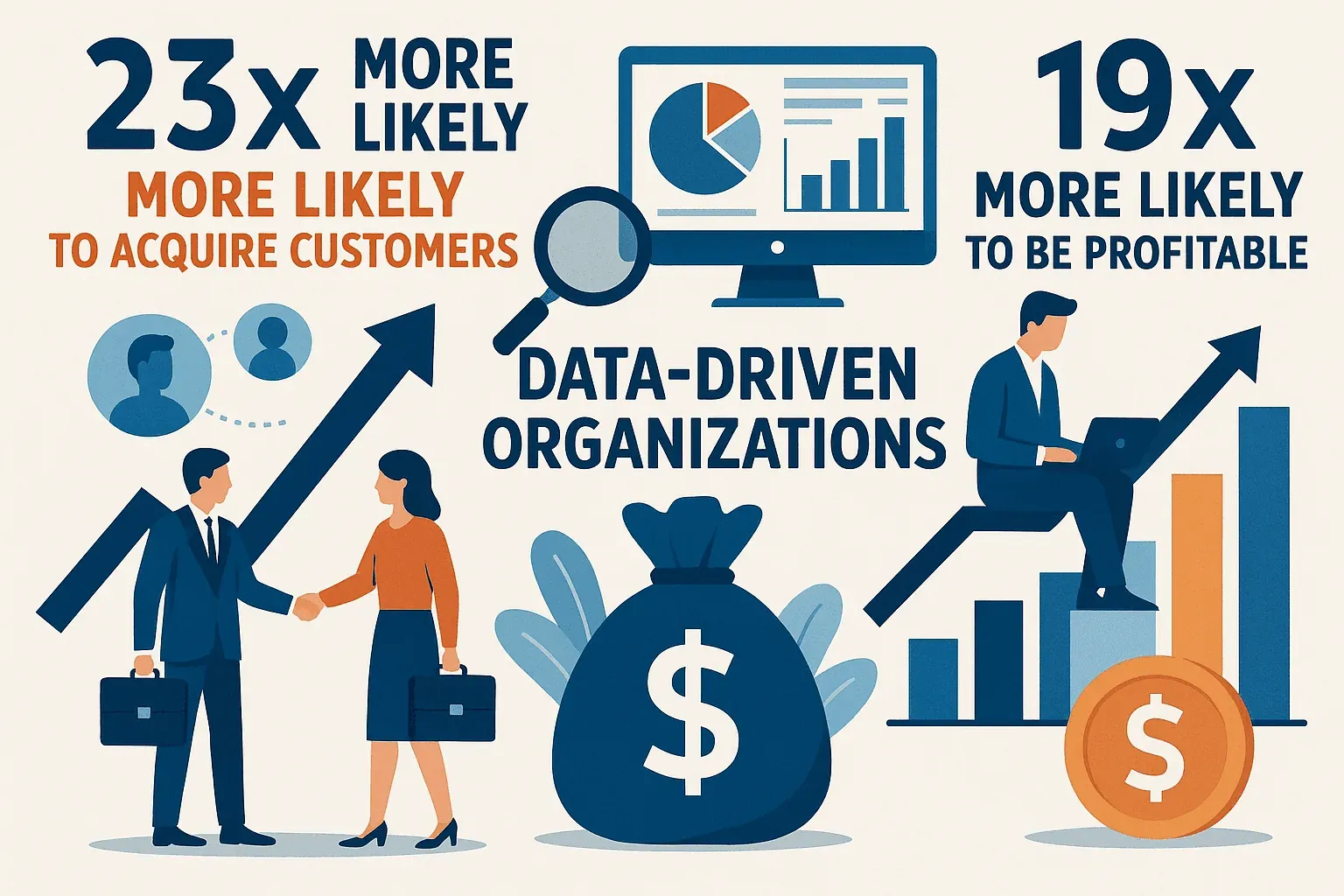
In today’s hyper-competitive world, guessing just doesn’t cut it. Businesses that use data mining to guide their decisions are pulling ahead—by a lot. A widely cited McKinsey customer-analytics study found that intensive users of customer analytics were 23× more likely than peers to acquire new customers and 19× more likely to outperform on profitability. The original article is from 2014, and the numbers still get quoted a decade later — partly because no comparable cross-industry study has replaced it, and partly because the gap between teams that act on their data and teams that don't has, if anything, widened since.
 Here’s how data mining delivers value across the business:
| Use Case | How Data Mining Helps |
|---|---|
| Sales Forecasting | Predicts future demand by analyzing past sales and trends, optimizing inventory and staffing. |
| Customer Segmentation | Groups customers by behavior or demographics for targeted marketing and personalized offers. |
| Market Trend Analysis | Spots emerging trends by aggregating web, social, and industry data—fueling faster product development. |
| Fraud Detection | Identifies unusual patterns in transactions to catch fraud before it causes damage. |
| Operational Efficiency | Uncovers bottlenecks or maintenance needs by analyzing process and sensor data, reducing downtime and waste. |
A BARC survey often cited alongside these McKinsey numbers reported an 8% lift in profits and a 10% drop in costs among heavier analytics adopters — useful as a directional signal, not a guarantee for any one company.
Key Data Mining Techniques Explained
Data mining isn’t a single trick—it’s a toolkit. Here are the main techniques you’ll hear about, explained in plain English:
- Association Rules: Finds “if X, then Y” relationships. Think Amazon’s “Customers who bought this also bought…” (IBM).
- Classification: Sorts data into predefined categories. Like labeling emails as “spam” or “not spam,” or classifying customers as high or low risk.
- Clustering: Groups data into clusters based on similarity—without predefined labels. Great for discovering new customer segments or product groupings.
- Regression Analysis: Predicts a numeric value based on other factors. For example, forecasting next month’s sales based on advertising spend and seasonality.
- Decision Trees: Visual flowcharts that split data based on conditions, making decisions easy to interpret (e.g., “If age > 50 and income < $X, then…”).
- Neural Networks & Deep Learning: Advanced AI models that detect complex patterns—powering things like recommendation engines and image recognition.
These techniques often work together. For instance, you might use clustering to find natural customer segments, then classification to assign new customers to those groups, and regression to predict future sales for each segment.
Thunderbit and Data Mining: Making Web Data Extraction Easy
Let’s be honest—before you can mine data, you have to actually collect it. And a ton of valuable business data lives out on the web: competitor prices, product reviews, supplier catalogs, real estate listings, you name it. That’s where Thunderbit comes in.
Thunderbit is an AI-powered web scraper that helps business users (like sales, marketing, ecommerce, and real estate teams) extract structured data from any website—no coding required. Here’s what makes it a game-changer for data mining:
- Natural Language AI: Just click “AI Suggest Fields,” and Thunderbit’s AI reads the page, suggests the best columns to extract, and even creates custom instructions for each field (Thunderbit Blog).
- Two-Click Scraping: After approving the fields, hit “Scrape,” and Thunderbit pulls all the data into a neat table—handling pagination, subpages, and even infinite scroll.
- Subpage Scraping: Need more details? Thunderbit can automatically visit each subpage (like product detail pages or LinkedIn profiles) and enrich your dataset (Thunderbit Blog).
- Instant Templates: For popular sites like Amazon, Zillow, or Shopify, just apply a 1-click template—no setup needed.
- Accurate, Structured Data: Thunderbit’s AI cleans and formats data as it extracts, reducing the need for manual cleanup.
- Free Export: Download your data to Excel, Google Sheets, Airtable, Notion, or as CSV/JSON—no extra charges (Thunderbit Blog).
- Scheduling and Automation: Set up scrapes to run automatically on your schedule, keeping your datasets fresh.
It’s like having a super-powered research assistant who never gets tired, never complains, and always delivers your data in the format you need.
Try Thunderbit AI Web Scraper for Free
How Thunderbit Fits into the Data Mining Workflow
Here’s how Thunderbit plugs into a typical data mining process:
- Data Collection: Use Thunderbit to scrape relevant data from websites—competitor prices, customer reviews, lead lists, etc.—in minutes.
- Data Preparation: Thunderbit structures and cleans the data as it extracts, making it ready for analysis.
- Data Integration: Export to your favorite tools (Sheets, Airtable, Notion) and combine with internal data for a holistic view.
- Analysis and Mining: Use analytics or BI tools to run clustering, classification, or regression on your now-complete dataset.
- Decision-Making: Act on the insights—whether it’s adjusting pricing, targeting new customer segments, or launching a new campaign.
The beauty is that Thunderbit lowers the technical barrier, so even non-technical business users can gather and prep data for mining—no IT tickets or Python scripts required.
Real-World Data Mining Success Stories
Data mining isn’t just theory—it’s driving real results for businesses of all sizes. Here are a few standout examples:
- Red Roof Inn (2013–2014 winter): With flight-tracking partner 360i, Red Roof Inn served targeted mobile ads to travelers stranded by cancellations and weather. Reported lift: a 10% bookings boost in affected markets. It's an old example — but it's still one of the cleanest illustrations of pairing public data feeds with intent-rich ad targeting.
- Corel Software: Mined site and behavior data to segment customers and personalize retargeting, with a 106% reported lift in online revenue.
- Amazon & Netflix: The headline numbers — Amazon's recommender driving ~35% of sales (a 2013 McKinsey estimate) and Netflix's personalization saving roughly $1B per year (from a 2016 paper by Netflix's Uribe-Gomez and Hunt) — haven't been officially refreshed by either company, but they keep getting cited because no one has replaced them with a newer benchmark.
And in the Thunderbit universe? I’ve seen real estate agents compile their own market analysis datasets in an afternoon, sales teams build targeted lead lists from directories, and ecommerce operators monitor competitor prices daily—all with just a few clicks.
Common Challenges in Data Mining (And How to Overcome Them)
Of course, data mining isn’t all sunshine and rainbows. Here are some common hurdles—and how to clear them:
- Data Quality Issues: Messy, incomplete, or inconsistent data leads to unreliable insights. The fix? Invest time in data cleaning and use tools (like Thunderbit) that auto-format and validate data as it’s collected (GeeksforGeeks).
- Integration and Silos: Data scattered across systems is hard to analyze. Use export-friendly tools and cloud platforms to bring everything together in one place.
- Privacy and Security: With regulations like GDPR and CCPA, it’s crucial to handle data responsibly. Stick to public data, anonymize sensitive info, and control access to your datasets (GeeksforGeeks).
- Skill Gaps: Not everyone is a data scientist. That’s why user-friendly, no-code tools like Thunderbit are so valuable—they empower business users to participate in data mining.
- Interpreting Results: Complex models can be hard to explain. Focus on clear visuals, dashboards, and storytelling to communicate insights effectively.
Explore Thunderbit Blog for More Data Mining Tips Get Started Free
Ensuring Data Quality and Privacy
Here are some practical tips for keeping your data (and your business) safe and sound:
- Always sanity-check your data: Scan for blanks, duplicates, or outliers. Use filters and conditional formatting to spot issues quickly.
- Keep your data fresh: Schedule regular updates (Thunderbit can automate this) and document when your data was collected.
- Respect privacy: Only mine data you’re allowed to use, anonymize personal info, and control who has access to sensitive datasets.
- Stay compliant: Follow local laws and industry regulations, and keep logs of what data you collected and how it’s used.
Using Data Mining to Unlock Business Insights
So, what does all this look like in practice? Here’s how data mining helps teams get ahead:
- Understand Customer Behavior: Analyze purchase histories, support tickets, and web activity to spot trends, predict churn, and personalize offers.
- Track Market and Competitors: Scrape competitor prices, monitor reviews, and analyze industry news to spot opportunities and threats.
- Optimize Operations: Mine internal process data to find bottlenecks, predict equipment failures, or improve supply chain efficiency.
- Make Faster, Smarter Decisions: Replace guesswork with evidence—whether it’s launching a new product, adjusting pricing, or reallocating resources.
Thunderbit plays a key role here by making external data (from the web) as accessible and actionable as your internal data. It’s the bridge between what’s out there and what you can analyze.
Getting Started with Data Mining: Tips for Business Teams
Ready to dive in? Here’s my advice for teams looking to get started:
- Start with a Clear Goal: Define the business question you want to answer—don’t just mine data for the sake of it (Meegle).
- Pick the Right Tools: Choose user-friendly platforms that match your team’s skills. For web data, Thunderbit is a great starting point.
- Start Small, Iterate Fast: Run a pilot project on a slice of your data. Learn, refine, and scale up as you go (Meegle).
- Collaborate Across Teams: Bring together business and technical folks—insights are better when everyone’s involved.
- Invest in Data Literacy: Offer training, share best practices, and encourage a culture of curiosity and experimentation.
- Celebrate Wins: Document your successes and share them internally to build momentum.
The best part? With tools like Thunderbit, you don’t need a PhD or a big IT budget to get started. The barrier to entry is lower than ever.
Start Data Mining with Thunderbit
Conclusion: The Future of Data Mining in Business
Data mining has gone from a niche IT specialty to a must-have business skill. Companies that harness their data—internal and external—are making smarter decisions, moving faster, and outpacing the competition. And with the explosion of AI-powered, no-code tools like Thunderbit, even small teams can punch above their weight.
Looking ahead, expect data mining to become even more automated, more accessible, and more embedded in everyday business workflows. The future belongs to the curious, the data-savvy, and the agile. So, whether you’re a sales manager, a marketer, or just someone who loves a good spreadsheet, now’s the time to roll up your sleeves and start mining those golden nuggets of insight.
Want to see how Thunderbit can help you turn web data into business value? Download the Chrome extension and give it a spin—or check out the Thunderbit Blog for more tips, tutorials, and real-world examples.
FAQs
1. What is data mining, in simple terms?
Data mining is the process of discovering patterns and useful information hidden in large datasets. It’s like being a detective for your data—finding insights that help you make better business decisions.
2. How is data mining different from basic data analysis?
While basic analysis summarizes or reports on data, data mining digs deeper to uncover hidden trends, relationships, and predictions that aren’t obvious at first glance.
3. What are some common business applications of data mining?
Popular uses include sales forecasting, customer segmentation, market trend analysis, fraud detection, and optimizing operations.
4. How does Thunderbit help with data mining?
Thunderbit makes it easy to collect and structure web data—like competitor prices, product reviews, or lead lists—so you can analyze it alongside your internal data. Its AI-powered features mean you don’t need coding skills to get started.
5. What are the biggest challenges in data mining, and how can I overcome them?
Common challenges include data quality, integration, privacy, and skill gaps. Overcome them by using tools that automate cleaning and integration (like Thunderbit), following privacy best practices, and investing in data literacy for your team.
Ready to turn your data into actionable insights? Start exploring data mining today—and let technology do the heavy lifting, so you can focus on what matters most: growing your business. Learn More
Try Thunderbit AI Web Scraper for Data Mining Get Started Free




