Picture this: It’s 7:30 a.m. and millions of people—still half-asleep—are already snapping their friends, checking streaks, and adding AR filters to their morning coffee. This isn’t just a Gen Z ritual; it’s the daily pulse of Snapchat’s global community in 2026. With nearly a billion people using Snapchat every month and over 5 billion Snaps created every single day, Snapchat is more than just another social app—it’s a cultural force and a marketing playground, especially for brands chasing the elusive youth demographic (Snap Inc. Investor Report, Q3 2025).
Why do these Snapchat statistics matter? Whether you’re a marketer, a brand strategist, or just someone who wants to keep up with digital culture, knowing the latest numbers helps you understand where young consumers are hanging out—and how they prefer to communicate (spoiler: it’s candid snaps, not polished posts). So, let’s dive into the freshest Snapchat stats for 2026 and see what’s really happening behind those yellow ghost icons.
Snapchat by the Numbers: Quick Stats for 2026
Let’s kick things off with a rapid-fire look at the headline Snapchat statistics that everyone’s talking about this year. These are the numbers you’ll want to drop in your next marketing meeting—or at least at your next trivia night.
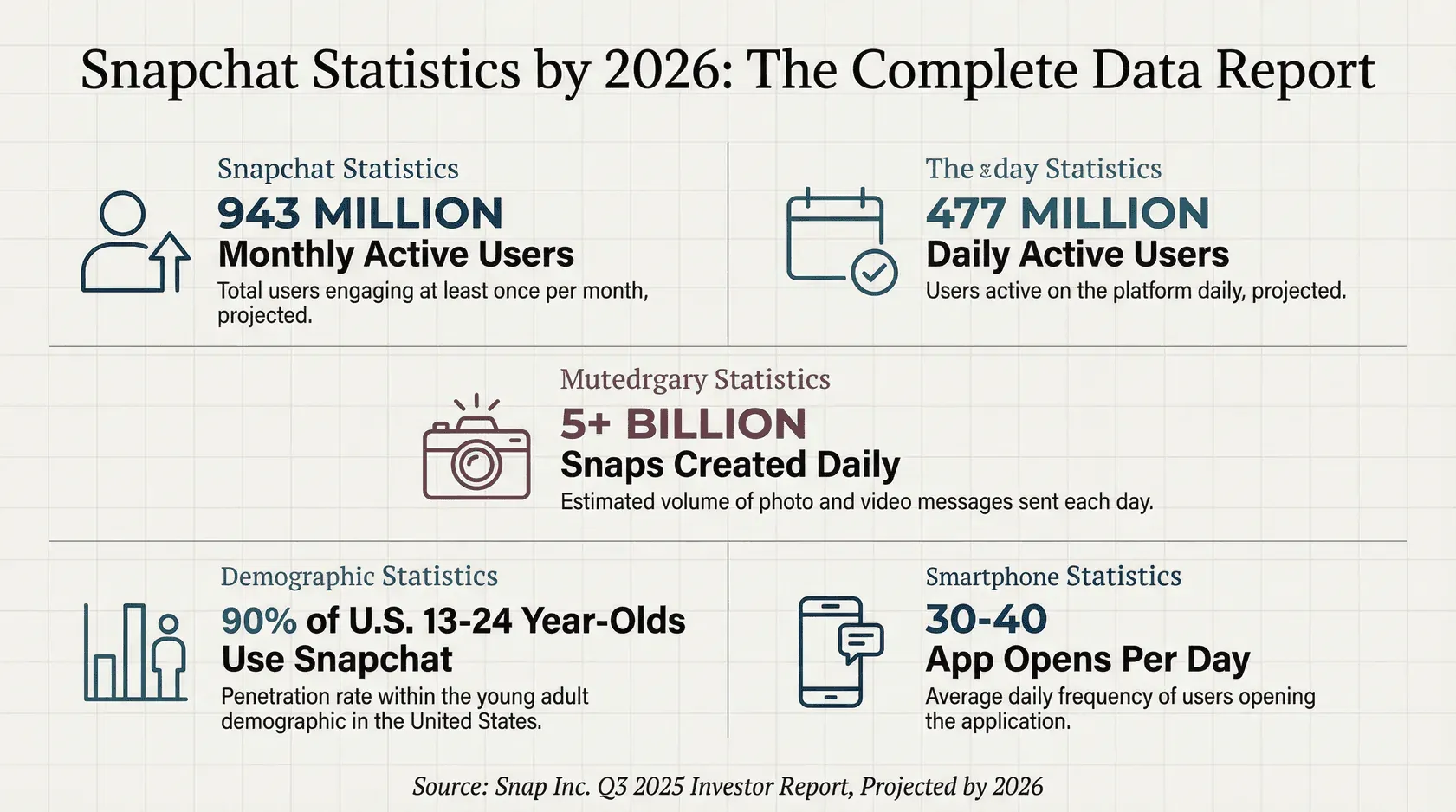
- 483 million daily active users (DAUs) worldwide as of Q1 2026—up about 5% year-over-year (Snap Inc. Q1 2026 Financial Results).
- 956 million monthly active users (MAUs) globally as of Q1 2026, up 43 million (≈5%) year-over-year and keeping Snapchat among the top 10 social networks worldwide (Snap Inc. Q1 2026 Financial Results).
- 5+ billion Snaps created every day—about 3.5 million every minute (The Social Shepherd).
- 214 million Snapchat users in India (Snapchat’s largest market), followed by 105 million in the United States (DemandSage).
- Snapchat’s advertising reach: ~709 million users age 13+ as of January 2025 (DataReportal).
- 90% of U.S. 13–24-year-olds use Snapchat—more than Facebook, Instagram, or Messenger combined in that age group, according to a Snap claim first published in 2020 (Social Media Today).
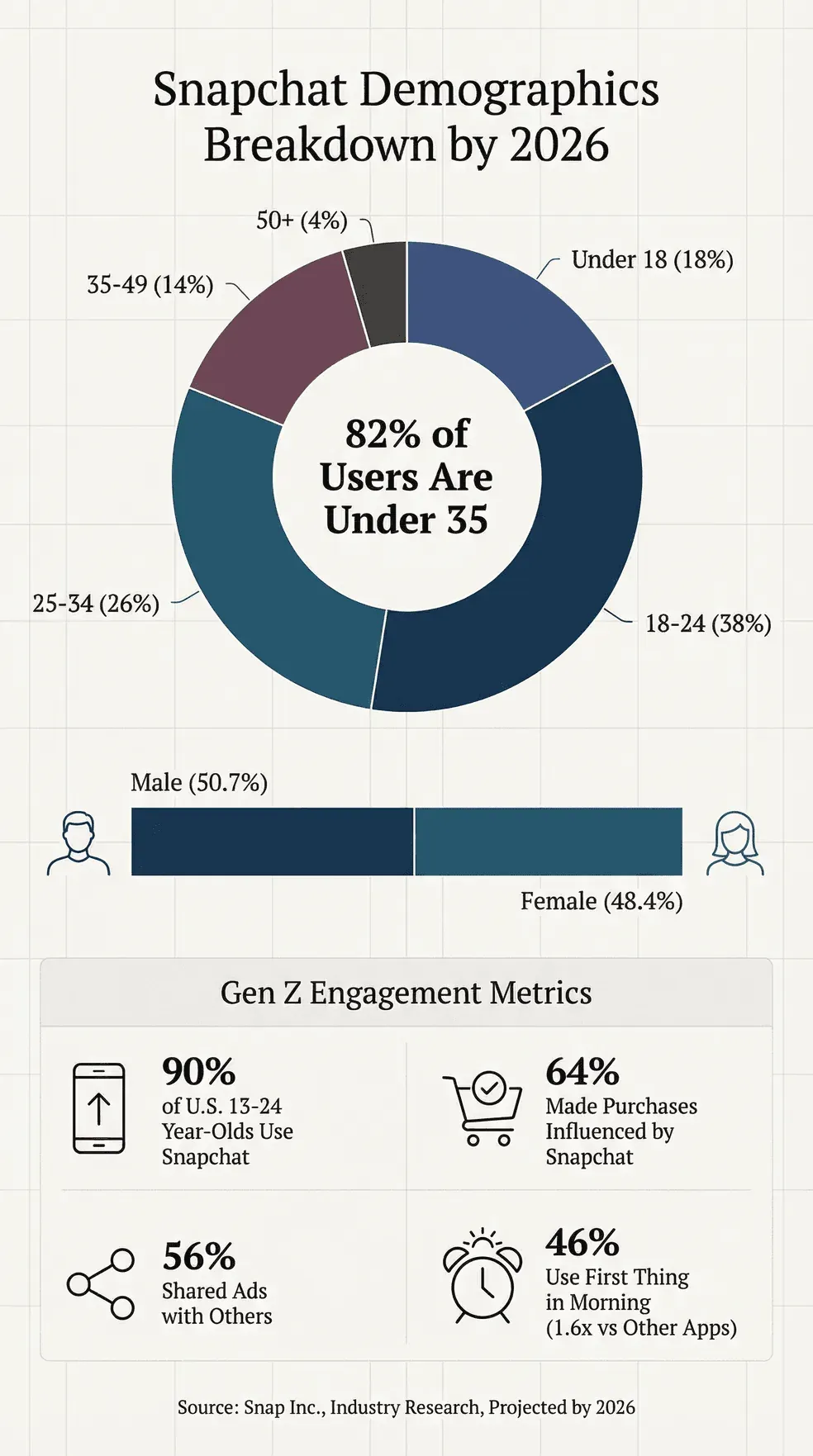
- 38% of global Snapchat users are 18–24 years old, and more than 82% are under 35 (DemandSage age breakdown, February 2026).
- Gender split: 50.7% male, 48.4% female globally (DemandSage).
- 25+ million subscribers across Snap's subscription products (Snapchat+, Lens+, Snapchat Platinum, Memories Storage Plans), with Snapchat+ as the primary driver; Snap announced in February 2026 that its direct-revenue ARR crossed $1 billion (Snap Newsroom).
- Roughly 75% of daily Snapchatters engage with AR every day, with AR Lenses played 9 billion times per day on average as of Q1 2026 (Snap Inc. Q1 2026 Financial Results).
- The average user opens Snapchat 30+ times per day (Sprout Social); in the U.S. the average runs closer to 40.
If you’re wondering “how many people use Snapchat?” or “who uses Snapchat?”—these numbers should give you a pretty clear picture.
Snapchat User Growth: How Many People Use Snapchat?
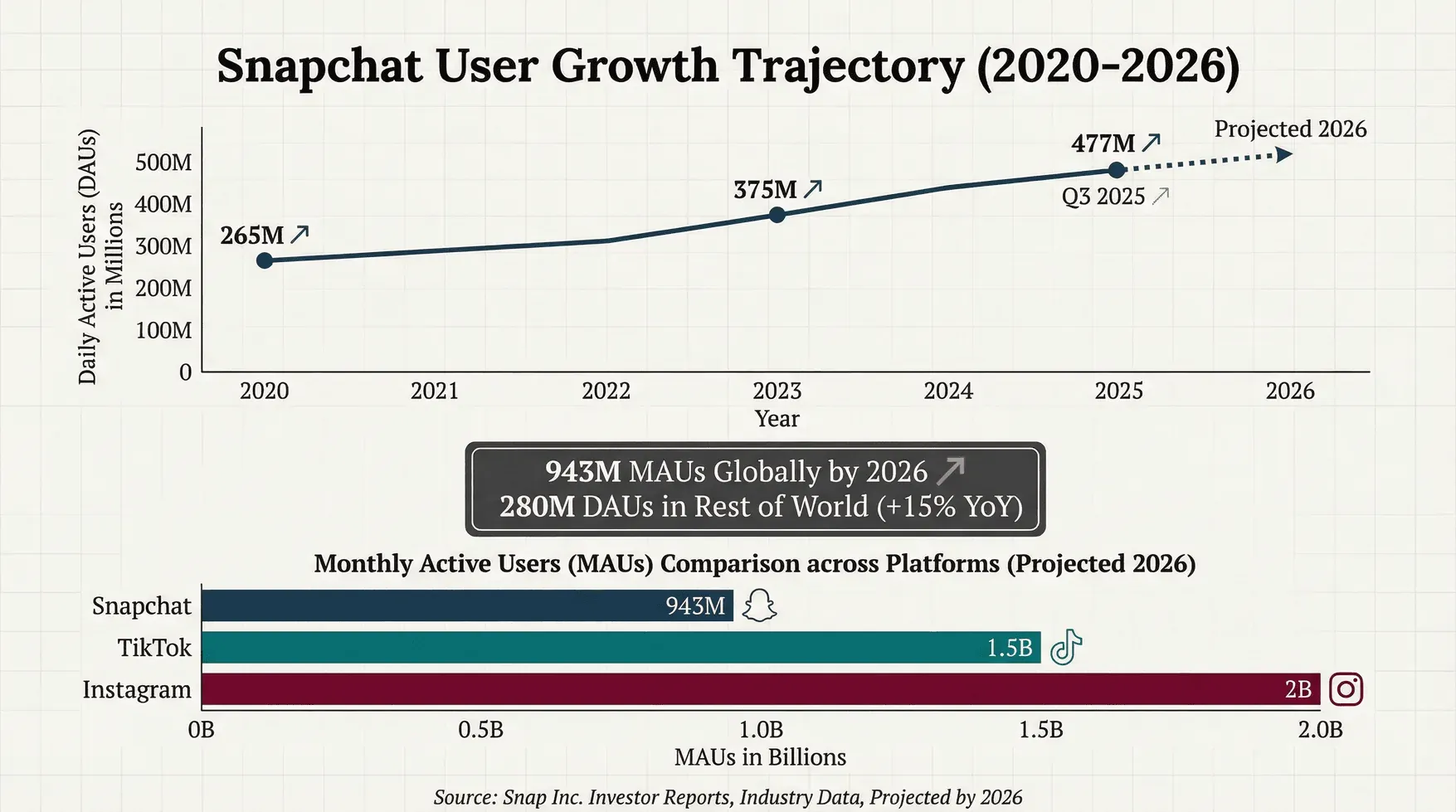
Snapchat's user base has kept climbing, but the curve has flattened a bit compared with prior years. As of Q1 2026, Snapchat reported 483 million daily active users—up 5% year-over-year and a recovery from Q4 2025, which had dipped to 474M after the company pulled back on community-growth marketing (Snap Inc. Q1 2026 Financial Results; Snap Inc. Q4 2025 Financial Results). For some perspective, back in 2020, Snapchat had around 265 million DAUs; by the end of 2022, it was at 375 million; it crossed 477M in Q3 2025 and now sits just shy of the half-billion mark (DemandSage).
Monthly active users tell an even bigger story: 956 million people use Snapchat every month as of Q1 2026, up 43 million year-over-year (Snap Inc. Q1 2026 Financial Results). That keeps Snapchat inside the top 10 social networks worldwide—well ahead of Twitter and Pinterest, though behind Facebook, Instagram, WhatsApp, YouTube, WeChat, and TikTok in the global social media rankings (The Social Shepherd).
Snapchat's "Rest of World" region — Asia, Africa, Latin America — keeps doing most of the heavy lifting on growth, reaching about 294 million DAUs in Q1 2026, up 12% year-over-year, while North America DAU slipped 7% YoY to 92M and Europe DAU dipped 2% to 97M (Snap Inc. Q1 2026 Financial Results). India, Pakistan, and Indonesia are leading the charge, thanks to more affordable smartphones and Snapchat’s focus on making the app work smoothly on Android devices.
Compared to other platforms, Snapchat’s 956 million MAUs are about half of Instagram’s 2 billion and two-thirds of TikTok’s 1.5 billion. But here’s the kicker: Snapchat absolutely owns the teen and young adult segment in key regions. In the U.S., for example, Snapchat reaches more under-25s than Facebook or Instagram, even though those platforms have bigger total user bases (Social Media Today).
Regional Spotlight: Where Snapchat Users Are Most Active
Let’s break down where Snapchat is making the biggest waves:
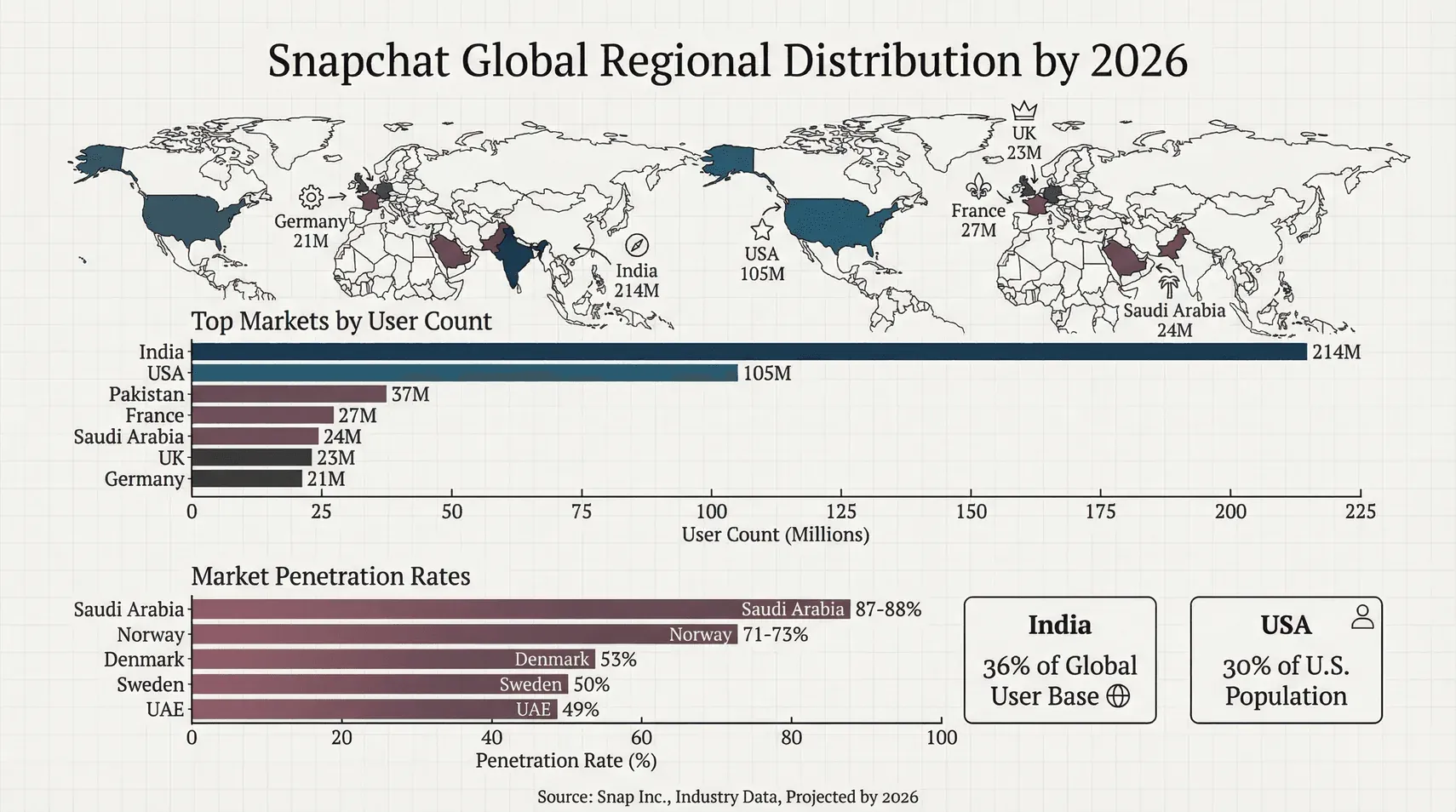
- India: Now Snapchat’s largest market, with about 214 million users (DemandSage). That’s roughly 22% of Snapchat’s global monthly active user base.
- United States: Still a powerhouse, with 105 million users—about 30% of the U.S. population (DemandSage).
- Other top countries: Pakistan (~37 million), France (~27 million), Saudi Arabia (~24 million), UK (~23 million), Germany (~21 million) (DemandSage).
- Highest penetration rates: Saudi Arabia leads with an estimated 87–88% of its eligible population (ages 13+) on Snapchat (Digital Web Solutions), followed by Norway (~71–73%), Denmark (~53%), Sweden (~50%), and the UAE (~49%) (Notta.ai).
The takeaway? Snapchat is a must-have channel in certain countries—especially if you’re targeting young, mobile-first consumers in the Middle East or Asia.
Snapchat Demographics: Who Uses Snapchat?
Snapchat is often called a “teen app,” and honestly, the numbers back it up. But there’s nuance here—let’s break down the demographics:
- Age: The largest chunk of users are 18–24 years old (about 38%), with another 26% in the 25–34 range (DemandSage). Around 18% are under 18. That means more than 82% of Snapchat’s users are under 35.
- Older users: Usage drops off fast after age 35—only about 14% are 35–49, and just 3–4% are 50+ (DemandSage).
- Gender: Globally, Snapchat is almost perfectly split—50.7% male, 48.4% female (DemandSage). In the U.S., the split leans slightly female at about 55% women.
- Parents on Snapchat: About 83% of Snapchat-using parents say they use the app to stay connected with their kids or family.
- Regional differences: In Western countries, Snapchat is almost universal among teens (e.g., 48% of U.S. internet users aged 15–25 are on Snapchat, per DemandSage’s U.S. audience breakdown). In the Middle East, because the population skews so young, Snapchat’s user base can actually be a majority of the total population.
In short, Snapchat is the place to be if you want to reach Gen Z or Millennials under 35. If you’re marketing to retirees, you might want to look elsewhere. Two housekeeping notes on the numbers above: the U.S. gender split and the parent-usage figure are widely repeated, but we could not trace either back to a primary published source, so treat both as indicative.
Gen Z and Millennials: Snapchat’s Core Audience
Snapchat’s dominance among Gen Z and young Millennials is legendary. Here’s what stands out:
- Gen Z: Snapchat reaches 90% of U.S. 13–24-year-olds—a figure Snap has been citing since 2020 (Social Media Today). In a much-quoted teen survey from around the same time, U.S. teens ranked Snapchat as their “most important” social network—even ahead of Instagram and TikTok (Notta.ai).
- Purchase influence: 64% of Gen Z students (13–27) say they’ve made a purchase influenced by Snapchat.
- Ad sharing: 56% of Gen Z have shared an ad on Snapchat with someone.
- Morning routine: About 46% of Gen Z Snapchatters use it first thing in the morning—1.6× more likely than opening any other social app at that time.
- Millennials: Snapchat is still sticky with young working-age adults. 61% of Snapchat’s 18–27-year-olds have bought something they saw on Snapchat, and 70% of Snapchat-using parents (often Millennials) have made purchases because of Snapchat. One caveat on this cluster of Gen Z and Millennial purchase numbers: the industry roundups that popularized them have since rewritten their pages, so we are quoting the numbers without a live source page behind them.
Why does Snapchat win with these groups? Privacy, authenticity, and a “close friends” vibe. Nearly 80% of Snapchatters say it’s where they can be their most authentic self (Snapchat Generation Report). Plus, all those AR lenses and creative tools? They’re catnip for Gen Z and Millennials.
Snapchat Engagement & Views: How People Use the Platform
Snapchat isn’t a “once-a-day scroll” app—it’s something people open and use constantly throughout the day. Here’s how the engagement breaks down:
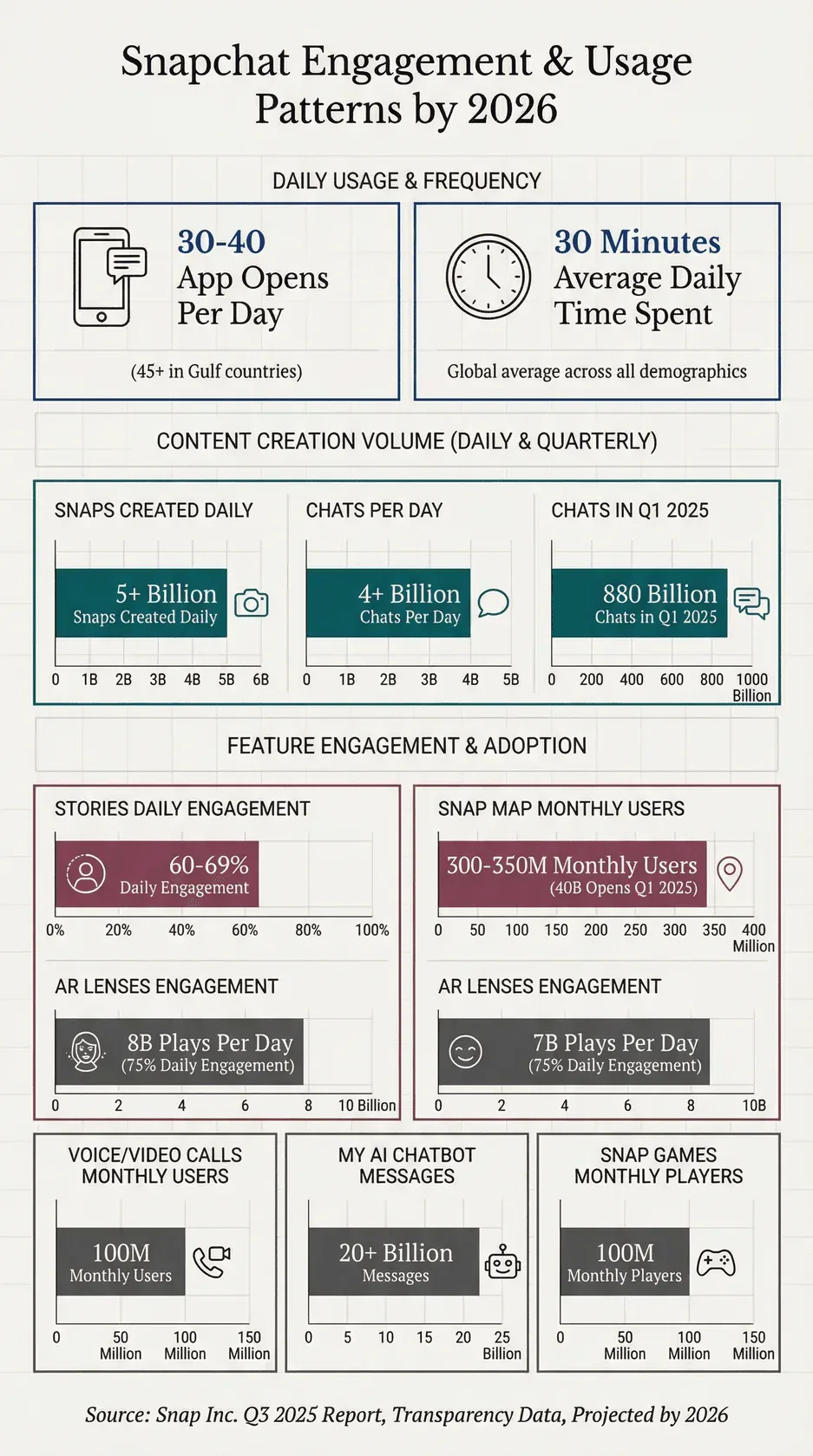
- App opens: The typical user opens Snapchat 30+ times per day (Sprout Social), with the U.S. average running closer to 40. In the Gulf countries, it’s over 45 times a day (The Meridio).
- Time spent: Users spend about 30 minutes per day on Snapchat (The Social Shepherd). For 18–24-year-olds, it’s closer to 28 minutes (DemandSage).
- Snaps & chats: Over 5 billion Snaps are created daily (The Social Shepherd), and chat volume runs into the billions: 880 billion chats were sent in Q1 2025 alone (Snapchat Generation Report), which averages out to well over 4 billion every single day.
- Stories: About 60–69% of users engage with Stories from friends every day.
- Spotlight: Snapchat’s TikTok-style feed has been credited with over 500 million monthly viewers, alongside a 175% year-over-year jump in time spent watching Spotlight content—both from Spotlight’s growth-surge years, since Snap no longer breaks out a Spotlight audience number.
- Snap Map: Over 300–350 million people use Snap Map each month (The Social Shepherd), and it was opened over 40 billion times in Q1 2025 (Snapchat Generation Report).
- AR lenses: Users play with AR lenses 9 billion times per day on average in Q1 2026 (Snap Inc. Q1 2026 Financial Results), and over 75% of daily Snapchatters engage with AR daily.
Snapchat’s engagement is frequent, fast, and intimate—people check it incessantly, and most of that time is spent interacting with friends rather than just passively scrolling.
Snapchat Stories, Spotlight, and More: Feature Usage Trends
Snapchat’s ecosystem is more than just Snaps and chats. Here’s how the major features stack up:
- Stories: About 60%+ of daily users watch friends’ Stories each day, and among U.S. teens, over 65% post to their Story daily.
- Spotlight: Estimates put Spotlight at over 500 million monthly viewers, with daily Spotlight video views said to have surpassed 350 million.
- Snap Map: Used by over 300–350 million monthly, with 40 billion opens in Q1 2025 (Snapchat Generation Report).
- AR Lenses: About 9 billion AR lens plays per day on average, with more than 75% of daily users engaging (Snap Inc. Q1 2026 Financial Results).
- Voice & Video Calls: About 100 million users make voice or video calls monthly.
- My AI Chatbot: Over 20 billion messages were sent to the AI chatbot within a few months of its 2023 launch.
- Snap Games: at its peak the platform drew 100 million monthly players, but Snap stopped investing in Snap Games in 2022 and the feature was retired the following year — the number is history, not a live product metric.
Snapchat’s features are designed to keep users coming back for more—whether it’s to maintain a Snapstreak, try a new AR filter, or just see what’s happening on the Snap Map. One caveat on this list: apart from the AR lens and Snap Map figures, Snap has stopped breaking out per-feature audience numbers, so the Stories, Spotlight, calling and My AI figures above are the last estimates to circulate publicly rather than current company disclosures.
Snapchat Monetization: Revenue, ARPU, and Subscriptions
Snapchat’s business is booming, and the numbers show it:
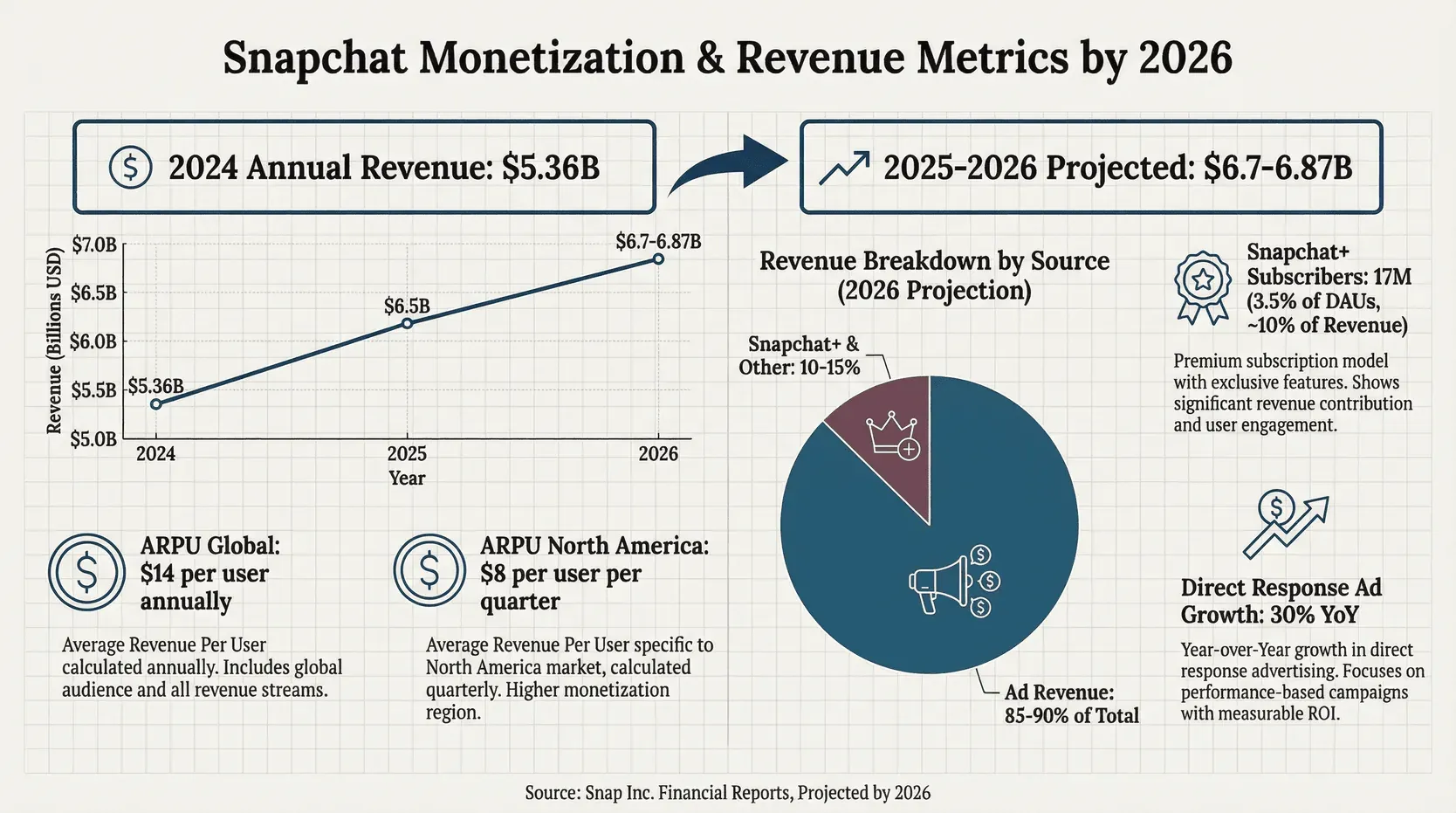
- Quarterly revenue: $1,529 million in Q1 2026, up 12% year-over-year (Snap Inc. Q1 2026 Financial Results); Q4 2025 revenue was $1,716 million, up 10% YoY (Snap Inc. Q4 2025 Financial Results).
- ARPU (Average Revenue Per User): $3.17 globally in Q1 2026, up 7% year-over-year (Snap Inc. Q1 2026 Financial Results). North America still leads — Q1 2026 NA revenue was $851M against 92M DAU, or roughly $9 per DAU per quarter.
- Subscription community: 25+ million subscribers across Snap's subscription products (Snapchat+, Lens+, Snapchat Platinum, Memories Storage Plans) as of February 2026, with direct-revenue ARR crossing $1 billion (Snap Newsroom).
- Ad revenue: Advertising has historically supplied about 85–90% of Snap’s revenue, but that share is being pulled down as subscriptions and other direct revenue scale—Snap’s direct-revenue run rate crossed $1 billion in February 2026.
- Direct Response ads: Purchase-related ad revenue grew 30% year-over-year in Q3 2025 (Snap Inc. Investor Report, Q3 2025).
Snapchat+ (the premium subscription) has been a surprise hit: the 25+ million subscribers across Snap’s paid products work out to under 3% of its monthly active users, all paying for extras like custom icons and exclusive badges. Watch the denominator here—subscriber penetration is reported against monthly actives, not daily ones.
Advertising on Snapchat: Marketer Adoption and Ad Performance
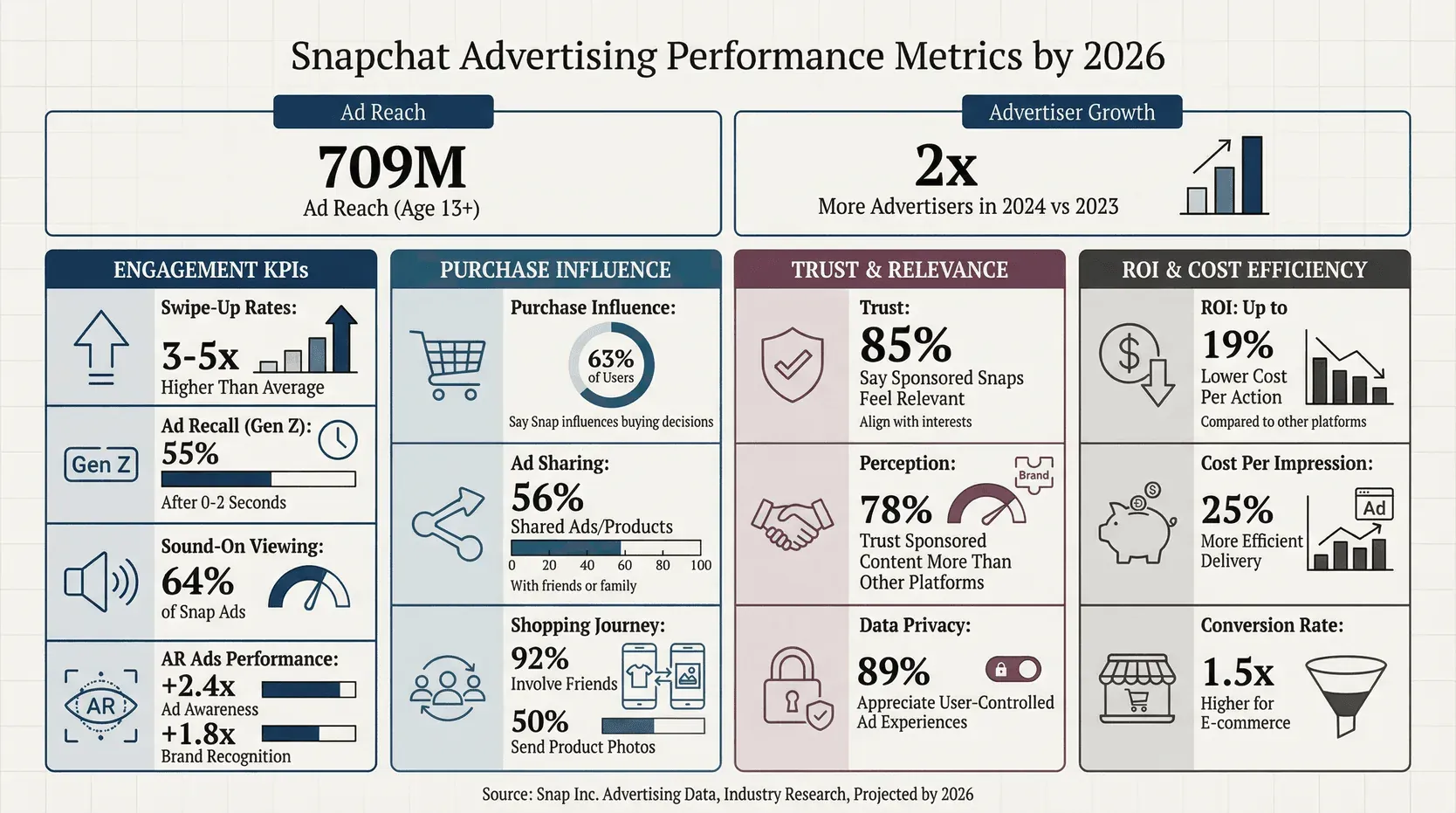
Snapchat’s ad platform has matured, and marketers are taking notice:
- Marketer adoption: Twice as many advertisers used Snapchat in 2024 as in 2023.
- Ad reach: Snapchat’s ad platform could reach ~709 million users age 13+ as of January 2025 (DataReportal).
- Swipe-up rates: Snap Ads have been reported to see swipe-up rates (click-through) 3–5× higher than the average on other social media platforms—a legacy benchmark that Snap no longer reports.
- Ad recall: 55% of Gen Z recall an ad after just 0–2 seconds on Snapchat (The Social Shepherd).
- Sound-on: 64% of Snap Ads are viewed with sound on (The Social Shepherd).
- AR ads: Branded AR Lenses have been credited with +2.4× higher ad awareness and +1.8× higher brand recognition than standard mobile ads.
- Purchase influence: 63% of users say Snapchat influenced a purchase decision, and 56% have shared an ad or product with friends.
Snapchat’s ad formats (vertical video, AR lenses, Sponsored Snaps) are tailor-made for its audience, and the numbers show they’re working.
Snapchat Safety and Content Moderation: Transparency in Numbers
Snapchat takes safety seriously, and the numbers from its Transparency Report back that up:
- Enforcement actions: In the first half of 2025, Snap’s Trust & Safety teams took 9,674,414 enforcement actions for Community Guidelines violations (Snap Transparency Report).
- Median response time: The median time to remove sexual content violations was 1 minute from detection; for harassment and threats, it was 2–5 minutes (Snap Transparency Report).
- Violative View Rate (VVR): Just 0.01%—for every 10,000 views, only about 1 view contained content that was later found to violate guidelines (Snap Transparency Report).
- Proactive moderation: In H1 2025, Snap’s AI systems proactively detected and enforced on 3,395,968 violations—about one-third of all enforcements (Snap Transparency Report).
- Child safety: In H1 2025, Snap identified ~994,000 pieces of child abuse content and disabled ~187,000 accounts for it (Snap Transparency Report).
Snapchat’s proactive use of AI and automation means most harmful content is removed before users even see it.
Proactive Detection: AI and Automated Moderation on Snapchat
Snapchat’s AI moderation is a silent guardian, scanning millions of Snaps and accounts to catch problems before they spread:
- Automated tools: Snapchat uses PhotoDNA, Google’s Content Safety API, and proprietary AI models to detect nudity, violence, hate symbols, and more (Snap Transparency Report).
- Speed: Median removal time for proactively detected sexual content was 0 minutes—essentially instant (Snap Transparency Report).
- Adaptability: Snapchat’s AI is constantly updated to catch new slang, codewords, or behavior patterns.
For users and parents, these stats mean Snapchat is actively working to keep the platform safe—and doing it at machine speed.
Snapchat in the GCC and Beyond: Regional Insights
Snapchat’s strongest foothold? The Gulf Cooperation Council (GCC) region, especially Saudi Arabia and the UAE:
- Saudi Arabia: Over 90% of young Saudis (13–34) are actively on Snapchat (The Meridio), with an average of 50 app opens per day.
- Penetration: Saudi Arabia’s penetration rate is around 88% of the eligible population (Digital Web Solutions).
- AR engagement: 85% of Snapchatters in KSA and the UAE engage with AR every day (The Meridio).
- Shopping: In Saudi Arabia and the UAE, 97% of Snapchatters have discovered new products via social ads, and 93% have shared brands they like with friends (The Meridio).
Snapchat’s cultural relevance in the GCC is unmatched, and it’s a key channel for brands targeting young, affluent consumers in the region.
Snapchat for Brands: Impact on Shopping and Advertising
Snapchat isn’t just for fun—it’s a serious driver of shopping and brand engagement:
- Purchase influence: 63% of Snapchatters say content on Snapchat influenced a purchase decision—a widely circulated figure that Snap does not publish itself.
- Word-of-mouth: 56% of users have shared an ad, product, or brand content with friends on Snapchat.
- Shopping journey: 92% of daily Snapchatters involve friends in their shopping process, and over 50% send product photos or messages via Snap while shopping (Snapchat Generation Report).
- Trust: 85% of U.S. Snapchatters say Sponsored Snaps feel “relevant to me” and “fit in with my habits on the platform” (Snap Inc. Investor Report, Q3 2025).
- ROI: Snap Ads can lower cost per action by up to 19% when Sponsored Snaps are included in the campaign (Snap Inc. Investor Report, Q3 2025).
On Snapchat, your brand can benefit from peer-to-peer amplification that’s hard to replicate elsewhere. It’s like being invited into a group chat—if you respect the vibe.
See More Snapchat Stats & Insights Get Started Free
Key Takeaways: What the Latest Snapchat Statistics Mean for You
Here’s what all these numbers boil down to:
- Snapchat is the Gen Z stronghold: Snap has said it reaches 90% of U.S. 13–24-year-olds—a claim it first made back in 2020 (Social Media Today). If you want to reach young people, you need to be on Snapchat.
- Global growth is driven by emerging markets: India and the Middle East are fueling Snapchat’s expansion (Digital Web Solutions).
- Engagement is sky-high: Users open Snapchat 30+ times a day and spend about 30 minutes daily (Sprout Social).
- AR and “camera marketing” are unique opportunities: more than 75% of daily Snapchatters engage with AR every day, as Snap reported in its Q1 2026 investor letter.
- Peer influence is massive: Over half of users share ads or products with friends.
- Snapchat ads deliver high ROI: Swipe-up rates were reported at 3–5× higher than average, though that is a legacy benchmark.
- Safety is actively managed: In the first half of 2025, the violative view rate was just 0.01%, with most removals happening in minutes (Snap Transparency Report).
- Ephemeral content = authenticity: Snapchat is the place for real, unfiltered brand moments.
- E-commerce is booming: AR try-ons and social shopping behaviors are driving sales.
- Snapchat+ and innovation: the 25+ million subscribers Snap reported in February 2026 show that users are willing to pay for premium features.
If you’re a marketer, a researcher, or just a digital culture enthusiast, these stats are your roadmap for understanding where Snapchat fits into the social media universe—and why it’s not going anywhere.
Citing Snapchat Statistics: Sources and Data Reliability
When you’re using Snapchat statistics for your own reports, presentations, or blog posts, it’s crucial to cite reliable sources. Here’s where the numbers in this article come from:
- Snap Inc. Investor Reports & Newsroom: The gold standard for DAU, MAU, and revenue stats (Snap Inc. Investor Report, Q3 2025).
- Statista: Consistent, cited statistics on demographics and country rankings (DemandSage).
- DataReportal: Annual digital reports for country-by-country user numbers and ad reach (DataReportal).
- Snapchat for Business Insights: Research-backed insights on ad performance and user behavior (Sprout Social).
- Industry blogs: Sprout Social, SocialPilot, The Social Shepherd, and Thunderbit’s own Snapchat stats roundup for the latest trends.
- Snapchat Transparency Reports: For all things safety and content moderation (Snap Transparency Report).
All the numbers in this article are from reputable, up-to-date sources. If you’re citing these stats, always include the timeframe, geography, and source name/date for maximum credibility. And if you want to stay ahead of the curve, check for new reports each quarter—Snap updates its DAUs and other key metrics regularly.
Snapchat’s story is still being written, but one thing’s clear: it’s not just for disappearing selfies anymore. It’s where culture, commerce, and communication collide—and the stats prove it.
See the Full Snapchat Stats Roundup
Try AI Web Scraper for Social Media Data Get Started Free