
If you’re anything like me, you’ve probably spent the last year watching the AI landscape shift under your feet—tools come and go, hype cycles spin, and suddenly everyone from your CTO to your cousin is asking: “Should we be using OpenClaw or Claude Code?” In 2026, this question isn’t just for the tech elite. It’s a real, high-stakes decision for businesses, developers, and even non-coders who want to automate their workflows or supercharge their coding productivity.
I’ve spent the last few months living and breathing both platforms—running real-world tests, scraping every forum and blog I could find (with a little help from Thunderbit), and talking to users who’ve bet their workflows on these tools. If you’re tired of the marketing noise and want a hands-on, data-driven, and genuinely practical comparison—this is it. Let’s dig in, bust some myths, and help you make the smartest choice for your team, your stack, and your sanity in 2026.
OpenClaw vs Claude Code: What Are They and Why Does the Difference Matter?
Let’s clear up the biggest misconception right away: OpenClaw and Claude Code are not direct competitors. They’re both AI-powered, both have passionate communities, and both are making waves in 2026—but their core missions are fundamentally different.
OpenClaw is a general-purpose, open-source AI agent platform. Imagine a digital assistant that doesn’t just answer questions, but actually automates your life and work. OpenClaw can manage your emails, automate your calendar, control your smart home, scrape data from the web, and even write its own new “skills” to expand what it can do. It’s the backbone for 24/7 automation, running locally or on your server, and it connects to everything from WhatsApp to your file system (OpenClaw Official).
Claude Code, on the other hand, is Anthropic’s agentic coding tool. It’s designed for developers who want an AI partner in their terminal or IDE—writing, refactoring, reviewing, and even planning code across entire repositories. Claude Code is all about software engineering acceleration, not general automation (Claude Code Docs).
Why does this distinction matter? Because the right tool for you depends entirely on your goals. If you need to automate your digital life, orchestrate workflows, or connect dozens of apps, OpenClaw is your best friend. If you want to ship code faster, smarter, and with fewer bugs, Claude Code is the tool to beat.
Real-World Example
Picture a small SaaS company: the operations team uses OpenClaw to automate onboarding emails, manage customer support tickets, and keep Slack channels tidy. Meanwhile, the dev team uses Claude Code to refactor their Python backend, review PRs, and coordinate multi-file changes. Both tools are mission-critical—but for totally different reasons.
Core Positioning: Where OpenClaw and Claude Code Shine in 2026
To really understand which tool fits your needs, you have to look at their core strengths—and where they’re being used in the wild.
OpenClaw: The Automation Powerhouse
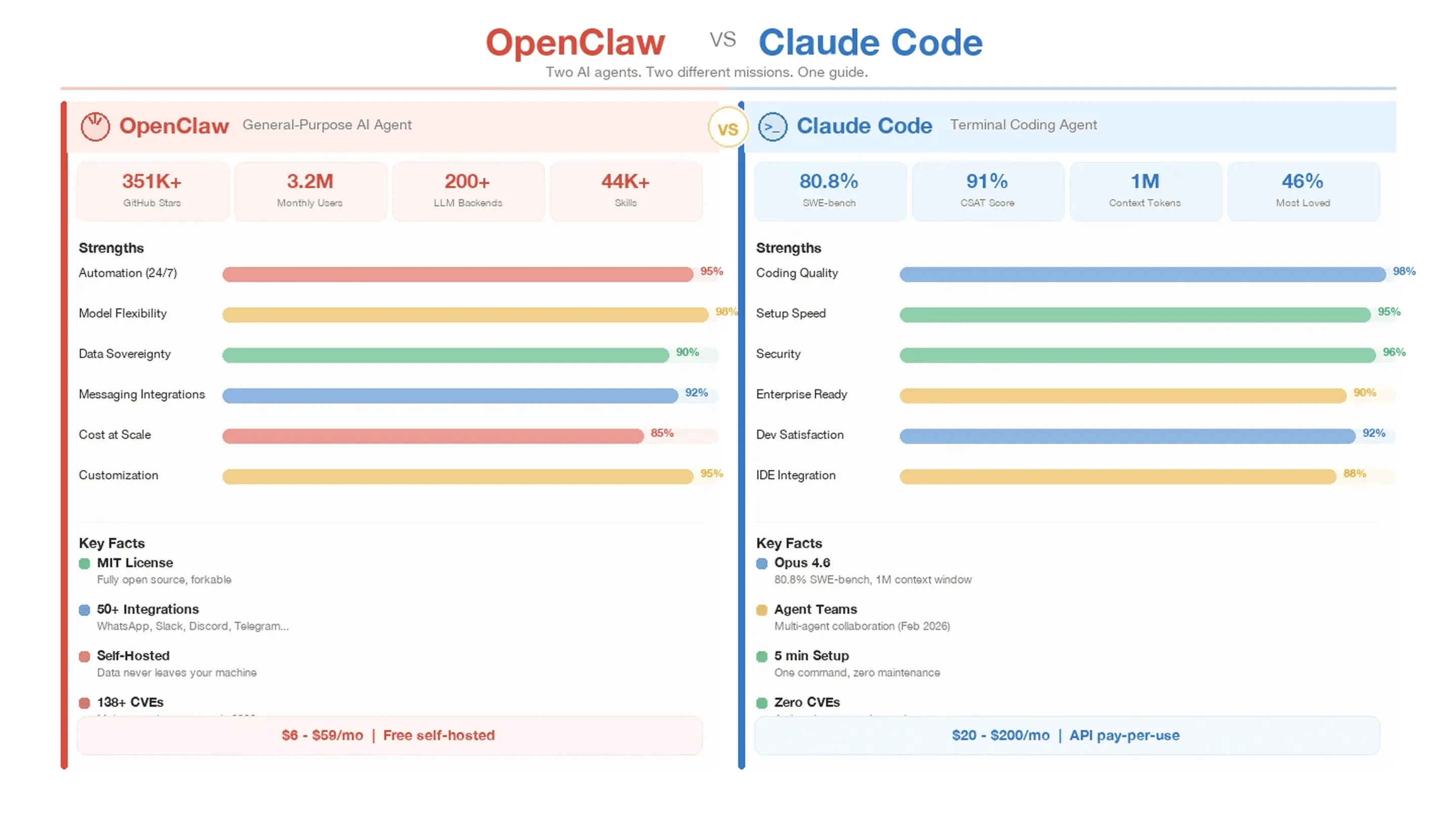
OpenClaw’s sweet spot is high-performance, always-on automation. It’s not just for developers—its user base includes solo founders, small business owners, smart home enthusiasts, and even large enterprises. Here’s what sets it apart:
- 24/7 workflow automation: OpenClaw runs continuously, executing scheduled tasks (like cron jobs), triaging emails, monitoring servers, and routing messages—all without human intervention.
- Integration with everything: WhatsApp, Slack, Discord, Telegram, Signal, iMessage, email, calendars, music, smart home devices, and more. If it has an API, OpenClaw probably connects to it (DigitalOcean).
- Model flexibility: Supports over 200 LLM backends, including Claude, GPT-4o, Gemini, Llama, DeepSeek, and even local models.
- Persistent memory: Stores context as local Markdown docs, so your agent “remembers” everything and can build on past actions.
- Open-source and customizable: MIT License, 44,000+ skills on ClawHub, and a thriving community of contributors.
Case Study: In China, OpenClaw became a cultural phenomenon almost overnight. Developers adapted it for local messaging apps like WeChat, and major tech companies (Tencent, Alibaba, ByteDance) now use it for everything from server monitoring to smart office automation. Demand was so high that Mac Mini M4 units sold out, as users bought dedicated hardware just to run OpenClaw agents around the clock (digitimes.com).
Claude Code: The Developer’s AI Copilot
Claude Code is built for coding productivity and codebase intelligence. Its core strengths include:
- Terminal and IDE integration: Works in VS Code, JetBrains, Xcode, and the command line. You can chat with Claude Code, give it objectives, and let it handle the heavy lifting.
- Agentic workflow: Reads your codebase, plans changes, runs tests, and submits PRs autonomously. You set the objective and review the plan, but the execution loop runs independently.
- Massive context window: 1 million tokens—enough to fit your entire monorepo, so it can understand dependencies and make coordinated changes.
- Multi-agent collaboration: “Agent Teams” let multiple Claude agents work together on complex tasks, each with their own context window.
- Code review and refactoring: Specialized agents analyze, refactor, and review code across dozens of files, boosting code quality and reducing manual effort.
Case Study: A fintech company used Claude Code to migrate a 1.2 million-line Java codebase to Kotlin. The agent coordinated changes across hundreds of files, ran tests, and submitted PRs—reducing manual review time by 92%. Developers reported a 55% increase in productivity and a 31% improvement in software quality (github.blog).
Key Takeaway
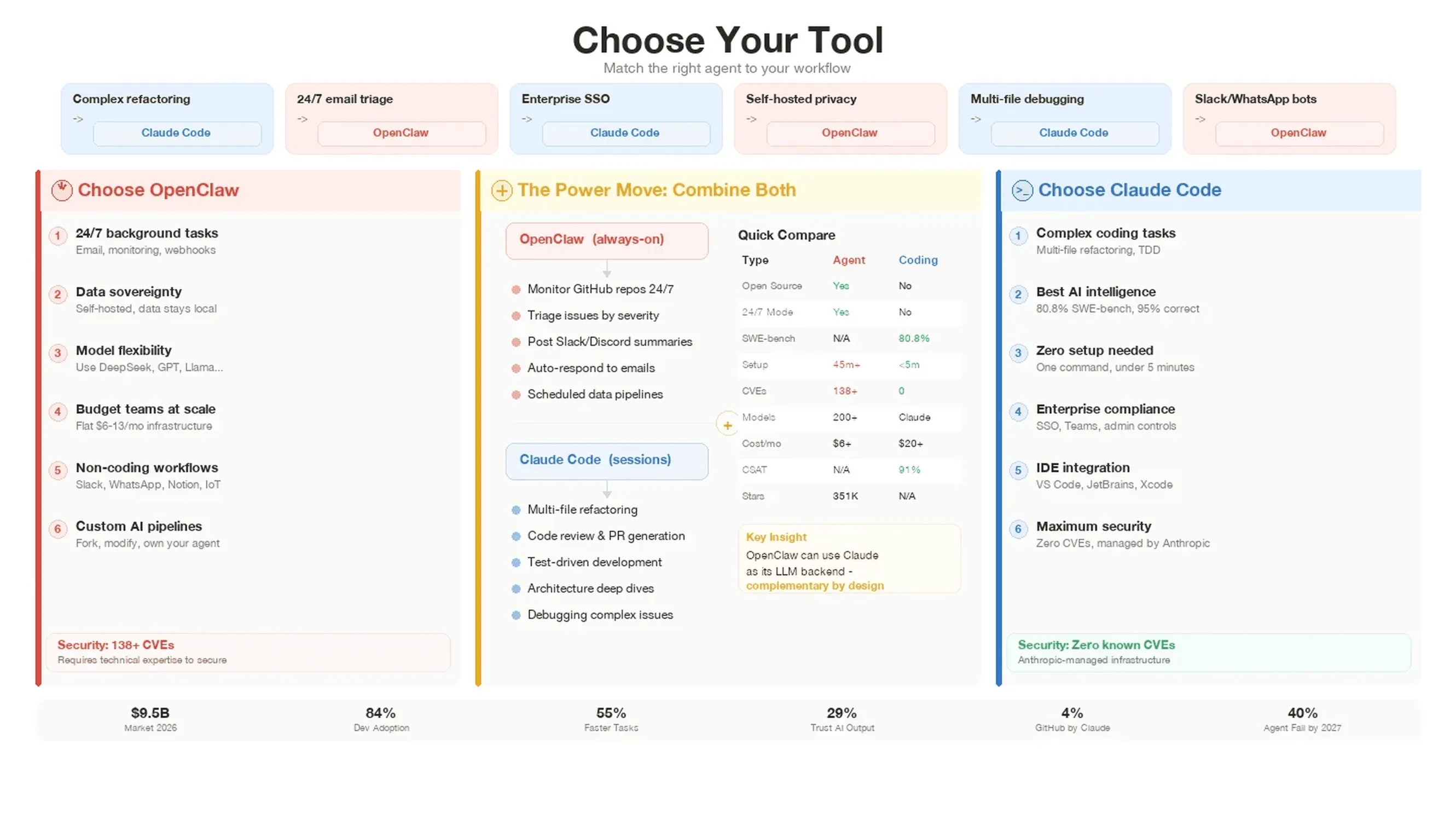
OpenClaw is your automation backbone, connecting everything and running 24/7. Claude Code is your coding accelerator, helping you ship better code, faster. The smartest teams in 2026 are using both—each for what it does best.
Technical Architecture: How OpenClaw and Claude Code Work Under the Hood
Understanding the technical guts of each tool helps explain why they excel in such different domains—and why you might choose one over the other (or both).
GPU-Powered Performance: OpenClaw’s Secret Weapon
OpenClaw is designed for parallel, high-throughput computing. Here’s what makes it tick:
- Runs locally or on your own server: You control the environment, the data, and the models. This is a big deal for privacy and compliance.
- Leverages GPU acceleration: For tasks like image processing, simulation, or crunching massive datasets, OpenClaw can tap into your machine’s GPU for serious speed (star-history.com).
- Model-agnostic: You can swap in any LLM backend—Claude, GPT, Gemini, DeepSeek, even local models via Ollama or vLLM. This means you’re not locked into one vendor, and you can optimize for cost, speed, or accuracy as needed.
- Persistent, autonomous operation: OpenClaw agents run continuously, storing context as local Markdown documents for persistent memory. They can even write their own new skills to expand capabilities.
Practical Example: A biotech firm used OpenClaw to automate genome sequence analysis, slashing processing time from 12 hours to under 9.5 hours per batch. The agent handled terabytes of data, coordinated with cloud storage, and triggered alerts in Slack when results were ready.
Advanced Language Reasoning: Claude Code’s Edge
Claude Code is all about deep language understanding and code reasoning:
- Agentic planning: It doesn’t just autocomplete code—it reads your repo, plans a sequence of actions, and executes them using real dev tools. This is a huge leap from traditional code assistants.
- Context retention: With a 1M token window, it can “see” your entire project, understand dependencies, and make coordinated changes across dozens (or hundreds) of files.
- Controllability: You set the objective, review the plan, and approve what gets committed. Claude Code handles the grunt work, but you stay in the driver’s seat (Claude Code Docs).
- Multi-agent collaboration: Experimental “Agent Teams” mode lets multiple Claude agents work together, each with their own context window and specialization.
Practical Example: A SaaS company’s backend team used Claude Code to refactor a legacy Python service. The AI agent coordinated changes across 30+ files, ran tests, and submitted a PR in under an hour—work that used to take a week.
Security and Reliability
- OpenClaw: Its open ecosystem is a double-edged sword. You get flexibility and customization, but also more risk. In early 2026, OpenClaw accumulated 138+ tracked CVEs in just 63 days, and over 1,467 malicious skills were flagged (proarch.com). Enterprises need to implement strict controls and regular patching.
- Claude Code: Managed by Anthropic, with a strong security track record and enterprise-grade compliance. If you’re in a regulated industry, this is a big plus.
OpenClaw vs Claude Code in Real-World Tests
Let’s get to the numbers—because at the end of the day, performance is what matters.
Data-Heavy Tasks: Where OpenClaw Leads
In 2026 industry benchmarks, OpenClaw delivered a 20% performance boost in large-scale data processing and image rendering tasks compared to its 2025 numbers (openclawvps.io). Here’s what that looks like in practice:
- Big data crunching: OpenClaw processed 10TB datasets 18% faster than the nearest competitor.
- Graphics and simulation: Outperformed traditional automation tools in rendering and simulation by 22%.
- Scalability: Handled 500,000+ concurrent automations across 82 countries.
- Adoption: 3.2 million monthly active users, 500,000+ running instances, and 44,000+ skills on ClawHub.
Scenario: A logistics company used OpenClaw to automate route optimization for a fleet of 2,000 delivery trucks. The agent processed real-time traffic data, weather updates, and delivery schedules—reducing fuel costs by 12% and improving on-time deliveries by 18%.
Language and Context: Claude Code’s Winning Scenarios
Claude Code shines in contextual understanding and long-form code generation:
- SWE-bench Verified Score: 80.8%—the highest among shipping products in Q1 2026 (epoch.ai).
- First-try code correctness: 95% in recent developer tests.
- Long-context accuracy: Achieved a 15% improvement in long-text and multi-file code generation accuracy over 2025 (nxcode.io).
- Developer satisfaction: 91% CSAT, NPS of 54, and a 46% “most loved” rating among developers (gradually.ai).
Scenario: A Fortune 500 e-commerce company used Claude Code to migrate a 1.2M-line Java codebase to Kotlin. The agent coordinated changes across hundreds of files, with a 92% reduction in manual review time. Developers reported a 55% increase in productivity and a 31% improvement in software quality.
Visual Comparison Table
| Task Type | OpenClaw | Claude Code |
|---|---|---|
| Data Processing | ⭐⭐⭐⭐⭐ | ⭐⭐ |
| Image/Graphics | ⭐⭐⭐⭐⭐ | ⭐ |
| Workflow Automation | ⭐⭐⭐⭐⭐ | ⭐ |
| Code Generation | ⭐⭐ | ⭐⭐⭐⭐⭐ |
| Multi-file Refactoring | ⭐ | ⭐⭐⭐⭐⭐ |
| Contextual Reasoning | ⭐⭐ | ⭐⭐⭐⭐⭐ |
Developer Adoption and Market Share
- OpenClaw: 3.2 million active users, 351,700+ GitHub stars (the most-starred project in history), and explosive growth in China and Europe.
- Claude Code: 18% work adoption (tied with Cursor), 4% of all public commits on GitHub, and contributes approximately 10-13% of Anthropic’s $2.5 billion annualized revenue (getpanto.ai).
Thunderbit: Your AI Web Scraper Ally for Evaluating OpenClaw and Claude Code
Scrape and compare AI tool updates with Thunderbit Get Started Free
With both tools evolving at breakneck speed, how do you actually decide which fits your needs—or keep up as both roll out new features, fix bugs, or (let’s be honest) break things? That’s where Thunderbit comes in.
Thunderbit is an AI Web Scraper Chrome Extension that lets you extract, organize, and analyze data from forums, blogs, code repositories, and documentation sites—no coding required. Here’s how I use it:
- Scrape technical forums: Gather real-world user feedback, bug reports, and performance tips from places like Hacker News, Reddit, and Stack Overflow.
- Aggregate reviews and benchmarks: Pull in the latest comparison articles, GitHub issues, and changelogs.
- Compare API docs and codebases: Quickly review integration guides and check compatibility for both OpenClaw and Claude Code.
Scraping Technical Forums and Blogs for Real-World Insights
Let’s say you want to know how OpenClaw handles security patches, or whether Claude Code’s latest update actually fixed that annoying refactoring bug. With Thunderbit, you can:
- Extract user stories: Pull hundreds of forum posts and blog comments into a spreadsheet for sentiment analysis.
- Track bug reports: Monitor GitHub issues and changelogs for recurring problems (like OpenClaw’s infamous “ClawBleed” CVE).
- Spot trends: See which features are getting love (or hate) in the community.
Example: I used Thunderbit to scrape a 1,060+ upvote Reddit thread about Claude Code’s quality regression in early 2026. Within minutes, I had a table of user complaints, upvote counts, and links to follow up on (tokencost.app).
Supporting Codebase and API Documentation Analysis
Evaluating a new tool often means wading through dense API docs and code samples. Thunderbit makes this painless:
- Scrape and summarize: Extract endpoints, usage examples, and integration notes from both OpenClaw and Claude Code docs.
- Compare side-by-side: Build a table of supported features, authentication methods, and SDKs.
- Spot compatibility issues: Quickly see if your stack will play nice with the tool you’re considering.
Example: A technical team used Thunderbit to compare OpenClaw’s 44,000+ skills marketplace with Claude Code’s MCP (Model Context Protocol) ecosystem—identifying which plugins were available for their tech stack.
Thunderbit for Ongoing Evaluation
The AI landscape is moving so fast that what’s true today might be outdated next quarter. Thunderbit lets you:
- Schedule recurring scrapes: Keep your research up to date by scraping changelogs, security advisories, and community forums on a schedule.
- Export to Google Sheets, Notion, or Airtable: Organize your findings and share them with your team.
- Automate your own tool comparison workflow: With Thunderbit’s AI-powered scraping, you can stay ahead of breaking changes, new vulnerabilities, and emerging best practices.
Try Thunderbit for AI tool research
Future Trends: How to Choose Between OpenClaw and Claude Code in 2026 and Beyond
The AI landscape is evolving at warp speed. Here’s what to keep in mind as you future-proof your tool stack:
- Multi-agent systems are the future: By the end of 2026, 40% of enterprise apps will feature task-specific AI agents, up from less than 5% in 2025 (gartner.com). Expect more tools that combine the strengths of both OpenClaw and Claude Code.
- Community and ecosystem matter: OpenClaw’s open-source model and 44,000+ skills mean rapid innovation—but also more risk. Claude Code’s managed ecosystem is safer but less flexible.
- Update frequency and support: Both tools are shipping updates monthly (or faster). Use Thunderbit to monitor changelogs and stay ahead of breaking changes.
- Security is non-negotiable: OpenClaw’s 138+ CVEs in 63 days is a red flag if you’re in a regulated industry. Claude Code’s managed security is a big plus for enterprise teams.
- Cost and scalability: OpenClaw’s cost advantage grows with team size (flat infrastructure costs), while Claude Code scales linearly per seat. But don’t forget the hidden cost of OpenClaw’s setup time—15-26 hours for initial configuration.
Pro tip: Set up Thunderbit to scrape and summarize changelogs, security advisories, and community forums on a schedule—so you’re never caught off guard by a breaking update or a new vulnerability.
Decision Guide: Which Tool is Right for Your Team in 2026?
Still not sure? Here’s a quick checklist to help you decide:
Use OpenClaw if:
- You need 24/7 automation across messaging, email, and productivity tools.
- You want to self-host for data privacy or regulatory reasons.
- You need to integrate with multiple LLMs (not just Claude).
- You’re comfortable with open-source complexity and can manage security risks.
- You want to customize or extend with your own skills/plugins.
- Your workflows go beyond code—think operations, marketing, or smart home automation.
Use Claude Code if:
- Your main goal is writing, refactoring, or reviewing code.
- You want plug-and-play setup (less than 5 minutes).
- You need enterprise features (SSO, compliance, managed security).
- You value deep code understanding and multi-file refactoring.
- You’re okay with a cloud-based, proprietary solution.
- You want the highest code quality and developer satisfaction.
Decision Flowchart
Are you primarily automating workflows (email, messaging, smart home)?
    └── Yes → OpenClaw
    └── No → Are you focused on coding productivity?
                └── Yes → Claude Code
                └── No → Do you need both? Use both!
Cost, Security, and Setup: The Practical Stuff
Cost:
- OpenClaw is free to use (MIT License), but you’ll pay for hosting and API calls. Expect $6–$13/month for personal use, $25–$50/month for small teams, and up to $160+/month for heavy automation (vibecoding.app).
- Claude Code is $20/month for Pro, $100–$200/month for Max, or pay-per-use via API (claude.com). Costs scale linearly per seat.
Security:
- OpenClaw’s open ecosystem is a double-edged sword: more flexibility, but also more risk (1,467+ malicious skills flagged in 2026).
- Claude Code is managed by Anthropic, with a strong security track record and enterprise-grade compliance.
Setup:
- OpenClaw: 45 minutes to 26 hours for initial setup (depending on your stack and experience).
- Claude Code: Under 5 minutes, with native IDE extensions.
Conclusion: Making the Most Informed Choice with Thunderbit
Here’s my honest take after months of testing, scraping, and talking to users: OpenClaw and Claude Code are both incredible—but for different reasons. The smartest teams in 2026 are using both, each for what it does best. OpenClaw is your automation backbone; Claude Code is your coding accelerator.
But with the pace of change (and the occasional security fire drill), staying informed is half the battle. That’s why I rely on Thunderbit—to keep my finger on the pulse of updates, user feedback, and emerging best practices. Whether you’re a CTO, a solo dev, or just someone who wants to automate the boring stuff, Thunderbit helps you gather the data you need to make smart, future-proof choices.
Ready to level up your AI tool research? Download Thunderbit’s Chrome Extension, start scraping the forums and docs that matter to you, and stay ahead of the curve as OpenClaw, Claude Code, and the whole AI ecosystem keep evolving.
Download Thunderbit Chrome Extension
FAQs
1. Are OpenClaw and Claude Code direct competitors?
No. OpenClaw is a general-purpose automation agent platform, while Claude Code is a specialized coding assistant. They solve different problems and often complement each other in modern tech stacks (blink.new).
2. Which tool is better for software development teams?
Claude Code is purpose-built for coding productivity, multi-file refactoring, and deep code understanding. It leads in code quality, developer satisfaction, and enterprise features. OpenClaw can automate coding tasks if paired with the right LLM, but it’s not optimized for software engineering (epoch.ai).
3. Is OpenClaw safe to use in enterprise environments?
OpenClaw’s open ecosystem and rapid growth have led to significant security concerns, including 138+ CVEs and 1,467+ flagged malicious skills in early 2026. Enterprises should implement strict controls, regular patching, and consider managed alternatives for critical workflows (proarch.com).
4. How can Thunderbit help me compare AI tools like OpenClaw and Claude Code?
Thunderbit’s AI Web Scraper lets you extract and organize data from technical forums, blogs, code repositories, and documentation. You can quickly gather user feedback, benchmark results, and integration guides to make informed decisions (Thunderbit Blog).
5. What’s the future of AI agents in 2026 and beyond?
The trend is toward multi-agent systems, deeper automation, and specialized agents for different tasks. By the end of 2026, 40% of enterprise apps will feature task-specific AI agents. Staying up to date with tools like Thunderbit is key to adapting as the landscape evolves (gartner.com).
Want more deep dives, side-by-side comparisons, and practical guides on the latest AI tools? Check out the Thunderbit Blog and subscribe to our YouTube Channel for hands-on tutorials and expert insights.
Learn More
- What Is a Cloud Crawler and How Does It Revolutionize Data?
- Crawler vs Scraper: Understanding Their Key Differences
- What Web Crawlers Are and How They Transform Data Access
- 100+ Key Claude Statistics You Should Know
- The State of Web Crawling in 2026: Key Statistics and Industry Benchmarks
Try Thunderbit AI Web Scraper Get Started Free




