

Online pricing is moving at lightning speed these days. I’ve seen brands go from updating prices once a month to changing them multiple times a day—all in the name of staying competitive. If you’ve ever wondered how Amazon seems to always have the “right” price, or why hotel rates jump right before you book, you’re already seeing online pricing intelligence in action. This isn’t just for tech giants anymore; businesses of all sizes are now tapping into real-time pricing data to make smarter decisions, boost revenue, and outmaneuver the competition.
So, what exactly is online pricing intelligence, and why is it suddenly the secret sauce for sales, ecommerce, and operations teams? In this guide, I’ll break down what it means, how it works, and how tools like Thunderbit are making it accessible to everyone. Whether you’re running an ecommerce shop, managing a retail chain, or just trying to keep up with market shifts, understanding online pricing intelligence could be the difference between leading the pack and getting left behind.
Try Thunderbit for Pricing Intelligence
What Is Online Pricing Intelligence? The Basics Unpacked
Let’s start with the essentials. Online pricing intelligence is the process of collecting, analyzing, and acting on real-time pricing data from across the web—think competitor prices, market trends, and even customer demand signals. The goal? To inform and optimize your own pricing strategy so you can stay competitive, maximize profits, and respond quickly to market changes.
Industry leaders like Vendavo define pricing intelligence as “the process of gathering and analyzing data about market prices, competitor prices, and customer willingness to pay, to inform pricing strategies for informed business decisions.” In plain English: it’s about knowing what’s happening in the market right now, so you can set the right price at the right time.
Imagine you’re running a lemonade stand, but instead of guessing what to charge, you have a dashboard showing what every other stand in town is charging, how many cups they’re selling, and what the weather’s doing. That’s online pricing intelligence—except, you know, with a lot more zeros and a lot less lemonade.
Why Online Pricing Intelligence Matters for Modern Businesses
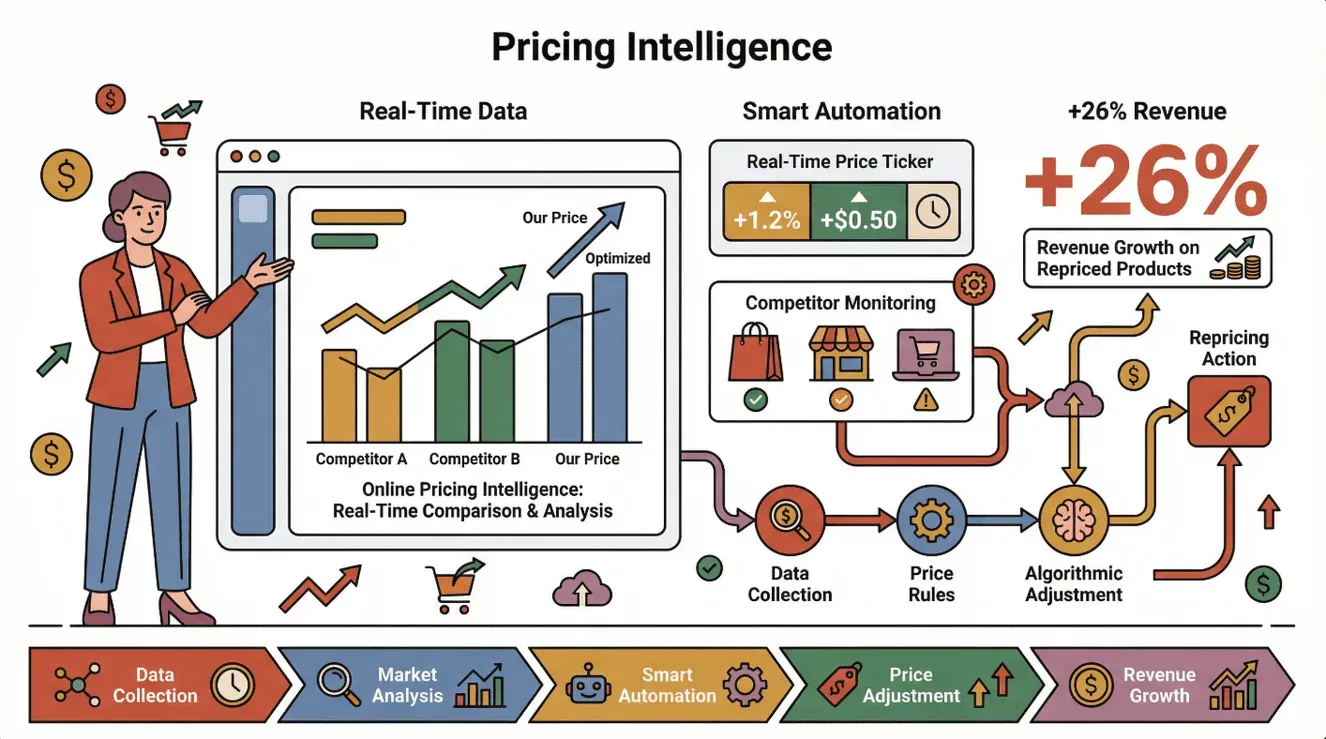 Why is everyone suddenly obsessed with pricing intelligence? Because in today’s digital world, pricing is no longer a “set it and forget it” game. The right price can mean the difference between a sale and a lost customer. The wrong price? Well, let’s just say your inventory might start collecting dust.
Here’s what online pricing intelligence brings to the table:
- Improved Competitiveness: By tracking competitors in real time, you can react instantly to price changes and never get undercut (Shopify).
- Revenue Growth: Dynamic pricing strategies powered by real-time data have been shown to increase profitability by up to 5%, and some retailers have seen 26% revenue boosts on repriced products.
- Faster Market Response: When a competitor slashes prices or demand spikes, you can adjust instantly—no more waiting for the next “pricing meeting.”
- Workflow Automation: Pricing intelligence tools can automate tedious tasks, freeing up your team to focus on strategy, not spreadsheets.
Here’s a quick look at how different teams benefit:
| Team | Benefit of Online Pricing Intelligence | ROI Example |
|---|---|---|
| Sales | Win more deals by matching or beating competitor prices | Higher conversion rates, less discounting |
| Ecommerce | Optimize SKU pricing, run smarter promotions | 5–26% revenue uplift on repriced products |
| Operations | Automate price monitoring, reduce manual errors | Lower labor costs, faster decision cycles |
Without pricing intelligence, businesses often fall into the trap of reactive pricing—always a step behind the market, losing margin, or missing out on sales. As BCG's pricing-trends analysis puts it, the gap between pricing leaders and laggards keeps widening as the data and tooling on the leader side compounds.
Competitive Price Tracking with Thunderbit See how Thunderbit helps you track and analyze competitor prices effortlessly. Get Started Free
Traditional Pricing vs. Online Pricing Intelligence: What’s Changed?
Let’s take a quick trip down memory lane. Not so long ago, pricing was mostly manual—think spreadsheets, quarterly reviews, and a lot of “gut feeling.” But as the market sped up, those old-school methods started to show their cracks.
Manual Pricing: The Old Way
Traditional pricing usually looked like this:
- Periodic price checks: Maybe once a month, someone would check competitor websites and update a spreadsheet.
- Static price lists: Prices were set for a season or quarter, with little flexibility.
- Slow reaction times: If a competitor changed prices, it might take weeks to respond.
- Human error: Manual data entry meant mistakes, missed updates, and inconsistent pricing.
I’ve seen retailers lose entire weekends to “pricing audits,” only to find their data was outdated before the next Monday rolled around.
AI-Powered Online Pricing Intelligence: The Modern Approach
Now, with AI and automation, pricing intelligence is a whole different ballgame:
- Real-time data collection: Tools scan thousands of competitor SKUs, marketplaces, and channels 24/7.
- Dynamic pricing: Prices can be updated multiple times a day based on market signals. The often-cited figure of around 2.5 million Amazon price changes daily — meaning an average product can reprice roughly every 10 minutes — is still being repeated in 2026 industry coverage as a benchmark for what algorithmic pricing at scale looks like.
- Automated alerts: Teams get notified instantly when a competitor makes a move.
- Data-driven decisions: AI analyzes trends, demand, and even customer behavior to recommend optimal prices.
The result? Faster, more accurate, and more profitable pricing decisions. As BCG puts it, “companies that fail to invest in pricing intelligence risk losing their competitive edge.”
How Thunderbit Powers Online Pricing Intelligence
This is where I get to brag a little—because Thunderbit was built to make online pricing intelligence dead simple for business users. No coding, no endless setup, just actionable data in a couple of clicks.
Thunderbit is an AI web scraper Chrome Extension (100,000+ installs, last updated May 2026) that helps you:
- Monitor competitor prices across any website, marketplace, or product page.
- Identify market trends and pricing signals in real time.
- Structure and export data directly to Excel, Google Sheets, Airtable, or Notion.
- Automate repetitive tasks like daily price checks, subpage scraping, and more.
Key Features for Pricing Intelligence
Here’s what makes Thunderbit a go-to for pricing teams:
- AI Suggest Fields: Just click, and Thunderbit’s AI scans the page, recommends the right columns (like “Product Name,” “Price,” “SKU”), and sets up your scraper.
- Subpage Scraping: Need more details? Thunderbit can visit each product’s subpage to grab specs, reviews, or historical prices—no extra setup required.
- Scheduled Scraping: Set it and forget it. Thunderbit can automatically scrape competitor prices daily, hourly, or on any schedule you need.
- Instant Data Templates: For popular sites (Amazon, Shopify, etc.), use pre-built templates for one-click scraping.
- Free Data Export: Download your data or send it straight to your favorite tools—no paywall, no hassle.
Thunderbit is especially handy for ecommerce teams tracking hundreds (or thousands) of SKUs and competitor URLs. And because it’s powered by AI, you don’t have to worry about your tracker breaking every time a site updates its layout (Thunderbit Blog).
Example Workflow: Using Thunderbit for Pricing Analysis
Let’s say you’re running an online electronics store and want to keep tabs on your top three competitors. Here’s how you’d do it with Thunderbit:
- Install the Thunderbit Chrome Extension and open your competitor’s product listing page.
- Click “AI Suggest Fields.” Thunderbit scans the page and suggests columns like “Product Name,” “Current Price,” and “Stock Status.”
- Start Scraping. Thunderbit pulls all the data into a neat table. If you want more details (like ratings or shipping costs), enable subpage scraping.
- Schedule Regular Checks. Set Thunderbit to scrape prices every morning so you’re always up to date.
- Export and Analyze. Send the data straight to Google Sheets or Excel, compare against your own prices, and adjust as needed.
No more late-night price checks or manual copy-paste marathons—just actionable insights, ready when you need them.
Start Monitoring Competitor Prices with Thunderbit
Real-World Applications: Online Pricing Intelligence Across Industries
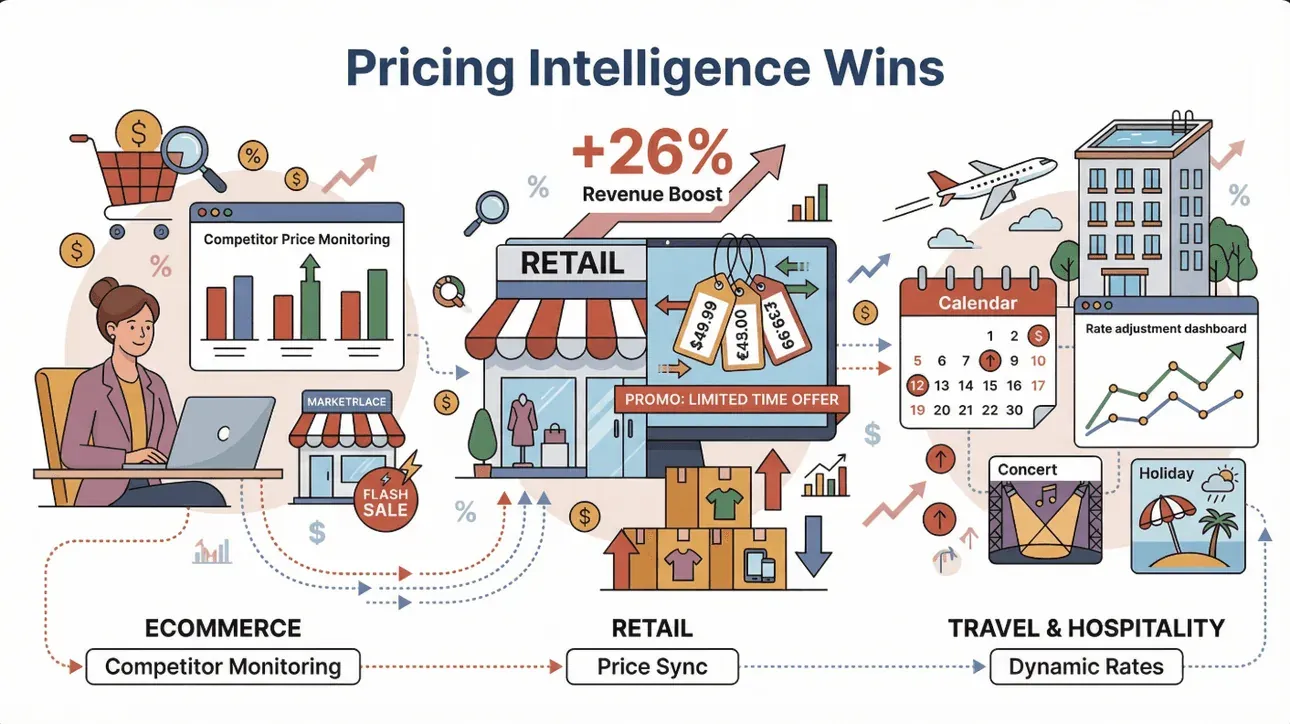 Online pricing intelligence isn’t just for ecommerce giants. Here’s how different industries are using it to win:
Ecommerce: Staying Ahead of Competitors
Ecommerce brands use pricing intelligence to:
- Monitor competitor prices on marketplaces and direct sites.
- React instantly to flash sales or price drops.
- Optimize promotions for maximum margin and conversion.
One sporting goods retailer saw a 26% revenue boost on repriced products after implementing pricing intelligence.
Retail: In-Store and Online Price Optimization
Retailers (both brick-and-mortar and online) use pricing intelligence to:
- Synchronize online and in-store prices for consistency.
- Run dynamic promotions based on competitor moves.
- Manage inventory by adjusting prices to clear stock or boost margin.
As BCG notes, retailers using AI-powered pricing can react to market changes in hours, not weeks.
Travel and Hospitality: Dynamic Rate Management
Hotels, airlines, and travel platforms use pricing intelligence to:
- Adjust rates in real time based on demand spikes (think concerts, holidays, or weather events).
- Track competitor rates to avoid being overpriced or undercut.
- Maximize occupancy and revenue by optimizing nightly rates (HospitalityNet).
A hotel using dynamic pricing can see up to 5% higher profitability compared to static pricing.
Learn More About Data Scraping Discover how data scraping powers pricing intelligence and more. Get Started Free
The Technology Behind Online Pricing Intelligence
Let’s demystify the tech for a second. At its core, online pricing intelligence combines:
- Web Scraping: Automated tools collect pricing data from competitor websites, marketplaces, and public sources.
- AI-Driven Analysis: Machine learning algorithms spot trends, detect anomalies, and recommend price changes.
- Automated Reporting: Dashboards and alerts deliver insights to your team in real time.
Here’s how the process typically works:
- Data Discovery: Identify which products, competitors, and channels to monitor.
- Data Extraction: Use web scraping tools (like Thunderbit) to collect pricing and product info.
- Data Validation: Clean and verify the data to ensure accuracy.
- Analysis: AI crunches the numbers, spots patterns, and flags opportunities.
- Reporting: Insights are delivered via dashboards, exports, or automated alerts.
The beauty of modern tools is that you don’t need to be a data scientist to get value—AI handles the heavy lifting, and you get clear, actionable recommendations.
Getting Started: Steps to Implement Online Pricing Intelligence
Ready to make the leap? Here’s how to get started:
- Define Your Goals: Are you looking to beat competitors, optimize margin, or automate tedious tasks?
- Choose the Right Tool: Look for solutions that are easy to use, integrate with your existing workflows, and deliver accurate data. Thunderbit is a great starting point for most teams.
- Set Up Your Monitors: Identify which products, competitors, and channels matter most.
- Automate Data Collection: Use scheduled scraping to keep your data fresh.
- Integrate with Your Workflow: Export data to your favorite tools and set up alerts for key changes.
- Review and Refine: Regularly review your strategy, adjust monitors, and experiment with new pricing tactics.
Here’s a quick comparison of Thunderbit and other common solutions:
| Feature | Thunderbit | Manual Methods | Legacy Tools |
|---|---|---|---|
| Ease of Use | Very High | Low | Medium |
| Integration | Sheets, Excel, Notion, Airtable | Manual copy-paste | Limited |
| Data Accuracy | AI-validated | Prone to errors | Template-based |
| Setup Time | Minutes | Hours | Days |
| Maintenance | AI adapts to changes | High (manual fixes) | Frequent updates |
The Future of Online Pricing Intelligence: Trends and Opportunities
The world of pricing is evolving fast. Here’s what’s on the horizon:
- Deeper AI Integration: Algorithms will get even better at predicting demand, spotting competitor moves, and recommending prices (BCG).
- Predictive Analytics: Instead of just reacting, businesses will start anticipating market shifts before they happen.
- Real-Time Automation: Prices will update automatically across all channels, with minimal human intervention.
- Cloud and Big Data: More data, faster processing, and better insights—accessible to businesses of any size.
As pricing intelligence becomes mainstream, the gap between leaders and laggards will only widen. Companies that invest early will be able to adapt, compete, and grow—even as the market gets more volatile.
Conclusion: Turning Insights into Action
Online pricing intelligence isn’t just a buzzword—it’s a strategic advantage. By harnessing real-time data, AI-driven analysis, and automation, businesses can make smarter pricing decisions, outmaneuver competitors, and drive revenue growth. Tools like Thunderbit are making this accessible to everyone, not just the Amazons of the world.
If you’re ready to ditch the guesswork and start making data-driven pricing decisions, now’s the time to explore online pricing intelligence. Your bottom line—and your customers—will thank you.
Want to dive deeper? Check out the Thunderbit Blog for more guides, tips, and real-world success stories.
Get Started with Thunderbit for Pricing Intelligence Get Started Free
FAQs
1. What is online pricing intelligence in simple terms?
Online pricing intelligence is the process of collecting and analyzing real-time pricing data from competitors and the market to help businesses set the best prices for their products or services.
2. How does online pricing intelligence benefit my business?
It helps you stay competitive, increase revenue, and react quickly to market changes by providing up-to-date insights on competitor prices and market trends.
3. What’s the difference between manual pricing and online pricing intelligence?
Manual pricing relies on periodic, often outdated data and is slow to react. Online pricing intelligence uses automated tools and AI to deliver real-time, accurate insights—so you can adjust prices instantly.
4. How can Thunderbit help with online pricing intelligence?
Thunderbit automates the process of collecting competitor pricing data, structures it for easy analysis, and integrates with your favorite business tools—no coding required.
5. Is online pricing intelligence only for large companies?
Not at all. With tools like Thunderbit, businesses of any size can access the same real-time pricing insights as the big players—leveling the playing field for everyone.
Learn More




