
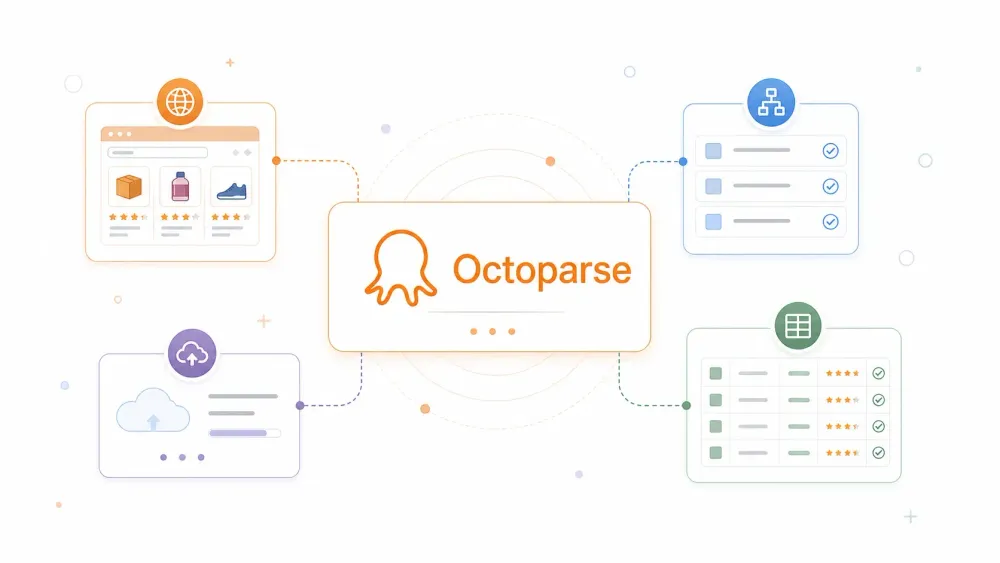
The most honest Octoparse review starts with a small confession: web scraping always sounds simpler in a product demo than it feels at 11:47 p.m., when a page has infinite scroll, three popups, a login wall, and a "Next" button that only works when it feels emotionally ready. I have spent years around automation products, and I still think the real test of a scraping tool is not whether it can extract one clean table from one clean page. The real test is whether a regular business user can get useful data on Tuesday afternoon without asking engineering for a "quick script" that becomes a three-week side quest.
That is where Octoparse has earned its reputation. As one of the longest-running platforms in this category, it has had time to develop into a genuinely mature no-code web scraping product, built around visual workflows, templates, cloud extraction, scheduling, and flexible exports. I like tools that make automation more accessible without pretending the web is always tidy, and Octoparse is one of the few that has stuck with that idea long enough to round out the workflow end to end. In this review, I will walk through what Octoparse does well, how its pricing works as of May 2026, and which teams are most likely to get real value from it.
Why Octoparse Matters in 2026
Web scraping has moved from "developer trick" to "business workflow." Sales teams collect leads from directories. Ecommerce teams monitor competitor prices. Real estate teams gather listings. Recruiters track job posts. Marketing teams pull reviews, creators, social profiles, and search results into spreadsheets.
The market numbers back this up. Mordor Intelligence estimates the web scraping market at $1.17 billion in 2026, growing to $2.23 billion by 2031 at a 13.78% CAGR. The same report says cloud deployment accounted for 67.45% of the market in 2025, and price and competitive monitoring is one of the fastest-growing use cases. Research and Markets also points to cloud scraping, AI-driven extraction, real-time market analysis, and automated lead generation as major growth drivers.
That is the larger reason tools like Octoparse exist. Most teams do not want to become web scraping teams. They want the data. Preferably in Google Sheets. Preferably before the next meeting.
What Is Octoparse?
Octoparse is a no-code web scraping platform that helps users turn webpages into structured data. Instead of writing Python, Playwright, Scrapy, or Puppeteer scripts, you build a scraping "task" inside a visual interface.
According to the Octoparse Help Center, a task is also called a bot, agent, or crawler. In plain English, it is a set of instructions Octoparse follows: open this page, click this element, scroll here, go to the next page, extract these fields, and export the results.
That makes Octoparse closer to a visual browser automation builder than a simple table scraper. It can simulate browsing actions like clicking, searching, paginating, scrolling, and selecting data. You can create a custom task from scratch, or you can start with a preset template for common sites and categories.
The basic workflow looks like this:
- Open a website inside Octoparse.
- Use auto-detect or click the fields you want.
- Review the suggested data columns.
- Configure pagination, scrolling, subpages, or load-more actions.
- Run the task locally or in the cloud.
- Export the data to a file, database, spreadsheet, or API depending on your plan.
For a business user, that is a huge step down from "ask someone to maintain a scraper." Octoparse keeps the workflow itself visible and editable, so the logic stays legible weeks later when you need to revisit it — which is one of the practical reasons teams keep using it after the initial build.
Octoparse Key Features
Visual Workflow Builder
Octoparse's biggest advantage is its visual builder, which is the part of the product that has clearly absorbed the most attention over its release history. You point and click through a website, and Octoparse turns those interactions into an extraction workflow. This matters because most modern pages are not polite little tables — they have product cards, hidden details, filters, dropdowns, pagination, and JavaScript-loaded content, and the builder handles all of these without forcing you down to raw selectors.
For users who want control, this is where Octoparse stands out. You can inspect every step of the workflow and adjust it directly, set up custom actions, handle repeated page patterns, and define exactly how the crawler should move through a site. Few no-code tools expose this level of structure to non-developers, which is one reason Octoparse keeps showing up in serious procurement evaluations rather than only hobbyist roundups.
Auto-Detect
Octoparse's auto-detect feature is designed to help users start faster, and it is one of the areas where the team's longer development runway shows. The auto-detect documentation says it can identify data on pages with listings, tables, infinite scroll, load-more buttons, and pagination. Octoparse has also continued to improve recognition across nearly 200 popular domains — the kind of incremental investment that is easy to overlook in a feature checklist but adds up over time.
In practice, auto-detect handles common page layouts well: product listings, directories, search results, job boards, and real estate listings. It suggests fields, detects repeated blocks, and produces a workable starting workflow in seconds. From there, you have full control to remove unwanted fields, rename columns, add missing data, or refine the pagination — all from the same interface.
My take: it gets you to a working scraper faster than most alternatives I have tested, and that head start compounds when you are setting up dozens of tasks across a quarter.
Templates
Octoparse has one of the largest template libraries in the no-code scraping market. Its template gallery covers categories such as ecommerce, lead generation, social media, real estate, jobs, maps, reviews, travel, directories, search engines, finance, education, sports, news, and media — a breadth few competitors come close to matching.
Templates remove the setup step entirely. Instead of building a crawler from scratch, you enter a URL, keyword, or parameter, and the template already knows which fields to collect, how to paginate, and how to handle the quirks of that particular site. For the most popular sources, that turns a multi-hour build into a one-minute task, which is part of what makes Octoparse practical to roll out beyond a single power user on the team.
Cloud Extraction and Scheduling
Cloud extraction is one of the biggest reasons to upgrade from the free plan, and it is a capability Octoparse has been refining far longer than most of its competitors have existed. Running a scrape locally is fine for small projects, but recurring business workflows need more than "keep my laptop awake and hope the office Wi-Fi behaves."
Cloud extraction runs tasks on Octoparse's managed infrastructure, with the kind of uptime and concurrency you would expect from a platform serving enterprise customers. Scheduling layers automation on top: daily price checks, weekly market research, monthly directory refreshes — all without anyone having to remember to hit "run."
This is where Octoparse stops looking like a scraper and starts behaving like a proper data operations platform. Ecommerce teams tracking prices, ops teams checking inventory, researchers watching public datasets, and sales teams refreshing lead lists all draw on the same underlying reliability. For teams who have outgrown ad-hoc scripts, cloud extraction is usually the feature that justifies the upgrade on its own.
Export and API Options
Octoparse supports the export formats teams actually use day to day: Excel, CSV, JSON, HTML, and XML, plus direct delivery to databases, Google Sheets, cloud storage, Zapier, and APIs depending on the plan. That coverage means the data lands wherever your existing reporting already lives, with no second integration project required.
The Octoparse OpenAPI docs describe an API that supports task management, cloud extraction, and data retrieval, available on Standard, Professional, and Enterprise accounts. The published rate limit of 20 requests per second is generous for the kind of workflows most business and analytics teams run, and Professional and Enterprise plans add more advanced task and cloud extraction controls on top.
That API layer is one of the cleanest hand-offs I have seen between business and technical users in this category: a non-technical user can build and own the scrape visually, while a data analyst or engineer pulls the results into a warehouse, BI tool, or downstream system without having to rebuild anything.
Octoparse Pricing in 2026
As of May 2026, the Octoparse pricing page lists a free plan and paid plans starting at $69/month for Standard and $249/month for Professional when billed annually.
| Approach | Best For | Trade-Off |
|---|---|---|
| Manual copy-paste | One-time, tiny tasks | Slow, error-prone, hard to repeat |
| Custom scripts | Technical teams needing full control | Requires engineering time and maintenance |
| Managed data services | Large recurring datasets with budget | Less hands-on control, higher service cost |
| Octoparse | Business users building repeatable no-code scrapers | Requires some workflow setup and testing |
There are also optional add-ons that round out the platform for teams with heavier needs. Residential proxies are listed at $3/GB. CAPTCHA solving costs $1-$1.50 per thousand. Pay-per-result templates range from $0.001 to $3 per thousand results. For teams who want a hand getting started, crawler setup starts at $399, and a fully managed data service is available from $599.
What I appreciate about this pricing structure is that the base subscriptions stay accessible while the heavier capabilities are available à la carte. That keeps the entry point low for small teams and lets larger teams scale into proxy, CAPTCHA, and managed services as their workflows grow — without having to migrate to a different vendor when the volume goes up.
What Users Like About Octoparse
Octoparse reviews are consistently positive across the major review sites. Capterra shows 4.7/5 from 106 reviews, with ease of use at 4.4 and customer service at 4.5. G2 shows 4.8/5 from 52 reviews. Those are the kind of numbers a product only earns by sustained iteration, not by marketing — and they hold up across user types from solo researchers to operations teams at much larger companies.
The positive patterns are clear:
- Users like that they can scrape without coding.
- Templates save time on common websites.
- Cloud mode lets tasks run in the background.
- Google Sheets and spreadsheet exports fit existing workflows.
- Support and tutorials help users learn more advanced workflows.
- For some projects, Octoparse reduces hours of manual copy-paste to minutes.
One G2 reviewer described using Octoparse for a catalog project that would have taken 20+ hours manually. That kind of story is exactly why no-code scraping exists. Nobody wakes up excited to copy product details from 200 pages. Well, almost nobody. There is always one spreadsheet enthusiast in every company, and I respect the dedication.
How Teams Get the Most Out of Octoparse
What I appreciate about Octoparse is that it is built to be a real product, not a demo. The platform gives you meaningful control over the workflow, and a few simple habits make that control pay off quickly.
The first habit is taking advantage of the dual-mode design. Octoparse lets you handle popups, infinite scroll, asynchronous loading, login states, and layout changes through workflow steps you can configure directly — which is why it holds up on the kind of complex modern sites where lighter tools tend to plateau. Most teams end up with a small library of patterns they reuse across new tasks.
The second is leaning on auto-detect as the starting point. It produces a working workflow on common page structures within seconds, and the visual editor makes it easy to rename fields, drop ones you do not need, or add anything the heuristics did not catch. The 80% head start is precisely what makes Octoparse faster than building from scratch.
The third is using local and cloud runs together. Local extraction is a fast feedback loop while you iterate on a task; cloud extraction is what you switch to once the task is stable and needs to run on a schedule. Octoparse's run logs and exports make that handoff straightforward.
The fourth is sizing the plan around the workflows you actually run. The base subscriptions cover most teams comfortably, and the optional add-ons — proxies, CAPTCHA solving, pay-per-result templates, managed setup — let you scale specific capabilities without overhauling the rest of your stack. Teams typically find that the time saved on recurring workflows pays for the plan many times over.
The fifth is treating Octoparse as the layer between business users and downstream data systems. Non-technical owners build and maintain the visual workflows, while analysts and engineers consume the output through the API or direct exports. That division of labor is one of the things Octoparse handles unusually well.
The short version: Octoparse rewards a small amount of upfront setup with a workflow that keeps paying back every time it runs. That is a fair deal for a platform built to handle the real, messy modern web.
How Octoparse Compares With Other Scraping Approaches
The best way to understand Octoparse is to compare it with the three other ways teams usually collect web data: manual copy-paste, custom code, and fully managed data services.
Manual collection is cheap at first but does not scale. Custom code gives developers full control at the cost of meaningful engineering time to build, test, and maintain. Managed data services are convenient but usually only justify their budget once the data need is very large.
Octoparse sits in the middle ground that most teams actually need. It gives business users and analysts a visual way to build repeatable scrapers, while still offering the workflow depth required for more advanced tasks. That combination is why Octoparse keeps coming up as the practical answer for teams that want more than a basic scraper without turning every data request into an engineering project.
| Approach | Best For | What You Get |
|---|---|---|
| Manual copy-paste | One-time, tiny tasks | No setup, but no repeatability either |
| Custom scripts | Technical teams needing full control | Maximum flexibility with engineering ownership |
| Managed data services | Large recurring datasets with budget | Hands-off delivery at a higher service cost |
| Octoparse | Business users building repeatable no-code scrapers | Visual workflows, cloud scheduling, and flexible exports in one platform |
My recommendation: Octoparse is a strong choice when you want a full visual crawler that can handle recurring work. It is especially compelling for teams that need scheduled data collection, spreadsheet-ready exports, and the flexibility to handle real-world webpages without writing code.
Who Should Use Octoparse?
Solo Researchers
Octoparse is a strong fit when your target websites have repeatable structures and you want to run the same extraction more than once. The free plan is generous enough to learn the platform on real projects, and Standard picks up smoothly once recurring work justifies the cloud features.
Sales Teams
Octoparse is well suited to repeatable directory scraping, recurring lead research, and scheduled collection. For teams pulling data from the same directories or marketplaces week after week, the ability to build a task once and reuse it indefinitely removes most of the manual cleanup that usually drags down outbound workflows.
Ecommerce Operators
Octoparse is one of the more reliable picks for recurring product and pricing workflows, especially when scheduled extraction is part of the operation. The depth of the visual workflow editor is what makes it hold up as catalogs grow and page structures evolve.
Marketing Teams
Marketing teams use Octoparse for review collection, content research, SERP analysis, creator lists, and competitor monitoring. It is particularly strong when the same research workflow needs to run on a schedule and feed downstream dashboards or reports.
Data Analysts
Octoparse fits naturally into analyst stacks: a no-code setup layer for the extraction itself, plus API and database export to move clean data into the rest of the pipeline. The combination saves the back-and-forth of getting engineering involved for every new source.
Developers
Developers find Octoparse useful for fast prototyping and for offloading routine scraping work that does not need a custom codebase. The API and export options make it easy to wire results into existing systems, so the time saved on the extraction layer goes back into higher-value engineering work.
My Final Verdict
Octoparse is easy to recommend if you need a mature no-code web scraping tool with templates, cloud extraction, scheduling, and flexible exports. It is especially well suited to business users and analysts who want a visual workflow builder with the depth to handle real websites, not just the simple ones.
For public webpages with repeatable structures — recurring business data workflows, competitor monitoring, product research, job boards, directories, market research — Octoparse gives non-technical teams a practical way to collect structured data without building everything from scratch. The combination of templates, visual workflows, cloud scheduling, and an open API means the platform scales with the team rather than capping out the moment the work gets real.
My practical advice is simple: start with the free plan, build a task on one of the sites you actually care about, and let the workflow run for a week or two. Most teams find that the time savings show up immediately, and the upgrade decision becomes obvious from there.
For teams that want a configurable visual crawler, Octoparse deserves a serious look. It is not trying to be the smallest possible scraper; it is built to give non-technical and semi-technical users a real workspace for turning the modern web into structured, repeatable data workflows — and it has had more than a decade to get that workspace right.
FAQs
Is Octoparse free?
Yes. Octoparse has a free plan with 10 tasks, one device, local extraction, and 50,000 exported rows per month. It is best for learning, small projects, and testing whether Octoparse works on your target websites.
Is Octoparse good for beginners?
Yes. Simple pages can be scraped in minutes using auto-detect or one of the hundreds of preset templates, and the visual workflow builder makes it straightforward to adjust fields and pagination as you go. The free plan gives beginners enough room to learn the platform on real projects before deciding to upgrade.
How much does Octoparse cost in 2026?
As of May 2026, Octoparse paid plans start at $69/month for Standard and $249/month for Professional when billed annually. Users should also consider add-ons such as proxies, CAPTCHA solving, pay-per-result templates, crawler setup, and managed data services.
What are the main Octoparse alternatives?
Alternatives depend on your use case. Developers may reach for custom tools like Playwright or Scrapy when they need full control over a codebase. Teams with very large infrastructure needs sometimes compare scraping APIs, proxy providers, or managed data providers. For business users who want a visual no-code workflow that handles real websites end to end, Octoparse remains one of the most established and capable options on the market.
When should I use Octoparse instead of a simpler scraper?
Use Octoparse when you want a configurable visual crawler with task workflows, templates, cloud extraction, scheduling, and API options. A simpler scraper may be enough for one-off extraction, but Octoparse is better suited when the workflow needs to be repeated, monitored, exported, and refined over time.




