
The digital ad world is moving at warp speed—blink, and your competitors have launched a new campaign, tested a fresh offer, or shifted their messaging. I’ve seen firsthand how the brands that keep a close eye on competitor ads aren’t just playing catch-up—they’re setting the pace. In today’s crowded market, researching competitor ads isn’t just a “nice to have”—it’s mission-critical for anyone serious about growth, whether you’re in sales, marketing, or operations.
Let’s face it: digital ad spend is at an all-time high, with Nielsen reporting that brands are spreading their budgets across more channels and platforms than ever. But here’s the kicker—companies that leverage competitor ad analysis see significantly higher ROI and campaign efficiency. If you want to spot market trends, uncover creative strategies, and benchmark your performance, you need a system for researching competitor ads that goes beyond guesswork.
In this guide, I’ll walk you through a practical, step-by-step approach to researching competitor ads—using official transparency resources and documented analysis—so you can turn raw ad data into actionable insights and outsmart the competition.
Why Research Competitor Ads Matters for Your Business
Let’s get real: why should you invest time in researching competitor ads? For starters, it’s about more than just “spying” on the other guys. Done right, competitor ad analysis helps you:
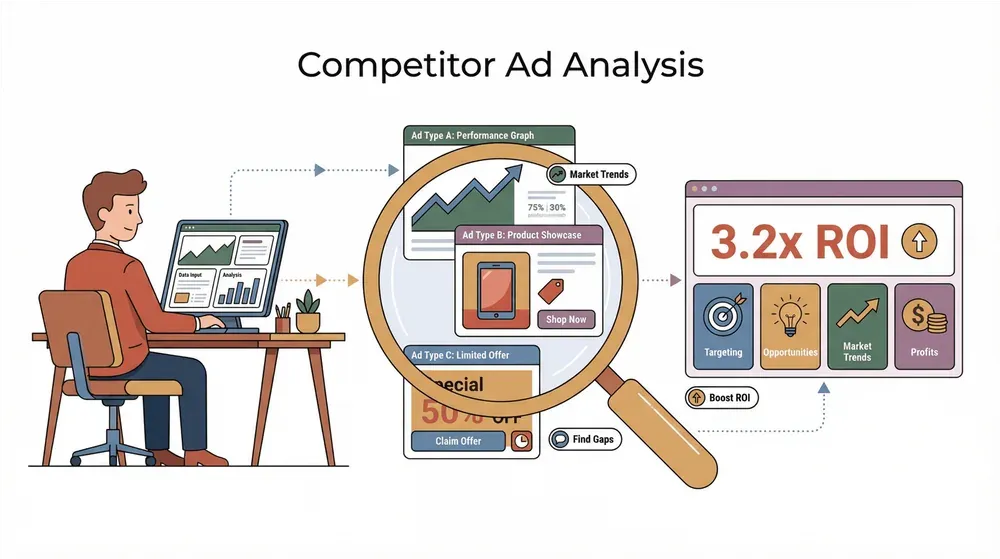
- Spot market trends early: See which offers, visuals, and messages are gaining traction—before they become mainstream.
- Find gaps and opportunities: Identify what your competitors are missing, so you can fill the void and stand out.
- Optimize your own ad strategy: Refine your targeting, creative, and value proposition based on what’s actually working in your market.
- Boost ROI: Data-driven advertisers are more likely to achieve higher profits and campaign efficiency.
Take it from the pros: “You want to be on par with—or exceeding—those of your competitors,” as RightSpend puts it. Whether you’re generating leads, launching new products, or defending market share, competitor ad research is your shortcut to smarter, more targeted decisions.
Real-World Impact
I’ve seen teams use competitor ad analysis to:
- Improve lead generation: By mimicking high-performing ad formats and offers.
- Refine messaging: By identifying which value propositions resonate in your niche.
- Increase conversion rates: By learning from competitors’ landing page flows and CTAs.
It’s not just theory—59% of marketers see higher ROI from planning and analyzing their competition. The bottom line? If you’re not researching competitor ads, you’re leaving money (and market share) on the table.
Overview: What Is Competitor Ad Analysis?
Let’s break it down. Competitor ad analysis is the process of systematically collecting, reviewing, and interpreting your competitors’ advertising campaigns—across search, social, display, and more—to inform your own strategy (Kaya).
Think of it like scouting the opposing team before a big game. You’re not just looking at the scoreboard—you’re studying their plays, lineups, and tactics, so you can adjust your own game plan.
Traditional vs. Modern Approaches
Traditionally, competitor ad research meant:
- Manually searching for ads in Google or on social feeds
- Using third-party tools for high-level spend and keyword data
- Relying on anecdotal evidence or agency reports
Modern, data-driven approaches (like web scraping and AI) let you:
- Collect actual ad creatives, copy, and landing pages at scale
- Analyze targeting signals and campaign timing
- Benchmark performance with real engagement data
A typical competitor ad analysis workflow looks like this:
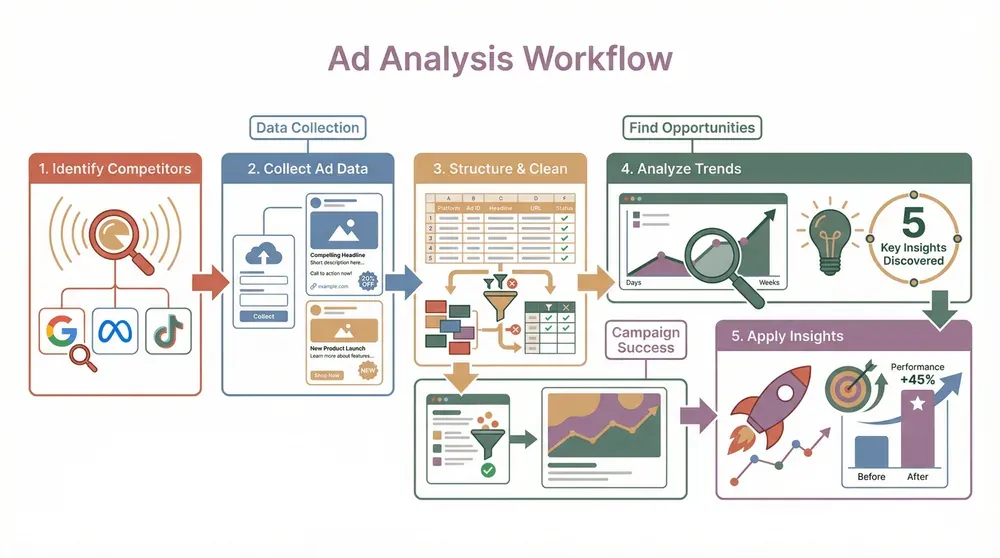
- Identify competitors and platforms (Google, Meta, TikTok, etc.)
- Collect ad data (copy, visuals, URLs, offers)
- Structure and clean the data
- Analyze for trends, gaps, and opportunities
- Apply insights to your own campaigns
Traditional vs. Modern Approaches to Researching Competitor Ads
Let’s put the old and new head-to-head:
| Aspect | Traditional Methods | Modern (Web Scraping & AI) |
|---|---|---|
| Data Depth | High-level, often incomplete | Granular: full ad copy, images, URLs, CTAs |
| Speed | Manual, slow, limited sample size | Automated, scalable, real-time |
| Accuracy | Prone to human error, outdated snapshots | Consistent, up-to-date, repeatable |
| Customization | Rigid, one-size-fits-all reports | Fully customizable fields, segments |
| Cost | Expensive agency fees or tool subscriptions | Low-cost, pay-as-you-go, or free |
| Outcome | General trends, limited actionable insights | Actionable, campaign-ready data |
Traditional tools like SEMrush, SpyFu, and Adbeat provide keyword and spend estimates, but often miss the creative “why” behind the ads (AgencyAnalytics). Official transparency resources and careful landing-page review can reveal the actual message, offer, and creative strategy behind an ad.
Collecting Competitor Ad Data with Web Scraping
Here’s where things get interesting. Web scraping lets you gather competitor ad data directly from the source—no more relying on third-party summaries or outdated screenshots. Instead, you can:
- Extract real ad copy, images, and offers from Google Ads, Meta Ad Library, TikTok, and more
- Capture landing page URLs to see the full conversion flow
- Analyze creative trends and targeting clues (like audience segments or geo-targeting)
For Meta advertising research, use the fields and filters made available through Meta Ad Library and keep a documented record of each observation.
Key Platforms for Ad Scraping
- Google Ads Transparency Center: See search and display ads by brand or keyword (Panoramata)
- Meta Ad Library: Browse Facebook and Instagram ads by advertiser
- TikTok Ad Library: Explore TikTok ad creatives and trends
- LinkedIn Ads: View sponsored content and targeting details
Key Data Points to Capture When Researching Competitor Ads
When you’re scraping competitor ads, focus on these fields:
- Ad Copy: Headlines, descriptions, and body text—reveals messaging and value props
- Visuals: Images, videos, and design elements—shows creative style and trends
- Offer Details: Discounts, bundles, limited-time promos—spot what’s converting
- Landing Page URLs: Where the ad sends users—analyze congruence and funnel
- Call-to-Action (CTA): “Shop Now,” “Learn More,” etc.—see what’s driving clicks
- Targeting Signals: Geo, audience, device, or keyword clues (when available)
- Ad Duration & Frequency: How long and how often ads run—spot evergreen vs. seasonal plays
Why does this matter? Because structured, granular data lets you benchmark, compare, and optimize—rather than just “admire” your competitors’ ads from afar (Kaya).
A Documented Workflow for Competitor Ad Research
Start with official transparency resources such as Google Ads Transparency Center and Meta Ad Library. Define the competitors, markets, time period, and questions before collecting observations. Record the source URL, advertiser, date, visible copy, creative format, offer, and why the example matters.
For a public landing page linked from an ad, review the visible offer, message, conversion path, and proof points manually. Follow the website's terms and privacy requirements when retaining information. Do not treat Meta Ad Library as a source for automated extraction, scheduled collection, or account-based access.
Analyzing and Interpreting Competitor Ad Data
Now comes the fun part—turning raw data into insights.
Key Metrics to Evaluate
- Ad Frequency & Duration: Which ads run the longest? Evergreen ads often signal top performers (Panoramata).
- Creative Variations: How many versions of the same offer or message? Spot A/B tests and creative trends.
- Engagement Signals: Look for clues like “likes,” “shares,” or comments (when available).
- Landing Page Congruence: Is the landing page aligned with the ad? Consistency boosts conversions.
- Offer Types: Are competitors pushing discounts, bundles, or free trials? Track what’s trending.
Simple Analysis Framework
- Frequency Counts: Which headlines, CTAs, or offers appear most often?
- Trend Spotting: Are there seasonal spikes or new creative formats?
- Gap Analysis: What are your competitors missing? (e.g., no video ads, weak CTAs)
- SWOT Analysis: Strengths, weaknesses, opportunities, and threats in competitor ad strategy (Kaya).
Leveraging AI to Enhance Competitor Ad Analysis
AI can help organise observations that your team has lawfully recorded: group messages by theme, compare offers, identify repeated creative patterns, and turn evidence into testable hypotheses. Keep the original source and date alongside each conclusion so it can be checked later.
Turning Insights into Action: Optimizing Your Own Ad Strategy
So, you’ve got the data—now what? Here’s how to put your findings to work:
- Test new creative concepts: Borrow high-performing headlines, visuals, or CTAs (with your own twist).
- Refine offers: If competitors are pushing “20% off,” try a bundle or a stronger guarantee.
- Adjust targeting: Spot gaps in competitor targeting (like underserved geos or segments) and fill them.
- Monitor continuously: Set up recurring scrapes to stay ahead of new campaigns and trends.
The best teams treat competitor ad research as an ongoing process—not a one-time project. Continuous monitoring means you’re always ready to pivot and outmaneuver the competition.
Conclusion & Key Takeaways
Competitor-ad research is most useful when it begins with a decision, uses official transparency resources, documents the evidence, and turns patterns into a testable hypothesis. For Meta advertising, work only with the information Meta makes available through its official transparency resource.
Learn More




