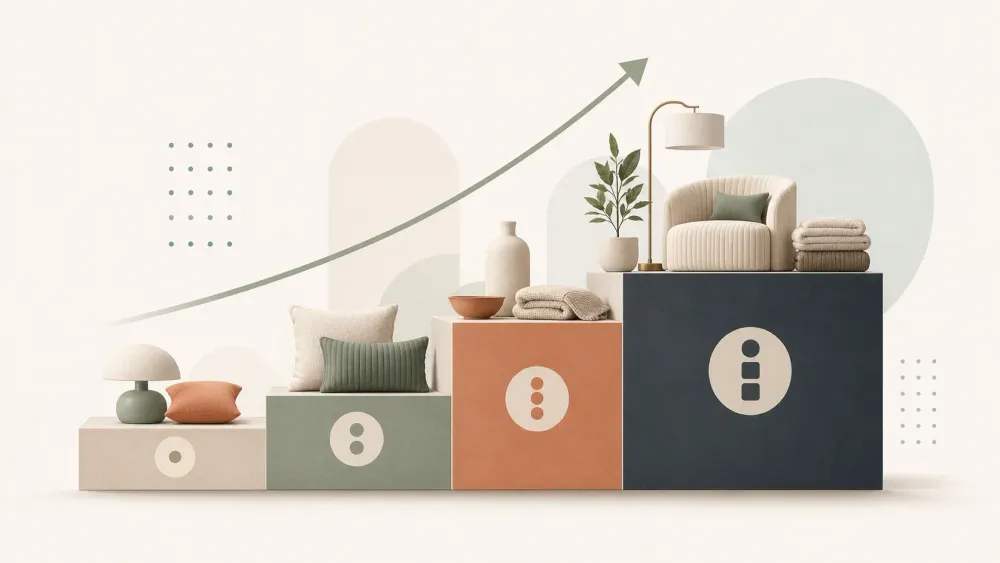
If you run an ecommerce brand, it is easy to think about conversion in terms of popups, discounts, reviews, and cart upsells. Those tactics matter. But before a shopper ever reaches the cart, your catalog has already shaped how much they are likely to spend.
We analyzed 503 product rows from 27 DTC home brands across kitchen, bedding, cleaning, fragrance, bath, and home goods categories. The clearest pattern was not simply “brands discount products” or “brands offer bundles.” The stronger pattern was this:
DTC home brands grow first-order AOV by building price ladders.
A good price ladder gives shoppers multiple ways to enter and move up:
- A low-risk entry item
- A mid-priced hero product
- A higher-value set or kit
- A premium bundle or system
- A refill or add-on path for repeat purchase
For ecommerce operators, this is the real question: does your product catalog guide first-time buyers from trial to commitment?
Try Thunderbit for Ecommerce Catalog Research
Key Data Points
| Metric | Result |
|---|---|
| Product rows analyzed | 503 |
| Brands identified | 27 |
| Rows with parseable prices | 295 |
| Median parsed product price | $135 |
| Bundle/set/kit-type product rows | 97 |
| Median bundle/set price | $219.30 |
| Median non-bundle price | $104.50 |
| Average visible sale discount | 36.5% |
What We Analyzed
The dataset came from product listing pages, not full product pages or checkout flows. That means this analysis focuses on catalog strategy rather than onsite conversion modules.
We looked at:
- Product prices
- Price ranges
- Sale-price signals
- Product name patterns such as
set,bundle,kit,starter, andrefill - Brand-level price spread
- Variant density, using repeated product names as a proxy
- Product architecture models across brands
This data cannot tell us whether a popup converted or whether a product page FAQ improved conversion. But it can show how brands structure their catalogs to influence order value.
1. Price Ladders Beat Single Price Points
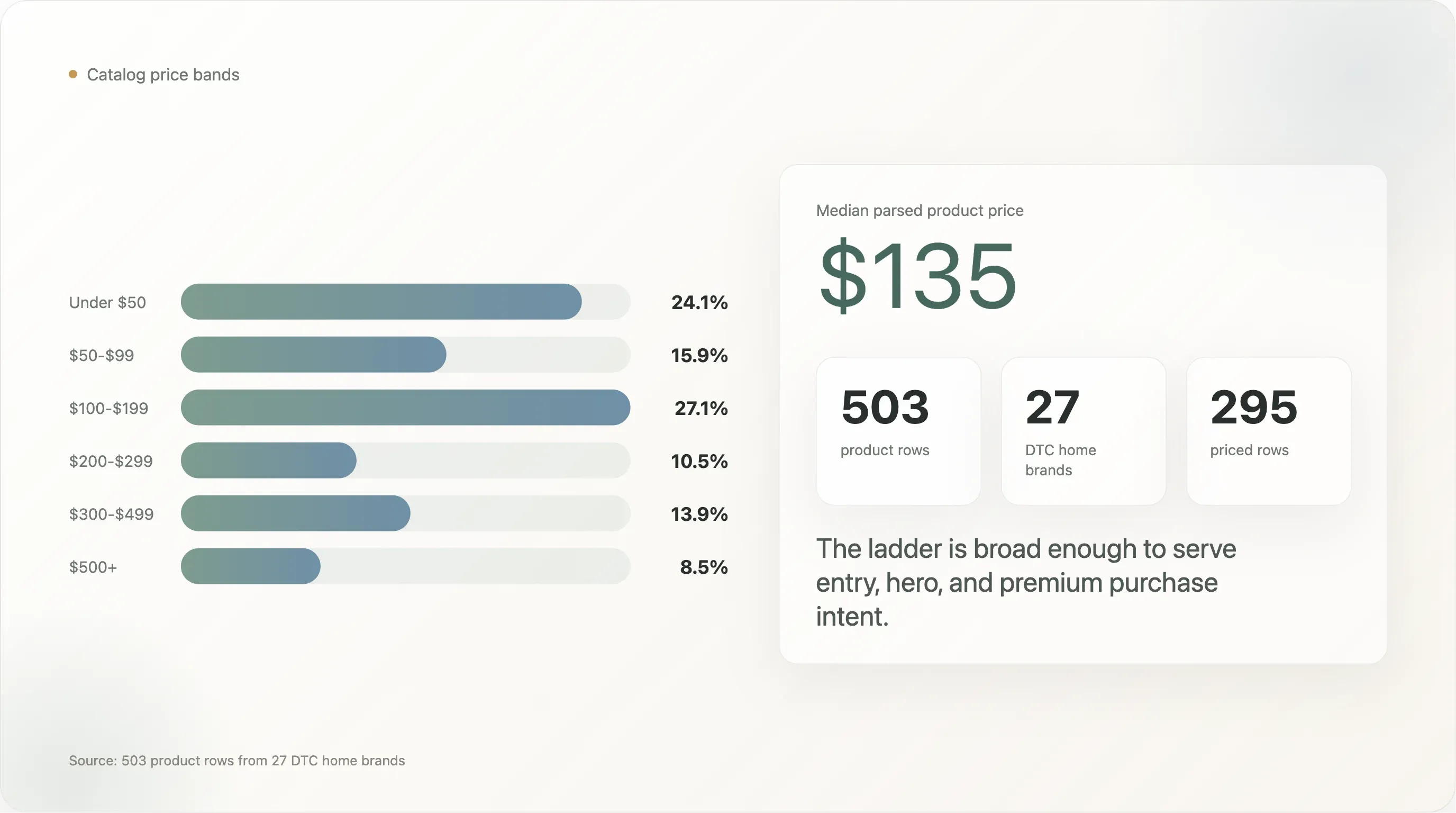
Across 295 products with parseable prices, the median price was $135. But the more useful insight is the spread.
| Price band | Product rows | Share of priced rows | Bundle/set signal rows |
|---|---|---|---|
| Under $50 | 71 | 24.1% | 5 |
| $50-$99 | 47 | 15.9% | 16 |
| $100-$199 | 80 | 27.1% | 24 |
| $200-$299 | 31 | 10.5% | 16 |
| $300-$499 | 41 | 13.9% | 21 |
| $500+ | 25 | 8.5% | 15 |
The lowest products reduce friction. The middle of the ladder captures mainstream demand. The top of the ladder is where sets, bundles, and premium systems become more common.
This matters because many ecommerce brands obsess over one “ideal” product price. Mature DTC brands often do something different: they create a ladder that supports different buyer intents.
For example:
- A cautious shopper may start with a refill, accessory, or smaller item.
- A ready-to-buy shopper may choose the hero product.
- A high-intent shopper may buy the complete set.
- A returning shopper may come back for refills or add-ons.
That is catalog design, not just pricing.
2. Bundles Are Not Just Upsells. They Are AOV Products.
The clearest AOV signal in the data is the gap between bundle/set products and non-bundle products.
| Product group | Rows | Median price | Average price |
|---|---|---|---|
| Bundle, set, kit, starter, duo, pack, or complete signal | 97 | $219.30 | $290.93 |
| No bundle signal | 198 | $104.50 | $160.66 |
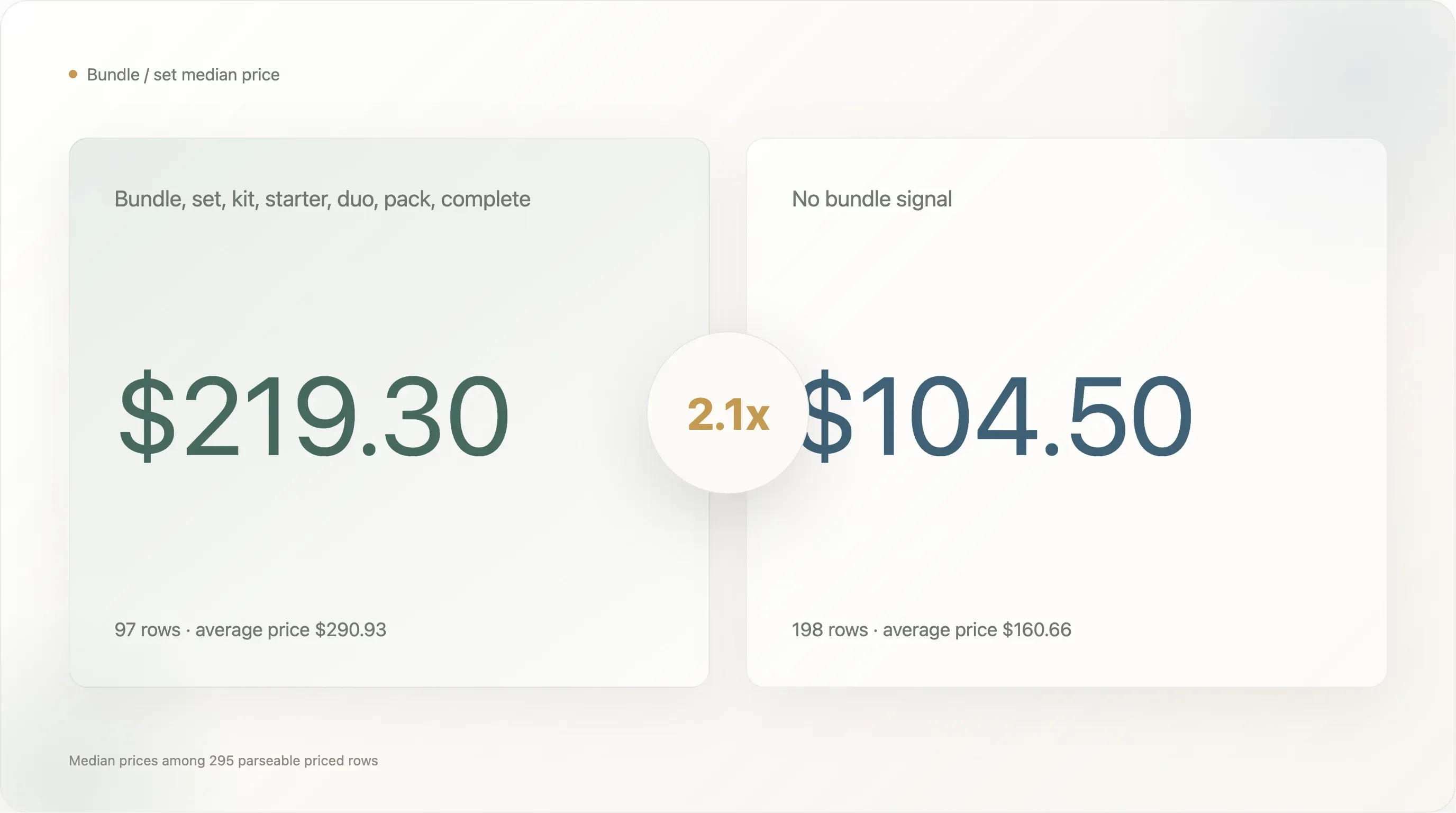
Products with a bundle or set signal had a median price about 2.1x higher than products without one.
For ecommerce teams, the takeaway is direct: a bundle should not only be a cart upsell or a temporary promotion. In many categories, the bundle should be treated as a core product.
That means:
- Give it a real product page.
- Position it as the easiest way to buy the category.
- Explain what problem the set solves.
- Show the value compared with buying separately.
- Make it visible before checkout, not only after add-to-cart.
If the bundle only appears in the cart, you are asking customers to upgrade after they have already made a decision. If the bundle is part of the catalog, you can shape the decision earlier.
3. “Set” Is Often Stronger Than “Bundle”
One small but useful detail: set appeared much more often than bundle.
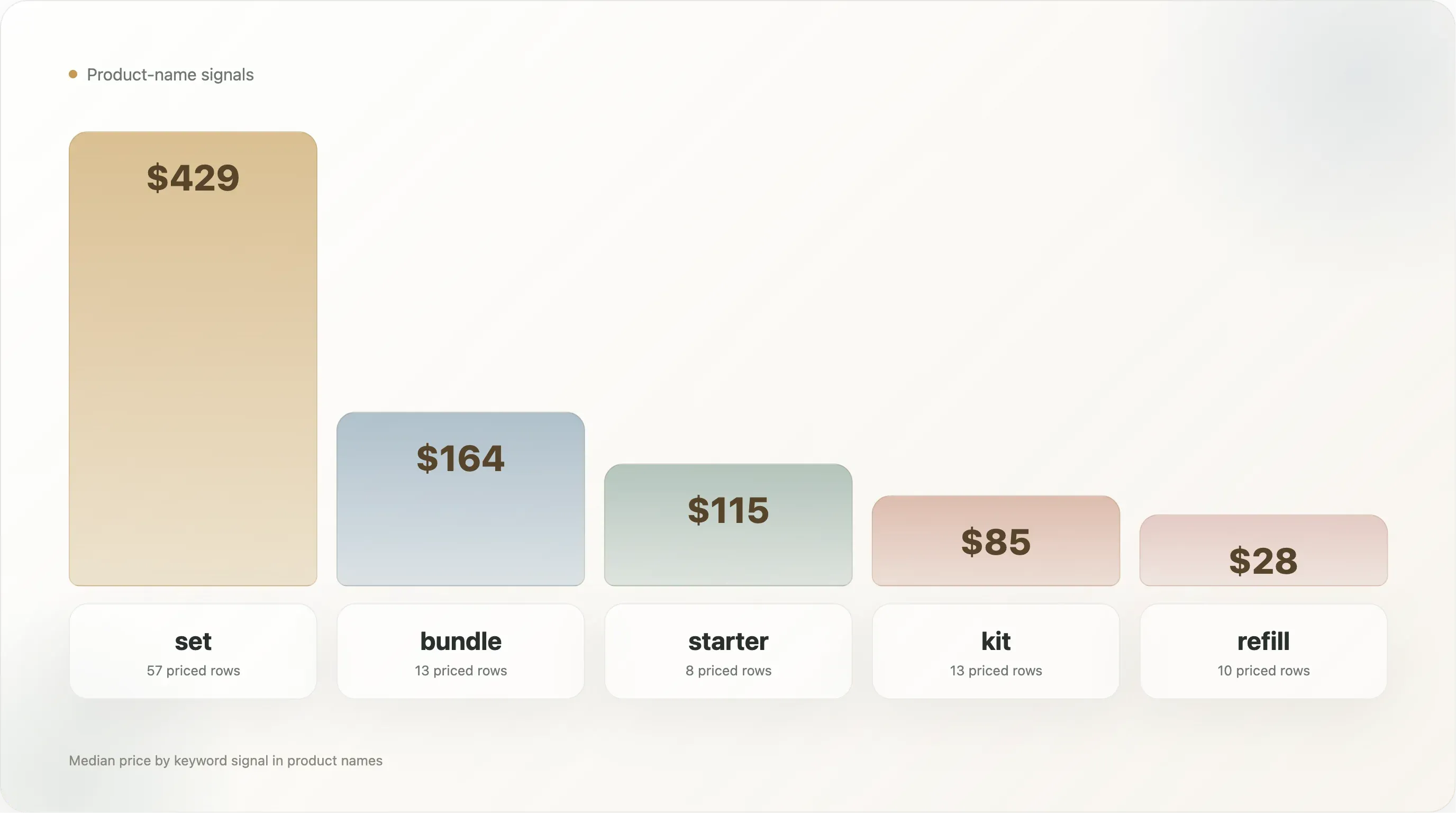
| Keyword signal | Product rows | Priced rows | Median price |
|---|---|---|---|
| set | 70 | 57 | $429.00 |
| kit | 24 | 13 | $85.00 |
| bundle | 18 | 13 | $164.48 |
| starter | 12 | 8 | $115.00 |
| refill | 11 | 10 | $27.99 |
This wording matters.
A “bundle” can sound like a deal. A “set” can sound like the natural way to buy the product. For home, kitchen, bedding, and bath categories, that distinction is important because shoppers are often buying for a use case, not just buying one isolated SKU.
Examples:
- Cookware Set
- Small Spaces Set
- Bamboo Sheet Set
- Ultimate Starter Kit
- Scent Refill
For ecommerce operators, this is a merchandising lesson: do not only ask, “Should we bundle these products?” Ask, “What should the default unit of purchase be?”
4. Some Brands Use Bundles to Move Buyers Much Higher
The size of the bundle premium varies a lot by brand.
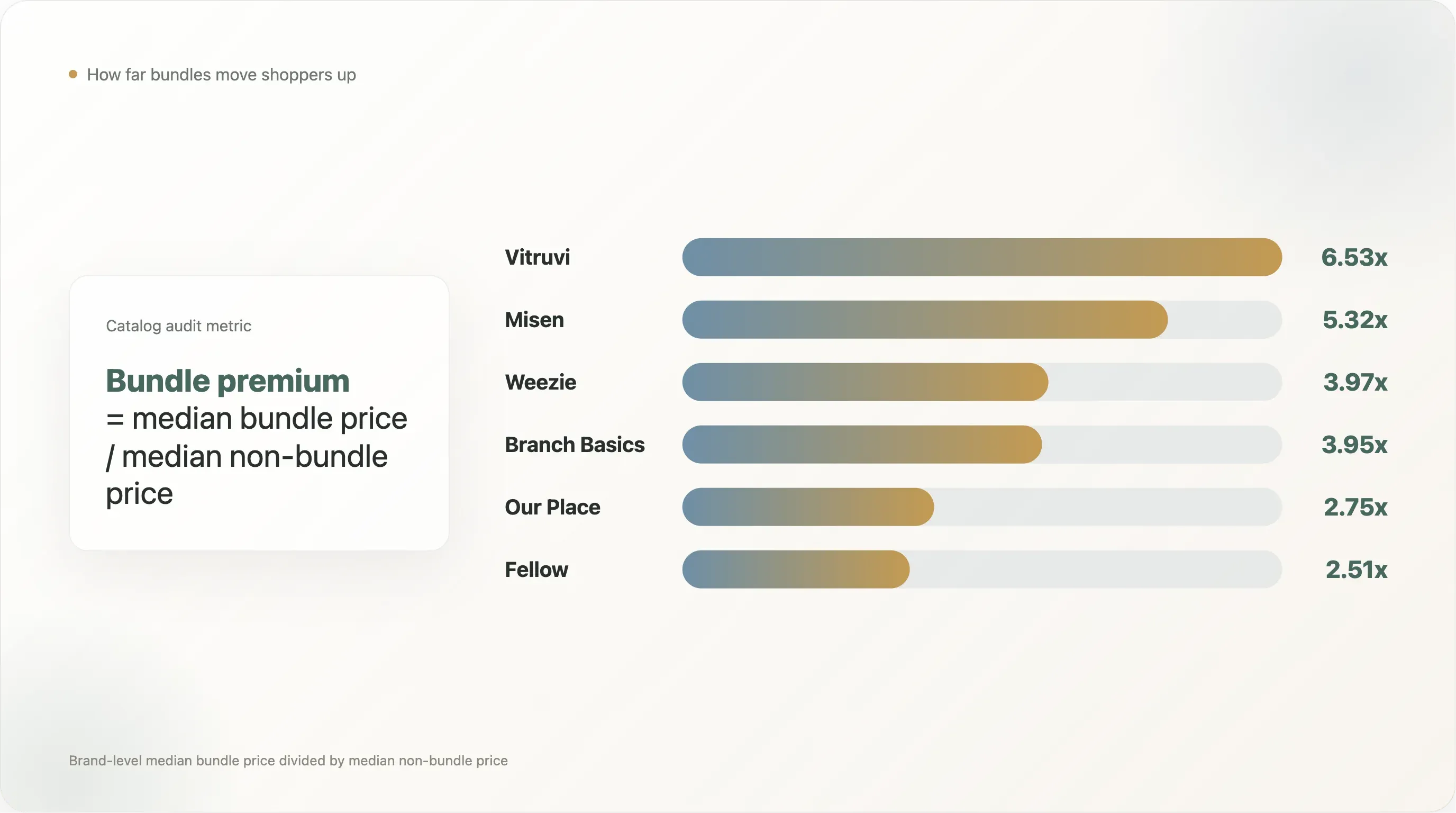
| Brand | Bundle/set median price | Non-bundle median price | Bundle premium |
|---|---|---|---|
| Vitruvi | $131.59 | $20.14 | 6.53x |
| Misen | $394.00 | $74.00 | 5.32x |
| Weezie | $282.20 | $71.00 | 3.97x |
| Branch Basics | $87.00 | $22.00 | 3.95x |
| Our Place | $499.95 | $182.00 | 2.75x |
| Fellow | $110.45 | $44.08 | 2.51x |
This is more useful than simply counting bundles. The real question is: how far does the bundle move the customer up the ladder?
For Vitruvi, individual products and refills sit near the low end, while diffuser kits move shoppers into a higher price tier. For Our Place, individual cookware sits lower, while cookware sets move customers toward a much higher order value.
If you operate an ecommerce store, calculate this for your own catalog:
Bundle premium = median bundle price / median non-bundle product price
If the result is close to 1.0x, your bundles may not be doing enough AOV work. If it is too high, you may need a mid-tier kit to bridge the gap.
5. Starter Kits Are the Bridge Between Trial and Commitment
Starter products had a median price of $115. Refills and consumables had a median price of $27.99.
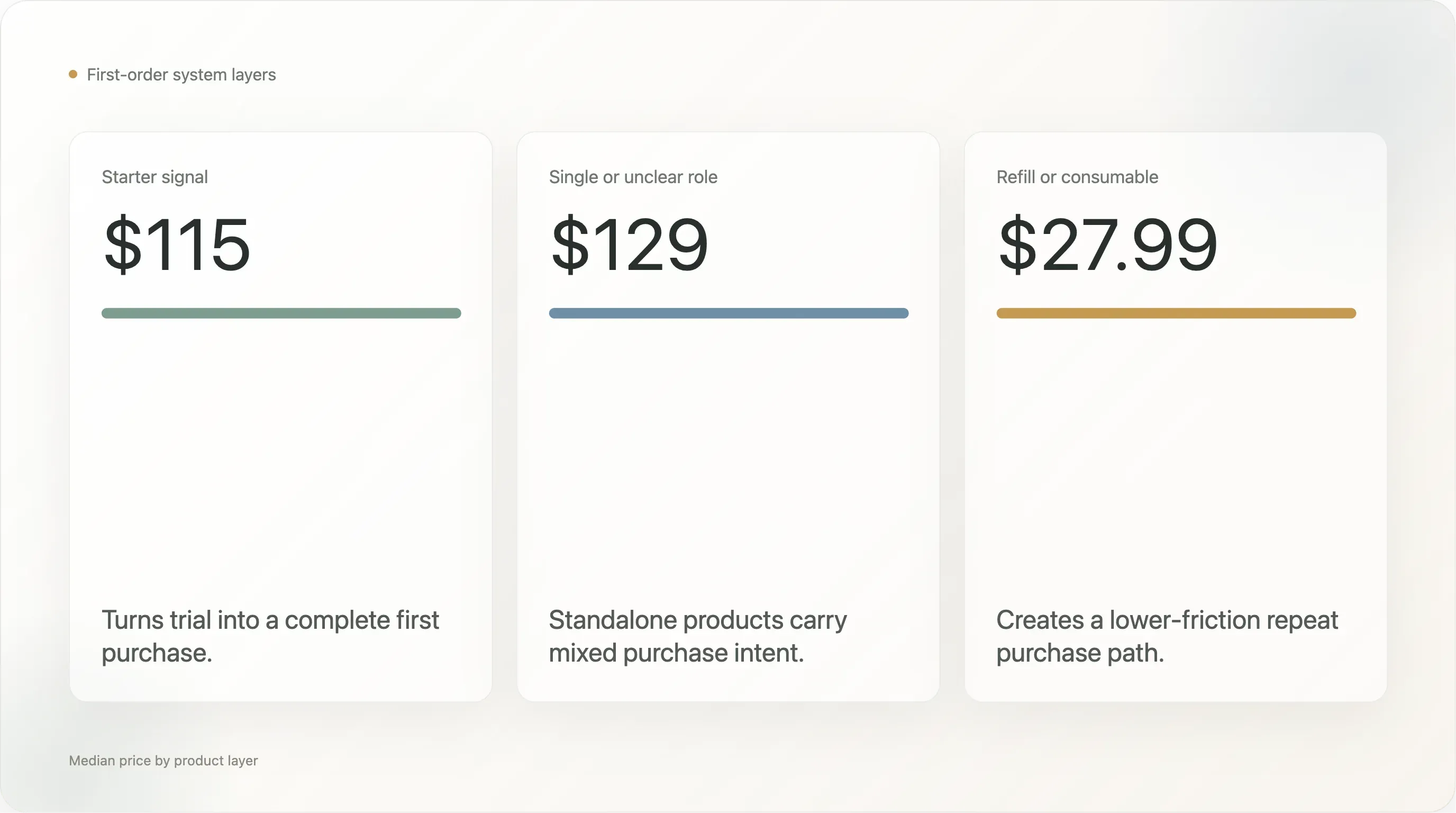
| Product layer | Rows | Median price | Commercial role |
|---|---|---|---|
| Starter signal | 8 | $115.00 | Turns trial into a complete first purchase |
| Refill or consumable signal | 24 | $27.99 | Supports repeat purchase |
| Single or unclear product role | 177 | $129.00 | Mix of standalone products |
This is especially relevant for categories like cleaning, fragrance, coffee, skincare, kitchen tools, and some bath products.
If customers need multiple components to experience the full value of your product, a starter kit is often better than pushing a single item. It helps customers understand the system.
A strong starter kit should answer:
- What do I need to get started?
- Why are these products grouped together?
- How long will this last?
- What do I buy next?
- Is this cheaper or easier than buying separately?
The refill layer then gives you a retention path. The starter kit handles acquisition; the refill handles repeat behavior.
6. Some Brands Build Very Wide Price Ladders
A wide price ladder lets a brand serve different levels of intent without forcing everyone into the same product.
| Brand | Lowest parsed price | Median price | Highest parsed price | Price spread |
|---|---|---|---|---|
| Branch Basics | $4.00 | $67.00 | $190.00 | 47.50x |
| Vitruvi | $7.99 | $27.99 | $335.97 | 42.05x |
| Parachute | $14.00 | $94.50 | $350.00 | 25.00x |
| Great Jones | $35.00 | $105.00 | $565.00 | 16.14x |
| Fellow | $21.20 | $49.95 | $339.95 | 16.04x |
Branch Basics and Vitruvi are good examples of wide ladders. They offer low-priced entry items, but they also have higher-priced kits or systems. That lets them serve both cautious first-time buyers and higher-intent shoppers.
This is a practical audit for ecommerce teams:
- What is your lowest-risk entry product?
- What is your main hero product?
- What is your best AOV-building set?
- What is your premium version?
- What does the customer buy next?
If those layers are missing, your store may be relying too heavily on discounts or cart upsells.
7. Variants Can Create Choice Without Catalog Sprawl
Product row count does not always mean true SKU breadth. Some brands have many rows because the same product appears in multiple colors, materials, sizes, or configurations.
| Brand | Product rows | Unique product names | Variant or duplicate rows | Variant density |
|---|---|---|---|---|
| Our Place | 47 | 10 | 37 | 78.7% |
| Misen | 6 | 3 | 3 | 50.0% |
| Fellow | 48 | 31 | 17 | 35.4% |
| Branch Basics | 36 | 25 | 11 | 30.6% |
| Cozy Earth | 46 | 36 | 10 | 21.7% |
Our Place is the clearest example. It had 47 product rows but only 10 unique product names. That suggests a strategy built around a smaller number of recognizable products with many variants.
For design-led home brands, this can be powerful. Variants create choice without forcing the brand to constantly launch unrelated products.
But there is a tradeoff:
- Too few variants can make the product feel less personal.
- Too many variants can increase decision friction.
- The best variant strategy needs clear defaults, strong visuals, and simple comparison.
If variants are part of your AOV strategy, do not hide the best-selling option. Give customers a default path.
8. Discount-Led and Architecture-Led Brands Behave Differently
Only 26 of the 295 priced rows showed a visible original-price-plus-sale-price signal. Those rows were concentrated mainly in Cozy Earth and Big Blanket Co.
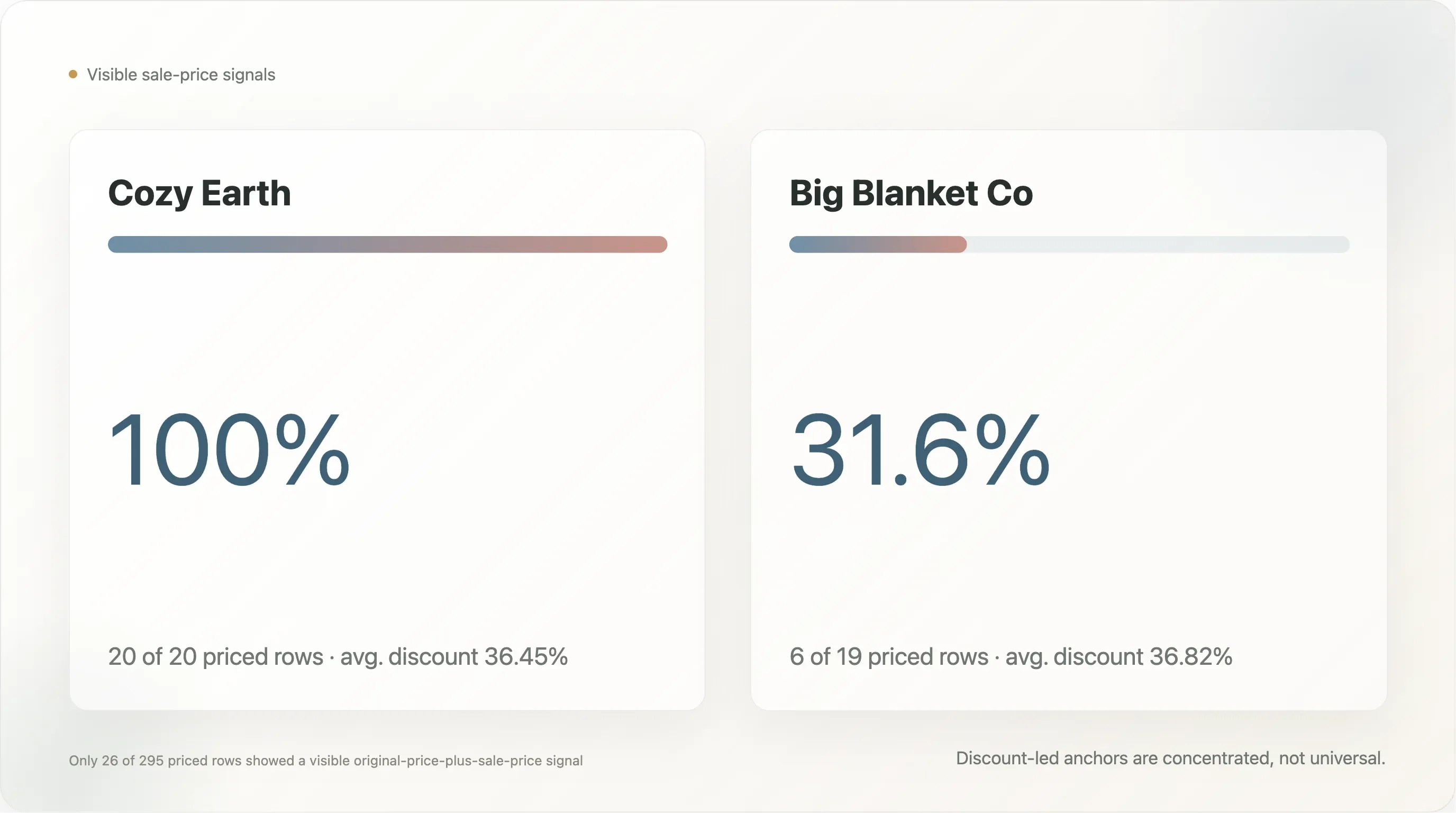
| Brand | Priced rows | Visible sale-price rows | Sale signal share | Average discount on sale rows |
|---|---|---|---|---|
| Cozy Earth | 20 | 20 | 100.0% | 36.45% |
| Big Blanket Co | 19 | 6 | 31.6% | 36.82% |
This does not mean other brands are not using value strategy. It means the value anchor is different.
Some brands are more discount-led. They show the markdown clearly.
Other brands are more architecture-led. They use sets, kits, variants, starter paths, and refill paths to make a higher-value purchase feel natural.
For ecommerce operators, both approaches can work. The risk is using discounts as a substitute for product architecture.
Before increasing your first-order discount, ask:
- Do we have a clear starter kit?
- Do we have a strong set offer?
- Is our best AOV product visible early enough?
- Do our product names communicate value?
- Is there a repeat-purchase path after the first order?
If the answer is no, the discount may be compensating for a weak catalog structure.
9. Five Catalog Models Ecommerce Teams Can Use
Based on the data, DTC home brands tend to fall into five catalog models.
| Catalog model | Example brands | Core mechanism |
|---|---|---|
| Hero product / premium hardware | Ooni, Tushy, Dorai Home | Fewer core products, higher education burden, stronger need for PDP clarity |
| Set-driven AOV model | Our Place, Caraway, Made In, Cozy Earth, Misen, Weezie | Multi-item purchases feel like the default SKU |
| Starter + refill model | Branch Basics, Vitruvi, Dropps, Blueland | First order seeds a system; refills support repeat purchase |
| Variant-led choice model | Our Place, Fellow, Branch Basics, Cozy Earth | Choice expands through color, material, size, or configuration |
| Discount-led price anchor model | Cozy Earth, Big Blanket Co | Visible original/sale pricing creates immediate value perception |
These models are not mutually exclusive. A brand can be set-driven and variant-led. A brand can also be starter/refill and discount-led.
The point is not to copy one model exactly. The point is to know which model your catalog is actually using.
Practical Checklist for Ecommerce Teams
Use this as a quick catalog audit:
- Entry product: Do we have a low-risk way for new shoppers to try us?
- Hero product: Is there a clear main product or category anchor?
- AOV product: Do we have a set, kit, or bundle that meaningfully increases order value?
- Starter path: If the product works as a system, do we sell it as a system?
- Refill path: If the product is consumable, is the repeat purchase obvious?
- Variant strategy: Do variants create useful choice or unnecessary friction?
- Value anchor: Are we relying on discounts, architecture, or both?
- Default option: Is the best first purchase easy to identify?
If you cannot answer these questions clearly, the issue may not be your popup, ad creative, or checkout. It may be your catalog.
Conclusion: AOV Is Designed Before the Cart
The main lesson from this dataset is simple: first-order AOV is shaped before checkout. It starts with how the catalog is structured.
Strong DTC home brands give cautious buyers a low-risk entry point, serious buyers a complete set, repeat buyers a refill path, and design-sensitive buyers enough variants to feel the product fits their home.
That is why the best ecommerce question is not only:
Should we offer 10% off?
It is:
Does our catalog give first-time buyers a clear path from trial to commitment?
For many brands, the biggest AOV opportunity is not another discount. It is a better price ladder.
Data note: This article is based on cleaned product listing data from local research files. It uses derived fields for normalized price, bundle/set signals, starter/refill signals, sale-price signals, variant density, and price spread. It does not use homepage, popup, PDP review, FAQ, or cart data because those fields were not available in the crawl.
Try AI Web Scraper for Catalog Research Get Started Free
Learn More