
It's wild to think how quickly "AI assistant" has gone from a buzzword to a boardroom staple. Just a few years ago, most enterprise leaders were still debating whether generative AI was hype or real. Now, in 2026, the numbers speak for themselves: 88% of organizations use AI in at least one business function, and the race to deploy assistants like Claude and Gemini is in full swing. I've been tracking enterprise AI for years, and I can honestly say I've never seen technology adoption move this fast—or reshape so many industries at once.
But what's really happening on the ground? How fast are Claude and Gemini growing in the enterprise, and what does that mean for business leaders, IT teams, and anyone trying to future-proof their company? In this deep dive, I'll break down the latest Claude Gemini enterprise adoption statistics, usage trends in businesses, and what's driving this explosive growth. Whether you're a CTO, a strategist, or just someone who wants to keep your finger on the pulse of enterprise AI, this is the data you need for 2026.
Try Thunderbit for AI-powered web scraping
Claude Gemini Enterprise Adoption: Top Statistics for 2026
Let's kick things off with the headline numbers—the kind you'll want to drop in your next exec meeting or strategy deck. These are the most recent, credible stats on Claude and Gemini's enterprise footprint, pulled straight from vendor disclosures, analyst reports, and independent research.
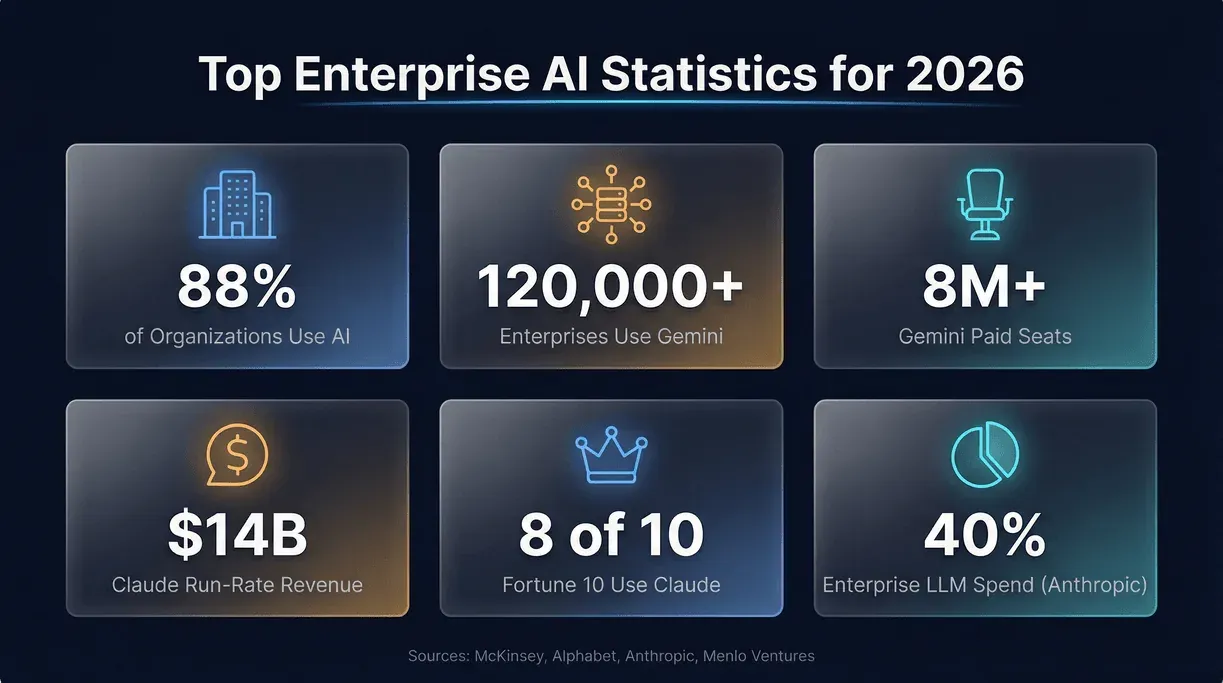
- 120,000+ enterprises are now using Gemini, according to Alphabet's Q4 2025 earnings call. That's a staggering number, especially considering Gemini Enterprise was launched just months ago.
- 8 million+ paid seats of Gemini Enterprise have been sold, with over 2,800 companies buying paid seats in the first four months (blog.google).
- Gemini Enterprise managed over 5 billion customer interactions in Q4 2025, a 65% year-over-year increase (abc.xyz).
- 95% of the top 20 SaaS companies and over 80% of the top 100 use Gemini (abc.xyz).
- Claude's annualized run-rate revenue crossed $30 billion by early April 2026 — up from roughly $14 billion in February and $19 billion in March, a trajectory Anthropic itself has described as "crazy" (pymnts.com, venturebeat.com). The number of customers spending over $100,000 annually on Claude grew 7× in the past year (anthropic.com).
- More than 1,000 customers now spend over $1 million annually on Claude — a figure that has more than doubled since February 2026, when the count was around 500 (pymnts.com). Eight of the Fortune 10 are Claude customers (anthropic.com).
- 300,000+ business customers are served by Anthropic (Claude), accounting for 80% of its revenue (reuters.com).
- Enterprise LLM spend is shifting rapidly: By 2025, Anthropic earned 40% of enterprise LLM spend, up from 12% just two years prior (menlovc.com).
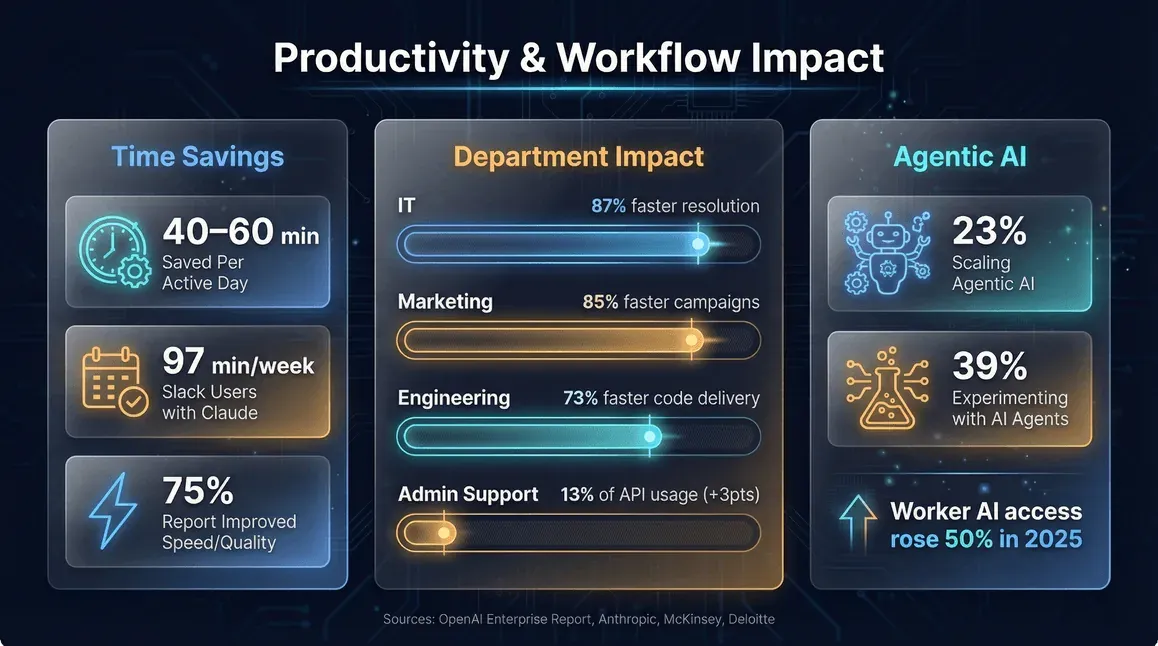
- Agentic AI systems are scaling: 23% of enterprises report scaling agentic AI, and 39% are experimenting with AI agents in 2026 (mckinsey.com).
- Worker access to AI rose by 50% in 2025, according to Deloitte's 2026 enterprise AI report (deloitte.com).
What do these numbers mean in practice? For one, we're seeing a shift from "pilot projects" to full-scale deployments. The fact that 95% of the top SaaS companies are using Gemini, and eight of the Fortune 10 are on Claude, tells you this isn't just hype—it's a foundational change in how business gets done.
Claude Gemini Enterprise User Growth: 2026 Trends
The pace of user growth for Claude and Gemini in the enterprise is, frankly, unprecedented. Let's break down what's driving this surge, which industries are leading the way, and what it means for the broader AI ecosystem.
Year-over-Year Growth and Adoption Momentum
Gemini Enterprise's launch has been nothing short of explosive. In its first four months, it racked up over 8 million paid seats and was adopted by 2,800+ companies (blog.google). And the momentum hasn't tapered off: on Alphabet's Q1 2026 earnings call (April 29, 2026), management reported 40% quarter-over-quarter growth in paid monthly active users of Gemini Enterprise and 9× year-over-year growth in seats sold through partners (blog.google). That's not just a fast start — it's a sign that enterprises are hungry for AI solutions that integrate directly into their existing productivity suites.
Claude, meanwhile, has seen its enterprise customer base skyrocket. The number of organizations spending over $100,000 annually on Claude grew 7× in the past year (anthropic.com). Anthropic's business customer count surpassed 300,000 by late 2025 (reuters.com), and the company now boasts a $14B run-rate revenue.
What's fueling this growth? It's not just the novelty of AI—it's the clear, measurable ROI that enterprises are seeing. From automating customer support to accelerating product development, these assistants are delivering real business value.
Industry and Regional Leaders
Industry concentration is a major theme. Technology, media, telecom, and healthcare are leading sectors for AI adoption (mckinsey.com). In these industries, the pressure to innovate—and the volume of data to manage—make AI assistants a natural fit.
IT and knowledge management functions are at the forefront of agentic AI adoption. These teams are using Claude and Gemini to automate everything from ticket triage to document summarization, freeing up skilled workers for higher-value tasks.
Regional growth is also accelerating. While the U.S. remains the largest market, international adoption is surging. OpenAI's enterprise report highlights markets like Australia, Brazil, Netherlands, and France growing at 143%+ year-over-year (openai.com). Gemini and Claude are both seeing rapid uptake in EMEA and APAC, especially among multinational corporations that need consistent, scalable AI solutions across borders.
Visualizing the Growth
| Metric | Claude (Anthropic) | Gemini (Alphabet) |
|---|---|---|
| Business Customers | 300,000+ (as of late 2025) | 120,000+ (as of Q4 2025) |
| Paid Seats | N/A | 8M+ (first 4 months of Gemini Enterprise) |
| Customers Spending >$100k/yr | 7× YoY growth | N/A |
| Customers Spending >$1M/yr | 1,000+ (April 2026) | N/A |
| Fortune 10 Penetration | 8/10 | 95% of Top 20 SaaS |
| Annual Revenue Run-Rate | $30B (April 2026) | N/A |
| Paid MAU Growth (latest qtr) | N/A | 40% QoQ (Q1 2026) |
| YoY Growth in Interactions | N/A | 65% (Q4 2025) |
Sources: anthropic.com, pymnts.com, blog.google, abc.xyz, reuters.com
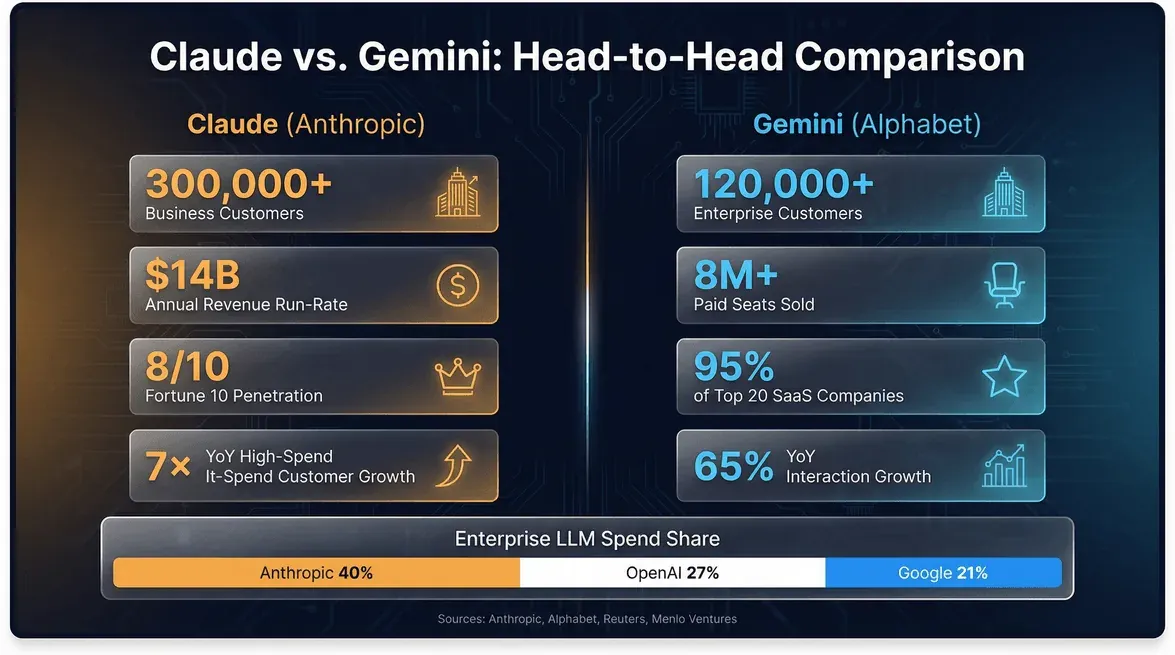 The takeaway? We're not just seeing growth—we're seeing compounding growth, with adoption rates accelerating year over year. For anyone betting on the future of enterprise AI, these are the numbers to watch.
Large Enterprise Deployment: Claude Gemini in the Global 50
When it comes to the world's largest organizations, the adoption of Claude and Gemini is especially pronounced—and for good reason. These companies have the most to gain (and the most to lose) from digital transformation, and they're not waiting around for the competition to catch up.
Penetration Among the Largest Enterprises
- Eight of the Fortune 10 are now Claude customers (anthropic.com). That's a level of market penetration that would make any SaaS vendor jealous.
- 95% of the top 20 SaaS companies and over 80% of the top 100 use Gemini (abc.xyz). This isn't just a "nice to have"—it's becoming table stakes for staying competitive.
Why Are Large Enterprises Deploying Claude and Gemini?
Process Optimization is a big driver. Both assistants are being used to automate back-office workflows, streamline knowledge management, and support customer service at scale. For example, Gemini's integration into Google Workspace means that AI-powered features are available right where employees already work—no extra logins, no new tools to learn (knowledge.workspace.google.com).
Data Analysis and Compliance are also key. Enterprises are leveraging Claude and Gemini for advanced analytics, document processing, and compliance monitoring. In industries like finance and healthcare, where regulatory requirements are strict, the ability to automate and audit workflows is a game-changer.
Security and Governance are non-negotiable at this scale. Adoption is driven by robust admin controls, audit logs, and compliance features (ciodive.com). Both Claude and Gemini offer enterprise-grade security, with features like SOC 2 compliance, HIPAA support, and granular access controls.
Use Case Examples
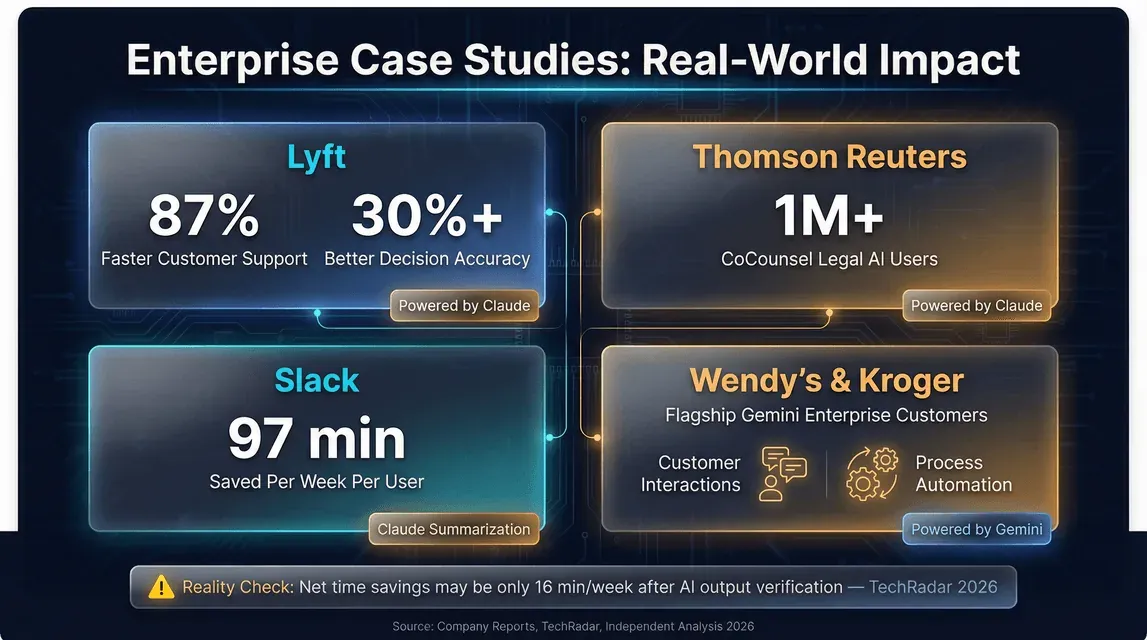
- Lyft: Reduced customer support time by over 87% and improved decision-making accuracy by over 30% with Claude (claude.com). That's not just incremental improvement—it's a fundamental shift in how support is delivered.
- Thomson Reuters: Uses Claude to power its legal AI platform, CoCounsel, which now serves over one million users (claude.com). This has enabled legal teams to automate research, draft documents, and manage compliance more efficiently.
- Wendy's and Kroger were the flagship Gemini Enterprise customers Alphabet pointed to on the Q4 2025 call (abc.xyz). On the Q1 2026 call, the named-customer list broadened well past retail — Bosch, Citi Wealth, Merck, and Mars were called out for Gemini Enterprise deployments, and Sundar Pichai highlighted American Express (agentic commerce on BigQuery), Vodafone (network automation), and Deloitte, Priceline, and Shell (security) as part of the broader Google Cloud AI story (blog.google). Across two quarters, that's a customer mix that's hard to dismiss as "retail experiments."
The lesson? If you're a large enterprise and you're not already deploying Claude or Gemini, you're officially behind the curve.
Claude Gemini's Impact on Enterprise Product Innovation
One of the most exciting trends in enterprise AI is how Claude and Gemini are accelerating product development and driving innovation. This isn't just about automating routine tasks—it's about fundamentally changing how new products and services come to market.
Reducing Time-to-Market
While vendor-neutral, OpenAI's enterprise survey found that 73% of engineers reported faster code delivery with AI assistants (openai.com). Claude and Gemini are being used to automate documentation, summarize requirements, and even generate code snippets. This means that product teams can move from concept to launch faster than ever before.
In my own experience working with SaaS and automation teams, I've seen how AI can cut weeks (sometimes months) off the product development cycle. Teams use Claude to draft specs, Gemini to analyze customer feedback, and suddenly the whole process feels less like herding cats and more like running a well-oiled machine.
Productivity Gains and Workflow Transformation
Slack reports that users saved an average of 97 minutes per week using Claude-enabled summarization and recap features (claude.com). That's more than an hour and a half every week—time that can be reinvested in creative work, strategic planning, or, let's be honest, a much-needed coffee break.
Innovation cycles are also accelerating. Enterprises using Claude and Gemini are able to experiment with new product concepts faster, thanks to AI-driven prototyping, user feedback analysis, and rapid iteration. I've heard from product managers who say that what used to take a quarter now takes a sprint.
Case Study: Legal Tech Transformation
Thomson Reuters' legal AI platform, CoCounsel, powered in part by Claude, crossed one million users and enabled legal teams to automate research, draft documents, and manage compliance more efficiently (claude.com). This is just one example of how AI assistants are reshaping entire industries—not by replacing humans, but by augmenting their capabilities and freeing them to focus on higher-value work.
The bottom line? Claude and Gemini aren't just making existing processes faster—they're enabling entirely new ways of working.
Key Drivers Behind Claude Gemini Enterprise Adoption
So, what's behind the meteoric rise of Claude and Gemini in the enterprise? After digging through the latest surveys, customer interviews, and analyst reports, several consistent themes emerge.
1. Scalability and Seamless Integration
Gemini's integration into Google Workspace is a textbook example of how to drive adoption at scale. By embedding AI features directly into Gmail, Docs, Sheets, and other core apps, Gemini becomes part of the daily workflow for millions of users (knowledge.workspace.google.com). No extra training, no new logins—just smarter tools, right where people already work.
Claude, on the other hand, excels in API-first flexibility. Enterprises can embed Claude into custom workflows, build plugins, and tailor the assistant to their unique needs (anthropic.com). This is especially valuable for companies with complex, domain-specific requirements.
2. Security, Governance, and Trust
At the enterprise level, security and compliance aren't just nice-to-haves—they're deal-breakers. Both Claude and Gemini have invested heavily in features like SOC 2 compliance, HIPAA support, audit logs, and granular admin controls (ciodive.com). This gives IT leaders the confidence to deploy AI at scale, even in regulated industries like finance and healthcare.
Deloitte's 2026 enterprise AI report emphasizes that trust and governance are now the gating factors for large deployments (deloitte.com). Companies want to know that their data is secure, their workflows are auditable, and their AI won't go rogue.
3. User-Friendly Interfaces and Customization
One of the biggest barriers to AI adoption has always been usability. Gemini's suite-embedded experience lowers the barrier for non-technical users, making AI accessible to everyone from sales reps to HR managers (knowledge.workspace.google.com).
Claude's focus on natural language understanding and customization appeals to teams with complex, domain-specific needs. Whether it's legal, healthcare, or financial services, Claude can be tailored to understand the nuances of each industry (anthropic.com).
4. Model Choice and Multi-Model Platforms
Enterprises increasingly want flexibility—using Claude, Gemini, and other models side-by-side, depending on the use case (microsoft.com). Microsoft's Copilot platform, for example, now integrates Claude as an option within its chat experience. This "best tool for the job" approach is becoming the norm, not the exception.
5. Connectors and Context Integration
OpenAI's enterprise report highlights "connectors" as a leading practice, noting that roughly "one in four" enterprises still hasn't enabled deep system integration to provide secure context (openai.com). Gemini and Claude are both investing in connectors, APIs, and plugins that make it easier to pull in data from across the enterprise.
The upshot? The more seamlessly an AI assistant can fit into existing workflows and systems, the faster it gets adopted—and the more value it delivers.
Claude Gemini Usage Trends in Businesses: Workflow and Productivity Gains
Let's get into the nitty-gritty: what does enterprise AI adoption actually look like on the ground? How are Claude and Gemini being used in daily business workflows, and what kind of productivity gains are companies seeing?
Quantitative Productivity Benchmarks
- OpenAI's enterprise worker survey found that users saved 40–60 minutes per active day on average, with 75% reporting improved speed or quality of output (openai.com).
- In IT, 87% of workers reported faster issue resolution; in engineering, 73% reported faster code delivery (openai.com).
- Slack users saved an average of 97 minutes per week with Claude (claude.com).
These aren't just vanity metrics—they translate directly into cost savings, faster project delivery, and happier employees.
Workflow Automation and Strategic Focus
Back-office automation is a major trend. Claude's Economic Index shows that "Office and Administrative Support" tasks now account for 13% of API usage, up 3 points in just three months (anthropic.com). This includes everything from email management to document processing and CRM updates.
Customer support is another area where AI assistants are making a big impact. Lyft cut support time by 87% and improved accuracy by over 30% using Claude (claude.com). That means faster responses for customers and less burnout for support teams.
Knowledge management is being transformed by Gemini, which streamlines document search, summarization, and compliance workflows at scale (abc.xyz). Employees spend less time hunting for information and more time acting on it.
The Real-World Catch: Trust and Verification
It's not all smooth sailing, though. A TechRadar report in March 2026 found that, once you factor in time spent verifying AI output, net weekly time savings can be much smaller—sometimes as little as 16 minutes per week. Trust and verification are real-world bottlenecks, especially in high-stakes workflows like legal, finance, and healthcare.
The lesson? AI assistants can deliver huge productivity gains, but only if they're deployed thoughtfully, with clear guidelines for validation and oversight.
Claude Gemini Corporate Deployment Data: Sector and Regional Insights
Let's zoom in on the sectors and regions where Claude and Gemini are making the biggest waves.
Sector Adoption Patterns
- Technology, Media, Telecom: These industries are leading in both scale and sophistication of deployment (mckinsey.com). They're using AI for everything from code generation to content moderation and customer engagement.
- Healthcare: Rapid growth, especially for document processing, compliance, and patient support (openai.com). AI assistants are helping doctors and nurses spend less time on paperwork and more time with patients.
- Finance and Professional Services: Heavy users of Claude for knowledge management, compliance, and client support (anthropic.com). In banking, for example, AI is being used to automate regulatory reporting and risk analysis.
- Retail and Manufacturing: Fastest-growing sectors for AI-powered automation and analytics (openai.com). From supply chain optimization to personalized marketing, AI is reshaping how goods are made and sold.
Regional Deployment Trends
- North America: Still the largest market by volume, with the U.S. leading global adoption (abc.xyz).
- EMEA and APAC: Experiencing the fastest growth, with notable acceleration in Australia, Brazil, Netherlands, and France (openai.com).
- Japan and Germany: High message-volume markets for enterprise AI (deloitte.com).
Unique Deployment Patterns
- Suite-embedded AI: Gemini's integration into Google Workspace is driving rapid seat growth (knowledge.workspace.google.com). This approach lowers friction and accelerates adoption.
- API-first adoption: Claude's flexibility appeals to enterprises building custom workflows and automations (anthropic.com). Companies with unique needs can tailor Claude to fit their exact requirements.
The big picture? AI adoption is global, cross-industry, and accelerating. If you're not already thinking about how to deploy Claude or Gemini in your sector or region, now's the time to start.
Comparative Analysis: Claude Gemini vs. Other Enterprise AI Assistants in 2026
Let's put Claude and Gemini side by side with other leading enterprise AI assistants like ChatGPT and Microsoft 365 Copilot. How do they compare in terms of adoption, features, and business impact?
| Provider | Business Customers | Paid Seats | Annual Revenue Run-Rate | Fortune 10/Top SaaS Penetration | Notable Use Cases |
|---|---|---|---|---|---|
| Claude (Anthropic) | 300,000+ | N/A | $14B | 8/10 Fortune 10 | Customer support, legal tech, knowledge mgmt |
| Gemini (Alphabet) | 120,000+ | 8M+ | N/A | 95% of Top 20 SaaS | Suite-embedded AI, process automation |
| ChatGPT (OpenAI) | 1M+ | 7M+ | N/A | N/A | Coding, professional services, IT |
| M365 Copilot (Microsoft) | N/A | N/A | N/A | 15M annual users | Productivity, workflow automation |
Sources: anthropic.com, abc.xyz, openai.com, reuters.com
Key Differentiators
- Gemini: Rapid seat growth due to integration with Google Workspace; excels in knowledge management and process automation. Its "in the flow of work" approach is a big reason for its fast adoption.
- Claude: Strong in high-spend enterprise accounts, API-first flexibility, and security/governance features. Its ability to handle complex, domain-specific tasks is a major selling point.
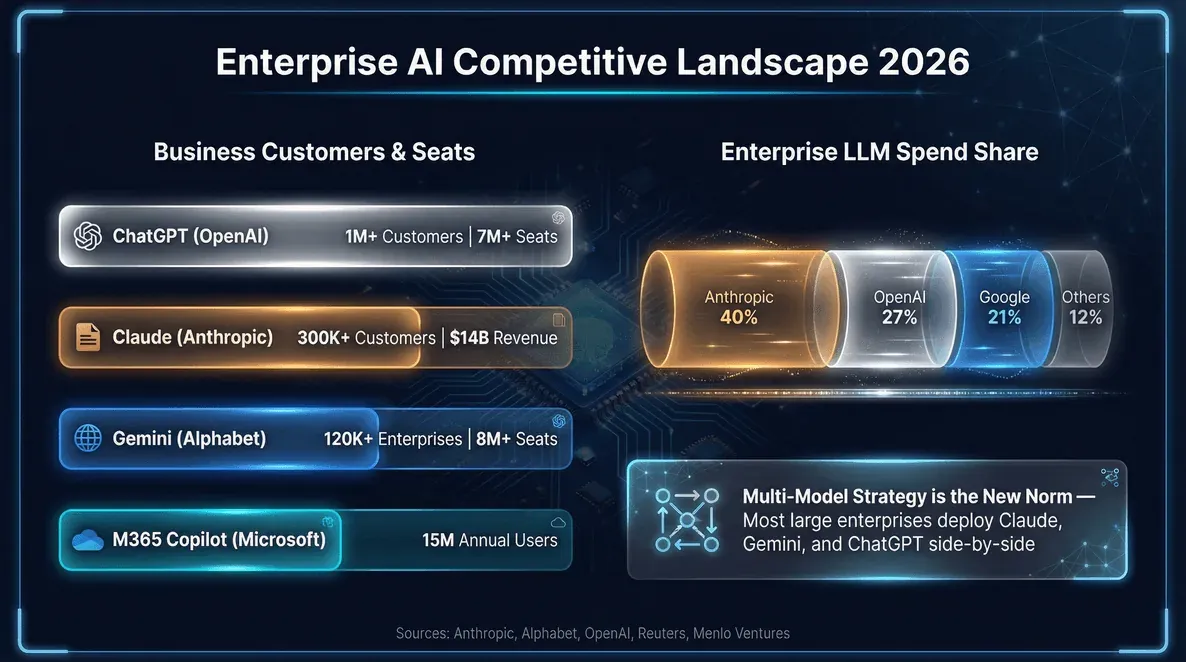
- ChatGPT: Largest business customer base, especially strong in professional services, coding, and IT. Its developer ecosystem and plugin marketplace are unmatched.
- M365 Copilot: Deep integration with Microsoft productivity apps, 15 million annual users. Its strength is in automating everyday office tasks and workflows.
Analyst Commentary
Menlo Ventures estimates that by 2025, Anthropic (Claude) earned 40% of enterprise LLM spend, OpenAI (ChatGPT) had 27%, and Google (Gemini) had 21% (menlovc.com). This shows a rapidly shifting market, with Anthropic and Google gaining share at OpenAI's expense.
The upshot? The enterprise AI assistant market is dynamic, competitive, and growing fast. No single provider dominates every use case, and most large enterprises are adopting a multi-model strategy.
Key Takeaways: Claude Gemini Enterprise Adoption in 2026
Let's wrap up with the most important insights for business leaders, IT teams, and anyone charting their AI strategy for the next year (or the next quarter—because let's be real, things move fast in this space).
- Enterprise AI is mainstream: 88% of organizations use AI in at least one function, and adoption is accelerating across all sectors. If you're not using AI yet, you're officially in the minority.
- Claude and Gemini are leading the charge: With hundreds of thousands of business customers and billions in revenue, these assistants are at the heart of the enterprise AI revolution. Their rapid growth is a signal that AI is no longer a "nice to have"—it's a competitive necessity.
- Growth is fastest in large enterprises and regulated industries: Security, governance, and integration are driving adoption among the Fortune 500 and top SaaS companies. If you're in a regulated industry, expect AI adoption to become a board-level priority.
- Productivity and innovation gains are real—but so are the challenges: While workers report saving up to an hour per day, trust and verification overhead can eat into those gains, especially in high-stakes workflows. Success depends on thoughtful deployment, clear guidelines, and ongoing oversight.
- The future is multi-model and platform-driven: Enterprises increasingly want to use Claude, Gemini, and other models side-by-side, depending on the use case and workflow. Flexibility, integration, and customization are the new battlegrounds.
- Regional and sectoral differences matter: Adoption is global, but the fastest growth is happening in EMEA and APAC, and in sectors like healthcare, finance, and manufacturing. Tailor your AI strategy to your industry and region for maximum impact.
- Suite-embedded and API-first approaches both work: Gemini's integration into Google Workspace and Claude's API-first flexibility show that there's no one-size-fits-all approach to enterprise AI. Choose the model that fits your organization's needs and culture.
If you're making decisions about AI adoption in your organization, the message is clear: the question is no longer "if," but "how fast, how deep, and how well-governed?" And if you're still on the sidelines, you might want to grab a coffee—before the AI does it for you.
Sources and Further Reading
For those who want to dig deeper into the numbers and trends, here's where the data in this article comes from:
- McKinsey, The State of AI 2025
- Alphabet Q4 2025 Earnings Call (Gemini Enterprise adoption)
- Google CEO remarks, Q4 2025
- Anthropic, $14B run-rate and enterprise growth
- Reuters, Anthropic business customer reporting
- OpenAI, 1M+ business customers and productivity survey
- Menlo Ventures, Enterprise LLM spend share
- Deloitte, State of AI in the Enterprise 2026
- TechRadar, AI productivity time savings
- Google Workspace Gemini integration
- CIO Dive, Claude Enterprise plan
- Claude Customer Stories: Lyft, Slack, Thomson Reuters, Slack, Thomson Reuters
FAQs
1. What are the latest statistics on Claude Gemini enterprise adoption in 2026?
The most recent data shows that over 120,000 enterprises use Gemini, with 8 million+ paid seats sold. Claude (Anthropic) serves 300,000+ business customers, with a $14B revenue run-rate and rapid growth in high-spend enterprise accounts (anthropic.com).
2. Which industries and regions are leading in Claude Gemini adoption?
Technology, media, telecom, and healthcare are leading sectors, with the U.S. as the largest market. However, international growth is fastest in Australia, Brazil, Netherlands, and France, with EMEA and APAC regions accelerating adoption (openai.com).
3. What productivity gains are enterprises seeing from Claude Gemini deployments?
Enterprises report significant time savings: OpenAI's survey found users save 40–60 minutes per active day, and Slack users saved 97 minutes per week with Claude. However, real-world gains vary depending on workflow fit and the need to verify AI outputs (openai.com, claude.com).
4. How does Claude Gemini compare to other enterprise AI assistants like ChatGPT and Copilot?
Claude and Gemini are both leaders in enterprise adoption, with strong penetration among Fortune 500 and top SaaS companies. ChatGPT has the largest business customer base, while Copilot boasts 15 million annual users. Each assistant has unique strengths in integration, security, and workflow automation (anthropic.com, abc.xyz, openai.com).
5. What are the main drivers behind enterprise adoption of Claude Gemini?
Key drivers include scalability, deep integration with productivity suites, robust security and governance features, user-friendly interfaces, and the ability to customize or combine models for specific workflows (knowledge.workspace.google.com, ciodive.com).
If you're hungry for more data-driven insights on AI adoption, productivity, and automation, check out the Thunderbit Blog. And if you're looking to put AI to work in your own business—whether it's data entry, workflow automation, or web scraping—Thunderbit is here to help you get started.




