
Picture this: You’re sitting in a strategy meeting, and someone says, “Let’s buy location data to optimize our next store launch.” Suddenly, everyone nods like they know exactly what that means. But if you’re like most business folks I talk to, you’re thinking, “Wait—what are we actually buying? Is it a map of people’s movements? Is it legal? Am I about to accidentally become a Bond villain?” Trust me, you’re not alone. The world of cell phone location data is booming—Grand View Research now sizes the global location intelligence market at $24.7 billion in 2025, on track for $53.6 billion by 2030 at a 16.8% CAGR—but it’s also a maze of jargon, privacy rules, and more flavors of data than a froyo shop.
I’m Shuai Guan, co-founder and CEO of Thunderbit, and I’ve spent years helping businesses wrangle data, automate workflows, and make sense of the digital and physical worlds colliding. In this guide, I’ll break down what it really means to “buy location data,” how cell phone location insights are built, the business cases that actually move the needle, and why supplementing purchased data with real-time web signals (yep, that’s where Thunderbit comes in) is the new secret sauce for smart decision-making. Grab your coffee—let’s demystify the world of location intelligence, minus the spy gear.
What Does It Mean to Buy Location Data?
Let’s start with the basics: When someone says they want to “buy location data,” what’s actually on the table? In plain English, you’re purchasing information about where mobile devices (and, by extension, people) have been over time. This isn’t about tracking individuals by name—good providers use anonymized device IDs, not personal info—but it is about understanding movement patterns, visits, and behaviors in the real world.
How Is Cell Phone Location Data Collected?
Most of the location data you can buy comes from mobile apps. Here’s how it works:
- Mobile Apps & SDKs: Many apps (think weather, navigation, shopping) ask for location permissions. When users opt in, these apps collect GPS coordinates, sometimes enhanced with Wi-Fi or Bluetooth signals for better accuracy. The data is sent to providers via embedded SDKs—little bits of code that quietly gather and transmit location pings (Tamoco).
- Ad Networks (Bidstream Data): When ads load in apps, they sometimes transmit device location as part of the ad request. This data is less accurate (often based on IP address or old GPS fixes), but it’s plentiful and cheap—think of it as the “fast food” of location data (Quadrant).
- Cell Tower & Wi-Fi Data: Carriers can estimate a device’s location by triangulating signals from cell towers or Wi-Fi hotspots. This is less precise (sometimes off by hundreds of meters), but it covers a lot of ground.
- Physical Sensors: Some providers use door counters, Bluetooth beacons, or cameras to count people at specific places. These are super accurate for that spot, but not “cell phone data” per se.
After collection, providers clean the data—removing obvious errors, filtering out duplicates, and mapping raw coordinates to real-world places (like “Starbucks at 5th Ave”). The end result is a dataset you can actually use for business decisions.
Types of Cell Phone Location Data: What Are You Really Buying?
Here’s where things get interesting. Not all location data is created equal, and what you buy depends on your goals (and your appetite for data wrangling).
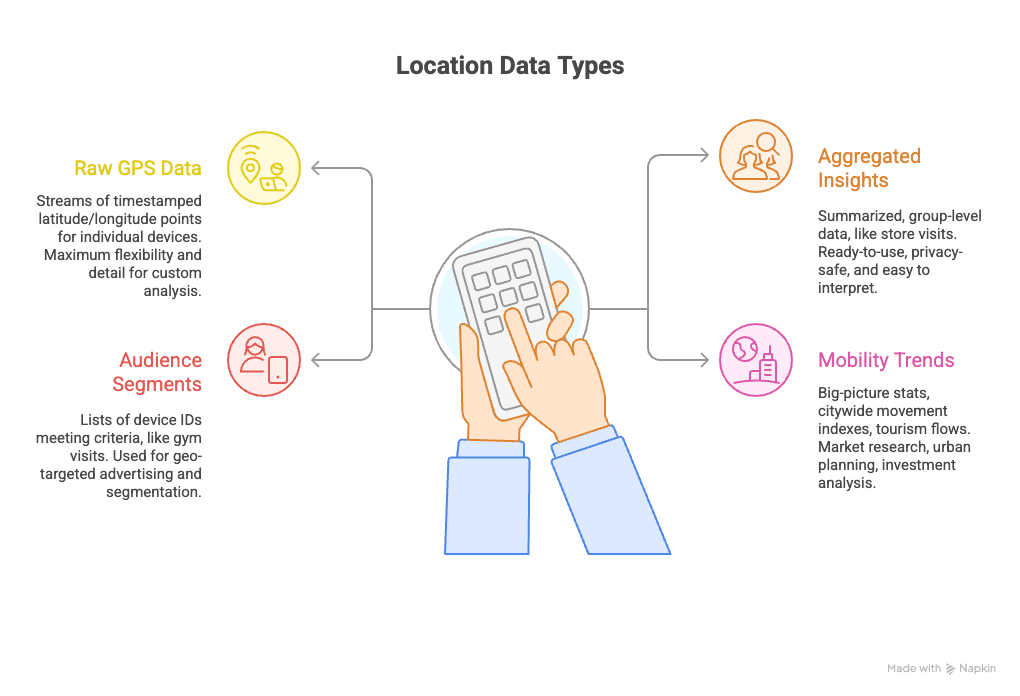
The Main Categories
- Raw GPS Trace Data:
- What it is: Streams of timestamped latitude/longitude points for individual devices (with anonymized IDs).
- Business value: Maximum flexibility and detail—great for custom analysis, but requires technical chops to process.
- Typical buyers: Data science teams, hedge funds, advanced marketers.
- Aggregated Location Insights (Foot Traffic, POI Visits):
- What it is: Summarized, group-level data—like “500 people visited Store A last week.”
- Business value: Ready-to-use, privacy-safe, and easy to interpret. Perfect for most business users.
- Typical buyers: Retailers, real estate, marketing teams.
- Audience Segments & Mobility Profiles:
- What it is: Lists of device IDs that meet certain criteria (e.g., “people who visited gyms in the last 30 days”).
- Business value: Used for geo-targeted advertising and behavioral segmentation.
- Aggregated Mobility Trends:
- What it is: Big-picture stats—citywide movement indexes, tourism flows, etc.
- Business value: Market research, urban planning, investment analysis.
Raw GPS Data vs. Aggregated Location Insights
- Raw GPS Data:
- Pros: Maximum granularity, enables custom analysis (e.g., mapping customer journeys).
- Cons: Privacy risks, huge data volumes, requires technical expertise.
- Use cases: Targeted advertising, advanced analytics, transportation studies.
- Aggregated Insights:
- Pros: Privacy-safe, easy to use, comes in dashboards or CSVs.
- Cons: Less flexible—can’t drill down to individual devices.
- Use cases: Site selection, market benchmarking, retail operations.
Most business users are better off with aggregated insights unless you have a data science team itching for a challenge.
Anonymized Data and Privacy Considerations
Let’s talk privacy. Providers usually anonymize data by stripping personal info, hashing device IDs, and aggregating results. But here’s the kicker: even “anonymous” location data can sometimes be re-identified with enough outside info (MIT study). That’s why the safest bet is to use aggregated data—group trends, not individual trails.
Under laws like GDPR and CCPA, precise location data is considered sensitive personal info. Always make sure your vendor collects data with user consent and follows the rules—otherwise, you could end up with a legal headache (and nobody wants to be the next headline).
Why Do Businesses Buy Cell Phone Location Data?
So, why go through all this trouble? Because location data unlocks real-world insights that can drive revenue, cut costs, and outsmart the competition. Here are the big use cases:
| Business Use Case | Description | Best Type of Data |
|---|---|---|
| Retail Site Selection & Real Estate | Pick new store locations by analyzing local foot traffic, customer density, and competition. | Aggregated foot traffic data |
| Geo-Targeted Advertising | Deliver ads to consumers based on location history or real-time presence. | Raw/device-level data, audience segments |
| In-Store & Mall Operations | Optimize staffing, store hours, and layouts using foot traffic and dwell time analytics. | Aggregated visit data and dwell times |
| Competitive Intelligence | Track competitor performance and customer overlap. | Aggregated location insights |
| Urban Planning & Investment | Analyze citywide movement trends for planning and investment decisions. | Macro mobility datasets |
| Market Research | Profile customers or areas by physical behaviors (e.g., “gym-goers,” “tourists”). | Device-level movement data, aggregated segments |
Common Use Cases in Action
- Site Selection: Retailers and real estate pros use foot traffic data to compare potential sites. For example, a convenience store chain might analyze highway exits to pick the best spot for a new outlet (Placer.ai).
- Geo-Targeted Advertising: Marketers create audience segments like “devices seen at gyms 3+ times/month” to target with ads (Tamoco).
- Retail Operations: Store managers use foot traffic and dwell time to optimize staffing and promotions (GrowthFactor).
- Competitive Intelligence: Businesses monitor competitor foot traffic to spot trends and respond quickly (SafeGraph).
- Investment Decisions: Real estate investors use foot traffic and mobility patterns to value properties and forecast growth.
The bottom line? Location data helps you make decisions based on what people actually do, not just what they say in surveys.
Data Quality and Privacy: What to Watch Out For When You Buy Location Data
Not all location data is created equal. Before you swipe your corporate card, here’s what you need to watch for:
Evaluating Data Accuracy, Freshness, and Coverage
- Accuracy: How close are the reported locations to reality? GPS is usually accurate within 5 meters outdoors, but bidstream or cell tower data can be off by 100–300 meters (Tamoco). Ask vendors for their typical accuracy and what signals they use.
- Freshness: How up-to-date is the data? Some providers update daily or weekly; others, monthly. For anything time-sensitive (like campaign measurement), you want data that’s as fresh as possible.
- Coverage: What percentage of the population or area is represented? Some datasets cover 10% of the US population in a given week (PMC). Make sure the sample is representative of your target audience and geography.
Pro tip: Always ask for a sample dataset to test quality. Compare visit counts to your own sales or in-store data as a sanity check.
Navigating Privacy Regulations When Buying Location Data
- GDPR (Europe): Treats location data as personal data. Requires explicit consent, transparency, and the right to delete (GeoPlugin).
- CCPA/CPRA (California): Defines precise geolocation as sensitive personal info. Consumers can opt out of sale/sharing (OAG CA).
- Other Regions: Many countries have similar laws—always check where your data subjects are located.
Checklist for buyers:
- Choose reputable providers with clear privacy practices.
- Ask about consent and data source.
- Only buy what you need (aggregated if possible).
- Secure the data and use it responsibly.
- Include privacy clauses in contracts.
The Limitations of Traditional Location Data Providers
Now, here’s the part nobody tells you in the sales pitch: off-the-shelf location data isn’t perfect. I’ve seen plenty of business users run into these headaches:
Why Off-the-Shelf Data Often Falls Short
- Generic Datasets: Most providers sell standardized data—great for broad trends, but lacking context. Want to know why foot traffic spiked? Good luck.
- Lack of Industry Tagging: Data often isn’t enriched with industry-specific labels (like “event-driven visits” vs. “regular shoppers”).
- Slow Updates: Some datasets update monthly or quarterly—by the time you get the data, the market’s already moved.
- Limited Customization: Fixed schemas and rigid models make it tough to answer unique business questions.
- Hidden Biases: Panels may under-sample certain demographics or geographies, skewing results (PMC).
- Support Issues: Big vendors can be slow to respond or unwilling to customize for smaller clients.
As one real estate pro put it, “Great for initial due diligence, but shouldn’t be taken as gospel. Sometimes you still need to do your own counts or check other sources” (Reddit).
Thunderbit: AI-Powered Web Scraping as a Supplement to Purchased Location Data
Scrape data from any website using AI Get Started Free
So, what do you do when your location data leaves you with more questions than answers? That’s where Thunderbit comes in. We built Thunderbit to help business users (not just data scientists) grab context-rich information from the web—think merchant directories, event calendars, user reviews, and more.
How Thunderbit’s AI Web Scraper Works
Here’s what makes Thunderbit different (and, dare I say, a little bit fun):
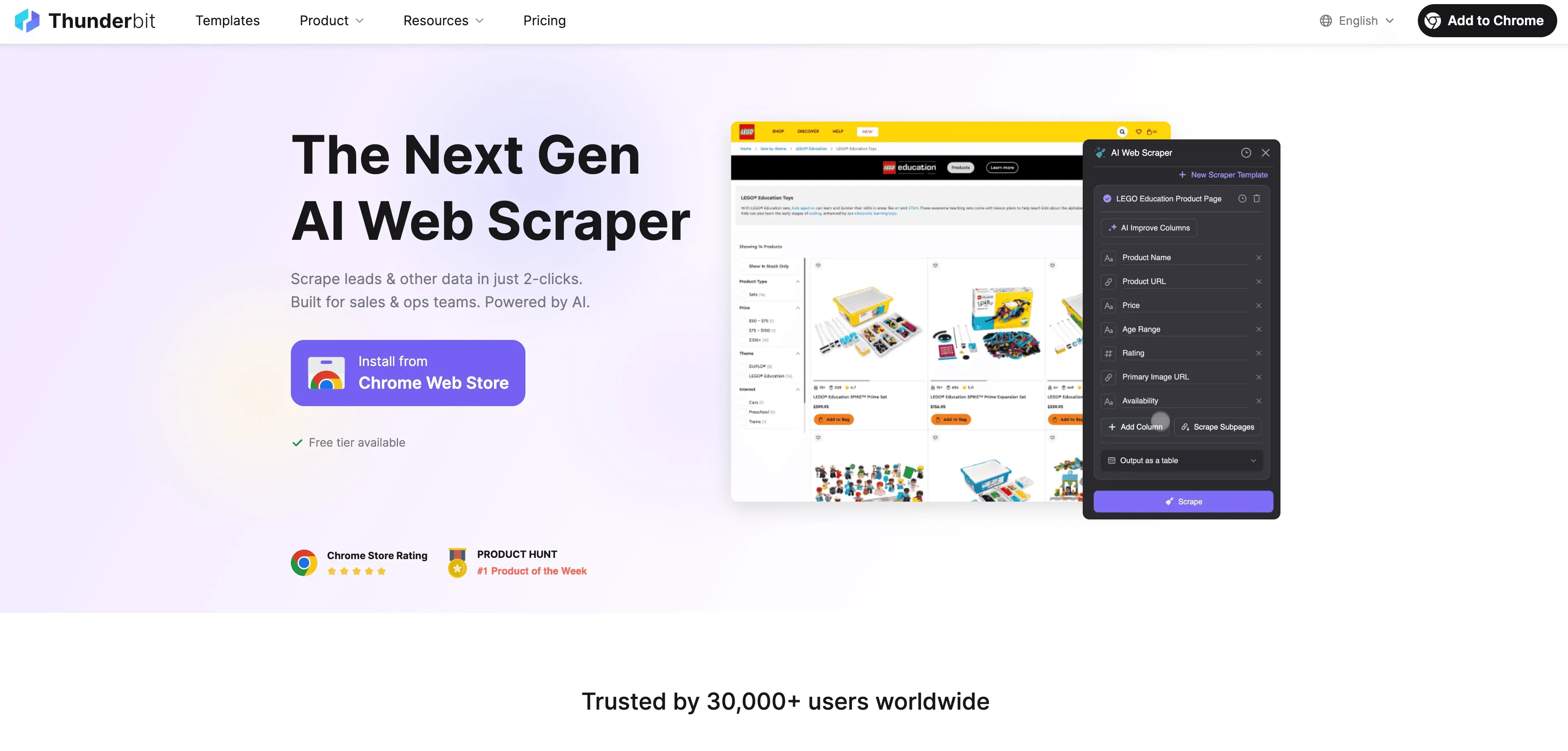
- Markdown Preprocessing: Before extraction, Thunderbit structures web pages into Markdown format. This means our AI doesn’t just scrape HTML—it “reads” the page like a human, understanding headings, labels, and context (Thunderbit Blog).
- AI Suggest Fields: Click a button, and Thunderbit’s AI suggests what fields to extract (e.g., Event Name, Date, Location). You can adjust or confirm, then hit “Scrape.”
- Subpage Scraping: Got a list of stores or events, each with its own detail page? Thunderbit can visit each subpage and pull extra info—no coding required.
- Handles Dynamic Content: Because it runs in your browser, Thunderbit sees fully loaded pages (including JavaScript, infinite scroll, etc.).
- No Coding Needed: It’s a Chrome Extension designed for non-technical users — point at a page, let the AI suggest fields, and review the output before exporting.
Try Thunderbit AI Web Scraper for Free
Real-World Scenarios: Enriching Location Data with Thunderbit
Let’s make this concrete:
- Explaining Foot Traffic Spikes: Your location data shows a downtown store had a huge spike last weekend. Thunderbit scrapes the city’s event calendar and finds a food festival two blocks away—mystery solved.
- Enriching POI Data: You’re comparing malls. Thunderbit scrapes Google Maps for store lists and reviews, revealing that one mall has higher-end boutiques and better ratings, even if its raw traffic is lower.
- Competitive Monitoring: Your competitor’s gym suddenly has more visits. Thunderbit scrapes their website and social media—turns out they launched a new class and referral bonus.
- Filling Data Gaps: Entering a new city? Thunderbit scrapes local directories and news to map out key retailers and hotspots, giving you a qualitative landscape before you buy expensive datasets.
In all these cases, Thunderbit acts as your on-demand research assistant—bridging the gap between what your location data tells you and why it’s happening.
How to Choose the Right Approach: Buying Location Data vs. Real-Time Web Signals
So, should you buy location data, scrape the web, or both? Here’s a quick decision framework:
| Approach | Pros | Cons | Best For |
|---|---|---|---|
| Purchased Location Data | Comprehensive, historical, structured, quantitative metrics | Costly, sometimes outdated, limited context, less flexible | Long-term trends, benchmarking, KPI tracking, strategic planning |
| Real-Time Web Scraping (Thunderbit) | Real-time, customizable, rich context, cost-effective for targeted needs | Not a direct measure of movement, manual setup, limited by public info | Explaining anomalies, tactical decisions, data enrichment, new/emerging trends |
| Both (Hybrid) | Combines hard numbers with real-time context for holistic insights | Requires some setup and integration, but pays off in better decisions | Most business scenarios—especially where speed and context matter |
When to use purchased data: For consistent, quantitative metrics—like weekly foot traffic reports or market share analysis.
When to use web scraping: For real-time context—like explaining sudden changes, monitoring competitors, or filling gaps.
When to combine: Almost always. Start with your core metrics, then use web scraping to dig deeper, explain anomalies, and enrich your analysis.
Key Takeaways: Making Smart Decisions When You Buy Cell Phone Location Data
- Know what you’re buying: Understand the difference between raw, aggregated, and anonymized data. Match the data type to your business goal.
- Prioritize quality and compliance: Ask vendors about accuracy, freshness, coverage, and privacy practices. Always check for GDPR/CCPA compliance.
- Don’t settle for generic: Off-the-shelf data is a starting point, not the finish line. Real business value comes from context and customization.
- Supplement with real-time web data: Tools like Thunderbit let you gather fresh, relevant signals—merchant directories, event calendars, reviews—that explain why your metrics are moving.
- Integrate for smarter decisions: The best teams use both purchased datasets and real-time web signals to move from “what happened?” to “why did it happen, and what should we do next?”
- Stay ethical and transparent: Use data responsibly, respect privacy, and keep your customers’ trust.
If you’re ready to move from confusion to clarity—and maybe even have a little fun along the way—consider adding AI-powered web scraping to your location intelligence toolkit. And if you want to see Thunderbit in action, check out our Chrome Extension or browse more guides on the Thunderbit Blog.
Location intelligence isn’t just about knowing where people are—it’s about understanding why they move, what they care about, and how you can serve them better. In a world where the physical and digital are more connected than ever, the smartest decisions come from combining both. Happy data hunting—and may your next “aha!” moment be just a click (or a scrape) away.
For more on web scraping, data enrichment, and practical AI for business, explore these Thunderbit resources:
- What Is Data Scraping and How to Do It
- How to Scrape Any Website Using AI
- The Best Web Scraping Tools & Software in 2026
- How to Scrape Google Search Result Page (SERP) - 3 Methods
Sources: Industry research from Grand View Research, Tamoco, Unacast, SafeGraph, GrowthFactor, MIT, and more. See links above for details.
FAQs
1. What does it mean to buy cell phone location data?
Buying cell phone location data means purchasing information about where mobile devices have been over time. This data is typically anonymized and aggregated, showing movement patterns, visits to specific places, and real-world behaviors, rather than tracking individuals by name.
2. How is cell phone location data collected and what types are available for purchase?
Cell phone location data is mainly collected through mobile apps that users grant location permissions to, ad networks, cell tower triangulation, and sometimes physical sensors. The main types available for purchase include raw GPS trace data, aggregated location insights (like foot traffic counts), audience segments, and broader mobility trends.
3. What are the main business use cases for buying location data?
Businesses use location data for retail site selection, geo-targeted advertising, optimizing in-store operations, competitive intelligence, urban planning, investment analysis, and market research. The data helps companies make decisions based on actual movement and behaviors rather than just survey responses.
4. What should buyers consider regarding data quality and privacy when purchasing location data?
Buyers should evaluate the accuracy, freshness, and coverage of the data. It’s important to ensure the data is collected with user consent and complies with privacy regulations like GDPR and CCPA. Always choose reputable vendors, ask about their privacy practices, and only purchase the data necessary for your business needs.
5. How can real-time web scraping tools like Thunderbit supplement purchased location data?
Web scraping tools like Thunderbit can enrich purchased location data by providing real-time, context-rich information from sources such as event calendars, merchant directories, and user reviews. This helps explain anomalies in location data, fill data gaps, and offer deeper insights into why certain trends are occurring, making business decisions more informed and actionable.
Learn More:
- From Clicks to Columns: Understanding Custom Data Extraction
- 10 Best Data Aggregation Tools & Software Solutions
- What Is Sales Intelligence? Definition, Benefits, and Tools
- Where to Buy Location Data: Best Providers for the Top 9 Types
Try AI Web Scraper for Location Data Enrichment Get Started Free




