

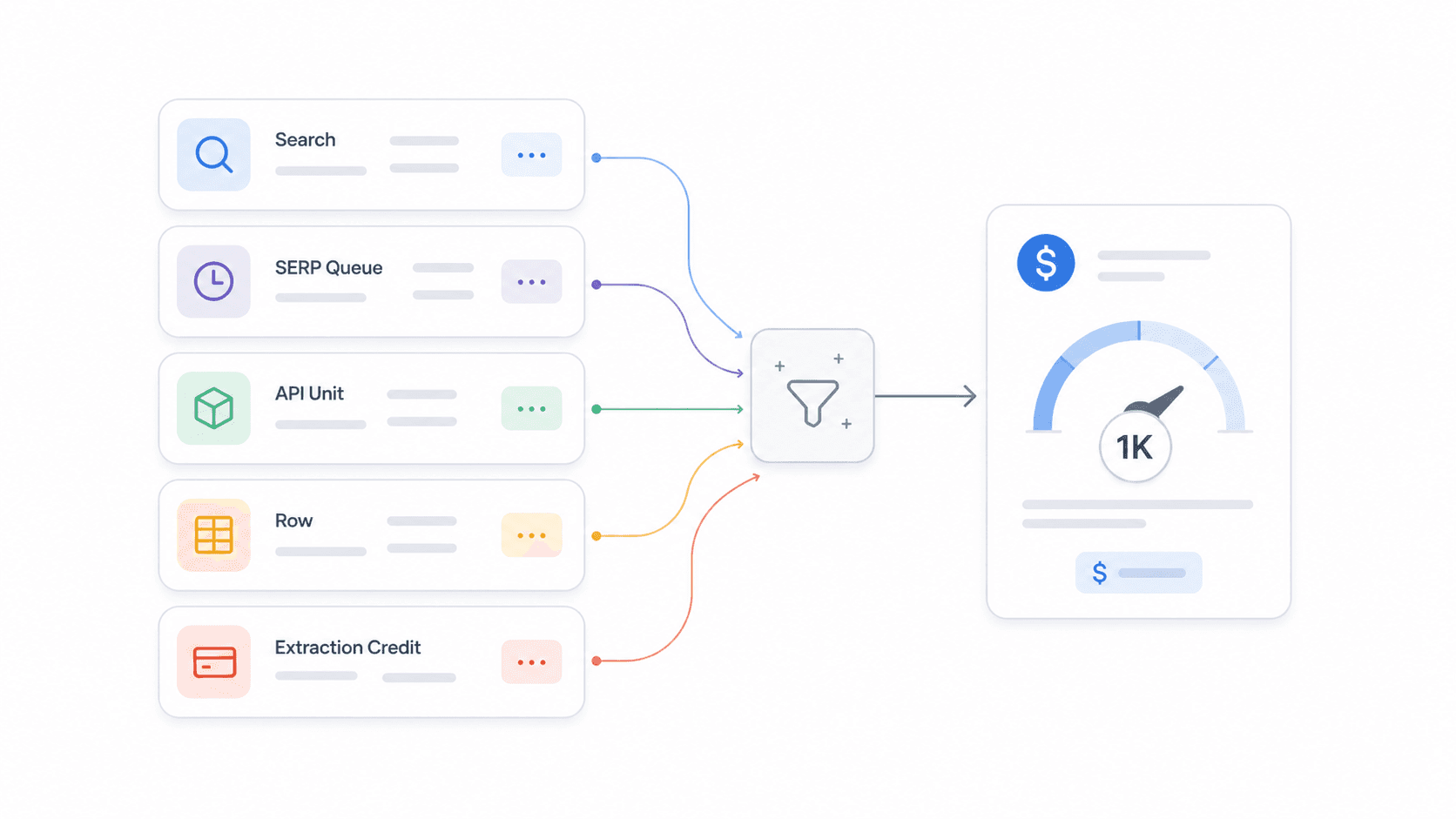
Every SEO API pricing page tells the truth — they're just not measuring the same thing. SerpAPI sells "successful searches." DataForSEO sells SERP pages across three latency queues. Ahrefs burns "API units" based on rows and fields. Thunderbit counts "Distill" and "Extract" credits. Trying to compare them is like comparing the price of apples, oranges, and a subscription to a fruit-of-the-month club.
I've spent the last several weeks digging through pricing pages, API docs, changelogs, and developer forums to build the comparison I wished existed when our team at Thunderbit started evaluating SEO data sources. The goal: normalize costs to a per-request basis, map AI Overview tracking support (which most guides completely ignore), and give you a decision framework that actually matches how SEO teams buy in 2026. This guide covers nine SEO APIs — from pure SERP parsers to all-in-one platforms to flexible AI extraction layers — with real cost math, free tier breakdowns, and honest pros and cons.
Try Thunderbit for flexible AI extraction Same AI engine as the API, driven from your browser. Describe the fields you need and export straight to Sheets or Excel. Get Started Free
How We Evaluated the Best SEO APIs for 2026
There's no single "best SEO API." The right choice depends on what data you need, how much you're willing to spend, and how your team actually works. After reading dozens of forum threads and talking to developers building SEO pipelines, I landed on seven criteria that keep coming up:
- Data coverage breadth: Does it cover SERPs, backlinks, keywords, on-page, and — critically — AI Overviews?
- Pricing model transparency: Credits vs. pay-as-you-go vs. subscription. Can you predict your bill?
- Rate limits and scalability: Requests per minute, concurrency caps, batch support.
- AI search / AEO tracking: Can it parse AI Overviews, Gemini citations, ChatGPT Search results?
- Documentation quality and developer experience: SDKs, Postman collections, clear error semantics.
- Free tier availability: Real free tier vs. expiring trial vs. nothing.
- Integration flexibility: Webhooks, export formats, MCP, Make/n8n, Looker Studio connectors.
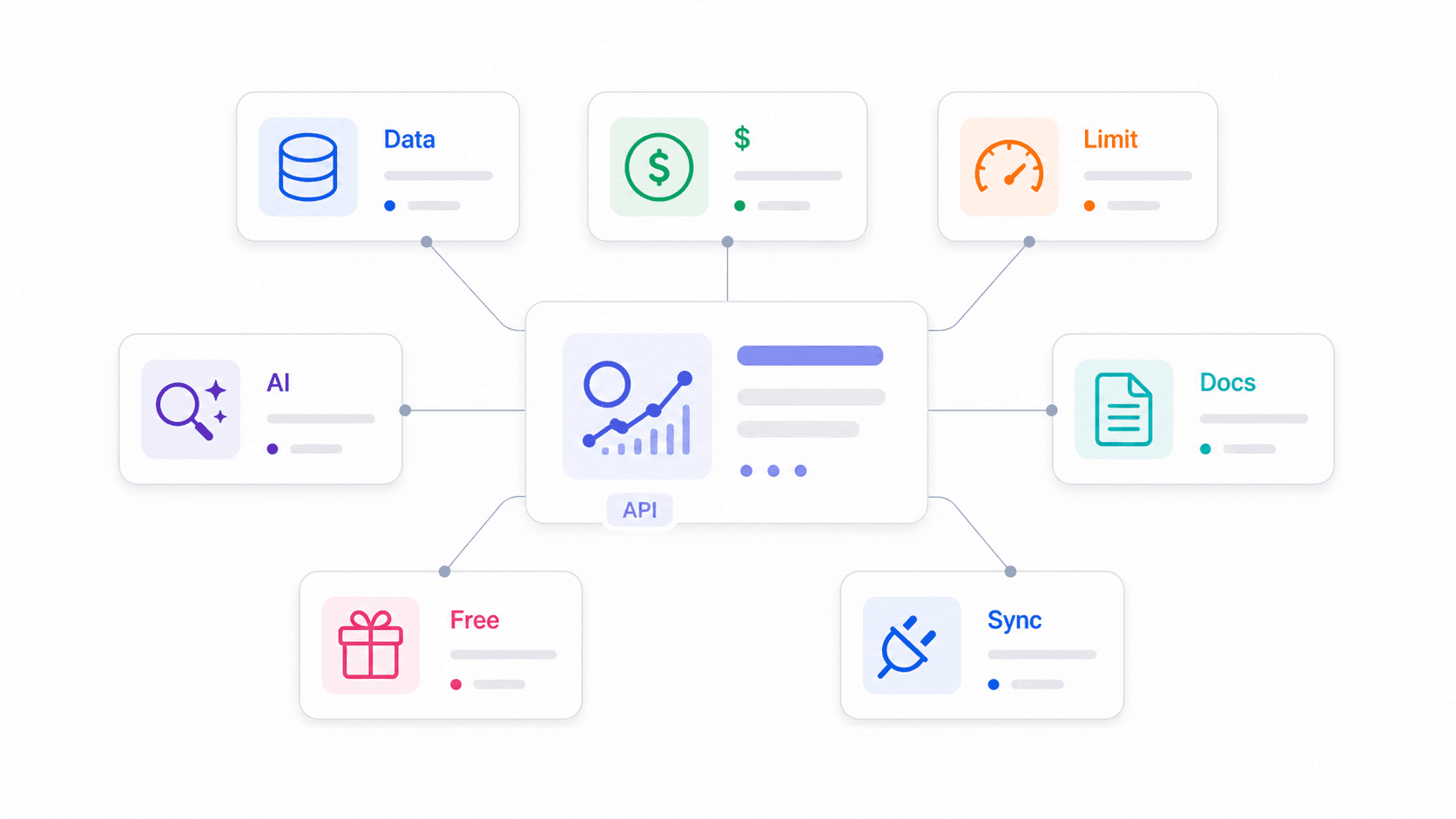
These aren't theoretical. Forum users say things like "The API credits system doesn't give great examples I can easily find" and "Google doesn't expose AI Overview data ... most tools are still catching up ... tracking is kinda broken atm." The criteria reflect what real buyers actually struggle with.
Extract SEO data with AI Pull SERP-adjacent page data that traditional SEO APIs don't expose—AI Overviews, competitor page structures, pricing tables. 600 free units to test. Get Started Free
The 9 Best SEO APIs at a Glance
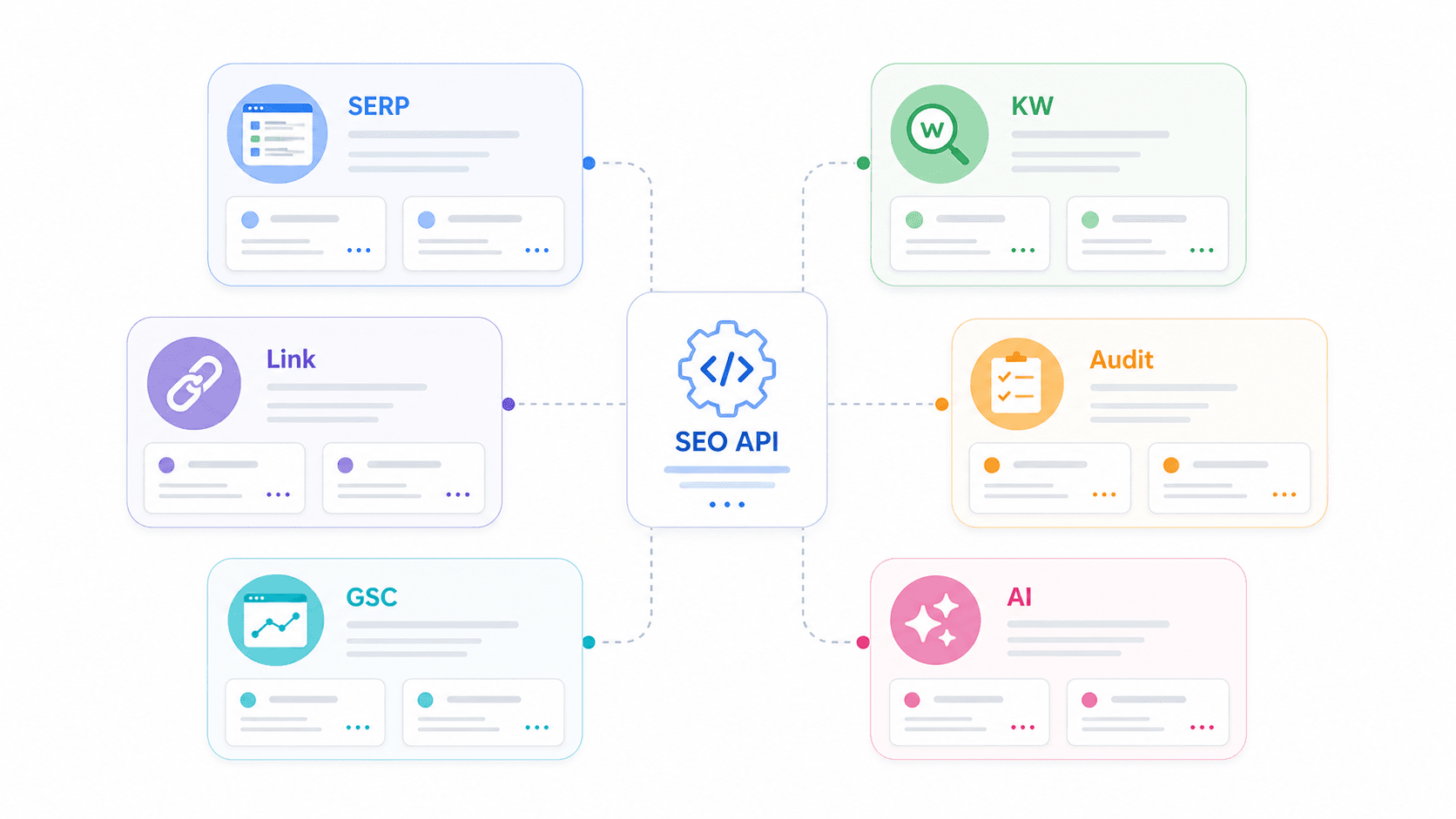
Before we go deep on each tool, here's the master comparison. The "Cost per 1K Baseline Units" column uses the cheapest available rate for each provider's primary unit — SERP queries for SERP APIs, rows for row-based APIs, and API units for credit-based systems. Read the individual sections for the caveats.
| Provider | Data Types Covered | Pricing Model | Est. Cost per 1K Baseline Units | Free Tier | Rate/Scale Snapshot | AIO/AI Search Support | Best For |
|---|---|---|---|---|---|---|---|
| Thunderbit | Page extraction, Markdown, custom schema | API units (1 Distill, 20 Extract) | $0.80/1K Distill, $16/1K Extract (Pro annual) | 600 units one-time | 2–50 concurrent by tier | ⚠️ Flexible workaround | Custom AI extraction, AIO parsing |
| DataForSEO | SERP, keywords, backlinks, on-page, domain | Pay-as-you-go credits | $0.60/1K Standard SERPs | $1 trial credit | 2,000 req/min | ✅ Google AIO parsing | Broad pay-as-you-go SEO data |
| SE Ranking | Domain, keyword, backlinks, audit, AI Search | API credits ($149/1M) | ~$119/1K AI Search overview calls | 100K credits / 14-day trial | Default limits, can request increases | ✅ Comprehensive AI Search API | Platform + AI visibility |
| SerpAPI | Real-time SERPs, 100+ engines | Monthly successful searches | $9.17–$75/1K depending on tier | 250 searches/mo | 50–6,000 throughput/hour | ✅ AIO + AI Mode endpoints | Real-time SERP parsing, DX |
| Ahrefs | Backlinks, keywords, SERP, Brand Radar | Subscription + API units | ~£49.50/1K min-unit requests (Lite) | Ahrefs Free (own site) | 100–unlimited rows by tier | ✅ Brand Radar (AIO, ChatGPT, Gemini, etc.) | Backlink intelligence, AI citations |
| Semrush | Keywords, domains, backlinks, position tracking | Business sub + API units | Not publicly normalizable | No free API tier | Varies by unit package | ⚠️ Product-level AIO; API details need checking | Marketing suite integration |
| Moz | DA, PA, Spam Score, link metrics | Rows/month | $0.50–$6.67/1K rows | 50 rows/mo | Plan-based | ❌ No confirmed AIO | Budget domain authority |
| Google Search Console | Own-site queries, clicks, impressions, CTR | Free quota-based | $0 | Fully free | 1,200 QPM per site | ❌ No AIO endpoint | First-party own-site baseline |
| Serpstat | Keywords, competitors, backlinks, audit | Monthly credits/rows | $0.205–$0.50/1K credits | 7-day trial | 1–10 RPS by plan | ⚠️ Partial/verify endpoint | Budget keyword/competitor data |
A quick note on reading this table: "Cost per 1K" is an approximation. Thunderbit's Extract and DataForSEO's Standard SERP are not the same product. The point is to give you a ballpark, not a guarantee. Each section below includes the real math.
1. Thunderbit — Best SEO API for Flexible, AI-Powered Data Extraction
Thunderbit is not a traditional SEO database. It doesn't maintain a proprietary keyword index or backlink graph. Instead, it's an AI extraction layer: point it at any URL, define the fields you want in a JSON Schema, and it returns structured data. That flexibility is exactly why it belongs on this list — especially for teams tracking AI Overviews, where Google's layout changes faster than most SEO API parsers can keep up with.
The core API has two capabilities. The Distill API converts any web page into clean, LLM-ready Markdown — useful for content audits, RAG pipelines, or feeding competitor pages into your own analysis tools. The Extract API takes a JSON Schema (you define field names and types) and uses AI to pull matching structured data from the page. Both support batch processing (up to 100 URLs), JavaScript rendering modes ("none," "basic," "full"), geo-routing, custom headers, and built-in anti-bot/CAPTCHA handling.
The same AI engine powers the Thunderbit Chrome Extension, which is part of a product trusted by over 200,000 users worldwide.
If you've used the extension to scrape product listings or lead data, the API is the programmatic version of that experience.
Why It Matters for AI Overview Tracking
Because you define the extraction schema, you're not waiting for a provider to update their parser when Google changes the AIO layout. You can define fields like ai_overview_summary, cited_domains, organic_result_titles, or whatever you need — and the AI adapts to the page structure. In my experience, this is the closest thing to a "future-proof" extraction approach for volatile SERP features.
Pricing and Rate Limits
Thunderbit uses a credit system: 1 API unit per Distill request, 20 units per Extract request. The current pricing breaks down like this:
| Tier | Units/Year | Price | Distill Pages | Extract Pages | Concurrent | Distill Cost/1K | Extract Cost/1K |
|---|---|---|---|---|---|---|---|
| Free | 600 one-time | $0 | 600 | 30 | 2 | $0 | $0 |
| Starter | 60,000 | $16/mo (annual) | 60,000 | 3,000 | 30 | $3.20 | $64.00 |
| Pro | 600,000 | $40/mo (annual) | 600,000 | 30,000 | 50 | $0.80 | $16.00 |
No surprise overage charges — you use your units and that's it.
Pros and Cons
Pros: Schema flexibility means you can extract any visible data — not just pre-packaged fields. AI adapts to layout changes. Dual Distill + Extract capability. Generous free tier. Built-in rendering, proxy rotation, and CAPTCHA handling.
Cons: No proprietary keyword volume, backlink, or domain authority database. Users must define and validate their own schemas. For pure commodity rank tracking at scale, a dedicated SERP API like DataForSEO will be cheaper per query.
Best for: Teams that need custom data extraction from SERPs (including AI Overviews), competitor pages, or any structured web content — especially when traditional SEO APIs don't expose the exact fields needed.
2. DataForSEO — Best Pay-as-You-Go Breadth
DataForSEO is the API-first workhorse of the SEO data world. Over 100 endpoints covering SERPs, keywords, backlinks, on-page analysis, domain analytics, reviews, and more. No dashboard, no platform — just data.
The three-tier latency architecture is what makes it stand out. Standard Queue is the cheapest (results in minutes), Priority Queue is faster, and Live Mode returns data in real time. You pick the speed you need and pay accordingly. The $50 minimum deposit with no subscription lock-in is genuinely rare.
Key Features
- Google Organic SERP API starts at $0.0006 per first-page result (Standard), $0.0012 (Priority), $0.002 (Live)
- AI Overview parsing is confirmed: responses include a structured
ai_overview_element, and theload_async_overviewparameter adds AIO data for one additional base price - 2,000 requests/minute general rate limit, up to 100 tasks per request for batch operations
- Endpoints for keyword research, backlink analysis, on-page SEO audit, and domain analytics
Pricing Normalized
| Queue | Cost per 1K First-Page SERPs | With AIO Loaded |
|---|---|---|
| Standard | $0.60 | ~$1.20 |
| Priority | $1.20 | ~$2.40 |
| Live | $2.00 | ~$4.00 |
One Reddit user captured the appeal: "Tried DataForSEO ... deposit sits there, calls draw from it, quiet months cost almost nothing."
Pros: Lowest cost for commodity SERP retrieval. Wide endpoint coverage. True pay-as-you-go. Strong accuracy.
Cons: Pricing gets complex with depth parameters, AIO add-ons, and special operators. Documentation is thorough but not always beginner-friendly. API-first means no polished dashboard.
Best for: Developers and agencies building custom SEO reporting pipelines who want broad data at the lowest per-query cost.
3. SE Ranking — Best Platform + API + AI Search Tracking
SE Ranking is the only provider on this list that combines a full SEO platform (dashboard, rank tracker, site audit) with two distinct APIs — Data API and Project API — and a dedicated AI Search API that tracks brand visibility across ChatGPT, Gemini, Perplexity, AI Overviews, and AI Mode.
That AI Search API is the real differentiator. It can return link presence, average position, AI traffic estimates, historical trends, competitor leaderboards, prompts-by-brand, and competitor comparisons across all major LLM platforms. If AI visibility is your primary concern, SE Ranking is the most comprehensive option right now.
Key Endpoints
- Data API: Domain analysis, keyword research, backlinks, website audit, AI Search
- Project API: Manage projects, keywords, rankings, audits, sub-accounts programmatically
- AI Search API: Brand overview, leaderboard (Share of Voice across LLMs), prompts-by-brand, competitor comparison
- MCP server for querying live SEO data inside Claude, ChatGPT, or Gemini CLI
Pricing
The API package is $149/month for 1M credits (also available standalone or as an add-on). A 14-day trial includes 100,000 free credits. Important: the AI Search overview endpoint costs 800 credits per request, which works out to about $119.20 per 1,000 overview requests. The leaderboard endpoint costs 7,500 credits per request.
Pros: Strongest dedicated AI Search API covering all major LLMs. Platform + API combo reduces tool sprawl. MCP, Make, n8n, and Looker Studio integrations. Trial credits for testing.
Cons: AI Search costs are high per request. Data is refreshed monthly, which may be too slow for daily AIO monitoring. No first-party SDKs (rely on Postman collection + REST docs). Default rate limits are lower than DataForSEO or SerpAPI.
Best for: SEO teams and agencies that want a single platform for classic SEO data and AI visibility tracking across LLMs.
4. SerpAPI — Best Real-Time SERP Parsing Across 100+ Engines
SerpAPI is the developer-experience gold standard for real-time SERP parsing. It returns a pixel-perfect JSON representation of what a user sees on a search results page — across Google, Bing, Baidu, Naver, YouTube, Walmart, Apple App Store, Google Maps, Google Shopping, and more than 100 engines total.
For AI search, SerpAPI offers both a Google AI Overview API (using page tokens when Google requires a separate request) and a Google AI Mode API.
The documentation is excellent, with native libraries for Python, Ruby, Node.js, and others.
Pricing
| Tier | Monthly Price | Searches | Throughput/Hour | Cost/1K |
|---|---|---|---|---|
| Free | $0 | 250 | 50 | $0 |
| Starter | $75 | 1,000 | 200 | $75.00 |
| Developer | $75 | 5,000 | 1,000 | $15.00 |
| Production | $250 | 15,000 | 3,000 | $16.67 |
| Big Data | $275 | 30,000 | 6,000 | $9.17 |
Only successful searches count. But unused searches do not roll over — plan accordingly.
Pros: Broadest engine coverage. Fast onboarding. High-quality structured JSON. Explicit AI Overview and AI Mode endpoints. Most generous free tier for prototyping.
Cons: Strictly a data extraction service — no keyword database, no backlink index. Expensive at high volumes compared to DataForSEO's Standard queue. No rollover on unused searches.
Best for: Developers who need real-time, multi-engine SERP data with excellent documentation and quick setup.
5. Ahrefs — Best for Backlink Intelligence and AI Citation Research
Ahrefs maintains one of the largest backlink indexes in the industry — 35 trillion+ historical external backlinks, updated every 15 minutes, across 500 million domains and 493 billion indexed pages. For link-based analysis, it's the benchmark.
The 2026 story, though, is bigger than backlinks. Ahrefs' Brand Radar API now tracks AI citations across Google AI Overviews, AI Mode, ChatGPT, Gemini, Perplexity, Copilot, and Grok. Endpoints include AI Responses, Cited Pages, Cited Domains, Share of Voice, mentions, and impression history. That makes Ahrefs a serious contender for AI visibility research, not just link audits.
Pricing
API access is available on paid plans starting from Lite (£99/mo), but direct API max rows per request scale from 100 (Lite) to unlimited (Enterprise at £1,199/mo). Additional unit purchases are currently only available on Enterprise. There's no free API tier — Ahrefs Free covers limited Site Explorer/Site Audit for your own verified site.
Pros: Largest and freshest backlink index. Strong DR/UR metrics. Now includes comprehensive AI citation/Brand Radar endpoints. API and MCP access support AI-agent workflows.
Cons: Expensive entry point. Row/field/unit pricing is hard to normalize. Enterprise is the only uncapped tier. One forum user put it bluntly: "I can't justify spending $1k a month on Ahrefs just for their API access."
Best for: Teams where backlink intelligence is mission-critical, and AI citation tracking across multiple LLMs is a priority.
6. Semrush — Best SEO API for Marketing Suite Integration
Semrush offers one of the broadest marketing data platforms, and its API provides access to keyword research, competitive analysis, domain analytics, position tracking, and more. If your team already lives inside Semrush for advertising, social, and content marketing, the API extends that ecosystem programmatically.
The catch: Standard API access requires a Business subscription ($499.95+/mo), and after upgrading, you still need to purchase API unit packages separately. Semrush's own docs note that one line in the Domain Organic Search Keywords report costs 10 API units (live) or 50 units (historical). Without knowing the unit package price, it's genuinely difficult to normalize costs — which is a common complaint in forums.
AI Overview Support
Semrush's product reports (Position Tracking, Organic Research, Keyword Overview, etc.) do show AI Overview data. The API overview page says it can "analyze AI Overview impact on your traffic." But the exact endpoint-level coverage for AIO parsing should be verified before assuming parity with SE Ranking or SerpAPI.
Pros: Massive keyword database. Strong competitive intelligence. Integrates with the broader Semrush marketing suite. Multiple endpoint types.
Cons: High entry cost (Business plan + unit packages). Complex authentication. Steep learning curve. No free API access. AI search tracking may lag behind SE Ranking at the API level.
Best for: Marketing teams already invested in the Semrush ecosystem who need programmatic access to their existing data.
7. Moz — Best Budget API for Domain Authority Metrics
Moz is the home of Domain Authority (DA) and Page Authority (PA) — metrics that, for better or worse, remain the lingua franca of link-based SEO conversations. The API is one of the most affordable entry points among established providers.
Pricing
| Tier | Price | Rows/Month | Cost/1K Rows |
|---|---|---|---|
| Free | $0 | 50 | $0 |
| Starter Small | $5 | 750 | $6.67 |
| Growth Small | $125 | 50,000 | $2.50 |
| Growth Large | $500 | 500,000 | $1.00 |
| Scale | $2,000 | 4,000,000 | $0.50 |
Pros: Lowest entry cost among established providers. Widely recognized DA/PA metrics. Simple implementation. Free tier available.
Cons: Narrower data coverage than DataForSEO, Semrush, or Ahrefs. No AI Overview or LLM visibility endpoints. Update frequency varies. Historical data access may require higher tiers.
Best for: Teams that primarily need domain authority scoring and link metrics without committing to a full platform subscription.
8. Google Search Console API — Best Free SEO API for Your Own Site Data
The Google Search Console API is mandatory baseline infrastructure. It gives you first-party search performance data — clicks, impressions, CTR, average position — directly from Google, for free. Every SEO team should have this connected, even if they use paid APIs for competitive data.
Key Limits
- Search Analytics: 1,200 queries per minute per site/user, 40,000 QPM per project, 30 million QPD per project
- URL Inspection: 2,000 queries per day per site, 600 QPM
- Historical data is generally limited to 16 months
- Data delay of roughly 2–3 days
Pros: Free. First-party Google data (most accurate for your own rankings). Integrates with Looker Studio, BigQuery, and the broader Google ecosystem.
Cons: Only covers verified properties — no competitor data. No backlink index. No keyword database. No AI Overview tracking endpoint. The 16-month historical window and ~2-day delay are real constraints for some workflows.
Best for: Every SEO team, as a baseline data source. Pair it with paid APIs for competitive intelligence.
9. Serpstat — Best Budget Keyword and Competitor Data
Serpstat offers keyword research, competitor analysis, backlink monitoring, and site audit capabilities through a credit-based API. It sits between the premium platforms (Ahrefs, Semrush) and the pure API-first providers (DataForSEO, SerpAPI) in both price and scope.
Pricing
| Plan | Price | API Credits/Month | API RPS | Cost/1K Credits |
|---|---|---|---|---|
| Individual | $50/mo | No API | N/A | N/A |
| Team | $100/mo | 200,000 | 1 | $0.50 |
| Team x2 | $169/mo | 400,000 | 1 | $0.42 |
| Agency | $410/mo | 2,000,000 | 10 | $0.205 |
One credit generally equals one returned row. API access starts at the Team plan.
Pros: Competitive pricing for broad SEO data. Decent coverage across keywords, links, and competitors. MCP integration introduced in 2025–2026.
Cons: Individual plan has no API access. Lower-tier RPS is limited (1 request per second on Team). SERP scraping pricing may be "upon request." AI Overview support exists in the product but is unclear at the API endpoint level.
Best for: Budget-conscious teams that need keyword and competitor data without premium-tier pricing.
Which SEO APIs Actually Track AI Overviews in 2026?
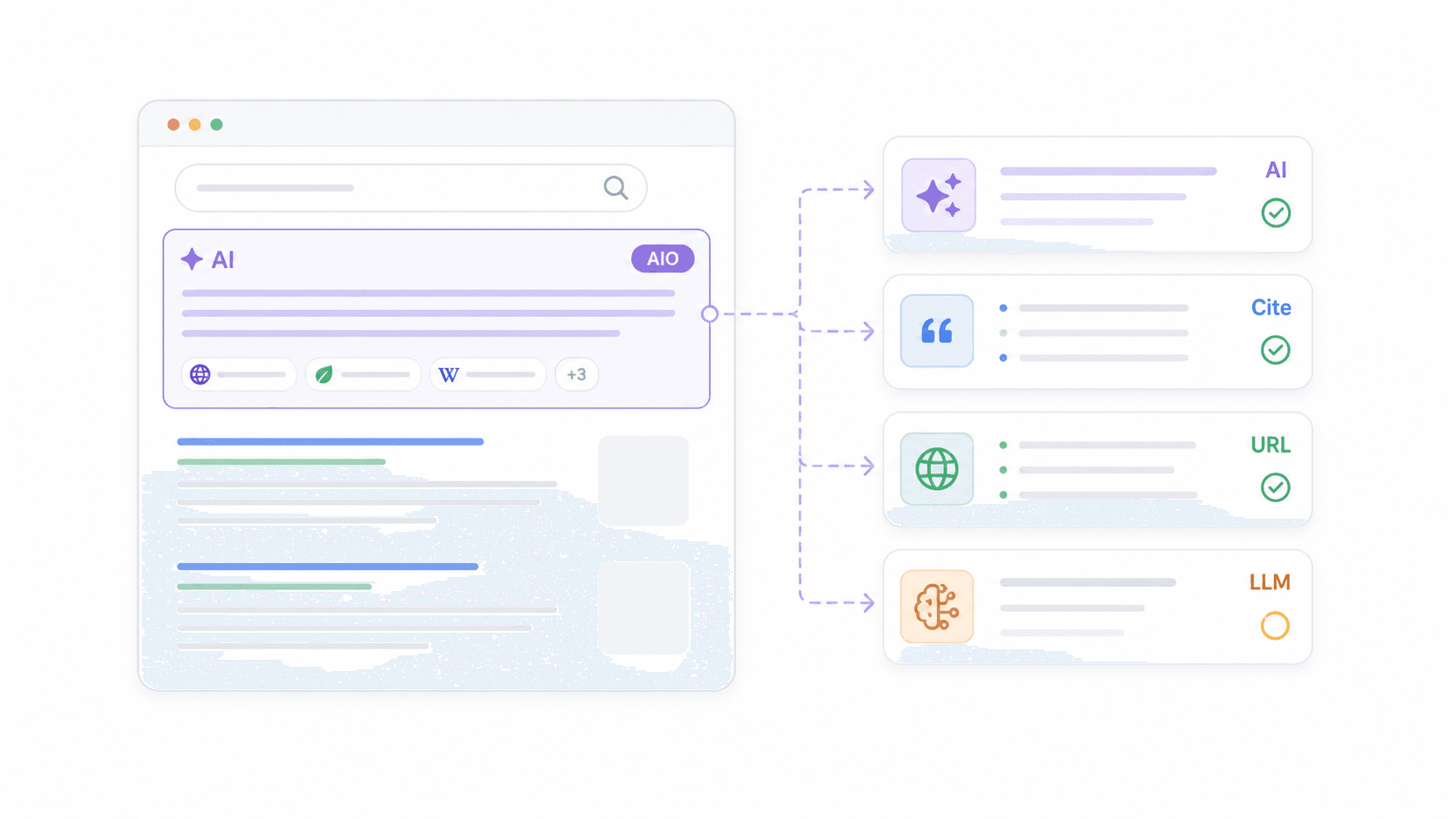
This is the single biggest gap in every competing guide I've read. AI Overviews now appear in a meaningful share of Google searches — Semrush's analysis of 10M+ keywords found AIOs in over 13% of all searches, while BrightEdge reported AIOs triggering on nearly half of its tracked keyword set by early 2026. The exact percentage depends on the query set, but the trend is clear: AIO tracking is no longer optional.
Forum users feel this acutely: "AIO are the hardest part to track right now. Most APIs just fail when Google changes the layout."
Here's the honest breakdown for all nine providers:
| Provider | AI Overview Extraction | LLM Citation Tracking | AI Layout Adaptation | Status |
|---|---|---|---|---|
| Thunderbit | Schema-based extraction if page is accessible | Possible if schema requests citations/links | AI adapts; validate output | ⚠️ Flexible workaround |
| DataForSEO | ai_overview_element + async overview param | AIO citations in SERP data | Provider-maintained parser | ✅ Google AIO support |
| SE Ranking | ai-overview + ai-mode engines in AI Search API | ChatGPT, Gemini, Perplexity, prompt/brand endpoints | Monthly refresh | ✅ Comprehensive |
| SerpAPI | AIO block in Google Search + Google AI Overview API | AIO references; Google AI Mode API | Strong parser focus, page token workflow | ✅ Real-time AIO/AI Mode |
| Ahrefs | Brand Radar: google_ai_overviews, google_ai_mode | Cited pages/domains across ChatGPT, Gemini, Perplexity, Copilot, Grok | Large prompt database | ✅ Brand/citation intelligence |
| Semrush | Product reports show AIO data; API claims AIO impact analysis | AI Visibility Toolkit tracks AI platforms | Platform-level support | ⚠️ Verify API endpoints |
| Moz | No confirmed AIO API | No confirmed LLM citation API | N/A | ❌ Not confirmed |
| GSC API | No dedicated AIO endpoint | No citation data | N/A | ❌ Not confirmed |
| Serpstat | Product/changelog AIO support | Broad SEO access; LLM citation unclear | Partial | ⚠️ Partial/verify |
Thunderbit's position here is worth explaining. It's not a prebuilt AIO parser — it's an extraction layer. Because you define the schema (ai_overview_summary, cited_urls, organic_titles, etc.), you can extract AIO content from any SERP page the moment it's accessible. When Google changes the AIO layout, you don't wait for a provider to update their parser. You adjust your schema or let the AI figure out the new structure. It's a workaround, not a turnkey solution — but for teams that need to move fast on volatile SERP features, that flexibility matters.
Normalized Cost-per-Request Breakdown: What $100/Month Actually Gets You
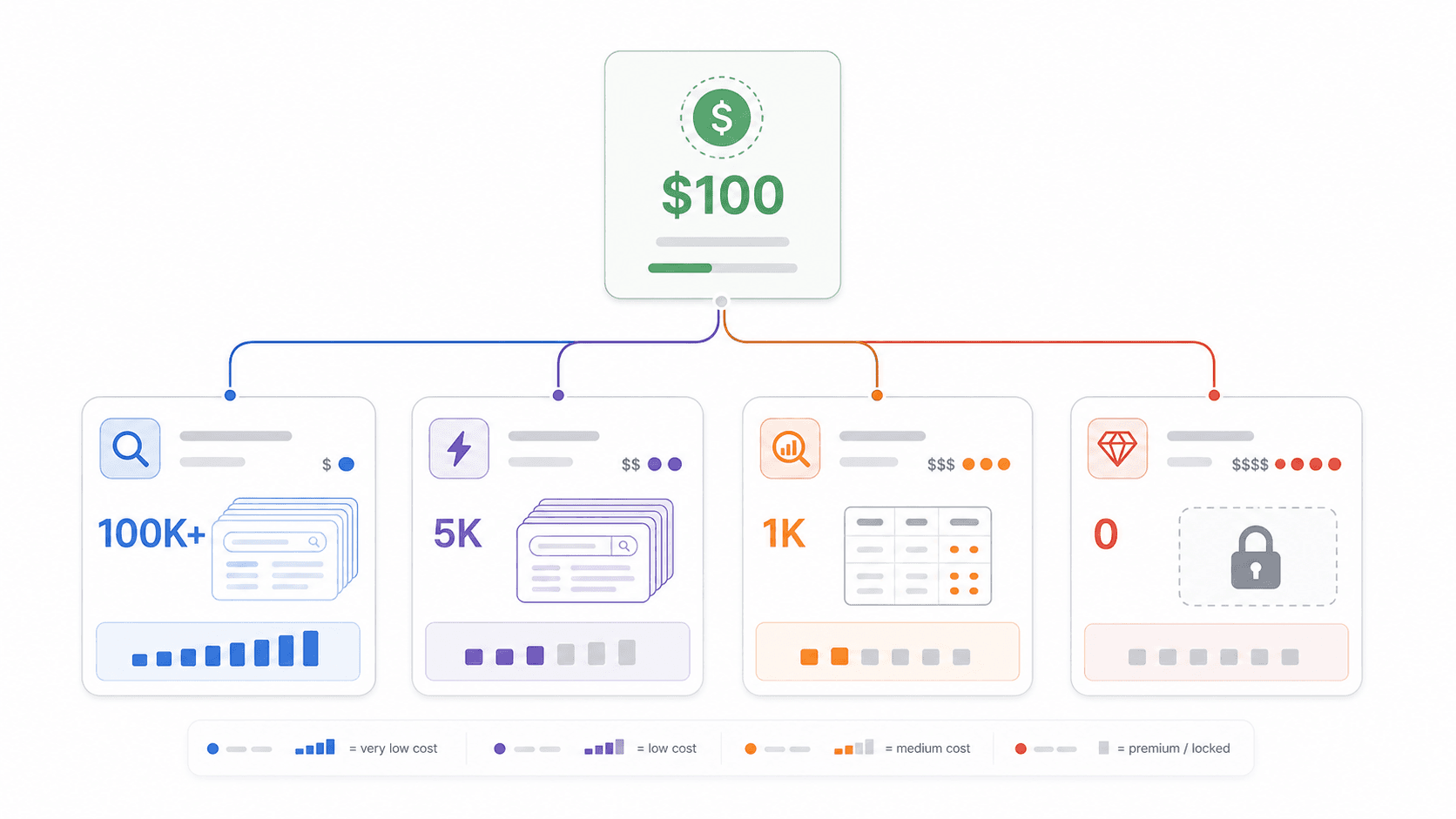
The number one pain point in forums — with eight or more mentions in my research — is unpredictable pricing and surprise overage charges. Every guide lists prices, but nobody normalizes them. So here's the math.
| Provider | Pricing Model | SERP Query Cost/1K | Keyword Lookup Cost/1K | Backlink/Authority Cost/1K | Min Monthly Spend | Free Tier |
|---|---|---|---|---|---|---|
| Thunderbit | API units | Not traditional SERP; Extract $16/1K (Pro annual) | Custom extraction only | Custom extraction only | $16/mo (annual) | 600 units one-time |
| DataForSEO | Pay-as-you-go | $0.60 Standard | Endpoint-specific | Endpoint-specific | $50 deposit | $1 credit |
| SE Ranking | Credits | Not direct SERP baseline | Endpoint-specific | Endpoint-specific | $149/mo for 1M credits | 100K credits/14 days |
| SerpAPI | Successful searches | $9.17–$75 by tier | SERP-derived only | N/A | $75/mo (Starter) | 250 searches/mo |
| Ahrefs | Subscription + units | SERP via API units | API units by rows/fields | API units by rows/fields | Lite £99/mo | Ahrefs Free (own site) |
| Semrush | Business + API units | Not publicly normalizable | 10 units/line live, 50 historical | Varies | Business sub + units | No free API |
| Moz | Rows | N/A | Beta endpoints/rows | $0.50–$6.67/1K rows | $5/mo | 50 rows/mo |
| GSC API | Free quotas | Own-site only, $0 | Own-site query data, $0 | No backlink data | $0 | Free |
| Serpstat | Credits/rows | Upon request | ~$0.205–$0.50/1K | ~$0.205–$0.50/1K | $100/mo (Team) | 7-day trial |
What $100/Month Actually Gets You
| Provider | What $100 Buys (Approximately) |
|---|---|
| Thunderbit | Pro is $40/mo annual — budget covers Pro + effectively ~125K Distill or ~6,250 Extract pages/month at Pro unit economics |
| DataForSEO | ~166,666 Standard first-page SERPs, or ~83,333 with AIO loaded |
| SE Ranking | Below the $149/mo API package; use trial or raise budget to $149 |
| SerpAPI | Developer plan at $75 buys 5,000 searches; $100 doesn't buy a larger standard tier |
| Ahrefs | Below Lite price (£99/mo); not enough for paid API |
| Semrush | Not enough for Business + API units |
| Moz | Starter Large at $75 (15K rows) with $25 left over |
| GSC API | Unlimited by price; limited by verified properties and quotas |
| Serpstat | Team at $100 buys 200K API credits/month at 1 RPS |
The contrast is stark. A $100 budget gets you over 166,000 SERP queries on DataForSEO, or 5,000 on SerpAPI, or zero on Ahrefs. Context matters.
Free Tier Showdown: What You Can Build for $0
No competing guide has a dedicated free-tier comparison, despite "most affordable SEO API for developers" being a high-intent query. Here's what's actually available without a credit card:
| Provider | Free Tier? | Free Limit | What's Included | What's Gated |
|---|---|---|---|---|
| Google Search Console | ✅ Fully free | Unlimited (own sites) | Rankings, clicks, impressions, CTR | Only verified properties |
| Thunderbit | ✅ Free plan | 600 units one-time | Distill + Extract endpoints | Higher volume, concurrency |
| SerpAPI | ✅ 250 searches/mo | 250 SERP queries | Google, Bing, AI Overview, etc. | Volume, throughput |
| DataForSEO | ✅ Trial credit | $1 free credit | All endpoints | Scale |
| Moz | ✅ 50 rows/mo | 50 rows | DA, PA, link metrics | Volume, historical data |
| Serpstat | ⚠️ Trial only | 7-day trial | Platform testing | API requires Team+ plan |
| SE Ranking | ⚠️ Trial only | 100K credits / 14 days | Full API during trial | Subscription required |
| Ahrefs | ❌ No free API | — | Ahrefs Free for own site (limited) | Broad API requires paid plan |
| Semrush | ❌ No free API | — | — | Business plan required |
Starter Stack for $0
You can build a surprisingly functional SEO data pipeline without spending anything:
- Google Search Console API for your own site's clicks, impressions, CTR, and position data
- SerpAPI's 250 free monthly searches for SERP snapshots and AI Overview testing
- Thunderbit's 600 free units for on-demand page extraction, competitor analysis, and custom AIO parsing experiments
- Moz's 50 free rows for small-batch domain authority checks
That's enough to prototype a reporting dashboard, test AI Overview extraction, and validate your workflow before committing budget.
Single API vs. Multi-Provider Stack: How to Choose
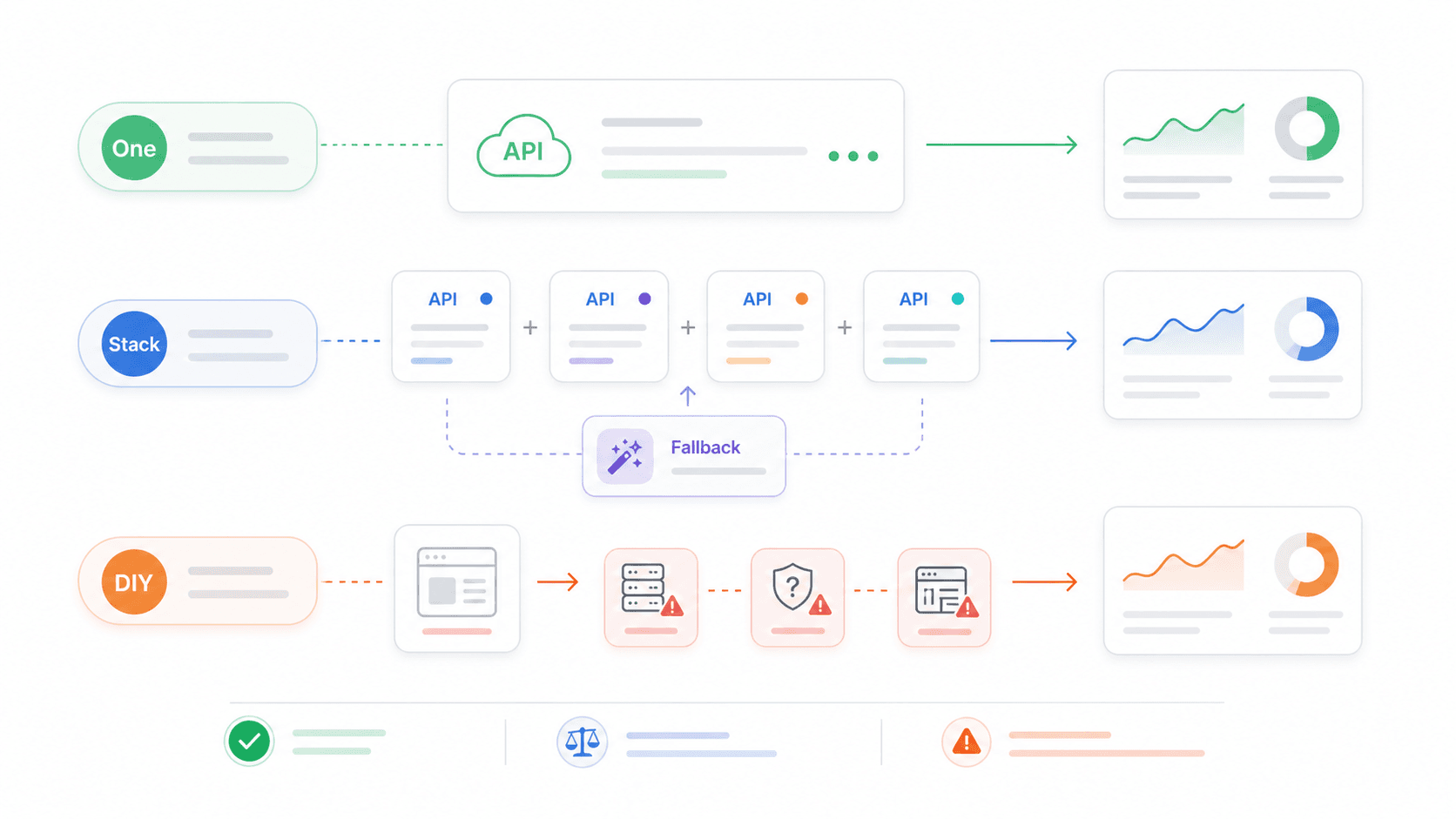
Forums surface this dilemma constantly: "Ideally all through a single integration instead of stitching together three providers" versus "Two bills with combined cost 40% lower = annoying but better." And then there's the reliability angle: "If your dashboard depends on a single SEO software API you're gonna have a bad time."
No competing guide addresses this systematically. Here's a decision framework:
| Your Priority | Recommended Approach | Example Stack |
|---|---|---|
| Lowest total cost | Split by data type | DataForSEO (SERPs) + Moz (link metrics) + GSC (free rankings) |
| Simplest integration | All-in-one provider | DataForSEO for API-first breadth, or SE Ranking for platform + API |
| Maximum backlink depth | Premium link source + cheaper SERP | Ahrefs (backlinks/Brand Radar) + DataForSEO or SerpAPI (SERPs) |
| Best real-time SERP DX | Specialized SERP API | SerpAPI |
| Future-proof (AI search) | AIO-capable API + flexible extractor | SE Ranking or Ahrefs Brand Radar + Thunderbit Extract |
| Custom data not in SEO APIs | Extraction layer | Thunderbit Distill/Extract + GSC + DataForSEO |
| Agency reporting | Platform + API + dashboard | SE Ranking or Semrush, with GSC as baseline |
When to go all-in-one: You need rank tracking + backlinks + keywords and your budget supports it. Fewer vendor relationships, one authentication flow, one billing cycle.
When to split providers: You're optimizing cost per data type. Ahrefs for backlinks, SerpAPI for SERPs, GSC for free baseline. More integration work, but potentially 40%+ savings.
When to add an extraction layer: You need data that traditional APIs don't expose — niche SERPs, AI Overview content, competitor page structures, pricing tables, job listings. That's where Thunderbit fits as a complement.
Risk mitigation: For high-stakes monitoring, build a primary + fallback architecture. If your SERP parser breaks when Google changes the AIO layout, having Thunderbit Extract as a backup means you can define a new schema and keep pulling data within minutes.
DIY Scraper vs. Paid SEO API: The Real Cost Math
I see this debate in forums constantly. The arc is almost always the same: developer builds a scraper, it works for a few weeks, then CAPTCHAs and IP bans start, proxy costs creep up, Google changes the SERP layout, and suddenly the "free" scraper is consuming 15+ dev hours per month. One Reddit user summed it up: "Maintenance cost in dev hours was way more than just paying for API. CAPTCHAs, IP rotation, parsing changes every time Google tweaks the SERP layout."
| Approach | Upfront Cost | Monthly Maintenance | Anti-Bot Handling | Data Accuracy | Time to First Data |
|---|---|---|---|---|---|
| DIY Python scraper | $0 (code) + proxy costs | 10–20 dev hrs/mo | Manual proxies, retries, rendering | Variable | Days to weeks |
| Thunderbit API (Extract) | Credit-based, no infra | Near-zero if schemas are stable | Built-in rendering, proxy, CAPTCHA | AI-structured; validate samples | Minutes to hours |
| Traditional SEO API (e.g., DataForSEO) | Credits or subscription | Near-zero | N/A (pre-processed data) | High (proprietary DB) | Minutes |
For a moderate 10K–50K SERP/month workflow, DataForSEO Standard costs roughly $6–$30 before AIO extras. SerpAPI costs $75–$275 depending on tier.
DIY proxy spend might look modest at $50–$200, but developer time at $100/hour × 10 hours = $1,000/month — and that's before reliability issues start compounding.
Thunderbit sits in the middle: you get the flexibility of custom extraction (define your own schema, scrape any page) without the maintenance burden of a DIY scraper, and without being locked into only the data fields a traditional SEO API pre-packages. It's not the cheapest option for pure rank tracking, but it's the most adaptable when your data needs don't fit neatly into someone else's endpoint.
I'm not going to say DIY scraping is never the right call. For internal research, very low volume, or non-Google pages with permissive access, it can work. But for production rank tracking or AIO monitoring, the math almost always favors a paid API.
Which SEO API Should You Pick?
After normalizing costs, mapping AI Overview support, comparing free tiers, and building decision frameworks, here's where each provider fits best:
- Best for startups and budget teams: GSC API + DataForSEO Standard (or SerpAPI Free) + Thunderbit Free
- Best for agencies needing API-first breadth: DataForSEO
- Best platform + AI Search API: SE Ranking
- Best real-time multi-engine SERP parsing: SerpAPI
- Best backlink intelligence and AI citation research: Ahrefs
- Best marketing suite integration: Semrush
- Best affordable domain authority metrics: Moz
- Best budget keyword/competitor data: Serpstat
- Best custom/flexible extraction (including AI Overviews): Thunderbit
The practical buying advice: start with a free tier or small deposit. Run your exact workflow for one week. Calculate cost from real response rows, retries, AIO add-ons, latency needs, and failed-task behavior. The cheapest published price is rarely the cheapest production setup.
If you want to see what AI-powered extraction looks like for SEO data, give Thunderbit a try — the free tier is enough to test your use case. For more on how we think about web data extraction, check out our guide to best practices for extracting data from any website, our SERP API comparison, our web scraping tools roundup, or watch tutorials on the Thunderbit YouTube Channel.
Try Thunderbit for flexible SEO data extraction Get Started Free
FAQs
1. What is an SEO API and who needs one?
An SEO API is a programmatic interface that lets you pull SEO data — rankings, keywords, backlinks, SERP features, AI Overview presence — into your own tools, dashboards, or workflows. Agencies building custom client reports, developers automating SEO pipelines, ecommerce teams monitoring competitor rankings, and startups building SEO products all benefit from API access rather than manual CSV exports.
2. Which SEO API is best for tracking AI Overviews in 2026?
For Google SERP-level AIO parsing, SerpAPI and DataForSEO both offer confirmed endpoints. For AI visibility across multiple LLM platforms (ChatGPT, Gemini, Perplexity, Copilot, Grok), SE Ranking and Ahrefs Brand Radar have the most comprehensive coverage. Thunderbit's Extract API offers a flexible schema-based approach when you need to extract AIO content from pages that traditional parsers haven't updated for yet. Moz, GSC, and Serpstat do not have confirmed AIO API support.
3. Can I build a useful SEO data pipeline for $0?
Yes, with limits. Combine Google Search Console API (free, own-site data), SerpAPI's 250 free monthly searches (SERP snapshots), Thunderbit's 600 free units (page extraction and AIO parsing), and Moz's 50 free rows (domain authority checks). That's enough to prototype a reporting dashboard and validate your workflow before committing budget.
4. Should I use one all-in-one SEO API or stitch together multiple providers?
It depends on your priorities. All-in-one providers like DataForSEO or SE Ranking simplify integration and billing. Splitting providers by data type (e.g., Ahrefs for backlinks, SerpAPI for SERPs, GSC for free baseline) can save 40%+ but adds integration complexity. For high-stakes monitoring, consider a primary + fallback architecture to protect against parser outages.
5. Is building my own SERP scraper cheaper than paying for an SEO API?
Almost never at production scale. DIY scrapers look free until you factor in proxy costs, CAPTCHA handling, IP rotation, JavaScript rendering, and — most importantly — developer maintenance time. At 10K+ SERP queries per month, the dev-hour cost alone typically exceeds what DataForSEO or SerpAPI would charge. Thunderbit's Extract API offers a middle path: custom extraction flexibility without the infrastructure burden.
Learn More




