

The global flight data API market is projected to hit USD 520 million in 2026, and every week another AI travel startup pops up that needs fare data, status feeds, or booking pipelines. Most "best flight API" articles lump booking APIs together with tracking APIs, bury pricing behind "contact us" links, and haven't caught up with the biggest shakeup of the year — the Amadeus Self-Service shutdown.
I've spent the last few months researching, testing, and comparing flight data tools for our team at Thunderbit, and the single biggest lesson is this: there is no "best flight API." There's only the best flight API for your specific job. A startup building a fare comparison app needs completely different plumbing than an airport shuttle company tracking arrivals. This article gives you a transparent, use-case-driven comparison of 10 flight APIs and tools — with real pricing, actual free-tier limits, and honest guidance on when an API isn't even the right tool. I'm also going to address the Amadeus deprecation head-on, because if you're building on Self-Service right now, you need a plan before July 17, 2026.
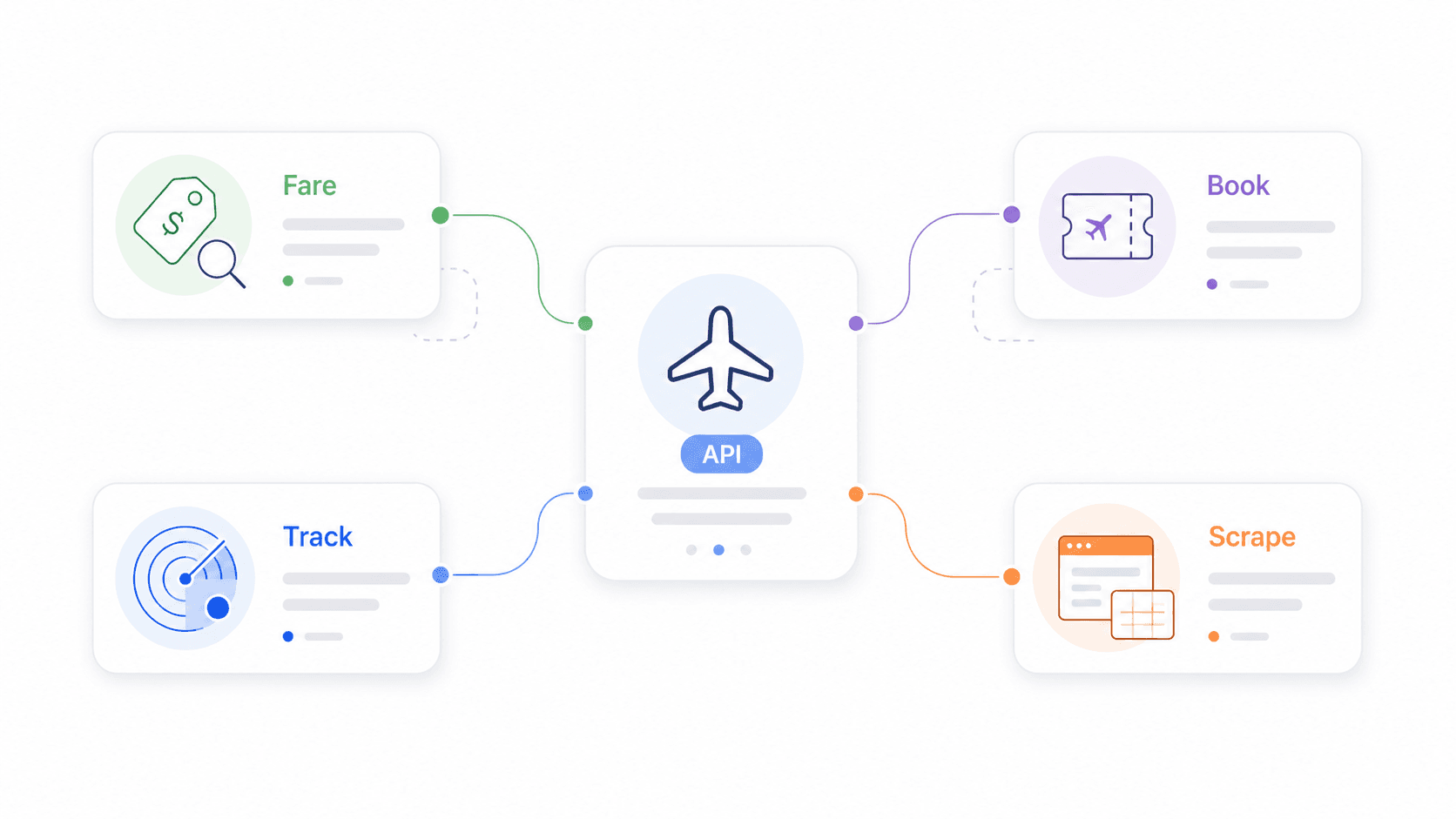
What to Look for When Choosing the Best Flight API
I evaluated every tool on this list against six dimensions. Here's what each one means in plain language:
- Free tier / trial limits: Developers and startups need a $0 starting point. But "free" can mean a sandbox with fake data, a handful of live calls, or a dollar credit that evaporates after a few queries. The distinction matters more than most articles let on.
- Pricing transparency: Some vendors publish exact per-call or per-order prices. Others say "contact sales." If you're an early-stage team trying to estimate costs, opaque pricing is a dealbreaker.
- Data type (booking vs. tracking vs. pricing): This is where most confusion lives. A booking API issues tickets. A tracking API gives you flight status, delays, and gate info. A pricing/search API returns fares. A scraping tool pulls whatever's visible on a page. These are not interchangeable.
- Rate limits & caching rules: A "cheaper" API can actually cost more if you have to poll it every few minutes. Some APIs prohibit caching, which forces repeat paid calls for identical data.
- Access model (self-serve vs. partnership): Self-serve means you sign up, get an API key, and start building. Partnership means an application, commercial review, traffic requirements, and sometimes weeks of waiting.
- Real-time data depth: "Real-time" can mean live fare shopping, live flight position, or cached indicative pricing. Gate and terminal data is often locked behind enterprise tiers.
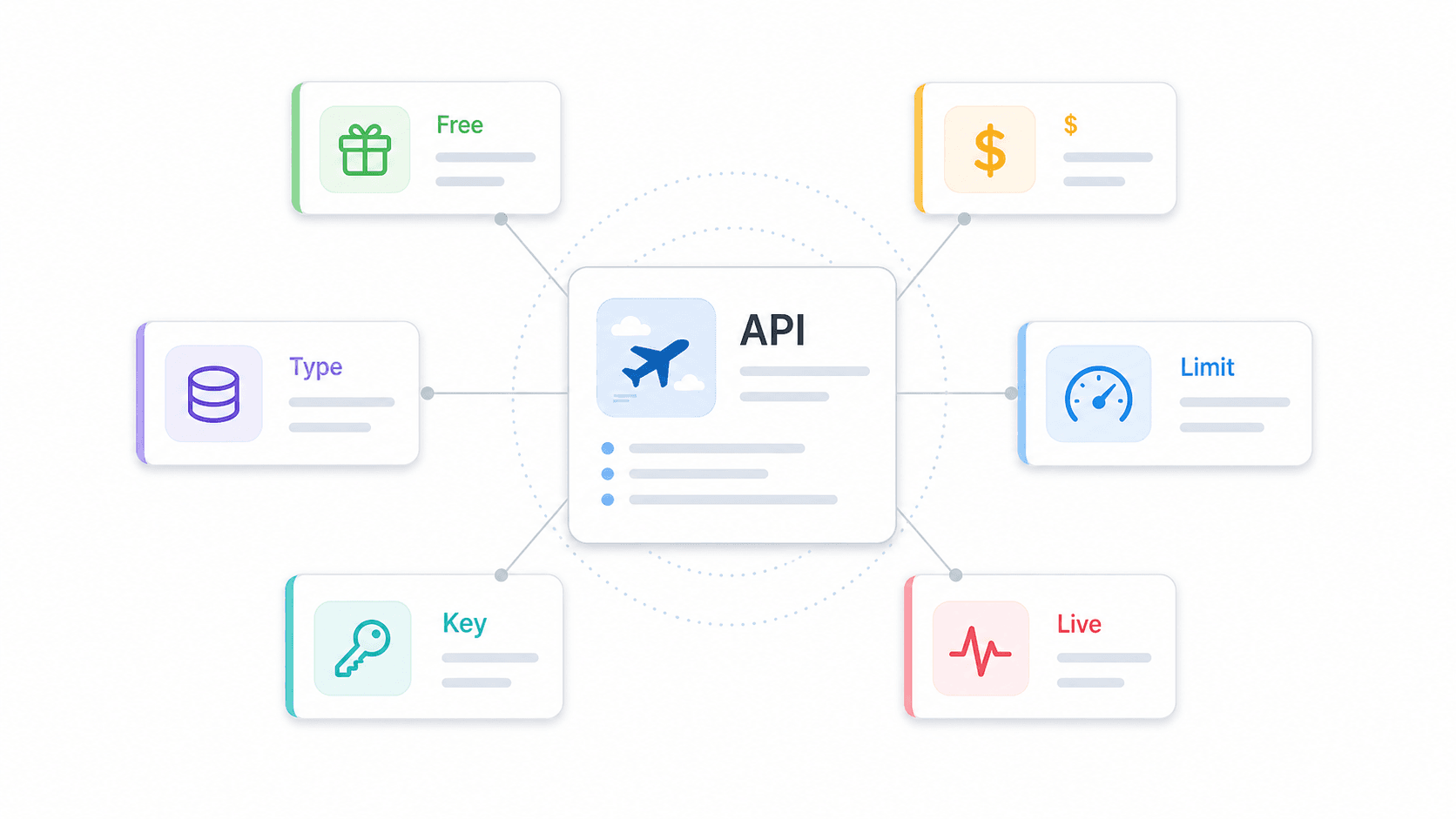
Most competitor articles skip at least half of these. This one won't.
Free-Tier Showdown: Exact Limits for Every Flight API
This is the table nobody else publishes. I went through the docs, pricing pages, and RapidAPI listings for all 10 tools and pulled the actual free-tier numbers as of May 2026.
| API / Tool | Free Calls or Pages | Data Included | Signup Model | Key Limitation |
|---|---|---|---|---|
| Thunderbit | 6 pages free; 10 with free trial | Scraped page-visible prices, schedules, availability | Chrome extension / self-serve | Not a booking or certified tracking API |
| Amadeus | Free monthly quota (varies by API; ~2,000 common for flight search) | Search, pricing, booking flow, status, airport data | Self-serve until July 17, 2026 | Test data is limited/cached; portal sunsetting |
| Duffel | Test mode free | Search, offer, order, ticketing, ancillaries | Self-serve / managed content | Test mode uses sandbox/mock airline data |
| Kiwi.com Tequila | Partner/affiliate access (historically free key; now increasingly gated) | Search, multicity, NOMAD, booking/affiliate | Partner / Travelpayouts for some | Travelpayouts says Kiwi API requires 50K MAU |
| Skyscanner (official) | No public free tier | Metasearch live and indicative prices | Official partnership | Requires commercial approval, often 100K MAU |
| Skyscanner via RapidAPI | ~100 requests/month (third-party listings) | Skyscanner-like search data | RapidAPI | Not official Skyscanner partnership |
| FlightAware AeroAPI | Up to $5/month free query credit ($20/mo for ADS-B feeders) | Flight status, tracking, historical, alerts | Self-serve, paid query model | "Free" is a dollar credit, not a fixed call count |
| AeroDataBox | 600 API units/month | Flight status, schedules, airport, aircraft | RapidAPI / API.Market | Units ≠ requests; endpoint cost varies |
| Aviationstack | 100 requests/month | Real-time flights, airports, airlines, schedules | Self-serve | Free tier limited to 1 req/60s |
| FlightAPI.io | 20–100 free calls (docs and marketing pages conflict) | Flight price search, tracker, airport schedule | Self-serve | Does not facilitate direct booking |
| Travelpayouts | Free registration; per-minute API limits | Cached/aggregated fares, trends, popular routes, affiliate links | Affiliate platform | Search API requires 50K MAU; data may be cached |
A few things jump out.
Amadeus and Duffel offer test modes, but the data isn't real — it's sandbox or cached. Aviationstack's 100 free requests are genuinely live, but you'll burn through them fast. FlightAware's "free tier" is actually a $5 monthly credit, which is clever but not the same as a fixed call count. And Thunderbit's 6 free pages are a different animal entirely — you're scraping visible web data, not calling a structured API.
Which Type of Flight API Do You Actually Need?
Too many forum threads end the same way: someone picked a tracking API when they needed a booking API, or asked a metasearch API to issue tickets. The FAA handles more than 45,000 flights and 2.9 million passengers on an average day in U.S. airspace alone. The data landscape is enormous — and fragmented.
| Your Use Case | You Need | Best Options |
|---|---|---|
| Build a booking engine | Booking/ticketing API | Duffel, Amadeus Enterprise (if accredited) |
| Build a fare comparison site | Search/pricing/metasearch API | Kiwi Tequila, Skyscanner partner, FlightAPI.io, Travelpayouts |
| Airport shuttle dispatch | Real-time arrival/delay tracking | FlightAware, AeroDataBox, Aviationstack |
| Display gate/terminal info | Status + airport infrastructure data | FlightAware, AeroDataBox |
| Monitor competitor pricing | Price extraction (no booking) | Thunderbit (scrape OTAs), FlightAPI.io, Travelpayouts |
| Travel affiliate site | Search + monetization | Travelpayouts, Skyscanner affiliate |
| Validate API prices against airline site | Scraping complement | Thunderbit + your chosen API |
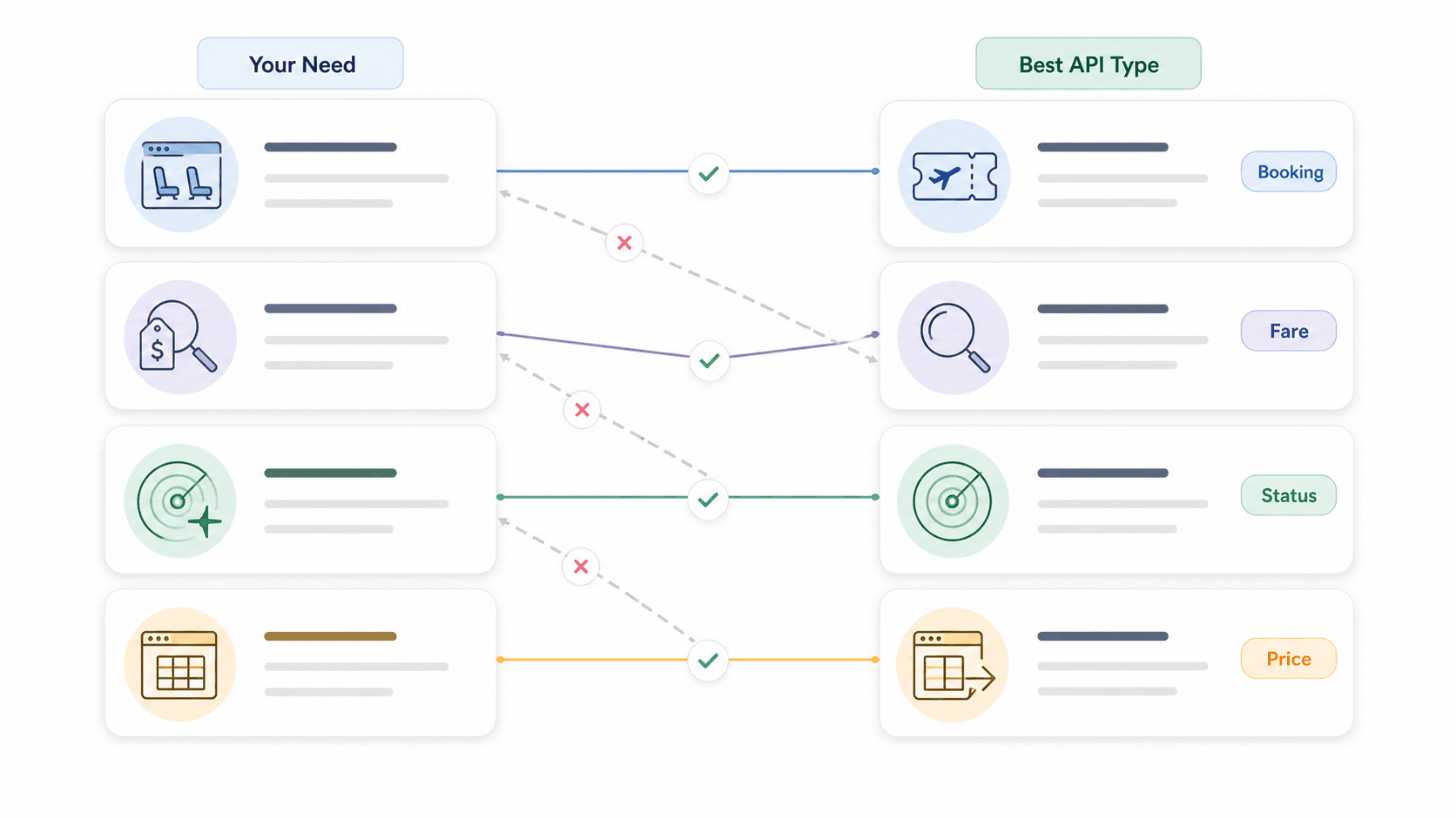
The most common wrong turn: asking a tracking API for fare prices, or assuming Google Flights has a public API.
It doesn't. Google shut down QPX Express on April 10, 2018 and never replaced it.
1. Thunderbit
Thunderbit is not a traditional flight API. It's an AI-powered web scraping tool — a Chrome extension — that can extract flight prices, schedules, and availability from any airline website or OTA page without writing code. The workflow is genuinely two clicks: hit "AI Suggest Fields" and Thunderbit reads the page to propose columns, then click "Scrape" to pull structured data.
I work on the Thunderbit team, so I'll be upfront about where it fits and where it doesn't.
Thunderbit shines in scenarios where traditional APIs fall short:
- Niche airlines not covered by aggregators (regional carriers, ultra-low-cost airlines with limited GDS presence)
- Price validation — checking whether the fare your API returns matches what the airline actually shows on its own site
- Low-volume monitoring — tracking 50–200 routes daily without committing to an API minimum
- Partnership gates — when the API you want requires commercial approval you can't get yet (looking at you, Skyscanner)
Key features for flight data use cases:
- Scheduled scraping: Set Thunderbit to check airline or OTA pages on a recurring schedule for ongoing price monitoring
- Subpage scraping: Click into individual flight listings to enrich data (e.g., pull fare class details from a booking page)
- Export anywhere: Send data directly to Excel, Google Sheets, Airtable, or Notion
- No API key setup: Install the extension, navigate to a page, and start extracting
For teams that only need visible fare and schedule data from a few travel sites, Thunderbit templates can be a quicker bridge than building against an API first. The Flyin Scraper, Travelstart Scraper, and Gotogate Scraper are practical starting points for extracting flight listings, prices, routes, and schedule fields from OTA pages.
Thunderbit Pricing and Free Tier
Thunderbit uses a credit-based system where 1 credit = 1 output row. The free tier gives you 6 pages (10 with a free trial). Paid plans start at ~$15/month (monthly) or $9/month (yearly) for 500 credits. For a practical flight monitoring scenario — say, tracking 100 routes daily with one fare row per route — that's about 3,000 rows/month, which maps to the Pro 1 tier at roughly $38/month on monthly billing.
Compare that to per-query API pricing for the same job: monitoring 100 flights every 5 minutes through a query API could run into hundreds of thousands of billable checks per month. For price monitoring specifically, scheduled scraping is often the more cost-effective path.
Try Thunderbit for Flight Price Monitoring
Best For
Price monitoring, competitor intelligence, niche airline data extraction, and validating data from other flight APIs. Not for booking, ticketing, or certified real-time operational tracking.
2. Amadeus
Amadeus is one of the largest GDS providers in the world, and for years its Self-Service API has been the default recommendation for startups needing flight search, pricing, and booking. The catalog is massive: Flight Offers Search, Flight Offers Price, Flight Create Orders, Seatmap Display, flight inspiration, cheapest dates, and more.
In production, Amadeus offers a 90% discount on flight search calls when you create bookings through the platform — a meaningful incentive for apps that actually sell tickets.
The Amadeus Self-Service Deprecation: What Changes in July 2026
This is the story no competitor article is telling. PhocusWire reported on February 9, 2026 that Amadeus confirmed it would pause new registrations and decommission the Self-Service API portal for existing users on July 17, 2026. Tragento corroborated the same date, noting that API keys will be disabled and the Self-Service portal will become inaccessible.
What this means: if you're a startup or independent developer, you'll need to migrate to Amadeus Enterprise, which may require IATA/ARC accreditation — a significant commercial and operational hurdle. The self-serve era for Amadeus is ending.
Amadeus Pricing and Free Tier
The test environment provides a free monthly quota with limited, cached data and a 10 TPS cap. Production offers 40 TPS and real-time data, charging only above monthly free limits. But the test environment explicitly contains limited/cached data, not live fares — a detail that catches many new users off guard.
Best For
Enterprise travel sellers, large OTAs, and teams with IATA/ARC accreditation or existing GDS relationships. For startups building new projects in 2026, I'd recommend Duffel first and Thunderbit as a bridge for price monitoring during migration.
3. Duffel
Duffel is the cleanest migration path from Amadeus Self-Service, and real user consensus on forums backs this up. It's a modern REST API with direct airline connections via NDC, covering 300+ airlines including major carriers and LCCs. The full booking pipeline — search → offer → order → ticketing — is handled through a single, well-documented API.
The biggest differentiator for startups: Duffel explicitly says sellers do not need to be an ARC/IATA travel agent when using Managed Content. That's a massive barrier removed.
Duffel Pricing and Free Tier
Duffel publishes transparent pricing: $3 per confirmed flight order, 1% of total order value for Managed Content, $1 per paid ancillary, and an excess search fee of $0.005 per search after a 1,500:1 search-to-book ratio. Test mode is free and uses Duffel Airways as a sandbox — though test prices and schedules are not realistic.
Best For
Teams migrating from Amadeus Self-Service, startups building booking flows, and developers who want modern API design without accreditation requirements.
4. Kiwi.com Tequila
Kiwi.com Tequila is known for flexible itineraries, multi-city routing, and virtual interlining — meaning it can combine carriers that don't normally codeshare. If you've ever wanted to build a "fly anywhere" inspiration search, Tequila's routing logic is hard to beat.
Kiwi.com Tequila Pricing and Free Tier
The access story has gotten murkier in 2026. Older docs described free API-key access, but Travelpayouts' current Kiwi API help page says access requires a project with at least 50,000 MAU. Reddit threads confirm that free Tequila access has become harder to obtain. The revenue model is typically commission-based for bookings.
Best For
Metasearch apps, travel inspiration tools, and complex multi-city itinerary builders — once you clear the access requirements.
5. Skyscanner API via RapidAPI
Skyscanner's official Travel API is partner-based. It requires commercial use and case-by-case approval, and the company says it cannot give access to students, non-commercial users, startups without robust plans, low-traffic sites under 100K MAU, or agencies. The developer docs describe global content across 52+ markets, 30 languages, and 1,300+ supply partners.
For smaller developers, RapidAPI marketplace listings offer Skyscanner-like data. APIHiver's 2026 tutorial says Sky Scrapper on RapidAPI offers up to 100 requests/month free. But these are third-party listings, not official Skyscanner partnerships — data rights and freshness may differ.
Skyscanner Pricing and Access Model
Official partnership pricing depends on your commercial agreement. RapidAPI tiers vary by listing. The key distinction: official Skyscanner partnership gives you live pricing and indicative prices; third-party RapidAPI listings may have restricted or cached data.
Best For
Established travel companies building metasearch UIs, affiliate sites with deal comparison, and teams with enough traffic to pass partner review.
6. FlightAware AeroAPI
FlightAware AeroAPI is the go-to for real-time flight tracking — live positions, delays, cancellations, gate info, and historical data. It's powered by ADS-B feeds and is not for fare shopping or booking. FlightAware tracked more than 69 million flights in 2025, roughly 189,000 per day.
FlightAware Pricing and Free Tier
The Personal tier offers up to $5 free monthly query usage ($20/month for ADS-B feeders). Standard starts at a $200/month minimum with 5 result sets/second. Premium offers 100 result sets/second. Volume discounts kick in after the first $5,000/month.
Here's where it gets expensive: monitoring 500 flights every 5 minutes means 4.32 million checks/month. Even at a hypothetical $0.002/result set, that's $8,640/month.
Polling frequency dominates costs with query-based APIs.
Best For
Airport operations, travel disruption apps, shuttle dispatch, logistics, and flight status displays.
7. AeroDataBox
AeroDataBox is an affordable tracking and airport data API available through RapidAPI and API.Market. Its pricing page lists a free Basic tier with 600 API units/month, Pro at $5.35/month, Ultra at $32/month, and Mega at $160/month.
Units are not equal to requests — endpoint cost varies by tier — and data coverage is best-effort. The coverage page lists examples like United States at 100% schedule coverage and 86% live status/time coverage, while France sits at 92% / 79%. Terminal, gate, and baggage belt data is available but listed as "sometimes" rather than guaranteed.
AeroDataBox Pricing and Free Tier
600 free units/month on Basic, with rate limiting at 1 request/second. RapidAPI also has an additional 1,000 requests/hour limit.
Best For
Small apps needing affordable airport/flight status data, prototyping, and combining with other data sources for richer results.
8. Aviationstack
Aviationstack is a straightforward REST API for real-time and historical flight data, schedules, airlines, airports, and aircraft. Its pricing page states the free plan includes 100 requests/month with a personal license and HTTPS. Paid plans: Basic $49.99/month for 10,000 requests, Professional $149.99/month for 50,000, Business $499.99/month for 250,000.
Historical flights, airline routes, autocomplete, flight schedules, and future flights are all locked to paid tiers. The free plan is limited to 1 request per 60 seconds and a maximum result limit of 100.
Best For
Developers prototyping flight apps, small projects needing schedule data, and dashboards where simplicity matters more than depth.
9. FlightAPI.io
FlightAPI.io focuses on flight prices, airport schedules, and tracking-style endpoints. It covers 700+ airlines and provides one-way, round-trip, and multi-city pricing data with booking links — but does not facilitate direct booking.
FlightAPI.io Pricing and Free Tier
The free tier messaging is inconsistent across FlightAPI.io's own pages. Product pages mention 20 free credits, while docs say 100 requests per 30 days. The blog lists Free 20 calls, Lite $49/month for 30K credits, Standard $99/month for 100K credits, and Plus $199/month for 500K credits. Per-request credit costs: one-way 2 credits, round trip 2, multi-trip 5, flight tracking 1, airport schedule 2.
Best For
Price comparison dashboards, fare alert tools, and budget-conscious startups that need search/pricing data without ticketing.
10. Travelpayouts
Travelpayouts is unique on this list because it's an affiliate-first platform, not a traditional paid API. Partners promote travel brands, use affiliate tools, access APIs, and earn commissions — typically 1.1–1.5% of flight booking value. You don't pay per call; you earn per booking.
Travelpayouts Pricing and Free Tier
Free to register and access the Data API. However, the full real-time Aviasales Search API requires 50,000 MAU. Rate limits are per-endpoint: /v1/prices/calendar at 300 RPM, /statistics/v1/execute_query at 30 RPM. Travelpayouts explicitly recommends caching frequently used data.
Data freshness is the trade-off: results are cached/aggregated, not live shopping queries. For SEO content, deal pages, and "best time to fly" features, that's fine. For a real-time fare comparison engine, it's not enough.
Best For
Travel blogs, affiliate sites, deal aggregators, and "best time to fly" content where monetization matters more than live ticketing.
Best Flight APIs Compared: Side-by-Side Table
| API / Tool | Free Tier | Starting Price | Data Type | Rate Limit | Self-Serve? | Best For |
|---|---|---|---|---|---|---|
| Thunderbit | 6 pages; 10 trial | ~$15/mo or $9/mo yearly | Scraping / monitoring | Plan-dependent | Yes | Price monitoring |
| Amadeus | API-specific free quota; test cached data | Usage-based; Enterprise post-sunset | Search / booking / travel data | Test 10 TPS; prod 40 TPS | Until July 2026 sunset | Enterprise travel apps |
| Duffel | Test mode free | $3/order + 1% Managed Content | Booking / ticketing | 1,500:1 search-to-book before excess fee | Yes | Booking startups |
| Kiwi Tequila | Partner/affiliate access | Commission / partnership | Flexible search / booking / affiliate | Not clearly public | Partly | Multi-city search |
| Skyscanner official | No public free tier | Commercial agreement | Metasearch | Partner-specific | No | Established metasearch |
| Skyscanner via RapidAPI | ~100 requests/mo (third-party) | Varies by listing | Metasearch-like | Varies | Yes via RapidAPI | Small tests |
| FlightAware AeroAPI | $5 monthly query credit | $200/mo minimum Standard | Tracking / status / history | 10 result sets/min Personal | Yes | Operations tracking |
| AeroDataBox | 600 units/month | $5.35/mo RapidAPI Pro | Status / schedules / airport | 1 req/sec Basic | Yes via marketplace | Affordable status data |
| Aviationstack | 100 requests/month | $49.99/mo | Status / schedules / static data | Free: 1 req/60s | Yes | Simple REST prototypes |
| FlightAPI.io | 20–100 free calls (conflicting docs) | $49/mo Lite | Price / schedule / tracker | Plan-dependent | Yes | Budget price search |
| Travelpayouts | Free affiliate registration | Commission model | Affiliate fares / trends / data | 30–600 RPM by endpoint | Yes, but search gated | Affiliate sites |
Good pairings to consider: Duffel + FlightAware for booking plus disruption/status. Travelpayouts + Thunderbit for affiliate content plus source-site price validation. Aviationstack or AeroDataBox + Thunderbit for a low-cost prototype with supplemental scraping.
The Hidden Cost of "Cheap" Flight APIs: What Pricing Pages Don't Tell You
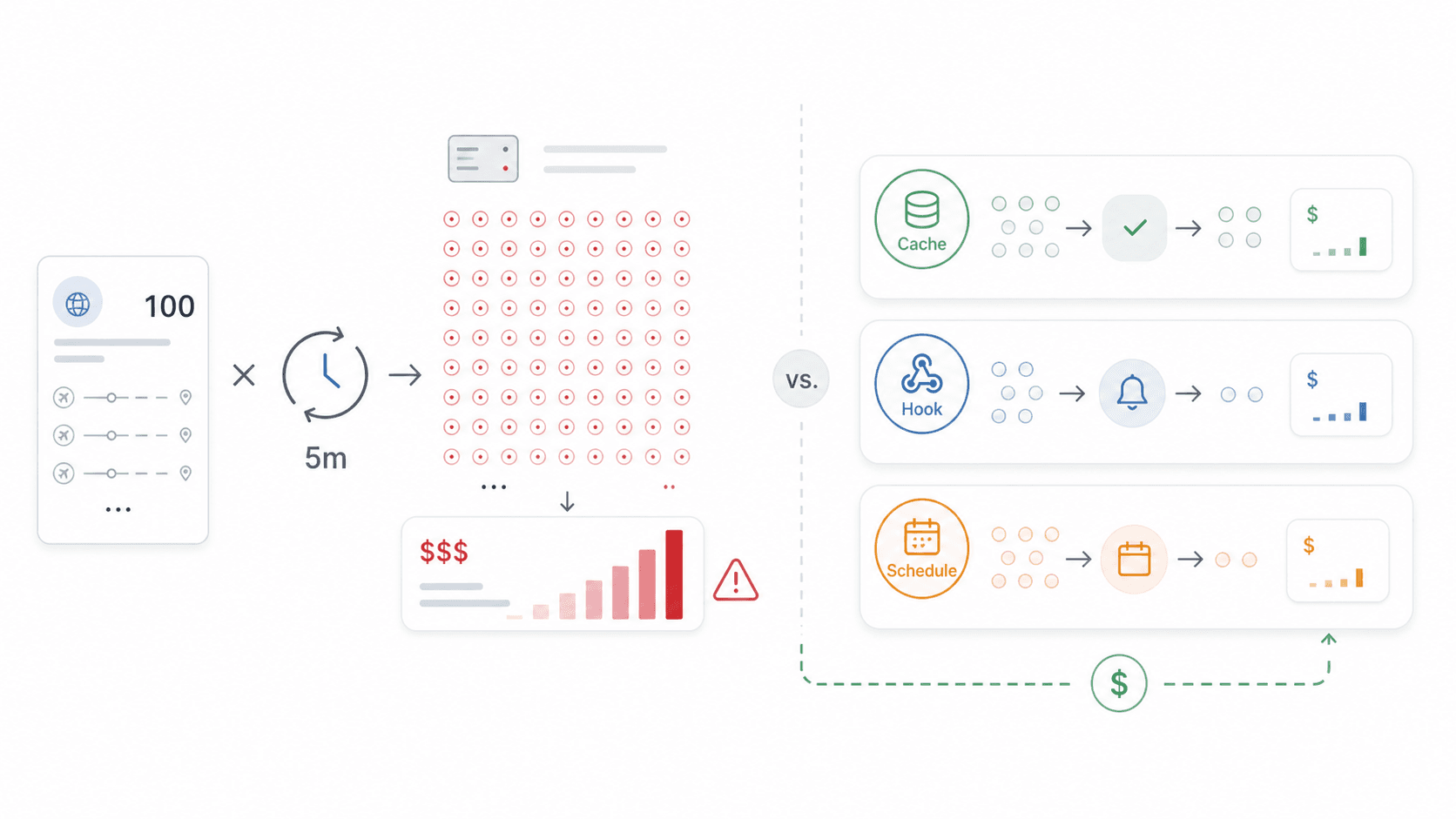
Sticker prices are misleading in the flight data world. Three cost drivers hide below the surface:
Polling costs. APIs without webhooks or alert endpoints force you to call repeatedly. Monitoring 500 flights every 5 minutes is 4.32 million checks per month. At even $0.002/check, that's $8,640/month — and that's a conservative estimate depending on the endpoint.
Caching restrictions. Some APIs prohibit caching results, forcing paid repeat calls for identical data. Travelpayouts explicitly recommends caching, which is a good sign. Duffel's docs advise using latest price data before booking because offers change — but that means revalidation calls add up.
Tiered data stripping. Real-time gate, terminal, baggage belt, and full historical data are often locked behind enterprise tiers ($500+/month). AeroDataBox lists many operational fields as "sometimes available" rather than guaranteed at lower tiers.
Here's a concrete cost comparison. Monitoring 100 routes daily for fare changes via Thunderbit's scheduled scraping: roughly 3,000 output rows/month at ~$38/month on the Pro 1 tier. Monitoring 100 flights for operational status every 5 minutes through a query API: 864,000 checks/month. At $0.002/check, that's $1,728/month. The use cases are different, but the cost gap illustrates why polling frequency is the real budget killer.
Tips for keeping costs down:
- Cache data wherever the API's terms allow
- Separate "price discovery" from "booking revalidation" — don't revalidate until the user is ready to buy
- Use webhooks or alert endpoints when available instead of polling
- Deduplicate identical user searches
- Pair a low-volume scraper (like Thunderbit) with APIs rather than forcing every edge case through a paid endpoint
When Scraping Beats a Flight API (and When It Doesn't)
This isn't a pitch for one tool over another. It's a practical framework for when each approach makes sense.
Scraping wins when:
- You need pricing from a specific airline's site not covered by aggregator APIs
- You want to validate API data against the source of truth (the airline's own website)
- Your volume is too low to justify minimum API commitments
- The API you need has partnership gates you can't pass (Skyscanner, for example)
APIs win when:
- You need booking/ticketing capability — scraping can't issue tickets
- You need sub-minute real-time tracking (ADS-B feeds)
- You need certified data for regulatory or compliance purposes
- You need predictable commercial data rights for redistribution
In my experience, the smartest teams use both. An API for breadth and booking, plus scraping for edge cases, validation, and niche routes. Thunderbit fits the scraping side: its AI-powered Chrome extension extracts flight prices and schedules from airline and OTA pages without code, exports to Google Sheets or Airtable, and runs on a schedule for ongoing monitoring. For a deeper look at how to scrape products from ecommerce sites or copy data from website to Excel, we've covered those workflows on the Thunderbit blog.
A legal note: public website access does not automatically grant unlimited commercial reuse. Check terms of service, respect rate limits, and use official APIs when contractual rights are required.
How to Pick the Best Flight API for Your Use Case
Quick decision guide:
- Building a booking engine? Start with Duffel. Evaluate Amadeus Enterprise only if you have IATA/ARC accreditation.
- Need real-time tracking? FlightAware for highest-confidence operational data. AeroDataBox or Aviationstack for lower-cost prototypes.
- Building a fare comparison site? Skyscanner official if you qualify. Kiwi Tequila, FlightAPI.io, or Travelpayouts for lighter-weight options.
- Price monitoring without API contracts? Thunderbit.
- Running a travel affiliate site? Travelpayouts plus Skyscanner affiliate products.
- Currently on Amadeus Self-Service? Plan your migration before July 17, 2026. Duffel is the most practical destination; Thunderbit can bridge price monitoring during the transition.
- No coding skills? Thunderbit or Travelpayouts are the most accessible starting points. For more options, check our roundup of best free AI web scraping tools.
The flight data landscape in 2026 is more fragmented than ever — but that also means there's a tool for every budget and every use case. Match your actual job (booking, tracking, pricing, or affiliate) to the right category first, then compare vendors within it.
If you want to see what flight price scraping looks like in practice, give the Thunderbit Chrome extension a try — the free tier is enough to test it on a few airline pages. And if your use case is booking or real-time tracking, start with Duffel or FlightAware respectively. The worst decision is building on the wrong category of API and discovering it six months later.
FAQs
1. Is there a free flight API?
Yes, but none is unlimited for production-grade live fares. Good free or prototype options include Aviationstack (100 requests/month), AeroDataBox (600 units/month), FlightAPI.io (20–100 free calls), Amadeus sandbox (while available), Travelpayouts (free affiliate registration), and Thunderbit (6 free pages). Each has different data types and limitations — check the free-tier table above.
2. What happened to Google Flights API?
There is no public Google Flights API. Google shut down QPX Express on April 10, 2018 and has not replaced it. Alternatives include Skyscanner, Kiwi Tequila, Duffel, FlightAPI.io, or scraping Google Flights with tools like Thunderbit.
3. Is Amadeus Self-Service API shutting down?
Yes. PhocusWire reported the Self-Service tier is sunsetting on July 17, 2026. New users and small startups should not build a new long-term dependency on Self-Service. Duffel is the most recommended migration path for booking use cases.
4. Can I scrape flight data instead of using an API?
For price monitoring, validation, and low-volume public data extraction — yes. Tools like Thunderbit can extract visible fare data from airline and OTA sites without code. For ticket issuance, certified operations, or high-frequency real-time tracking, you need a proper API.
5. Which flight API is best for a startup on a budget?
For booking, Duffel offers the most practical modern starting point with transparent per-order pricing. For status data, Aviationstack or AeroDataBox have affordable entry points. For fare/price experiments, FlightAPI.io or Travelpayouts Data API work well. Add Thunderbit when a route, airline, or OTA page is missing from an API or when you need recurring price validation without per-query costs.
Try Thunderbit for Flight Data Extraction Get Started Free




