Picture this: you’re scrolling through your LinkedIn feed, and it feels like every other post is someone launching a new AI startup, raising a $100 million round, or announcing a “world-changing” product. It’s not just your imagination—2026 is the year artificial intelligence startups have gone from a trickle to a tidal wave. But with so much hype and so many headlines, how do you separate the signal from the noise? Whether you’re a founder, investor, or just trying to keep your business ahead of the curve, understanding the real numbers behind the AI boom is the difference between riding the wave and getting wiped out.
I’ve spent the past year deep in the trenches of the AI ecosystem—building, researching, and (yes) occasionally doomscrolling funding news. The stats I’m about to share aren’t just jaw-dropping; they’re essential benchmarks for anyone who wants to thrive in the artificial intelligence gold rush. So, let’s dig into the most important AI statistics and AI startup statistics for 2026, and see what they really mean for the future of tech, business, and, well, all of us.
The AI Startup Surge: Headline Stats for 2026
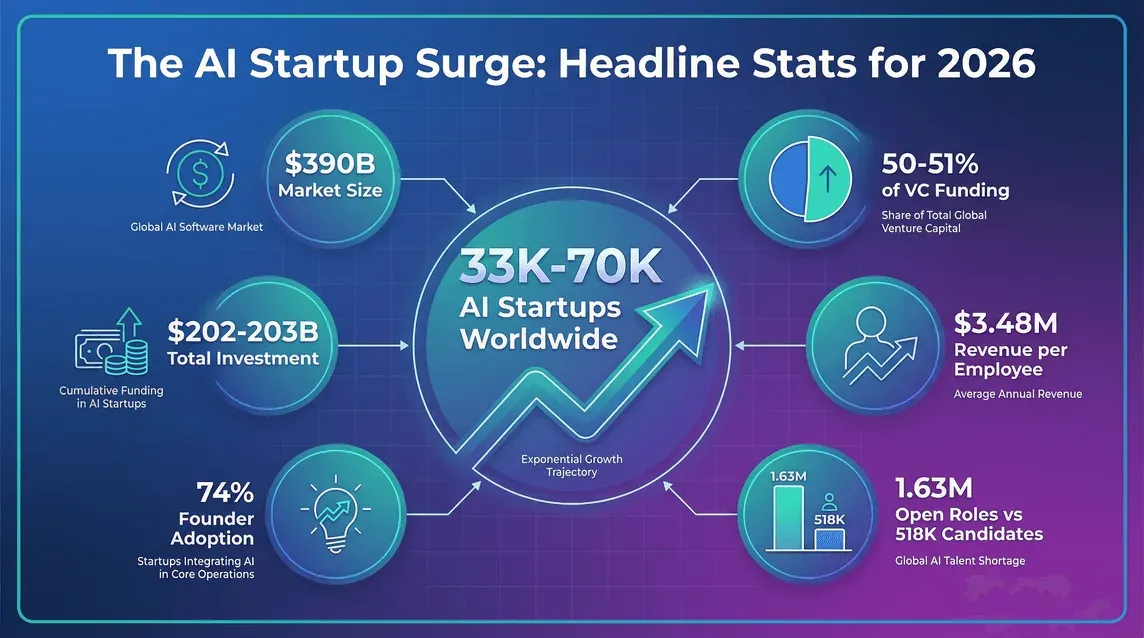
Let’s start with the numbers that are making jaws drop in boardrooms and Slack channels everywhere. Here are the headline AI statistics and AI startup statistics you need to know for 2026:
| Statistic | 2026 Value / Trend |
|---|---|
| Number of AI startups worldwide | ~33,000 to ~70,000 |
| Global AI market size (2025) | ~$390 billion, projected 36% CAGR to $1.8 trillion by 2030 |
| Global VC funding to AI (Q1 2026 only) | $242 billion — 80% of global VC, on pace to dwarf 2025 |
| Share of global VC funding captured by AI startups (full-year 2025) | 50–51% (up from 34% in 2024) |
| Total VC investment in AI startups (full-year 2025) | ~$202–203 billion |
| Average revenue per employee at top AI startups | $3.48 million (5–6× higher than leading SaaS) |
| AI adoption among new tech startups | ~74% of founders incorporate AI |
| YC Winter 2026 batch — share of AI / agent-infra startups | ~60% AI overall, ~41.5% building agent infrastructure |
| AI talent gap | 1.63 million open AI roles vs. ~518,000 qualified candidates |
If you’re not at least a little bit stunned, check your pulse.
Global AI Startup Landscape: Growth, Funding, and Market Share
What Is Data Scraping and How to Do It in 2025 Get Started Free
The AI startup landscape in 2026 is, frankly, wild. Depending on who you ask, there are either ~33,000 or ~70,000 AI-focused startups worldwide. That’s not just a lot of pitch decks—it’s a fundamental shift in how new companies are being built.
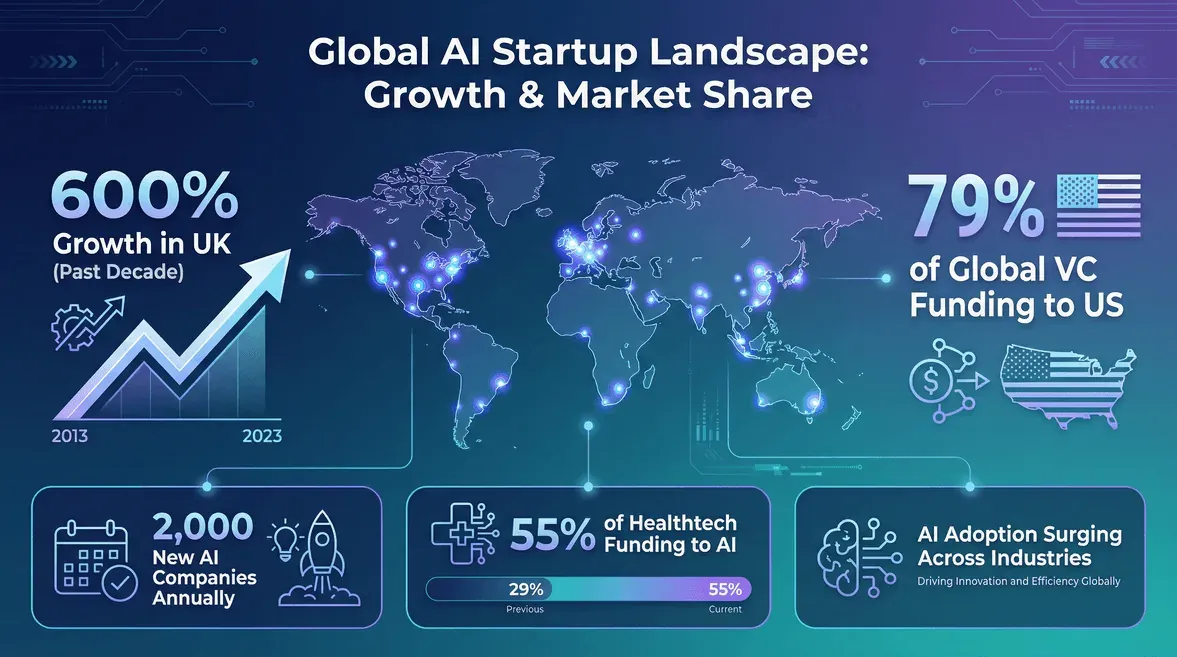
- Growth rate: In the UK alone, the number of AI firms has grown 600% over the past decade, and about 2,000 new AI companies launch every year.
- Regional hotspots: The U.S. dominates, with ~79% of global AI VC funding flowing to American startups.
- Sector breakdown: AI is eating the world, but some sectors are getting more love than others. For example, ~55% of healthtech funding now goes to AI startups (up from 29% in 2022).
- AI-native, AI-first, and AI-enabled: What’s the difference? AI-native startups are built around AI from day one (think foundation model labs or agentic AI companies). AI-first means AI is the core product or differentiator. AI-enabled startups use AI to enhance existing products or operations. In 2026, the lines are blurring, but the trend is clear: if you’re not using AI, you’re probably not getting funded.
The bottom line: AI isn’t just a feature anymore—it’s the foundation.
Where the Money Flows: AI Startup Funding and Investment Trends
Q1 2026 update — the picture has shifted again. Crunchbase numbers published in April 2026 show investors deployed $300 billion across roughly 6,000 deals globally in Q1 2026 alone, the largest single quarter on record. AI startups absorbed $242 billion of that — about 80% of total global VC funding, up from 55% in Q1 2025. Four frontier labs — OpenAI ($122B), Anthropic ($30B), xAI ($20B) and Waymo ($16B) — collectively pulled in $188B, or 65% of all global venture investment in the quarter. In other words: one quarter of 2026 is on track to nearly match all of 2025's AI funding.
Let’s talk about the money, because, let’s be honest, that’s what keeps the lights on (and the GPUs humming).
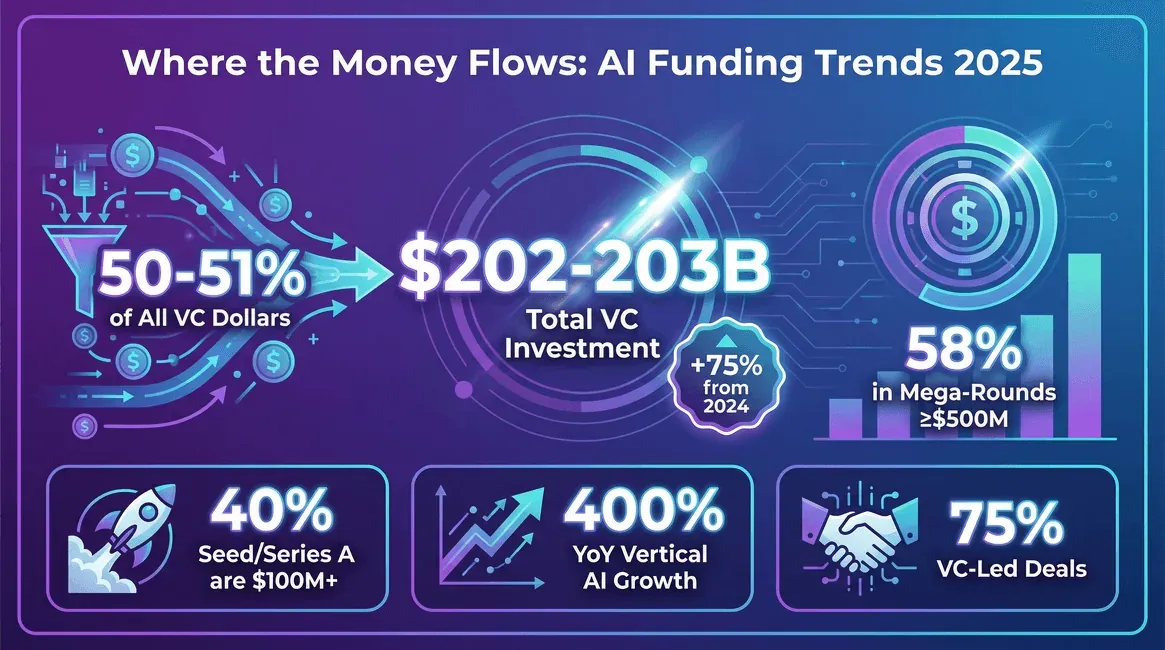
- Total VC investment in AI startups (2025): ~$202–203 billion, up 75% from $114B in 2024.
- Share of global VC funding: 50–51% of all VC dollars now flow to AI startups.
- Mega-rounds: 58% of AI startup funding went into rounds ≥$500M in 2025. SoftBank’s $40B investment in OpenAI alone is enough to make any founder’s eyes water.
- Early-stage shift: ~40% of seed/Series A funding is going to $100M+ rounds in 2026, mostly for AI companies.
- Valuations: OpenAI closed its $122B mega-round across February and March 2026, with widely reported post-money figures in the $850B range and a path to a possible Q4 2026 listing. Anthropic priced its Series G at a $380B post-money valuation in early 2026, with secondary-market and follow-on chatter pushing higher into the year. Median late-stage AI startup valuations remain well above traditional software benchmarks — but with that altitude comes a sharper question about which of these multiples will actually survive the next funding cycle.
Sector hot spots:
- Generative AI is still the belle of the ball, but “vertical AI” (industry-specific solutions) is gaining steam. According to Bessemer, LLM-powered vertical AI firms are growing ~400% YoY on average, with ~65% gross margins.
Deal flow: While tech giants and private equity are writing big checks, VCs still lead 75% of deals, often in syndicates. The average deal size is up, and the days of “spray and pray” seed investing are fading—unless you’re building an AI agent, apparently.
AI Startup Performance: Productivity, Profitability, and Team Structure
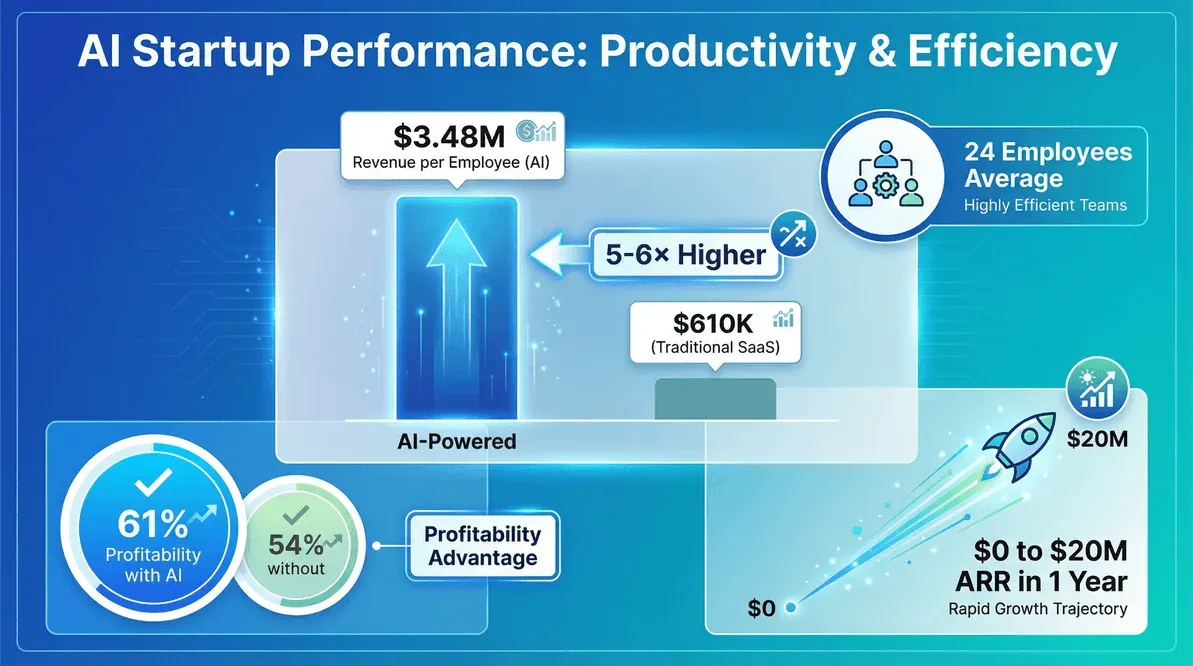
Here’s where things get spicy. AI startups aren’t just raising more money—they’re doing more with less.
- Revenue per employee: Top AI startups average $3.48M per employee—that’s 5–6× higher than leading SaaS firms (which hover around $610K).
- Team size: The 10 largest AI startups average just ~24 employees. Compare that to the hundreds or thousands at legacy tech companies.
- Profitability: 61% of SaaS companies using AI tools are at breakeven or better, versus 54% of those not using AI.
- Time-to-market: Some GenAI startups are going from $0 to $20M ARR in a year by focusing on a single pain point (MIT/Fortune).
What’s driving this? Lean, cross-functional teams powered by AI automation—coding, analysis, content creation, you name it. It’s not just about working smarter; it’s about working smaller and scaling faster.
AI Adoption in Startups: Use Cases and Implementation Trends
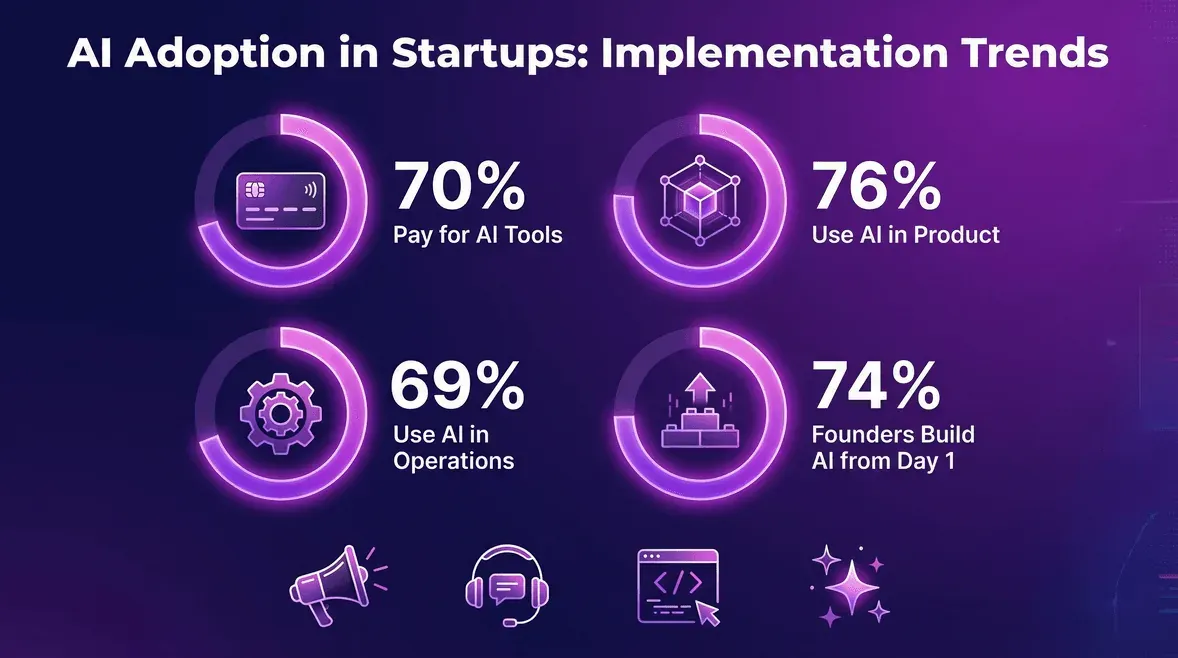
AI isn’t just a buzzword for startups—it’s the new normal.
- Adoption rates: ~70% of startups are already paying for at least one AI tool. Among SaaS firms, 76% use AI in their product and 69% in day-to-day operations.
- Founder mindset: ~74% of new founders build AI into their business model from day one.
Most common use cases:
- Marketing & sales automation: Generating copy, email outreach, social media content, and A/B testing.
- Customer service: Chatbots and virtual assistants to automate support.
- Product development: AI-assisted coding, data cleaning, analytics, and business intelligence.
- Niche features: Embedding AI directly in the product (think smart suggestions, predictive analytics, or even image generation).
Pro tip: The most successful startups focus on 2–3 core AI use cases that move the needle, rather than spreading themselves thin across a dozen “nice-to-have” features (HubSpot).
The Rise of Agentic AI and Autonomous Systems in Startups
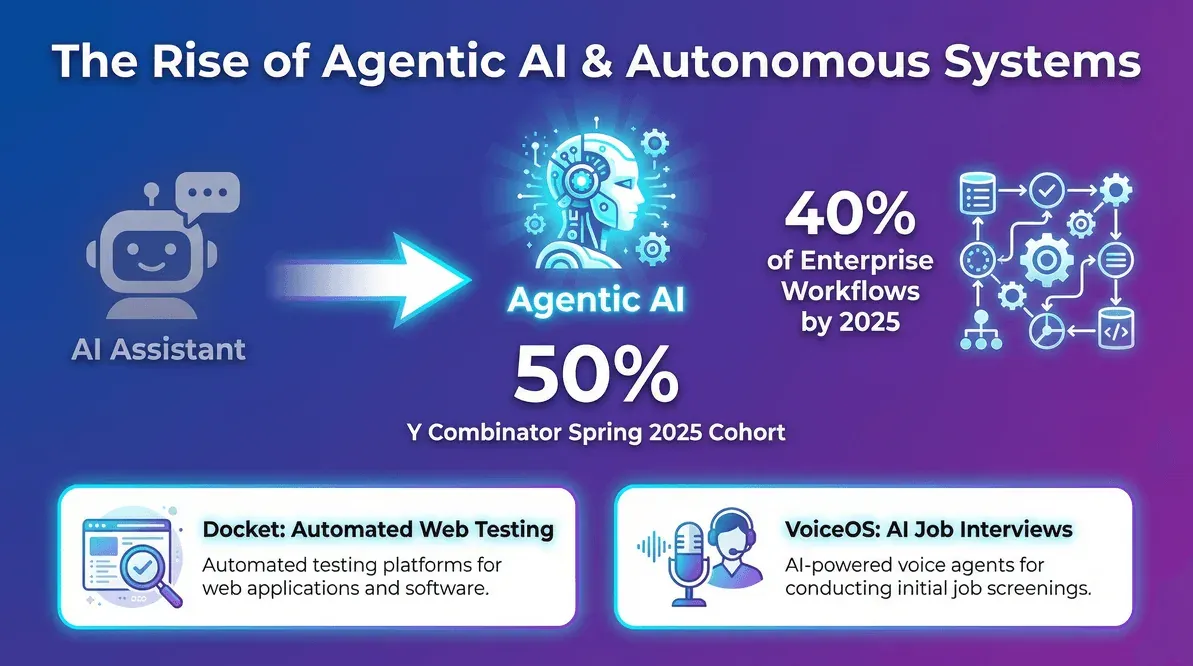
Remember when “AI assistant” meant a chatbot that could barely schedule a meeting? In 2026, the hottest trend is agentic AI—systems that can actually do things for you, not just suggest them.
- Agentic AI adoption: YC's Spring 2025 cohort was the first where nearly half (46%) of the batch was agent-focused. The Winter 2026 batch pushed further — roughly 60% of companies are AI-focused, with about 41.5% building agent infrastructure specifically. The trajectory is one-way: agents have gone from "cohort theme" to "default starting point."
- Industry prediction: Gartner expects ~40% of enterprise workflows to incorporate agentic components by 2025.
Examples:
- Docket: AI agent that writes and runs web tests.
- VoiceOS: AI system that conducts job interviews automatically.
The shift is real: we’re moving from AI as a productivity aid to AI as an autonomous “co-founder.” (I’m still waiting for my AI to bring me coffee, but I’ll take automated web testing for now.)
AI Startup Challenges: ROI, Integration, and Talent
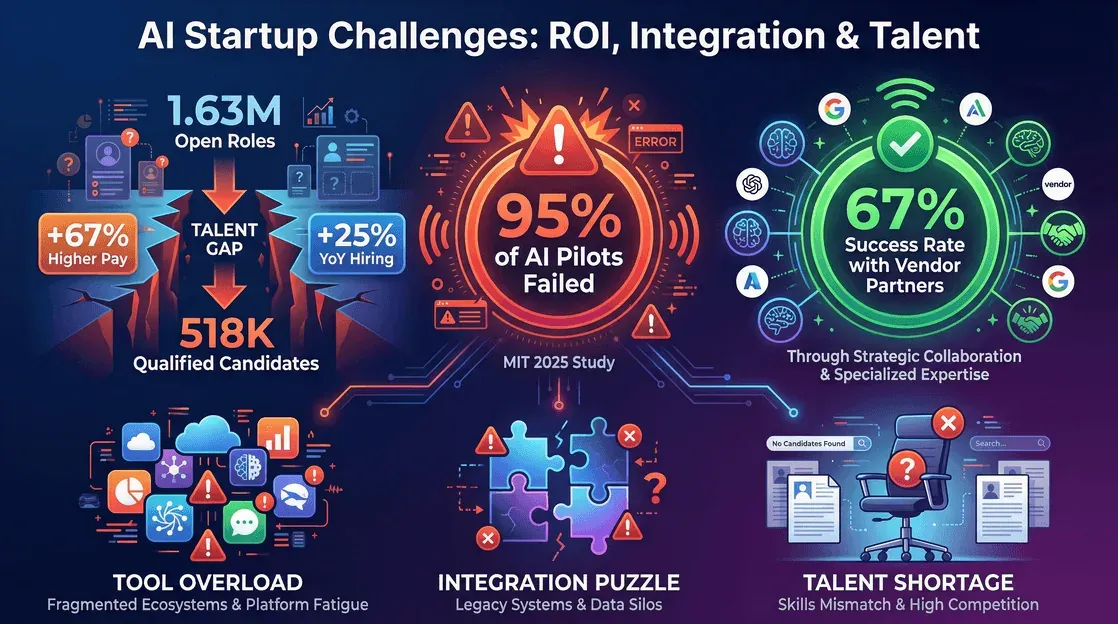
It’s not all sunshine and GPU clusters. AI startups face real challenges—some of which are big enough to trip up even the best teams.
- ROI struggles: A 2025 MIT study found that 95% of enterprise AI pilots stalled or failed to show measurable benefit. Ouch.
- Integration headaches: Many startups suffer from “AI tool fatigue”—too many tools, not enough strategy. The most successful teams pick a handful of best-fit tools and integrate them deeply, rather than chasing every shiny new app.
- Talent shortage: There are ~1.63 million open AI roles globally, but only ~518,000 qualified candidates. AI roles pay ~67% more than typical software jobs, and hiring for AI engineers jumped ~25% year-over-year.
Best practices:
- Validate your AI use cases and integrate deeply with workflows.
- Use proven AI platforms and partner with vendors (which have a ~67% success rate), rather than building everything in-house.
- Get creative with hiring: remote teams, outsourcing, and training up promising developers.
AI Startup Trends to Watch: Full-Stack AI, Verticalization, and No-Code Tools
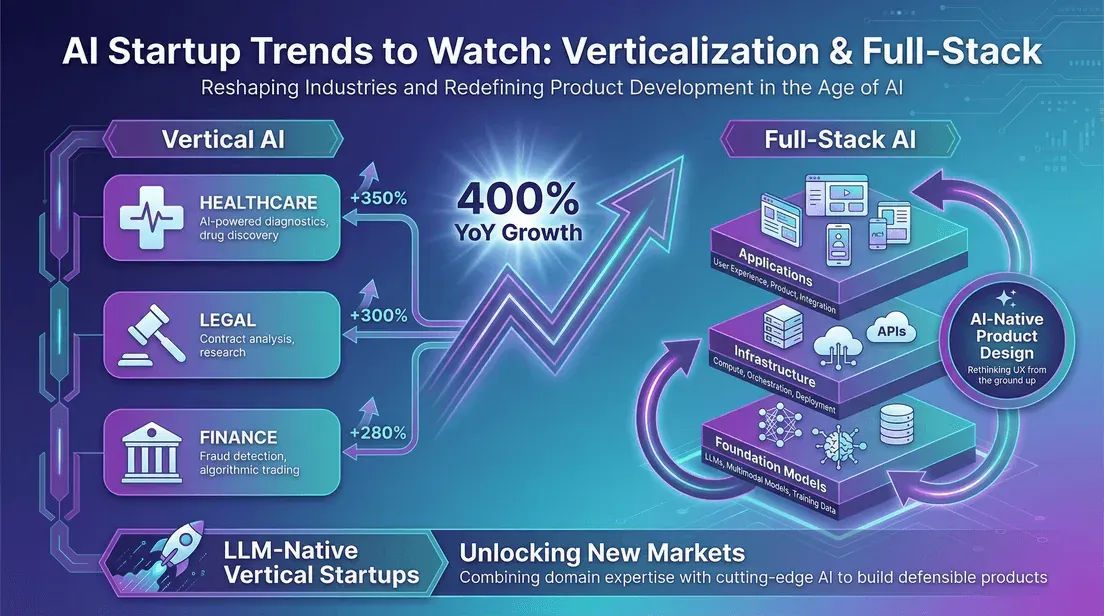
If you want to know where the puck is going, keep your eye on these trends:
- Vertical (industry-focused) AI: Bessemer says LLM-native vertical startups (legal, healthcare, finance, etc.) are scaling at ~400% YoY, unlocking markets legacy SaaS never touched.
- Full-stack AI startups: More companies are “owning the stack”—from models to end applications—especially in regulated industries.
- AI-native product design: AI is no longer a bolt-on; it’s baked into the core of new products.
- No-code/low-code AI tools: 84% of tech leaders say AI won’t replace low-code/no-code tools, but 76% say AI will enhance them. Expect a surge in drag-and-drop AI builders and platforms that let non-engineers build AI-powered workflows.
As someone who’s spent a lot of time making AI tools usable for non-coders (shoutout to Thunderbit), I can tell you: the demand for easy, powerful AI is only going up.
The Future of AI Startups: Regulation, Market Adjustments, and Sustainable Growth
The Best Web Scraping Tools & Software in 2025 Get Started Free
The AI party isn’t over, but the bouncers (regulators and market realities) are starting to check IDs.
- Regulation: In the U.S., 131 AI-related laws were passed by 2024 (up from 49 in 2023). The EU’s AI Act is set to enforce stricter compliance. Startups need to build for privacy, transparency, and safety from day one.
- Market correction: After years of “build first, ask questions later,” the focus is shifting to selective capital deployment and clear ROI. Expect more realistic valuations (think biotech-like 2–4× revenue multiples) and a premium on sustainable growth.
- Responsible AI: Ethics, safety, and bias mitigation aren’t just nice-to-haves—they’re becoming competitive advantages that build trust with users and investors.
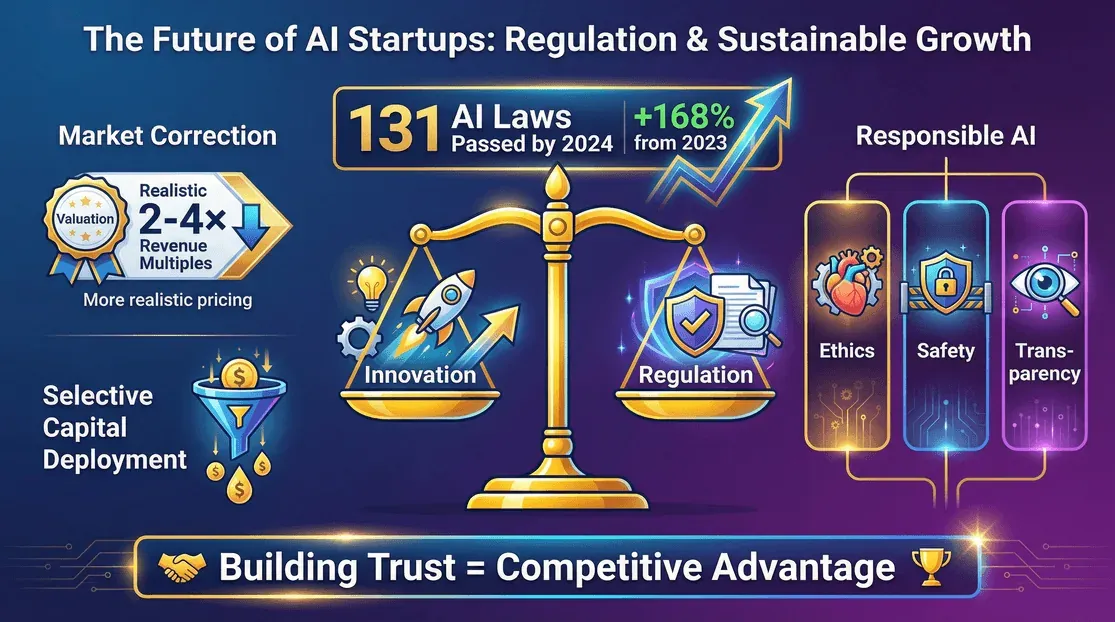
The winners in 2026 and beyond will be the startups that balance bold innovation with operational discipline and compliance.
Key Takeaways: What the 2026 AI Startup Statistics Mean for Founders and Investors
Let’s bring it home. Here’s what all these AI statistics and AI startup statistics mean for anyone building or betting on artificial intelligence in 2026:
- Benchmark ruthlessly: Compare your funding, revenue per employee, and adoption rates to the best in class. If your AI startup isn’t lean and efficient, you’re leaving money (and market share) on the table.
- Focus your AI: The most successful startups pick 2–3 high-impact AI use cases and execute relentlessly. Don’t get distracted by shiny objects.
- Plan for capital concentration: The biggest rounds go to the biggest bets. If you’re not building something foundational or vertical, consider strategic partnerships or consolidation.
- Manage the talent crunch: Get creative with hiring, training, and partnerships. AI talent is expensive and scarce—plan accordingly.
- Leverage proven tools: Partner with established AI vendors and platforms (like Thunderbit) to avoid “tool fatigue” and maximize ROI.
- Embrace emerging trends: Vertical AI, full-stack solutions, and no-code tools are shaping the next wave. If you’re not building for these trends, you might be building for yesterday.
- Stay compliant and user-centric: Build trust through transparency, ethics, and measurable outcomes. Regulations are coming—get ahead of them.
For founders, operators, and investors, these AI statistics aren’t just trivia—they’re your roadmap for surviving and thriving in the most competitive, fast-moving tech market we’ve ever seen.
If you want to dive deeper into AI, automation, and how to actually put these stats to work, check out more on the Thunderbit Blog. And if you’re looking for the easiest way to automate your own data workflows, give our Thunderbit Chrome Extension a spin. (Hey, I had to sneak in at least one plug.)
Here’s to building smarter, leaner, and more impactful AI startups in 2026—and to not getting replaced by your own agentic AI… at least not this year.
Get Thunderbit Chrome Extension Free
Further Reading & Sources:
- AI Statistics Every Startup Should Know (HubSpot)
- How Many AI Companies Are There? (Exploding Topics)
- AI Statistics 2024–2025: Global Trends (Founders Forum)
- 6 Charts That Show The Big AI Funding Trends Of 2025 (Crunchbase)
- AI Startups are Dominating Traditional Software in one Key Metric (Web Strategist)
- AI Adoption Among Private SaaS Companies (SaaS Capital)
- How Startups are Using AI for Growth (Kruze Consulting)
- Part I: The future of AI is vertical (Bessemer Venture Partners)
- AI Index 2025: State of AI in 10 Charts (Stanford HAI)
Want more actionable insights? Subscribe to the Thunderbit Blog for the latest on AI, automation, and building the next generation of startups.
Try Thunderbit AI Web Scraper for Free Get Started Free